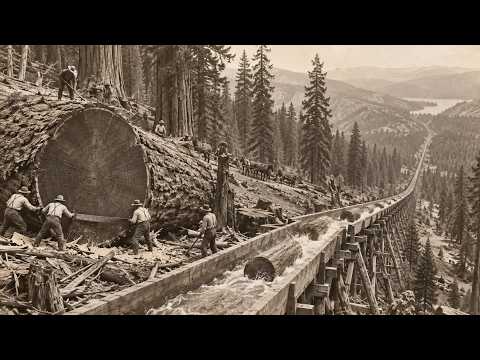
In 1890, a lumber company in California’s Sierra Nevada set out to cut the biggest trees on Earth and send them 54 miles down a mountain in a wooden trough full of running water. Picture the trough the way the old photographs show it: a long wooden V on stilts, crossing a granite canyon on a line of trestles that runs off toward the horizon. In front of it, a sequoia stump so wide that a dozen men are standing on top of it with room to spare. Some of those trees took a crew nearly two weeks to cut through. And when a tree that size finally went over, it often didn’t land so much as explode, splitting open along its whole length on the ground it had stood over for more than a thousand years.
It worked in its way. For more than 30 years, lumber rode that water down to a railroad town in the valley in about 15 hours. But the company cut something like 8,000 giant sequoias to feed it. Only about one in five of the trees it felled ever reached the mill, and three separate fires came for the operation before it was over. I wanted to know how anybody moved anything from up there at all. I’ve been reading the engineering survey of the dam, the company histories, and the accounts the flume towns kept.
Two people walk through this story. One is John Eastwood, a young surveyor out of Fresno who walked the canyon in 1887, laying out the line the water would follow. Twenty years later, he came back to build something nobody on earth had ever built. The other is Frank Bool, the general manager who ran 700 loggers in one of the greatest sequoia groves in the world and whose name ended up on the one giant they left standing.
The mountain fought back in order. First, there was no way down. Then, the trees were too big to fall in one piece. Then, the money ran out. The mill burned. The flume ran short of water. The new mill burned. And last of all, the canyon itself caught fire.
The first problem was the simplest one. The trees were in the wrong place. Spring of 1889, two San Francisco businessmen, Hyram Smith and Austin Moore, had put together about 30,000 acres of timber in the high country east of Fresno along the King’s River. The year before, they had incorporated it as the King’s River Lumber Company. On paper, they owned one of the richest stands of timber in America, pine and the giant sequoias, more of the big trees in one place than almost anywhere else. The problem was altitude. The mill site they picked sat at about 4,500 feet on a little stream called Mill Flat Creek. The nearest railroad, the Southern Pacific, ran through the San Joaquin Valley at a town called Sanger. Between the two lay the deep gorge of the King’s River Canyon, and a drop of roughly 4,200 feet.
A wagon road could be built. But a loaded lumber wagon behind a team of mules grinding down switchbacks all day and climbing back up empty the next could move only so much. For a mill meant to cut tens of millions of board feet a year, mules were a way to go broke slowly. So Smith and Moore looked at the one thing their mountain had plenty of. It had height and it had snowmelt. That’s the strange idea underneath this whole story. The drop that made the timber so hard to reach was the same drop that could carry it out. If you could get the lumber into a channel of water and keep that channel sloping downhill the entire way, gravity would do the hauling for free day and night for 54 miles.
Think of the rain gutter on the edge of a roof. Pour a cup of water in at one end and it runs to the downspout on its own as long as the gutter tips the same way the whole length. A lumber flume is a rain gutter 54 miles long, hung on stilts across a canyon with the downspout at a railroad yard. The catch was that the gutter could never tip the wrong way. Not once, not for a few feet. One section sloping uphill, and every board coming down would stop dead and pile up behind it, which meant somebody had to walk the canyon and find a line that only ever went down.
That somebody was John Eastwood. He had been born in Minnesota in 1857, studied engineering, worked railroad surveys in the Pacific Northwest, and in 1884 hung up a sign in Fresno as a surveyor and civil engineer. A year later, the young city made him its first city engineer. He hated the desk. By 1887, he was back in the mountains, leading the survey party that laid out the flume’s route from Millwood down to Sanger. The engineering survey of his later dam, written for the National Park Service’s historic engineering record, says the company’s chief engineer got the public credit for the flume and that Eastwood almost certainly made a major contribution. Anyway, I like that line because it’s the kind of thing that only gets written down by somebody who read the letters.
The route Eastwood’s party staked followed Mill Flat Creek down to the King’s River, then ran along the canyon wall above the river, mile after mile toward the valley. In places the line had to cross side canyons and gullies on trestles. At one point it had to cross the gorge of the Kings itself. Construction started in July of 1889. Every month without the flume was a month of lumber that couldn’t leave the mountain, and a mill that couldn’t ship was a mill that couldn’t pay its men.
What the crews built was a trough shaped like a V made of boards. Near the top of the mountain, its sides stood almost a yard high; down toward the valley, where the volume of lumber in it would be greatest, the sides grew to about four feet. The boards were high-grade redwood, and the whole trough rode on trestles of pine and cedar cut from the same forest it was built to empty. One account of the flume from a local history of Sanger says it was built in sections called boxes, each 16 feet long, hundreds of them to the mile. Another says, “Much of the labor came from Chinese crews.” Both details come from the town’s own history, and I haven’t found the payroll books to put names to those crews, which is a hole in the record I wish weren’t there.
To cross the main canyon at a place called Trimmer Springs, the company hung the flume from a suspension bridge of wood and steel, 451 feet long, a wooden water trough, full of moving water and lumber, hanging across a gorge on cables. Up top at the source, they built a small dam of concrete and stone on Mill Flat Creek to hold back the water the flume would need. Remember that little dam? It was barely big enough for the job. And the whole operation would come back to this problem two decades later.
On September 3rd, 1890, about 13 months after they started, the flume was finished: 54 miles. It had cost more than $300,000, not counting the land. And here’s the timing that stopped me when I lined up the dates. Less than a month later, on October 1st, 1890, Congress created two new national parks in those same mountains. Sequoia came a week earlier. On that October 1st came a small one called General Grant National Park, set aside to protect a single grove of big trees about 6 miles from the lumber company’s land. The grove had been logged around for years, and the government wanted it saved before the saws reached it. So the same autumn that the flume opened to carry the forest down, the federal government drew a line around a few square miles and said, “Not these.” Everything outside that line was fair game.
And the first trees the company went after taught it a lesson nobody up there had expected. The lumber company had a flume and it had a mill. What it didn’t have yet was a way to bring down a giant sequoia without destroying it. 1891, a grove in what’s now called Big Stump. Four lumbermen, Bill Mills, S.D. Fipps, and two brothers, Barney and John Lukey, were assigned one tree. It was about 16 feet across at the base and, by its rings, roughly 1,341 years old. This tree wasn’t headed for the flume. The American Museum of Natural History in New York wanted a cross-section of a real giant sequoia, and so did the British Museum in London. Back east and in Europe, a lot of people still didn’t believe these trees existed at the size the Californians claimed. Collis Huntington, president of the Southern Pacific Railroad, agreed to pay for the shipping. The tree came to be called the Mark Twain tree. Cutting it took 13 days.
I want to slow down on how a crew even starts on something that size, because every one of the 8,000 that followed came down roughly the same way. The bottom of a giant sequoia flares out like the foot of a candle where the wax has pulled. Cutting through that flare means cutting the widest, most twisted wood on the whole tree. So, the fallers climbed. They chopped a notch into the bark several feet up, jammed the end of a plank called a springboard into it, and stood on the plank. Then they cut another notch higher and did it again until they stood above the flare on boards wedged into a living tree. From there, two men with axes carved a huge wedge out of the side facing the way they wanted the tree to fall. Then two men moved around to the other side with a long crosscut saw and pulled it back and forth, back and forth toward that wedge. As the cut went deeper, the weight of the trunk above tried to squeeze the saw shut. So a third man drove iron wedges into the cut behind the blade to hold it open. 13 days of that on planks for one tree.
And when the Mark Twain tree finally fell, the crew got their museum sections. The New York slab went on display at the American Museum of Natural History. Another went to London, and the rest of a tree that had been growing since around the year 550, by the count of its rings, was cut up for grape stakes and fence posts. That’s the part that hit me. 13 centuries of growth, and most of it ended up holding up grape vines in the valley.
The museums got exactly what they wanted. The mill, watching from up the mountain, learned something worse about the timber it had just built a 54-mile machine to reach. Giant sequoia wood is brittle. A big pine bends a little when it hits the ground. A sequoia close to 300 feet tall doesn’t bend. When the biggest ones landed, the trunk could shatter across its length, splitting into slabs and splinters that were good for posts and shingles and not much else. The second problem was the opposite one. When a giant did come down whole, it was too big for any saw at the mill. The Sanger Depot Museum’s history says the crews broke the largest logs apart with blasting powder before they could be moved at all, and every blast threw away more wood. Add it all up, and the museum’s own figure is brutal. Of the redwood the company felled over the life of the operation, only about one-fifth ever reached the mill.
So here was a company that had built a 54-mile machine to carry lumber down a mountain, and it was feeding that machine with trees that destroyed most of themselves before they could be cut into lumber. You’d think that would have slowed them down. Instead, the company went looking for the biggest tree it could find.
1892, in a basin north of the mill called Converse Basin, the company found it. Hank Johnston, who wrote the standard history of this logging in 1966, described the grove as “thousands upon thousands of forest giants, so tall they almost blotted out the sky.” The tree they picked stood about 300 feet tall and measured about 95 feet around at the ground. They called it the General Noble.
The plan was the World’s Columbian Exposition in Chicago, 1893. They cut the trunk into 46 sections, some weighing more than four tons, hauled each down behind sixteen mules, and shipped it east on eleven railroad cars. The final bill came to $10,475.87. And in Chicago, a lot of the people who walked past it decided no tree could be that big. They called it the California hoax.
What’s left of the General Noble is still standing in Converse Basin. The stump is about 20 feet high because the crew cut it off well above the flare. People call it the Chicago stump. So a tree that had been growing for more than a thousand years was taken apart to prove it was real, and in Chicago they still called it a fake.
By 1893 the panic hit and lumber prices fell with it. In 1894 the company was reorganized and renamed the Sanger Lumber Company. In 1895 the creditors foreclosed. Austin Moore sold his mansion and retired. In 1897 Hyram Smith declared bankruptcy. The two men who had dreamed up the 54-mile flume were finished, and the creditors who now held the company looked at what they’d taken over and decided the answer was to cut faster.
Converse Basin was where they went. The new owners built a mill in the basin itself, with a band saw 90 feet long, driven by a steam engine of about a thousand horsepower, built as the longest band saw in the world. To run the cutting they had a general manager named Frank Bool, who oversaw about 700 loggers on a salary of $6,000 a year, a fortune for a lumber boss in the 1890s.
In the seasons that followed, the basin came apart. Trees that had stood for 2,000 years came down in days. By November of 1899, the mill had cut about 19 million board feet in that one season. Over the whole life of the operation, from 1892 to 1918, the count of giant sequoias felled in and around Converse Basin comes to roughly 8,000. Out of all those thousands of giants, somewhere between 60 and 100 large sequoias survived.
The biggest of them is still standing. The crews left one tree on a ridge above the basin. It’s about 267 feet tall and more than 112 feet around at its base, one of the largest trees on the planet, and it carries the general manager’s name: the Bool Tree. The story they tell in the mountains is that Frank Bool looked at it and ordered it spared because it was too magnificent to cut. Maybe. But his own daughter wrote a letter in 1951 saying the heroic story wasn’t quite right. As she understood it, the tree survived because cutting something that big wasn’t worth it. It would have shattered. So the largest tree left in Converse Basin may have survived the same way so many others died. Its size made it worthless to the people with the saws.
Somebody else was watching all of this. John Muir had walked these groves for decades, and the waste in Converse Basin became a catalyst for his push to get federal protection for the groves that were still standing. And the man who had surveyed the flume, John Eastwood, was about to learn a lesson of his own about water that would bring him back into this story.
After the flume, Eastwood turned to hydroelectric power. As chief engineer of the San Joaquin Electric Company, he built a plant on the North Fork of the San Joaquin River. In April of 1896 it began sending electricity to Fresno over a 37-mile line at 11,000 volts, the water dropping 1,410 feet to the turbines, by far the highest head of any power plant in the world at the time. But his company never had the money to build a storage dam high in the mountains to hold water back for the dry months. In 1899 a long drought came. The North Fork dried up and the turbines stopped. The San Joaquin Electric Company died with them. Eastwood had built a brilliant machine and watched it fail for want of stored water. He came out of it convinced that in the mountains of the West, a dam to hold water was the whole game, and that the only reason more people didn’t build them was the cost of hauling cement into country with no roads. He started thinking about a dam that used as little concrete as possible.
He didn’t know yet that the flume he’d surveyed was headed for the same problem. Back in Converse Basin, the logging ran on, and in 1905 the mill burned. A fire destroyed the Converse Basin sawmill, the one with the 90-foot band saw. The company rebuilt it and ran it two more years, but the operation was already hollowed out. That same year, the bankrupt company was sold. The buyers came from Michigan. Thomas Hume of Muskegon ran a lumber business that was buying timberland all over the country, and a western lumberman named Ira Bennett sold him on the old Smith and Moore holdings as an excellent investment. In late 1905, the new Hume-Bennett Lumber Company bought the whole thing: the land, the mills, and the flume.
Then they went up the mountain to look at what they’d bought. The dam survey sums up what they found in one plain sentence. Converse Basin had already been logged so heavily that to make a profit, the company would have to reach much deeper into the King’s River country. The basin they had just paid for was mostly stumps.
The new owners made a decision that tells you how much faith they still had in the flume. They abandoned the big mill site at Millwood. They would build a new mill farther up on a creek called Ten-Mile Creek and join it to the old flume with a new extension 17 miles long. And the new mill would sit beside a lake, which was a problem, because there wasn’t one. The site was a mountain meadow called Long Meadow. Hume and Bennett wanted it flooded for two reasons. A big pond beside the mill would hold the logs until the saws were ready for them. And the same pond would keep the flume full of water. That was the old weakness from 1890, the little dam on Mill Flat Creek. A flume that ran short of water in a dry summer stranded every board in it. They needed a reservoir big enough to carry the whole operation through a drought. They needed a dam in a remote mountain meadow, far from any railroad that could haul in cement, and they needed it cheap.
In the summer of 1907, the company went looking for an engineer. The company letters, which still survive in a Michigan archive, show them working through names, and at least two engineers declined to take charge of the job. The third one had walked that canyon before. On October 1st, 1907, John Eastwood wrote to the Hume-Bennett Lumber Company with a proposal. He would build their dam. But he had one condition. He would build it his way, as a new kind of dam that had been talked about by engineers but never actually built anywhere in the world. He called it a multiple arch dam.
To see why that was such a gamble, picture the usual way to hold back a lake. You pile up something heavy, earth or rock or solid masonry thick enough at the bottom that the water can’t shove it over. The dam fights the water with its own weight. It works, but it takes a mountain of material, and every ton of cement for a masonry dam would have to come up those mountain roads by wagon. Eastwood’s idea started from the other end. Instead of one heavy wall, build a row of thin concrete arches, each one curving into the water, held up from behind by narrow concrete walls called buttresses. Then lean the whole thing back upstream so the arches face the lake at an angle.
Here’s what that lean does, and it’s the part that sounds wrong when you first hear it. When the lake fills, the water doesn’t only push against the face of the dam. Because the face slopes back over the water, part of the lake’s weight presses down on it. The water that’s trying to push the dam over is also holding it down. Think of a sheet of paper. Stand it on its edge and it falls over. Fold a crease down the middle and the same sheet stands up on its own. Eastwood gave each buttress a T-shaped back for exactly that reason, so it couldn’t buckle sideways. And the curve of each arch did the same work a stone bridge does, turning the push of the water into squeeze, which concrete handles beautifully, instead of pull, which cracks it. The result, on paper, was a dam that used far less concrete than a solid wall to hold back the same water. For a company miles from any railroad, less concrete meant fewer wagon loads up the mountain.
The Hume-Bennett people were intrigued. They were also nervous. The company letters through that fall show them weighing the savings Eastwood promised against the risk of putting their whole new mill behind a design nobody had ever tried. They argued it through the winter. It was the spring of 1908 before they said yes.
In June of 1908, Eastwood went up to Long Meadow and began the survey. By the end of the month, the blasting had started. The foundation was granite, and it sat close to the surface, which saved weeks of digging. Eastwood still had trenches blasted along the whole length of the dam, so every buttress would be locked into the bedrock. The men who dug them by hand said they looked like rifle pits. Then he built the machine to build the dam. First, a wooden trestle the full length of the site, a little taller than the finished dam would be, with a tramway running along the top of it. Then a hoist in the middle to lift buckets of wet concrete from the mixer up to the tram cars. A second, smaller trestle carried granite from a quarry at the west end and dropped it about 50 feet onto a pile to break it up before it went into the crusher. Crushed granite, sand, and cement went into the mixer. Concrete came out the other end and rode the trestle to wherever the forms were waiting.
His crew averaged about 40 men. As far as the record shows, every one of them came from the local logging country. Laborers made $2.25 to $2.50 a day. Skilled men $3. And the carpenters who had to build the curved wooden forms exactly to Eastwood’s design made $3.50. The first concrete was poured in the middle of August. Eastwood started at the shallow west end with three small arches and four buttresses to prove his method of tying arch and buttress into one piece before he bet the rest of the dam on it. It worked. After that, he built all the remaining buttresses first and let them harden before a single remaining arch went on top of them. Thirteen buttresses, twelve arches, each spanning 50 feet, 677 feet long, rising 61 feet from the bedrock, leaning back at 32 degrees. Inside, the concrete ran more than seven miles of steel cable, there to fight cracking when the concrete shrank in the cold. Eastwood counted 114 working days. By November of 1908, the dam was built. The whole thing cost the company about $35,000.
But he didn’t fill it. He’d left an opening in the deepest arch so the creek could run through the site in a temporary flume during construction. Now, instead of closing it, he left the dam standing empty through the whole Sierra winter. He wanted to see what the cold would do to it. If a thin concrete arch was going to crack from the frost, he wanted it to crack while the lake behind it was empty. Through the winter of 1908, the first multiple arch dam in the world stood dry in the snow on Ten-Mile Creek, and nobody knew whether it would still be whole in the spring.
It was in June of 1909, with the dam through its first winter, that Eastwood had the opening closed and the creek began to fill Long Meadow. It could only fill so far, and the reason had nothing to do with engineering. The height of the dam, and so the size of the lake, had been set by a property line. In his very first letter to the company, Eastwood had described a reservoir whose limits would be the property lines of the company. At the southwest corner of the meadow sat 480 acres owned by a man named Gustaf Anderson, and the company could not flood land it didn’t own. So the first multiple arch dam in history was exactly as tall as a neighbor’s boundary allowed.
Eastwood’s design had changed on the way, too. His proposal in October of 1907 called for a long row of small arches, most of them only 20 feet across. By the time the blasting started, every arch had grown to 50 feet. Nobody has found the letter that explains when he changed his mind. The record only shows that he went in bigger than he’d first dared to.
Through the summer, the water rose and the meadow became a lake of about 87 acres. Around it, the company built its new mill and its new town, Hume. Then, in September of 1909, for the first time, water ran out of the reservoir into the new flume: 17 miles of fresh trough winding down to meet the old line Eastwood had surveyed 22 years before, and from there all the way to Sanger.
The operation that came out of it worked like this. Logging trains brought the logs to the lake, sequoia and pine both, and dumped them straight into the water. The logs floated there until the mill hauled them in. The lumber was cut, dried in kilns, and set into the flume. Water for the flume came out of two outlet valves set into the arches of the dam. Twelve more openings in the arches let the company spill floodwater in a wet spring, and a big valve at the bottom of the deepest arch could drain the lake down. For the first time since 1890, the company controlled its own water. For John Eastwood, that was the whole point. Ten years earlier, a dry year had shut down his power plant on the San Joaquin because there was no stored water behind it. The lesson he paid for in 1899 was now poured into concrete on Ten-Mile Creek, and a dry summer could no longer strand a single board in the trough.
Millwood, the old boom town at the head of the original flume, was done. Its mill closed in 1909, and what machinery was worth saving went up the mountain to Hume. Today, there isn’t a building left of it.
Hume Lake was supposed to be a stepping stone. Eastwood had designed the dam partly as a demonstration, proof that his arches could work so that he could use them on a far bigger job. He was already chief engineer of the Big Creek hydroelectric project on the upper San Joaquin, backed by Henry Huntington’s Pacific Light and Power. Big Creek would have power plants working under heads of 2,000 feet and more, miles of tunnel through hard rock, and storage dams to carry the water through the dry months. It was everything his old power company had lacked in 1899. In 1910, he built a second multiple arch dam at Big Bear Valley near San Bernardino. And at the end of that same year, Huntington’s corporation dismissed him as chief engineer of Big Creek and handed the project to a large engineering firm from the East Coast. The dream he had built Hume Lake to reach was gone.
What he did next is the reason his name is still in engineering histories. He stopped thinking of the multiple arch as a side project and spent the rest of his life on it, against engineers who believed in massive gravity dams and thought his thin arches were reckless. One of the most prominent of them, John Freeman, opposed him for years. Meanwhile, the arches at Hume Lake just kept holding back the water.
For a few years, the machine ran the way its founders had dreamed it would back in 1889. Lumber from a mill near the top of the Sierra rode one unbroken channel of water all the way down to a railroad, carried by snowmelt held in a concrete lake. But a better machine didn’t make the work any safer for the men feeding it. The company’s records from these years read like a ledger of what the woods cost. Ira Bennett was bought out in 1912, and Thomas Hume’s son George took over the running of the place. In 1913, California finally brought in workmen’s compensation, and for the first time the injuries started showing up in the record with dollar amounts beside them. On June 13th, 1914, a worker named C.M. Mooney was hurt. The company was ordered to pay him $1,046.67 for his disability. On October 20th of the same year, a worker named Orlando V. Carter was killed. His widow received $2,490. I couldn’t find what happened to either man, where Mooney was standing, or what killed Carter. All that survives is the date and the dollar figure. That’s how most of the men in this story come down to us. When they come down at all.
The board feet were counted to the last plank. The men who cut them were counted when the law finally made the company pay. In 1914, the company also widened its railroad from narrow gauge to standard gauge and bought 50 more logging cars. Hume was betting on the long run. Then the long run went to war.
When America entered the First World War in 1917, the company lost something like 40 percent of its workforce. That November, the mill at Hume caught fire. The engineering survey records it in one sentence. In November of 1917, a fire destroyed the main sawmill at Hume Lake. And after that, logging in the region began a rapid decline. Think about what had gone into that mill. A new town, a new railroad, 17 miles of new flume, and the first dam of its kind anywhere on Earth, all built to feed it. Eight years after the lake filled, the thing all of it existed for was ashes. The company went bankrupt that same year and changed its name back to the Sanger Lumber Company, the name Smith and Moore’s creditors had used in the 1890s. Before long, it was being run as the Sanger Lumber Company of Michigan, a name that tells you exactly where the money and the decisions now lived, half a continent away from the canyon. It was the third time in this story the operation had been reorganized around a failure, and still the flume ran.
The next year took the man whose name was on the biggest tree in the basin. Frank Bool died in San Francisco in 1918 at about 62. That same year is where the count of Converse Basin’s felled sequoias ends. From 1892 to 1918, the giants had come down for 26 seasons, and Bool had run the woods through the heart of it. The tree on the ridge outlived him, as it had outlived everyone who ever stood under it. His daughter’s letter came more than 30 years later. By then, nobody up there remembered him for the 700 men or the $6,000 salary. They remembered him for the one tree he didn’t cut.
That was the strange thing about the flume. Owners came and went, mills burned and moved, and the wooden V kept carrying lumber down the canyon. One history of the flume gives its working life as 1890 to 1923. By 1924, the company’s logging had stopped for good. The money had run out for the last time.
John Eastwood didn’t see the end. After Hume Lake, he went on to design 16 more multiple arch dams in California, Arizona, Idaho, Utah, and British Columbia. Within a couple of decades, other engineers had copied his idea, and by 1930 there were more than 50 multiple arch dams in use around the world. The biggest descendant of the idea he tested in that meadow is the Daniel-Johnson dam in Quebec, finished in 1969, 703 feet high. And according to the engineering survey in the United States, there has never been a failure of a multiple arch dam that cost a life or destroyed property. Eastwood himself never built another dam for a lumber company, and never built another in the Fresno country where he’d started. He died in August of 1924, the same year the logging stopped. The flume he’d laid out as a young man was still hanging along the canyon wall, its herders mostly gone, its last loads long since shipped.
And two years later, the canyon caught fire. 1926, a forest fire swept through the most remote part of the King’s River Canyon, the stretch of wall the flume followed far from any road, and it burned the flume where it stood. Every source I trust agrees on what was lost within a mile. The museum in Sanger counts seven miles of flume destroyed. Another history of the flume counts more than six. Either way, that fire took out a stretch of the trough longer than most towns, in a place no crew could easily reach, carrying wood that had been drying in the sun for 36 summers.
Think about what a fire meant to a line like that. In the busy years, flume herders were stationed along the route, each keeping his own stretch of water and lumber moving. By 1926, the logging had been stopped for two years. I haven’t found a record of how many herders were still out on the line by then, and with nothing coming down the trough, it’s hard to imagine many. The flume ran through some of the steepest, most broken country in California, with almost nobody left watching it. A wooden trestle is a stack of kindling built on a slope. The trough on top of it is a long open box of dry redwood. Once fire got into the line, it could run along it. I could not find the day the fire started or who first saw the smoke. And I’d rather tell you that than make one up.
What I can tell you is what that fire did to the idea two San Francisco men had bet everything on. Go back to the rain gutter all the way at the start of this story. A gutter works only if every foot of it slopes the right way. One bad section and everything piles up behind it. The flume was the same, only worse. It wasn’t one machine 54 miles long. It was thousands of 16-foot boxes and thousands of trestle legs, every one of them holding up its piece of the line. And the whole thing worked only as long as every last piece held.
So how did anybody move the biggest trees on Earth 54 miles down a mountain? This is the honest answer. Nobody ever moved a giant whole. They broke it on the ground and in the mill into blocks a foot square. And then they sent those blocks down a channel of water that had to stay unbroken for every one of those 54 miles. For 30-odd years, it did. In 1926, six or seven miles of it burned, and the rest of the line was useless the moment they did. Nobody rebuilt it. There was nothing left up top worth sending down. The Hume mill had been ash since 1917. The logging had stopped in 1924. Rebuilding six or seven miles of trestle on a canyon wall to carry lumber nobody was cutting would have meant spending real money on a company that had never made any.
Back in 1889, Smith and Moore had found the will and the $300,000 to build 54 miles of it in 13 months. In 1926, nobody could find a reason to replace six. In 1927, George Hume sold off the company’s equipment. The whole outfit, the machinery of an operation that had once employed more than 500 people, went for about $20,000, roughly one-fifteenth of what the original flume alone had cost to build. The flume itself, the bridge across the gorge at Trimmer Springs, the herder stations, all of it was left to rot or be scavenged along the canyon wall.
The Sanger Museum keeps one line about the whole enterprise that I haven’t been able to shake. None of the lumber barons who took part in it over that entire period ever made a profit. Think about the arithmetic of that. 30-odd years, something like 8,000 giant sequoias, a flume, two railroads, three mill towns, a world-famous exhibit in Chicago, and the first multiple arch dam on Earth. And at the end of it, every owner in the chain had lost money. The same museum puts the redwood cut over the life of the operation at about 191 million board feet. At its height, the company had around 300 men working in the forest and another 200 down in Sanger at the yards beside the Southern Pacific tracks where the flume ended. That is a whole town’s worth of labor for decades in the service of a business that never once came out ahead.
For eight years after the fire, the Humes held on to what was left. They owned a lake with no mill, a dam with nothing to float, a burned gap in a flume that no longer led anywhere, and thousands of acres of stumps. There was one more date to come. On April 8th, 1935, the Hume family sold what was left of the company to the United States Forest Service. The sale took in about 20,000 acres of cutover land in the King’s River country, along with Eastwood’s dam and the lake behind it. The cutover slopes of Converse Basin passed into the hands of the Forest Service that same year.
The Forest Service looked hard at turning the dam into part of a hydroelectric plant, the purpose Eastwood had always imagined for his arches. But by then, something else was happening at Hume Lake. People were coming up from the valley to camp and swim and fish in it. The lake the lumber company built to float sequoia logs had become a place to spend a summer. In January of 1946, 320 acres at the lake were sold to a man named Walter Warkington for $140,000, and the site became Hume Lake Christian Camps. In the 1950s, the dam’s upstream face got a six-inch coat of fresh concrete to slow its leaks, the only major change to Eastwood’s structure in its entire life.
Converse Basin, stumps and survivors together, became part of the Giant Sequoia National Monument in the year 2000. Before that, the fight John Muir had started in these mountains got its biggest win. On March 4th, 1940, President Franklin Roosevelt signed the law creating Kings Canyon National Park. It swallowed little General Grant National Park, the grove Congress had fenced off the same autumn the flume opened, and carried protection far up the canyon the flume had followed. Converse Basin didn’t make it inside the line. It sits just outside the park boundary to this day, in the national forest, because there was almost nothing left in it to protect. A few miles south, though, inside the park, is Redwood Mountain, more than 2,500 acres of giant sequoias. Today it’s described as the largest surviving sequoia grove in the world. Surviving is the word that matters there. Converse Basin had been one of the greatest groves on Earth until a 54-mile flume made it worth cutting. Redwood Mountain is what a grove like that looks like when the saws never come.
Which means nearly everything in this story is still out there. You can drive it. Start in the valley at Sanger, the town at the bottom of the flume. The old railroad depot is now the Sanger Depot Museum, and it keeps the memory of the flume, including a model of it, in the town where the trains of lumber came in after 15 hours on the water. The lumberyard sat beside the Southern Pacific tracks, and from there the boards that survived the mountain went out by rail to the rest of the country.
Upstream of Sanger along the King’s River is a place still called Trimmer Springs. Somewhere in that stretch of the gorge, the company hung its flume from a suspension bridge 451 feet long, a trough of moving water on cables over the river. The bridge is long gone. The name on the map is what’s left. From Sanger, head east and climb on Highway 180 toward the mountains. Near Squaw Valley, at the turnoff for Forest Service Road 13S97, there’s a historical marker put up in 1965 for Millwood, the town that once held more than 2,000 people in a season. It’s an off-highway vehicle area now, with no buildings left at all. Up those slopes at Millwood, the first line of the flume began its 54-mile run.
Keep climbing into Kings Canyon National Park and pull off at Big Stump. A short trail leads to the Mark Twain Stump, what’s left of the tree four men spent 13 days cutting in 1891. The stump is still there, wide and flat, the last of a tree that had counted 1,341 years. Around it, the grove that the early loggers leveled has begun to grow back. Young sequoias are coming up among the old stumps, and some of them are already big enough to make you stop. They have a couple of thousand years to go before they match what stood there.
A few miles on is Grant Grove, the grove Congress drew its line around in October of 1890, the same autumn the flume opened. The General Grant tree still stands in it. And if you want to see what Converse Basin looked like before 1892, the closest thing left is just south of here on Redwood Mountain, where the big trees still stand shoulder to shoulder the way they once did all across the basin to the north.
From Grant Grove, go about six miles north into the national forest to Converse Basin. A half-mile trail takes you to the Chicago Stump, the 20-foot shell of the General Noble, the tree they called the California hoax. In the Rough Fire of 2015, firefighters wrapped it in fire-resistant shelter to keep it from burning. More than a century after the company cut the tree, people were still working to save what was left of it. The rest of the General Noble had its own long afterlife. After Chicago, part of it went to Washington and stood at the Department of Agriculture as a little house built out of the tree, on display for more than 40 years before it rotted and was taken away.
Farther up the basin is the trail to the Bool Tree, the giant on the ridge that may have been spared because it was too big to be worth cutting. Stand at its base and look out at the slopes around it. What’s growing there now is mostly second growth, and in among it are the stumps. And last of all, drive on to Hume Lake. Walk out to the dam. Under your feet, the buttresses still sit in the trenches the crews blasted out of the granite in the summer of 1908, the ones they said looked like rifle pits. Above you, the arches curve out into the water, each one 50 feet across, the span Eastwood grew into after his first, more careful plan. Look closely at the face of the arches and you’ll see faint horizontal lines across them. Engineers call them lift lines. Each one marks where one day’s batch of concrete ended and the next began, back in the fall of 1908, when 40 local men poured this thing a bucket at a time off a wooden trestle. It’s still there. Thirteen buttresses and twelve arches leaning back into the water at 32 degrees. The first of its kind in the world. Watched over by the Forest Service the way it has been for decades. The water that once floated sequoia logs to a sawmill now has swimmers and canoes on it.
Which brings me back to that old photograph. The wooden V on its trestles running across the canyon toward the horizon, and the stump in the foreground with a dozen men standing on top of it. When I first looked at it, I saw a machine and a tree. After all of this, I see it differently. The stump is the reason the flume existed. The flume is the reason the stump exists. Fifty-four miles of wooden trough, built in 13 months to carry away the largest living things on Earth, one 12-inch block at a time, for a company that never once turned a profit. The flume burned. The company died. The men in that picture are long gone. And stumps like the one they’re standing on are still out there in Converse Basin, more than a century later, waiting for anyone who wants to climb up and stand where they stood.
So here’s what I keep coming back to, and I’d like to hear from you. A young surveyor staked a line down a canyon, a general manager spared one giant because it wasn’t worth the powder, and a wooden gutter outlived them both by a hundred years. If you could stand on the rim of Converse Basin in 1890 with the saws still silent, knowing what the next thirty years would cost, what would you have told them to build instead?
Report this article
Select a reason for reporting:






