The year was 1942, and the Pacific was drowning in darkness. Singapore had fallen, the Philippines were besieged, and the Japanese tide was surging toward Australia’s doorstep. On the rugged island of Timor, a tiny force of 700 Australians—bushmen, farmers, and laborers—stood as the last line of defense. They were called Sparrow Force, a name as humble as it was prophetic. Their mission: hold the island’s airfields and ports, buy the mainland precious weeks to fortify. They were lightly armed, isolated, and vastly outnumbered by thousands of battle-hardened Japanese veterans. The High Command expected them to break within days. But these men had other plans.
On the night of February 20th, 1942, the storm broke. Japanese paratroopers and marines slammed into Timor with overwhelming force. Within 48 hours, the main body of Sparrow Force was forced to surrender. The Japanese sent victory cables to Tokyo, declaring the island pacified. Back in Australia, the silence was absolute. The unit was struck from active lists. Families received telegrams: missing, presumed dead. To the world, the story was over. But they had counted the prisoners—not the ghosts.
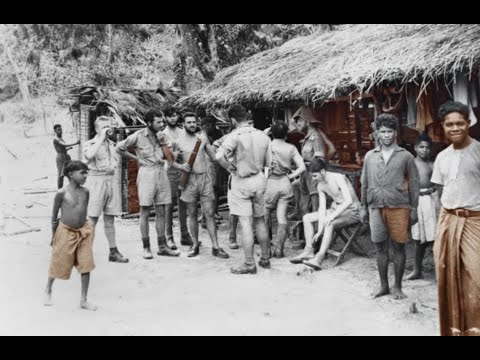
Deep in the limestone ravines, small groups of the 2/2nd Independent Company refused to surrender. They turned their backs on the coast and marched into the green hell. There, they made a fateful decision: they would not flee, and they would not surrender. They transformed from a conventional infantry unit into a lethal guerrilla insurgency. Stripped of supply lines and reinforcements, they learned to move like shadows, to strike and vanish. They were dead to the outside world—and in that acceptance, they found a terrifying freedom.
But survival in the jungle was not a feat of technology. It was a miracle of human connection. The local Timorese people did not see them as defeated fugitives—they saw symbols of resistance. Young Timorese boys, called criados, became their guardians, scouts, and brothers in arms. They moved with supernatural silence, spotting a bent twig or disturbed moss that signaled an enemy patrol miles away. Villagers shared their meager food, hid wounded soldiers, and risked everything under the Japanese doctrine of collective punishment. This was a partnership written in blood, not treaties.
For 10 grueling months, Sparrow Force waged one of the most effective guerrilla campaigns in military history. They blew up bridges, burned supply depots, and raided outposts. They forced the Japanese to divert nearly 12,000 elite troops—soldiers desperately needed elsewhere—to hunt a few hundred Australians. The occupiers controlled the roads and towns, but they never controlled the hearts of the people. And the Sparrows, written off as dead, were about to prove that even the smallest bird can survive a hurricane—if it has the will to fly.
By April 1942, the tactical war in the jungle was being won, but the war of attrition was quietly killing them. They were out of medicine, their boots had rotted away, and their ammunition was down to the last few rounds. Most critically, they had been dead to the Australian government for two months. Unless they could scream across the Timor Sea, they would soon be dead in reality.
The task of resurrecting the dead fell to a handful of signals personnel led by Captain Max Loveless. Their mission was a feat of pure desperate genius: build a high-powered radio transmitter with no tools, no spare parts, and no blueprint.
What followed was a scavenging campaign that would make any engineer marvel. The men raided bombed-out houses and ambushed Japanese supply columns—not for food, but for technological gold. Copper wire torn from old telephone lines. Valves scavenged from broken broadcast receivers. Solder liberated from the ruins of Dili.
The device that emerged from this chaos was a Frankenstein’s monster of electronics. A chassis hammered together from scrap metal and wood. Components held in place by ingenuity and prayer. For power, they used old car batteries hauled by hand over grueling mountain ridges, charged by a makeshift generator—a motor scavenged from a destroyed vehicle, fueled by petrol stolen from Japanese drums. They named the contraption Winnie, after Winston Churchill, the bulldog symbol of British resistance.
On the night of April 20th, 1942, in a shivering mountain hut, the signals team finally coaxed Winnie into a hum. Sergeant Jack Sargeant sat at the key, tapping out a frantic rhythm in Morse code toward Darwin.
At the receiving station in Australia, the operator was skeptical. Every report indicated Sparrow Force had been annihilated weeks ago. He suspected a Japanese ruse and sent back a cold coded challenge: Is Jack Sargeant there? What is his wife’s name?
When the answer pulsed back across the static of the Timor Sea—Kathleen—the room in Darwin erupted in stunned silence, then jubilation. The ghosts had spoken. The message was clear: Sparrow Force is still alive and fighting.
The impact of Winnie the War Winner cannot be overstated. It turned a band of fugitives back into a recognized military unit. Within weeks, the first Allied planes appeared over the mountains, dropping crates of silver rain—parachutes carrying quinine for malaria, boots for the barefooted, and the ammunition needed to turn the Japanese headache into a full-blown migraine.
Through a pile of scrap metal and the brilliance of a few determined men, Sparrow Force had conquered the isolation. The dead had returned—and they were ready to lead the fight.
By the end of 1942, the Japanese Imperial Command had had enough. They flooded Timor with fresh troops and launched a scorched-earth offensive, burning whole mountain ranges to flush out the ghosts. The Allies knew the Sparrows were invincible in spirit—but their bodies were failing. Extraction was the only option left.
In December 1942 and January 1943, Allied vessels—including the Dutch destroyer HNLMS Tjerk Hiddes—slipped through the Japanese blockade under moonless skies. The Sparrows emerged from the treeline for the last time: skeletal figures, matted beards, uniforms more holes than fabric. They looked back once at the jagged peaks that had been their fortress—then climbed aboard.
The numbers they carried home left military historians speechless. Roughly 700 men had inflicted an estimated 1,500 to 2,000 Japanese casualties while losing only 17 in combat. They had neutralized a force twenty times their size without ever fighting a major pitched battle. They entered the war as a tripwire expected to break in days—and left as one of the most successful guerrilla units in history.
But the cost fell heaviest on those who stayed behind. In retaliation for sheltering the Australians, the occupiers unleashed systematic vengeance. Villages were razed, livestock slaughtered, thousands executed for the crime of sharing a bowl of maize or a secret trail. Up to 60,000 Timorese perished during the occupation—a wound that still bleeds in the region’s memory.
For the veterans, the war never truly ended in 1945. For decades they lobbied Canberra for aid and recognition for their silent allies, never forgetting the criados who carried their packs. That bond shaped Australia’s modern relationship with Timor-Leste—from the 1999 peacekeeping mission to humanitarian efforts today.
Sparrow Force proved that victory does not always belong to the loudest guns. It belongs to those who refuse to be erased. No force is truly defeated as long as one soldier stands firm—and no debt is forgotten as long as the story is told.
Today, the legend of the Sparrows remains etched in the limestone peaks of Timor. Courage, once sparked, can never be truly extinguished. But it leaves us with a question that echoes across the decades: when the world writes you off as dead, what will you do to prove it wrong? Share your thoughts in the comments below.
Report this article
Select a reason for reporting:






