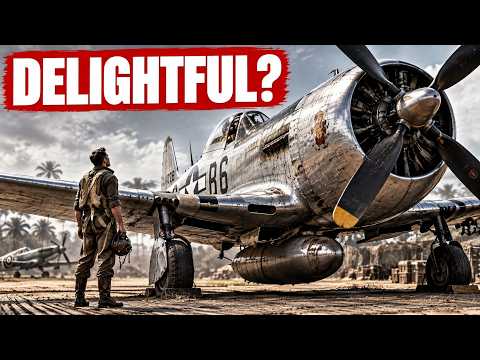
In the summer of 1944, on a dusty airstrip outside Bangalore, an RAF pilot walked toward the aircraft he was supposed to fly that morning. He stopped twenty feet away. He had been flying Hurricanes for three years. He knew the Hurricane like the back of his hand—every sound it made, every warning it issued before it quit. But the thing in front of him now was entirely different. It was taller than he was. Its propeller diameter exceeded twelve feet. Empty, before a single drop of fuel or round of ammunition, it weighed twice as much as his Hurricane fully loaded and ready for war. There was no two-seat version. No instructor could sit behind him to guide him through the flight. The first time any man flew a Thunderbolt, he flew it alone. And Britain hadn’t even asked for this plane. Every mission it could perform in Europe was already reserved for other aircraft. So all 830 of them were crated and shipped east to a war Britain had stopped thinking about. What that pilot later wrote was not what anyone on that tarmac expected. It wasn’t a complaint. It was something closer to affection, and it was tied to a single number—a number that would cost lives on the same runway before the year was out.
I’m glad you’re here today. Which state are you watching from?
The island had been quiet for so long that the men of No. 30 Squadron had almost forgotten what war sounded like. They had come to Ceylon in March 1942, flying Hawker Hurricanes from an airstrip south of Colombo. Three weeks later, on an early April morning, the Japanese arrived. Carrier aircraft came over the Indian Ocean with the first light of dawn—more numerous than anyone could count at the time. The squadron scrambled and fought. Some Hurricanes returned riddled with holes. Some never returned at all. For a few hours that morning, the war over Ceylon was as loud and real as anything over the fields of Kent. Then it stopped. For twenty-two months, nothing happened. The Japanese didn’t come back. The squadron stayed on its island in the crushing heat, patrolling an empty sea. The Hurricanes aged, their paint faded, and the young men who had run to their aircraft that morning became tired men who no longer ran anywhere. They flew only because the roster demanded it. They watched the horizon because watching was their job. Two years is a long time to wait for something that already happened.
In February 1944, the orders finally came. The squadron was leaving Ceylon. They moved first to Fazalpur on February 12th amid the flat brown dust of Bengal, then to Comilla in April. They were close enough to the fighting in Burma that the maps on the walls became important again. Then, on April 25th, they were sent somewhere no one expected. Not east toward the front, but south, deep into India, to an airfield called Yelahanka outside Bangalore—hundreds of miles from any living Japanese soldier. They were being pulled from the line. No one told them why. The answer sat on the other side of the airfield under canvas covers. When the covers came off, the men of No. 30 Squadron stopped talking. The Republic Thunderbolt didn’t look like a normal fighter. It looked like something designed by men who saw no reason to stop, so they built it around a massive engine. Its nose was immense—a huge, thick cylinder of an air-cooled engine, eighteen cylinders arranged in two rows, a Pratt & Whitney Double Wasp generating over 2,000 horsepower. The Hurricane’s Merlin produced about 1,300. This plane produced nearly double that, and it needed every bit of that power because the airframe around the engine was the largest single-seat fighter the RAF had ever put in a pilot’s hands. Empty, it weighed nearly 10,000 pounds, while the Hurricane weighed about 5,800 pounds empty. Loaded for combat with fuel, ammunition, and bombs, the Thunderbolt exceeded six and a half tons and kept growing. Its landing gear legs were as thick as a man’s thigh. The propeller blades were so long that engineers had to design a special telescoping landing gear, because ordinary legs would make the blades strike the runway on every takeoff. The guns were eight .50-caliber Brownings, four in each wing with 425 rounds behind each—3,400 rounds in total. A Hurricane pilot with cannon in the wings had 91 shells per gun and had to spend them as carefully as a man counting coins. A Thunderbolt pilot could hold the trigger down, turn around, come back, and still have ammunition left. Up close, it smelled of new paint, hot metal, and the distinctive oily sweetness of American factory grease—a smell no one in the squadron had known before. The rivets were flush and perfect. The panel lines were tight and even. Everything about it suggested it was built somewhere very far away by people who never knew shortage, and shipped across two oceans to a field where ground crews washed their tools in petrol because there was no alternative. The men walked around it as one walks around something unbelievable. One of them, standing at the wingtip, realized he couldn’t see over the engine cowling from the cockpit at all. While taxiing, the pilot had to guide seven tons of aircraft toward a runway he couldn’t see, swinging the nose from side to side to catch fleeting glimpses of where he was going. There was another problem, the most important one. There was no trainer version. The Thunderbolt had one seat, and only one. There would be no instructor, no quiet voice behind the headrest, no second pair of hands to help. The pilot had to read the notes, sit in the cockpit on the ground until he could find every switch with his eyes closed, then start that massive engine and take off alone, for the first time, with no way back but his own hands. In 1944, there was nothing in the RAF more lethal to a pilot than his first hour in a Thunderbolt.
What none of them knew, standing on that field at Yelahanka, was why that plane had reached them at all. The RAF hadn’t wanted it—not in Europe, at least. By mid-1944, the shape of the air war over France and Germany was already set, and every mission a Thunderbolt could perform there was owned by someone else. If you needed something heavy to break up a column of German armor, you sent a Typhoon, which the RAF considered best at low altitude where that work was done. If you needed to fight German fighters, you sent a Spitfire and soon a Tempest. There was no gap left for an American machine weighing seven tons designed to fight at 30,000 feet over Berlin. So 830 Thunderbolts were allocated to the RAF under Lend-Lease. Every one of them went east. 240 were early Razorback models, known as Thunderbolt Mark I, with the fuselage extending behind the cockpit and a framed canopy that gave the pilot no rearward visibility at all. Then 590 of the newer type, Thunderbolt Mark II, with the rear fuselage removed and a clear bubble canopy fitted instead, so the pilot could finally turn and see what was chasing him. Sixteen squadrons would fly them. Every one of those sixteen squadrons was east of Calcutta. No RAF Thunderbolt squadron ever flew a combat mission over Europe. That was the truth of the plane parked in front of No. 30 Squadron. It wasn’t a reward. It was what was left over. Conversion was handled through a unit at Yelahanka called No. 1670 Conversion Unit. It worked through the squadrons one by one. The first to receive Thunderbolts was No. 135 Squadron, led by Squadron Leader Lee Hawkins, starting in May. By June, Nos. 146 and 261 were training on them. The Americans were already calling the plane “the Jug,” and the name crossed over without anyone deciding it should. On July 6, 1944, No. 30 Squadron gave up its Hurricanes. Three years. Three years for one aircraft across two oceans and half a war, and it ended on a July morning in southern India with a signature on a form. The Hurricanes were flown away or pushed to the edge of the field, the Thunderbolts were parked in their place, and the squadron that had been a Hurricane squadron since 1941 stopped being one. Then the flying began, and the reports started coming in, and they were not what the squadron had prepared for. Squadron Leader D. A. McDonald of No. 30 Squadron wrote his first impressions plainly. “She was pleasant to fly,” he wrote. “A wide, roomy cockpit and controls that worked very smoothly.” He added: “And when you press the button, there is a very noticeable increase in power.” “Pleasant.” That was the word a Hurricane pilot chose on his first encounter with the largest and heaviest single-seat fighter in the RAF. It’s worth understanding what he meant. The Hurricane’s cockpit was a narrow metal box built around the man—hot, crowded, everything within reach because there was nowhere farther to put it. The Thunderbolt’s cockpit was a room. There was space at the shoulders, space at the elbows. A man could sit upright in it. On a five-hour mission in the heat of Bengal, that wasn’t a luxury. It was the difference between landing tired and landing completely exhausted. And the controls didn’t fight the pilot. Everyone expected something heavy and brutal, a machine to be wrestled. Instead, the Thunderbolt responded to its pilot smoothly, and the harder you pushed it, the better it performed. The button McDonald mentioned was for water injection, a system that sprayed a water-alcohol mixture into the engine to allow it to run at higher power without tearing itself apart. Press it and the Double Wasp rose from 2,000 horsepower to around 2,300. Men who had flown Hurricanes at their performance limits for three years now had a key that gave them power they didn’t need. But McDonald put an additional number in his notes, and that number was the most important. A Thunderbolt would not lift off the ground below 150 miles per hour. A Hurricane rose at 100. Fifty miles per hour is not a minor difference on a runway. It’s hundreds of extra yards passing under the wheels while seven tons of aircraft gain the required speed—hundreds of extra yards where nothing can be done but keep the plane straight and wait. The airfields at Yelahanka were long enough. The airfields they were heading to were not. Ahead of them in Bengal and Arakan were runways carved from rice paddies and jungle, surfaced with perforated steel plates over mud, short and narrow and flanked by trees at both ends. Every pilot who read that number did the same calculation in his head, and they all reached the same conclusion, and no one dared say it aloud in the mess that evening. There would be a moment on every takeoff, somewhere past midfield, when the plane was too fast to stop and too slow to fly. In a Hurricane, that moment lasted a heartbeat. In a Thunderbolt, on wet steel plates, in the humid monsoon air, it would last long enough to think about. The men of No. 30 Squadron had just received the most comfortable aircraft they had ever flown, but their next airfield’s runway was not going to give them enough takeoff distance.
The first Thunderbolts to reach No. 30 Squadron were early Mark I models, and every pilot who climbed into one discovered the same thing within 90 seconds of sitting down. He couldn’t see behind him. The Mark I had a razorback. The fuselage extended unbroken from behind the cockpit to the tail—a solid wall of aluminum filling the space the pilot desperately needed to see. The cockpit itself was framed and braced and slid backward on rails. A pilot could twist in his straps until his neck hurt and still see only metal. In Europe, American pilots had been dying in that blind spot since 1943, and everyone knew it. In September, the replacements arrived. The spine of the Thunderbolt Mark II was cut down and a single piece of molded Perspex was fitted over the cockpit—a transparent bubble that gave the pilot something no Hurricane pilot had ever had. He could turn his head and see his own tail. He could see the ground on both sides of his aircraft at the same time. He could see a plane coming. Pilots who flew both models in the same week described the change as if someone had knocked down a wall in a house. But the cockpit wasn’t the hardest part. The hardest part was abandoning three years of everything they knew. A Hurricane pilot fought by turning. That was the entire combat doctrine, dating back to before the war. You tried to position yourself behind the enemy, and if you couldn’t, you turned tighter than he could until you succeeded. The Hurricane wasn’t fast. It wasn’t fast at all. But it could maneuver in a tighter circle than any other aircraft, and an entire generation of RAF pilots had built their survival instincts on that single fact. The Thunderbolt couldn’t do that. It could never do that. Seven tons of aircraft cannot turn in a tighter circle than a Japanese fighter, and no amount of skill can change that arithmetic. The Nakajima Ki-43, which the Allies called “Oscar,” weighed about a third of a loaded Thunderbolt. In a turning fight, an Oscar would be behind a Thunderbolt within two circles and stay there. So pilots had to learn something that felt to them at first like cowardice. Don’t turn. Dive instead. Use the weight—all seven tons of it—point the nose down and let gravity do what your engine can’t, and slash through the enemy and past him so fast that he never gets a shot worth taking. And when you have all that speed, convert it straight into altitude, pull the nose up on momentum alone until you’re above him again. Dive, shoot, climb, repeat. Never linger, never circle, never give him the fight he wants. That was the American doctrine forged in their blood over Europe. And it clashed with every reflex a Hurricane pilot had built over three years. Some men adapted quickly. Others needed the instruction repeated two and three times, because the moment an enemy appeared through the windscreen, the old instinct surged up from deep inside and tried to pull the stick. Instructors used the bluntest phrases they could find. If you turn with him, you lose. Not likely lose. You lose. The aircraft you’re sitting in cannot do what you want to do, and the man you’re fighting knows that better than you do. The only fight you can win is the one where you never give him a second chance. There is a particular sense of insult in being told your aircraft has to run. Men who had spent 1942 and 1943 hearing that the Hurricane could outmaneuver anything in the sky now had to accept that their new plane, twice as powerful and eight times as heavily armed, was not allowed to stay and finish the fight. Some never fully reconciled with that reality. They applied the doctrine because it was correct, but they resented it, and both things were true at once.
There was something else the Hurricane had never taught them, and it had nothing to do with combat. The Thunderbolt’s cockpit at 20,000 feet over Burma was cold enough to require gloves. The same cockpit, parked on the steel matting at Chittagong at ten in the morning with the canopy closed and the engine running, was an oven with a man trapped inside. Ground temperatures exceeded 100 degrees Fahrenheit in the shade, and there was no shade inside a bubble canopy. Pilots took off with their clothes completely soaked in sweat. They climbed into cold air, and the wet flying suits froze against their skin, then they descended again into the heat—sometimes three times in one morning. The oxygen mask made it worse. It pressed against the face and filled with sweat. A pilot on a five-hour mission learned to tilt his head to the side at intervals to drain it. These are not the details that appear in official reports. They are the details every man who flew there remembered for the rest of his life. On September 13th, the squadron moved north to Arakan. Three weeks later, on October 5, 1944, it moved to Chittagong. Chittagong was the war itself. Bengal in October is a country recovering from drowning. The monsoon had been hammering the coast since June. What it left behind was a landscape of mud steaming in the morning sun. The air was so heavy with humidity that a man’s shirt was soaked through before breakfast and never dried. The airfield was a strip of perforated steel plates laid directly on the ground—thousands of interlocking metal sheets fixed over earth that shifted beneath them. When a Thunderbolt rolled over them, the entire surface rang and moved. Plate striking plate. A noise like a freight train crossing a bridge. That was the runway that had to give a seven-ton aircraft 150 miles per hour. The ground crews were worse off than anyone. Humidity is an enemy that never sleeps. It crept into radios and disabled them. Mold grew inside tool bags overnight. It corroded any exposed metal and made grease spoil inside its can. Men worked on engines under palm-frond shelters while rain poured two feet away, every tool they touched slippery, every bolt they tried to turn fighting them. A Thunderbolt engine had eighteen cylinders and thirty-six spark plugs, and someone had to service every one of them in those conditions. Then there was the country they had to fly over. Burma from 10,000 feet is just a green void. No fields, no roads, no villages with patterns a man could navigate by. Just forest, hill after hill, stretching in every direction under a haze that blurred everything into one color. There were rivers, and they helped, but Burma’s rivers bend and split and rejoin and look exactly like the river forty miles away. Pilots who had learned navigation over England, where you could fix your position from the shape of a church or the line of a railway, found themselves over terrain that offered nothing at all. If you lost your way over Burma, the ground would not tell you where you were. The compass would tell you if you trusted it, and the clock would tell you if you calculated carefully. Men who stopped calculating didn’t always come back. What didn’t happen on most days was the thing everyone had trained for. The Japanese Army Air Force in Burma by late 1944 was a shadow of what it had been. But it was still there. Oscars appeared, sometimes heavier Nakajima Ki-44s, and on certain days over certain targets a Thunderbolt pilot got exactly the fight he had trained for. But those days were rare, and they became rarer through the winter. A pilot could finish his entire combat tour and count his encounters with enemy aircraft on the fingers of one hand. What was killing men instead was the ground. Anti-aircraft fire in Burma wasn’t the wall of heavy shells they had faced in Europe. It was smaller, closer, and in some ways more personal. It was light machine guns hidden among trees around bridges. It was a machine gun mounted on a truck. It was infantrymen firing rifles directly at an aircraft diving toward them—hundreds of men doing it at once. And a bullet leaving a rifle barrel doesn’t care that it was aimed by a frightened conscript. A Thunderbolt came out of its dive at 500 feet to fly through all of that. This was the mission now. This was what the squadron did. The system had a nickname borrowed from the Typhoon squadrons in Normandy. They called it “the taxi rank.” A section of Thunderbolts took off, climbed, flew to a point on the map above the front line, and then began to circle. That was the mission. Circle and wait and burn fuel and listen. Somewhere below, moving with the leading infantry, was a visual control center—a small group of men with a radio. And when those men needed something destroyed, they called for support. A voice gave coordinates and a description. A bunker at the end of a rocky spur. An artillery position in a village. A road junction where trucks were moving. The section leader rolled his aircraft and dived on the target. A dive in a Thunderbolt was like nothing a Hurricane pilot had ever done. It began with a turn. The section leader banked his wing, the horizon swung and dropped away to be replaced by green, then steadied his nose on the target to be destroyed. From 8,000 feet, a bunker at a road junction doesn’t look like a bunker. It’s just a different shading. A place where the pattern of trees is slightly off. And the pilot had to keep that shading in the center of his windscreen while every part of his body told him the ground was rushing up. Speed increased with a violence no light aircraft could match. Seven tons heading downward with 2,000 horsepower doesn’t just accelerate. It plunges with purpose. The airframe began to make a sound, a rising tone through the structure, and the controls, which had been light and responsive at cruising speed, grew progressively heavier in the pilot’s hands until the stick felt embedded in concrete. That heaviness wasn’t a flaw. It was the aircraft maintaining absolute stability, and a stable weapons platform is the only kind worth having. The .50-caliber guns were set to converge at a predetermined point. Inside that distance, eight streams of fire met at a single point. A pilot who put that point in the right place and pressed the trigger for two seconds sent more than 200 rounds into a space the size of a garden shed. The Thunderbolt shuddered and slowed noticeably under the recoil of its guns. The entire aircraft seemed to lean back against the weight of what it was throwing. Tracers streaked straight and fast, then the ground erupted. If there were bombs, they were released at the end of the dive, and then came the critical moment that decided whether the pilot would return home. The pull-up. Hauling back on a stick that no longer responded to movement. Feeling the wings take the strain. Watching the green ground stop approaching and begin sliding under the nose. Blood drained from the pilot’s head, and the edges of his vision went gray at the corners. For three or four seconds, he flew on memory of where the horizon was. Treetops passed beneath him at 400 miles per hour. Then came the sudden rise—the reward for all that weight. All that speed converted straight into altitude. The nose went up and kept going up. The airfield was behind and below. Light anti-aircraft fire from the treeline reached the place where he had been, not where he was now. A Hurricane at that moment would have been low and slow and vulnerable. A Thunderbolt was gone, high and away. Twenty minutes later, the pilot was back circling at 8,000 feet. His hands steady, waiting for the next radio call.
There is something worth reflecting on in that. These were fighter pilots. Every man had joined to be a fighter pilot, had been selected for it, and had spent three years being told his purpose was to find enemy aircraft and destroy them. And now he was a taxi driver, circling over jungle at 8,000 feet waiting for a corporal on the radio to tell him where to go. No one wrote home about that. There was nothing worth writing about. You didn’t come back with a victory to boast about. You came back to report that the target had been hit, the intelligence officer wrote it down, and the next day you went back and did it again. But the aircraft they were doing these missions in turned out to be almost perfect for it. Everything London had decided made the Thunderbolt unsuitable for Europe made it exactly right for Burma. Everything. Every objection flipped. It was too heavy to maneuver. In Burma, no one needed to maneuver. What Burma needed was something capable of carrying weight, and the Thunderbolt carried more than any other aircraft in the theater. Three 500-pound bombs, and rockets under the wings. And those eight .50-caliber guns, which did to Japanese supply columns what no other RAF aircraft could do. Because eight guns firing together don’t just damage a truck—they tear it apart. Its rate of climb was poor for a fighter. In Burma, that mattered less than the fact that it dived like a falling safe. A Thunderbolt that had just dropped its bombs from 500 feet didn’t need to climb gently. It had speed—tremendous speed—and it used it to punch through light flak and come out the other side before the gunners could track it. Pilots who had flown Hurricanes over the same targets understood exactly what that difference was worth. Its engine was the wrong type. That was the objection in Europe, where liquid-cooled engines gave cleaner lines and better speed. But a liquid-cooled engine is a fragile thing. One bullet in the radiator, one hole in a cooling line, and the temperature rises and the engine stops, and the pilot has four minutes to find flat ground. The Double Wasp had no radiator and no coolant. It was cooled by air passing over it. Bullets could punch through cylinders while the other seventeen kept turning. Men came back from over 100 miles over Japanese-held jungle with an engine shaking and nearly falling apart, and they came back because the engine had nothing that could leak. And it was huge. That had been the complaint from day one. Too big, over-engineered, too much fuel, too much of everything. That size meant range. A Hurricane in Burma was tethered to its airfield by a thread no longer than an hour. A Thunderbolt with long-range tanks could stay in the air for five hours. Five hours changed the entire map. It meant a squadron in Bengal could reach targets that had been untouchable. It meant that when Liberators went to bomb Rangoon, nearly 500 miles down the coast, fighters could cover them all the way—something that had never been possible before. The aircraft no one wanted in Europe was the only aircraft in Asia that could do the job.
No. 135 Squadron, the first unit to convert, finished its training and returned to the front on October 16, 1944. Through that autumn and winter, other squadrons followed one by one. Sixteen squadrons in the end, all in the east, all working the same way, flying over the same jungle, waiting for the same voices over the same radios. On December 10, 1944, No. 30 Squadron moved forward again to an airstrip called Jumchar. The monsoon was over. The dry season had come, and with it the offensive everyone had waited two years for. The Fourteenth Army was moving. And when an army moves, it needs clear skies above it, roads smoothed ahead of it, bridges destroyed behind the enemy, and it needs all of that today, and again tomorrow. The pace of work increased and never went back. That was the period that shaped what the squadron became. Not the training at Yelahanka, not the first flights, not the novelty of American engineering. It was four months at Jumchar, flying the same kind of missions over the same kind of terrain morning after morning, until the exceptional became routine. Morning at Jumchar began in darkness. The cooks woke first, then the armament crews, and by the time the pilots reached the dispersal area, the bombs were hung, the ammunition belts were loaded, and the ground crew had been awake for two hours. Starting a Thunderbolt before dawn was an event in itself. The starter cartridge fired with a bang, the propeller turned, then the eighteen cylinders caught one after another, and the noise rolled across the runway toward the trees, flushing every bird within half a mile. Then the pilot climbed onto the wing root, stepped over the edge, and dropped into the comfortable cockpit; a mechanic leaned in to help with the straps, the canopy slid shut, and the world narrowed to a green semicircle of instrument faces and a windscreen with gray dawn light leaking through. Takeoff remained the hardest part every time. Release the brakes, push the throttle, tail up at about 60, then the long run, the ringing of the steel matting below, and the trees at the end of the runway becoming clearer and clearer. 110, 130, 150, the ringing stops, the aircraft is flying, and the pilot’s hands tremble slightly on the controls, and no one in the world will ever know. The men stopped feeling the fear they had felt at first and began to feel a tiredness that sleep did not relieve. Briefings became shorter because there was less to say. Post-mission reports became shorter because there was less to report. A pilot took off before the heat built, flew over the green canopy, circled, received his call, dived, did his work, came back, ate, slept, and the next day his name was on the list again. No one was shooting down aircraft. No one was achieving fame. In England, during that same winter, newspapers were full of news of the advance toward Germany, and the men flying over Burma read it in papers that reached them three weeks late. They had acquired a name for themselves by then. The Forgotten Army, the soldiers called it, and the pilots used it too, because it was accurate, and because there was a kind of harsh comfort in saying it aloud. They were flying the best ground-attack aircraft in the theater, in a campaign that would decide the fate of a country the size of France. The dry season was nearly over, the rain would return, and everyone at Jumchar understood that whatever was going to be decided in Burma would be decided in the next few months or never.
On April 24, 1945, No. 30 Squadron moved to Akyab on the Burmese coast, and everyone understood what that meant. Akyab wasn’t a rear airfield. It was a launchpad. The Fourteenth Army had crushed the Japanese at Meiktila and Mandalay during the dry season and was now advancing south toward the capital, and a clock was ticking that no one could stop. The monsoon would return. It would arrive in mid-May, and then the roads would dissolve and the airfields would flood, and the advance would halt wherever it had reached. Rangoon had to fall before the rains. The operation was called Dracula, and it began in early May with an amphibious landing at the mouth of the Rangoon River, simultaneous with an airborne drop, and the entire Fourteenth Army coming from the north. The air side of the operation was an intensification of everything the Thunderbolt squadrons had been doing all winter, compressed into days instead of months: strikes on approaches, strikes on any moving target, combat air patrols over the landing beaches, and escort for transports and bombers. On May 2, 1945, Rangoon fell. After three years of Japanese occupation, the capital of Burma was back in British hands, and the men who had helped make that happen had no way to celebrate. This was what a Thunderbolt pilot in Burma had to show for a year of war. He had a logbook, and in that logbook were times of sorties, coordinates of targets, and short handwritten lines stating what he had attacked. That was all. There were no victory markings painted under the cockpit canopy, because there were no victories of the kind that get painted. He didn’t shoot down aircraft. He destroyed bridges and trucks and bunkers and gun positions, and a bunker has no name, and no one paints a silhouette of a truck on the side of a fighter. The men who flew Spitfires over Kent in 1940 became household names in a single summer. The men who flew Thunderbolts over Burma in 1945 had only a logbook and a tan. And then, almost immediately, it was all over for them. No. 30 Squadron flew its last operational sortie on May 13, 1945, eleven days after Rangoon fell. The monsoon rains came, the front lines froze, and the squadron was withdrawn from operations. On May 18, the squadron returned to Chakulia in India. The war was still on. Japan had not surrendered, and would not for another three months. But for the men of No. 30 Squadron, the fighting was over, and most of them didn’t know it yet. They spent that summer in India doing what squadrons do when no one needs them. Training flights, maintenance, and waiting. On July 3, 1945, the squadron moved again down the coast to Visakhapatnam. And on the same day, a thousand miles to the east, the last major land battle of the Second World War began without them. The Japanese Twenty-Eighth Army had been trapped for months in the Pegu Yomas, a range of hills between the Irrawaddy and Sittang rivers, after British forces cut their route to Rangoon. Nearly 30,000 men, sick and starving and out of ammunition, had only one decision left: to try to break out. Their only route east lay across open ground and then a river. They came out on July 2. What happened over the next five weeks at the Sittang Bend was not a battle in the conventional sense. British and Indian infantry held their positions and waited. Above them, through gaps in the monsoon clouds, the support aircraft went to work. The same system, the same visual control posts with the same radios, the same Thunderbolts and Spitfires circling and waiting for a signal. The RAF flew more than 3,000 sorties in that period and dropped over 750 tons of bombs on men in the open. By August 7, when it was over, the Japanese had lost about 14,000 men. More than half were dead. On the British and Indian side, 95 men were killed and 322 wounded. 14,000 against 95. That is not a battle. That is what happens when one side has aircraft and the other side has nowhere to hide. That was the last major land engagement of the war. And when it ended, the Japanese Burma Area Army had effectively ceased to exist. Eight days later, Japan surrendered. No. 30 Squadron was not there. The squadron that had been first to convert at Yelahanka, that had learned to fly the Thunderbolt when no one knew how, that had moved up to Chittagong and Jumchar and stayed in the close support role throughout the dry-season offensive, sat at Visakhapatnam reading about the end in signals. There is no dramatic moment I can describe for you here. No one in the squadron made a speech about it. Units get moved and war goes where it goes, and the men who were pulled out eleven days after Rangoon simply weren’t there when the thing they had worked for reached its end. They kept the aircraft a little longer. No. 30 Squadron flew Thunderbolts until February 1946. Across the theater, other squadrons stood down one by one, and the last Thunderbolts left RAF service in October 1946, a full year after the war ended. And then the RAF had to decide what to do with 830 American fighters sitting on airfields in India. The aircraft had come under Lend-Lease. They had never actually belonged to Britain. Under the terms of that agreement, the machines had to be returned to the United States or disposed of another way. And shipping seven-ton fighters across two oceans at the end of a war, when America had thousands of newer aircraft in the desert, made no sense to anyone. So they were broken up where they stood. Ground crews who had spent two years keeping those engines alive in the worst climate in the world now walked down the flight lines with axes and cutting torches. Propellers were removed. Guns were taken out. Airframes were cut into pieces small enough to move, and the pieces went to scrap, and the scrap went to furnaces, and the existence of a fighter that had cost more than $80,000 to build in New York ended in a field in India in about an hour. One aircraft of this type survives in Britain today, serial number KL216, in a museum in London. The squadrons that flew them over Burma left nothing else behind at all. No preserved machine from Chittagong. No airworthy example carrying the markings of No. 30 or No. 135 Squadron. The aircraft went, and the airfields returned to jungle and rice paddies, and the perforated steel matting was lifted and sold, and within a few years there was no physical evidence that any of it had happened. Think about what that means. An army that called itself forgotten, fighting a campaign the newspapers at home barely covered, in an aircraft its own air force had decided it didn’t want in the main theater, and when it was all over, the men who flew and maintained them destroyed the last of them. And yet, let’s go back to that July morning in 1944 at Yelahanka, when Flight Lieutenant D. A. McDonald climbed out of a Thunderbolt for the first time and sat down to write his opinion of it. He didn’t write that it was too heavy. He didn’t write that it couldn’t maneuver. He didn’t write about its armor or its eighteen cylinders or its eight guns, and he didn’t write about the fact that it had been sent to him because no one in England could find a use for it. He wrote that it was pleasant to fly. A wide, roomy cockpit, he wrote, and controls that responded very well. And when you press the button, a very noticeable surge of extra power. This is a man describing an aircraft he has known for a few hours and admiring it without the slightest idea of what he will later ask of it. And over the fifteen months that followed, he and the men around him asked everything of it. They asked it to take off from a strip of steel matting laid over mud at a speed none of their aircraft had ever needed. They asked it to fly for five hours over a country without landmarks. They asked it to carry bombs a Hurricane couldn’t lift, to dive through rifle and machine-gun fire and come out the other side, and to bring them home on an engine full of holes. And it did all of that. There is a particular kind of respect men develop for machines that never let them down, and it isn’t like affection—it’s much harder to earn. The Thunderbolt earned that respect in Burma from a group of pilots who had every reason not to give it. They hadn’t chosen it. They hadn’t asked for it. It was given to them because it was surplus to the requirements of a more important war elsewhere. They flew it anyway, and it took them into the worst flying conditions on earth and brought them back alive, and when the mission was over, they watched it cut into scrap on an Indian airfield and went home to a country that never noticed. The best thing ever said about the Republic Thunderbolt in RAF service was said by a Hurricane pilot in Bangalore in the summer of 1944, before a single round was fired from it in combat, and everything that happened afterward only proved him right.
He had called it pleasant. The war proved him right, and then it erased the proof. The men who flew the Thunderbolt over Burma went home to a country that never noticed, and the aircraft they trusted was cut into scrap before their eyes. No memorial stands at Chittagong. No Thunderbolt carries the markings of No. 30 Squadron.
And yet the record survives—in a logbook, a tan, and one sentence written by a Hurricane pilot who stopped twenty feet from an impossible machine and decided to admire it anyway.
Perhaps that is enough. Perhaps the forgotten always know something the celebrated never learn: that a thing can be worth doing even if no one remembers it was done.
So here is my question for you—if you had flown that seven-ton giant into the green void over Burma, knowing it would end in a furnace and no parade, would you still have climbed into the cockpit? Tell me in the comments below.
Report this article
Select a reason for reporting:






