The roar of the crowd was a distant hum, drowned out by the pounding of her own heart. She clutched the letter so tightly that the paper threatened to tear, the words ‘I’m coming home’ blurring before her eyes. After years of fear and longing, the war was finally over—but the man who returned would not be the same one who left.
For the wives of Easy Company, victory came at a price. They had held their breath through every headline, every telegram, every knock on the door. Now, as the troopship docked and the men disembarked, a new battle began—one fought not on foreign soil, but in the quiet corners of homes and hearts.
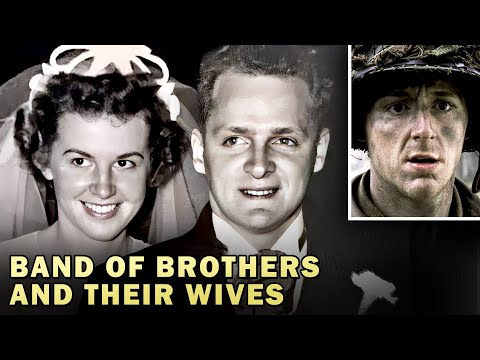
Betty Ann remembered the day she met John. He was all swagger and smiles, a paratrooper with a crooked grin and a promise to write every day. And he did—letters stained with mud and sweat, filled with longing and bravado. But the man who stepped off that ship was thinner, quieter, his eyes holding shadows she couldn’t name.
“You waited,” he whispered, his voice rough. She nodded, unable to speak. The embrace was awkward, two strangers relearning each other. The war had changed him, and she wondered if it had changed her too.
Across town, Mary sat by the radio, listening to the crackle of static. Her husband, a medic with Easy Company, had written of horrors she could only imagine. “I saved lives,” he wrote, “but I couldn’t save them all.” She traced the words with her finger, feeling the weight of his guilt through the ink.
When he finally came home, he didn’t speak for days. She learned to read his silences, to offer comfort without words. The other wives understood—they shared knowing glances at church, at the grocery store, in the schoolyard. They were members of a club no one wanted to join.
But amid the struggle, there was also joy. The laughter of children, the warmth of a shared meal, the slow dance in the kitchen to a song on the radio. “We made it,” they’d whisper to each other. “We survived.” And in those moments, the shadows receded, just a little.
Yet the war was never truly over. It lingered in nightmares, in sudden rages, in the way a car backfiring could make a man drop to the ground. The wives became experts at soothing, at pretending, at holding the pieces together.
One evening, as the sun set over the Kentucky hills, the women gathered on the porch. They talked of their men, of the boys they had married and the heroes they had become. “Do you think they’ll ever be the same?” asked one, her voice barely a whisper. The question hung in the air, unanswered.
But they knew the answer, even if they couldn’t say it. The war had forged their husbands into something new—stronger in some ways, broken in others. And these women, the wives of Easy Company, would carry on, fighting their own quiet battles, loving their men through the darkness.
Betty Ann found John out back behind the house one night, long after the others had gone to bed. He was sitting on an overturned crate, staring at the stars as if they owed him an explanation. “I keep waiting for it to feel like before,” he said, not turning around. “But it doesn’t.”
She sat beside him on the cold ground, her dress gathering dew. She didn’t try to fix it, didn’t offer the platitudes the other women had learned to recite. She simply took his hand and held it, letting the silence stretch until it felt less like a wall and more like a bridge.
“Tell me something true,” she finally said. “Not the version you think I want to hear.”
John was quiet for a long moment. Then, “I don’t know who I am anymore, Betty. The man who wrote you those letters—he died somewhere in those woods. I’m just the fella who walked out.”
Mary’s husband, Frank, took a job at the hardware store, though his hands shook too badly some mornings to hold the tools. She’d watch him from the doorway, a cup of coffee growing cold in her grip, and wonder how to reach him. The medic who had saved lives now flinched at the sound of a dropped wrench.
One afternoon, she found him in the backyard, teaching their son to whittle. “Easy now,” Frank said, his voice steady for the first time in weeks. “You don’t force it. You let the wood tell you what it wants to be.” Mary pressed her hand to her mouth and turned away before they could see her cry.
That night, she wrote a letter to the other wives—a short note, just a few lines. He laughed today. It was small, but it was real. She sealed it and walked to the mailbox, feeling lighter than she had in months.
The replies came slowly, then all at once. Mine held my hand in church. Mine slept through the night. Mine called me by my name, not just ‘ma’am.’ Small victories, but victories nonetheless.
Yet not every home found its footing. One wife—Ruth, who had married her high school sweetheart the week before he shipped out—packed a suitcase and left in the middle of the night. No one blamed her. No one blamed him either. Some wounds were simply too deep to stitch closed.
Betty Ann heard the news at the grocer’s and felt a strange pang of guilt, as if her own marriage had somehow survived at Ruth’s expense. She went home and found John in the kitchen, attempting to fix a leaky faucet, water spraying everywhere. He was laughing—actually laughing—and she realized she hadn’t heard that sound in years.
“I think I’m winning,” he said, drenched and grinning. “Or losing. Hard to tell.”
She grabbed a towel and knelt beside him, and for a moment, they were just a man and a woman, wet and ridiculous and alive. The war was still there, lurking in the shadows, but it didn’t own them tonight.
Later, as they lay in bed, John spoke into the dark. “I want to be your Johnny Cash,” he murmured, half-asleep. “Walk the line and all that.”
Betty Ann smiled, tears pricking her eyes. “You already are,” she whispered. “You came home.”
The morning brought a letter from Ruth, postmarked from a town three counties over. Betty Ann recognized the handwriting immediately—looping and hurried, the same script that had filled the margins of their shared notebooks in school. She almost didn’t open it.
“I’m not writing to apologize,” the letter began. “I’m writing because I need someone to know I’m all right.” Ruth wrote of a small apartment above a bakery, of the smell of bread at dawn, of a job waiting tables at a diner where no one knew her husband’s name. I wake up and I’m not afraid, she wrote. That has to count for something.
Betty Ann read it twice, then folded it carefully and tucked it into her apron pocket. She didn’t show John. Some things belonged only to the women who understood them.
The men of Easy Company began to gather on Thursday evenings, at first by accident—one stopping by another’s porch, then another, until the kitchen table was crowded with elbows and coffee cups. They didn’t talk about the war, not directly. They talked about ball scores and broken tractors and the price of feed.
But sometimes, late, when the wives had gone to bed and the whiskey had loosened tongues, the conversation would turn. “You remember the orchard?” one would ask, and the room would go quiet. They’d nod, and something would pass between them that no wife could ever enter.
Frank came home from those nights quieter than before, but not in the old, hollow way. Mary learned to read the difference. “They understand,” he told her once, haltingly. “They don’t need me to explain.” She kissed his forehead and said nothing, grateful for whatever small mercy had found him.
The town, meanwhile, wanted its heroes. There was a parade in the spring, a ribbon-cutting at the new memorial hall, a photographer from the county paper who arranged the veterans in a stiff row and told them to smile. They smiled. The photograph hung in the diner for years, and only the wives noticed how the men’s eyes never quite matched their mouths.
Summer came early that year, thick with honeysuckle and the drone of cicadas. Betty Ann found John in the garden one afternoon, kneeling in the dirt with his sleeves rolled up, planting tomatoes with the same careful intensity he’d once reserved for patrols. “These’ll come up strong,” he said, squinting at the sky. “Give ’em time.” She heard the double meaning and let it settle, warm and unspoken, between them.
The wives had stopped counting anniversaries of the war’s end. The dates that once hollowed them out had softened into ordinary days, marked only by a quiet glance across the kitchen table. Mary’s letters to the other women grew shorter, then stopped altogether—not from distance, but because there was less to say. The small victories had become the whole life.
Ruth came back for a visit in the fall, her hair cut short and her laugh louder than Betty Ann remembered. She sat on the porch with the others and told them about the bakery, the diner, the man who came in every Tuesday for pie. “I’m not sorry,” she said, and no one argued. Some of them envied her, and that was all right too.
One evening John pulled Betty Ann out to the yard, where the bluegrass stretched green to the fence line. The radio in the kitchen played something slow and old, and he held out his hand like a boy at a dance. “I don’t know the steps anymore,” he admitted. She took his hand anyway. “Neither do I,” she said. “We’ll make them up.”
They swayed there in the dusk, clumsy and laughing, and the shadows that had followed him home seemed to lean back and give them room. The war had not left. It never would. But it had loosened its grip, and that was a kind of grace.
“I’d walk the line for you,” John murmured against her hair. “Any line.” Betty Ann closed her eyes and let the music carry them, and for a moment the whole world was just two people and the sun going down on Kentucky.
Years later, when the grandchildren asked about the photograph in the diner, the wives would tell them about the parade and the smiles and the heroes. But they would keep the rest—the silences, the small victories, the slow dance in the yard—for themselves. Some stories were only ever meant for the women who lived them.
And you—when the ones you love come home changed, what line will you walk to meet them?
Report this article
Select a reason for reporting:






