War footage is often staged, sanitized, or lost to time. But in a dusty archive in Potsdam, an American military attaché named Edward Davis stumbled upon something extraordinary: four reels of raw, unedited film from the German perspective of World War I. Among them was a reel so harrowing, so authentic, that it would become known as the ‘Barrage Film’—the only verified combat footage from the Great War.
In this exclusive deep dive, military historian Dan Hill examines the footage frame by frame, revealing the chaos, tragedy, and surprising humanity of the Western Front.
The film opens with German troops marching in formation, their iconic pickelhaube helmets covered in cloth—a sign they are heading into battle. The dust kicked up by their boots is a stark reminder of the era’s logistics: on unpaved roads, massive troop movements were easily spotted. A band plays, but these musicians double as stretcher-bearers, ready to haul wounded men from the field.
From East Prussia to Belgium, the reel captures the sweep of the Schlieffen Plan—the German gamble to knock France out of the war in six weeks. French soldiers in their famous red trousers march to block the advance, while German troops pause to wash in a fountain, one puffing on a distinctive long-stemmed pipe.
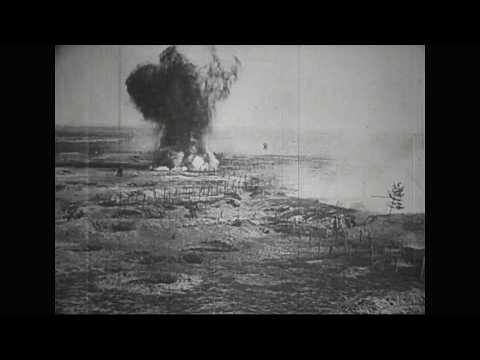
But the heart of the film is the barrage itself. Here, the camera captures an Allied bombardment with shocking clarity. White puffs of smoke mark British shells (Germans used explosives that left gray or black smoke). Men run for their lives, diving into trenches. In one gut-wrenching moment, a shell lands directly between two soldiers; when the camera restarts, they are gone—almost certainly casualties.
Davis, who obtained the film in 1921, later wrote: “No part of the Barosch film is faked, except possibly a few feet of an unimportant nature just at the end.” He showed it to thousands of American officers and men who had served overseas, and they agreed: the bursts, the debris, the soldiers’ attitudes—all genuine.
The cameraman himself was in a protected position, perhaps a bunker aperture, filming the destruction. The terrain, believed to be the Somme in 1916, is crisscrossed with trenches. Gas may have been used—phosgene or chlorine, delivered by shell—but not mustard gas, which would appear later.
As the reel continues, we see a German railway motorcar, a destroyed French fort with grass-covered banks for camouflage, and a field hospital where a French prisoner in an Adrian helmet helps carry stretchers. Then, cavalry with lances—a strange sight in a war of machine guns, but a reminder that horsemen still had a role as a quick reaction force.
The film ends with the ever-present German artillery: the 77mm gun, the workhorse of the army, capable of firing 5 miles and laying down devastating barrages.
This is not just footage; it is a window into the past, preserved by chance and verified by those who were there. And it is only the beginning of what this remarkable reel reveals.
But the story of how this film survived is almost as remarkable as the footage itself. Edward Davis, a cavalry colonel and combat veteran, had been stationed in Berlin as a military attaché immediately after the war. In the autumn of 1921, as he prepared to depart, he asked the German archives at Potsdam for a single reel as a souvenir. They gave him four.
Among them was the reel he would later call the ‘Barosch film’—though it may have been labeled the ‘Palestine film’ in German Signal Corps records. Davis was not just a collector; he was a trained cameraman who had filmed during the war and later lectured extensively on his experiences. He knew what authentic combat footage looked like.
“In my judgment, no part of the Barosch film is faked,” he wrote, “except possibly a few feet of an unimportant nature just at the end of the film.” Those final feet, he suspected, might have been augmented with mines to enhance the spectacle—a decision he criticized as unnecessary and counterproductive.
Davis’s assessment was not taken lightly. He screened the film for thousands of American officers and enlisted men who had served overseas, including at the Signal School. Their consensus was unanimous: the bursts were projectiles, not mines; the smoke, debris, and dispersion were all consistent with real shellfire. The relationship between the lines of advancing German infantry and the location of the shell bursts, the attitudes of the men—all pointed to authenticity.
What makes this footage so rare is the sheer danger of capturing it. Cameramen on the Western Front faced the same risks as soldiers, often worse, because they had to expose themselves to get the shot. Most combat footage from the war was staged after the fact, precisely because filming under fire was suicidal. The Barrage Film exists only because a German cameraman found a protected vantage point—perhaps a bunker aperture or a ruined building—and had the nerve to keep filming as shells rained down.
And the film rewards close scrutiny. In one sequence, a German railway gun—likely a ‘Big Bertha’ type, with a caliber of around 40 cm—is shown with battle damage: shrapnel holes piercing its armor. These guns were so massive they had to be moved by rail, and their shells, weighing up to 900 kilos, could be hurled over 11 miles. Later, we see German troops clambering over a captured French railway gun, one man perched precariously on the barrel while his comrade winds the elevation mechanism below—a moment of light-heartedness in the midst of war.
Then there is the human cost. Refugees stream along a road, all their worldly possessions piled in a wheelbarrow. The intertitle speaks of French bombardment, but the reality is darker: these are almost certainly Belgians fleeing the German advance, victims of what would become known as the Rape of Belgium. The camera does not linger, but the image sears itself into memory.
Back on the battlefield, the cameraman captures a German field hospital, where a French prisoner in an Adrian helmet helps carry a stretcher. Cavalrymen with lances ride past—a strange anachronism in a war of machine guns, yet a reminder that horsemen still served as a quick reaction force, ready to exploit any gap in the lines.
Finally, the reel returns to the artillery: the 77mm gun, the workhorse of the German army, capable of firing 5 miles and laying down devastating barrages. These guns, like the film itself, were instruments of destruction—but also of preservation, capturing a moment in time that would otherwise be lost.
As the reel runs out, one cannot help but wonder: what else lies in those archives at Potsdam? What other reels, forgotten or overlooked, might hold similar secrets? The Barrage Film is a start—but it is only a start.
Dan pauses the footage on a wide shot of the trench system, the frame grainy and speckled with dust and scratches. He leans in, pointing to a faint white line in the distance. “That chalk outline—that’s the British front line,” he says. “And notice the dugout entrance in the foreground. It’s angled away from the enemy. That’s how you know which way the Germans were facing.”
The detail is small but telling. It confirms what Davis argued a century ago: this is not a staged propaganda piece. It is a genuine record of men under fire, filmed by someone who understood the terrain and the stakes.
But there is more. Dan scrubs forward to a sequence showing German infantry moving in small groups, hugging the earth as shells explode around them. Their helmets are the distinctive stahlhelm, introduced in 1916—another clue that places the footage on the Somme. “Look at how they move,” Dan says. “Not in parade formation. Not charging dramatically. Just trying to stay alive.”
The camera pans right, and the bombardment intensifies. Shells land in clusters, throwing up geysers of earth and smoke. Dan notes that the ground is nearly empty of troops—most are huddled in dugouts, waiting out the storm. “This is what a real barrage looks like,” he says. “Not a Hollywood explosion. Just relentless, grinding destruction.”
Then comes a sequence that Dan admits is difficult to watch. A group of German soldiers sprint across an open stretch, desperate to reach the next trench line. One of them stumbles, falls, and does not get up. The camera keeps rolling. “There’s no cut, no staging,” Dan says quietly. “That man is almost certainly dead. And the cameraman kept filming because that was his job.”
The reel then shifts to a lighter moment—a brief respite from the carnage. German soldiers gather around a captured British trench mortar, examining it with curiosity. One man poses for the camera, grinning, while another pretends to load the weapon. “They’re boys, really,” Dan observes. “Most of them are in their late teens or early twenties. They find a novelty, and for a moment, they’re just kids again.”
But the war reasserts itself. The next shot shows a line of German prisoners being marched to the rear by British soldiers—a reversal of the earlier scene. Dan points out the mix of emotions on their faces: exhaustion, relief, fear. “For some of them, capture meant survival,” he says. “For others, it meant shame.”
As the footage draws toward its final frames, Dan returns to the question that has haunted historians for decades: why did this film survive when so much else was lost? The answer, he suggests, lies in the chaotic aftermath of the war. “In 1919 and 1920, Germany was in turmoil,” he says. “Archives were scattered, records were destroyed. Davis happened to ask at the right moment, and the Germans happened to say yes.”
He pauses the film on a final image: a German soldier standing alone in a trench, his back to the camera, staring out across no man’s land. The frame is still, almost peaceful. “We don’t know his name,” Dan says. “We don’t know if he survived. But for a few seconds, a century ago, he was captured on film. And now we’re watching him.”
The reel ends. The screen goes dark. But the questions linger—and the archives at Potsdam still hold secrets yet to be uncovered.
Dan lets the silence hang for a moment before turning back to the camera. “What you’ve just seen is the closest thing we have to time travel,” he says. “Not a recreation. Not a dramatization. Just a man with a camera, a hundred years ago, watching the world end around him.”
He explains that the Barrage Film remains a touchstone for historians precisely because it refuses to flatter or entertain. There are no heroes in it, no villains—only soldiers, refugees, and horses caught in a machine of industrial slaughter. “Davis knew what he had,” Dan adds. “He could have sold it, sensationalized it. Instead, he showed it to men who’d been there, and let them judge.”
And judge they did—thousands of American veterans, many of whom had survived the very barrages the film depicts. Their verdict was unanimous: this was real. The bursts, the debris, the way men ran and fell—all of it rang true.
Dan closes with a reflection on why footage like this matters. “We remember wars through numbers—millions dead, miles gained, shells fired,” he says. “But numbers numb us. This film doesn’t. It shows one man stumbling, one shell landing, one moment frozen forever.”
The reel may end, but the questions it raises do not. What other films are still waiting in Potsdam’s vaults? What other faces, unnamed and unremembered, have yet to be seen? And what would they tell us about a war we thought we knew?
As Dan signs off, one thought lingers: the past is never truly gone—it is only waiting to be watched. So tell us—if you could uncover one lost reel from history, whose story would you want to see?
Report this article
Select a reason for reporting:






