Dr. Rebecca Turner had handled thousands of old photographs. She knew the weight of history in her hands, the brittle texture of a century-old print, the faint smell of dust and decay. But nothing prepared her for image number seventeen.
It was a cold January morning in 2024 when she opened archive box 247B at the Massachusetts Historical Society. The Whitman family collection—sixty photographs from 1870 to 1920—seemed ordinary at first. Stern Victorian faces, wedding couples, children in stiff collars. Then she turned to the eighth-by-ten print mounted on thick cardboard, its back inscribed in faded ink: Whitman family, October 14, 1893, Salem, Massachusetts.
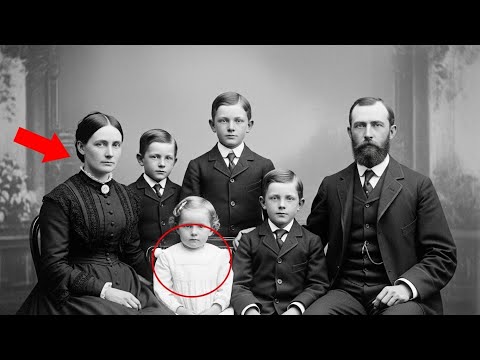
Five figures arranged in a formal parlor. A man and woman in their mid-thirties seated apart. Two boys standing between them, aged ten and eight, in dark suits and white collars. And on the woman’s lap, a girl of about six in a white lace dress, her hair tied with a white ribbon, her eyes closed.
Rebecca’s first thought was that the child had fallen asleep. Long exposure times in the 1890s often exhausted young subjects. But something was wrong. The mother’s hands were placed too precisely around the girl’s torso—not a casual embrace, but a structural hold, keeping the body upright and still.
She zoomed in. The child’s skin had an unnatural smoothness, even for the era’s limited photography. This was a post-mortem portrait.
Post-mortem photography was common in America from 1840 to 1910. For many working- and middle-class families, it was the only image they would ever have of a lost loved one—especially children. Rebecca cross-referenced the Thanatos Archive, a research database documenting American deathways, and confirmed her assessment. The evidence aligned perfectly.
First, the child’s pose. The mother’s hands acted as a structural support, holding the body in a seated position—a common practice. Photographers and families often arranged deceased children to look asleep or at rest, believing it less disturbing than showing the body lying down.
Second, the date on the back. October 14, 1893 was almost certainly the session date, not the death date. Families typically waited one to three days after death to arrange a post-mortem sitting, allowing time to notify the photographer and prepare the body.
Third, the white dress. While white was sometimes used for living children’s formal portraits, it was the standard color for post-mortem portraits of young girls in the 1890s. White symbolized innocence and purity—and the Victorian belief that deceased children became angels.
Rebecca returned to the original print, examining it through a jeweler’s loupe at ten times magnification. Details invisible to the naked eye emerged. No motion blur on the child’s face. Even a sleeping child would shift slightly during the thirty-to-sixty-second exposure required by 1893 cameras. The absolute stillness pointed to only one conclusion.
The eyes were closed, but the lids appeared flattened—a subtle indentation suggesting the Victorian practice of placing cotton or coins over the eyelids to keep them shut. And the hands: folded on the abdomen with fingers interlocked, a deliberate arrangement. A sleeping child’s hands would have fallen to the sides or rested loosely in the lap.
She checked the studio records again. Hastings Photography Studio had operated on Essex Street in Salem from 1889 to 1902. Local business directories revealed that Thomas Hastings advertised “memorial portraiture” as a specialty—a common euphemism for post-mortem photography.
Rebecca needed more. Who were the Whitmans? What caused the child’s death? And why had this image survived for 131 years, preserved with such care?
She returned to the archive box and found a leather-bound volume, five by seven inches, with a brass clasp. The cover was embossed with faded gold letters: Family Record. Inside, a genealogical log written in precise handwriting documented the Whitman family’s births, marriages, and deaths from 1875 to 1918.
She turned to 1893 and found the entry she was searching for: October 11, 1893. Our beloved daughter Anna Louise Whitman passed into God’s mercy at age six years and four months, of diphtheria. She died peacefully at home, surrounded by her mother, father, and brothers Thomas and William. Dr. Horace Fletcher attended the burial on October 13 at Harmony Grove Cemetery, Salem.
Three days between death and burial—typical for the period. The photograph was taken on October 14, one day after the burial. The detail stunned Rebecca. Why photograph a child after she had already been buried?
She turned the page. What she found next would change everything she thought she knew about the Whitman family.
The next entry was dated October 14, 1893—the same day as the photograph. The handwriting was shakier here, the ink slightly smudged. “Our Anna was taken from us, but we could not let her go without a likeness. Dr. Fletcher arranged for her to be brought home from the cemetery for one hour. The photograph was made in our parlor at noon. She looked as though she were sleeping.”
Rebecca read the passage three times. Exhumation for photography. It was rare but not unheard of—a practice documented in a handful of cases where grief overwhelmed convention. She pulled up the Thanatos Archive again, searching for similar accounts in New England. There were fewer than a dozen recorded instances. Each one involved a family of some means and a photographer willing to participate.
But something still didn’t fit. The entry mentioned only Anna. Yet the photograph showed five figures. Rebecca studied the image again. The two boys—Thomas and William—stood stiffly, their hands at their sides. Their faces were pale, their eyes fixed. She had assumed they were simply obeying the photographer’s instructions. Now she wondered.
She turned to the following page of the family record. The next entry was dated November 2, 1893—just three weeks after Anna’s death. “Our son William, aged eight years, followed his sister into eternal rest. The same illness. We commit his body to Harmony Grove.”
Diphtheria. It moved through households like a shadow, striking one child and then another. Rebecca’s stomach tightened. She looked back at the photograph. William was the shorter boy on the right. In the image, his posture was slightly slumped, his head tilted a fraction of an inch. She had attributed it to childhood restlessness. Now she reached for the loupe again.
At ten times magnification, the truth emerged. William’s left hand—the one nearest his mother—was not resting naturally. The fingers were curled inward, the knuckles slightly swollen. And beneath the collar of his dark suit, a faint discoloration marked the skin of his neck. Early signs of the membranous inflammation that characterized diphtheria.
Rebecca set the loupe down. Her hands were trembling. The photograph was not a single post-mortem portrait. It was a family portrait taken in the shadow of death—Anna already gone, William already infected, the rest of the family unaware or unwilling to acknowledge what was coming.
She checked the family record again. Thomas, the elder boy, survived. The parents survived. But two children were taken in a single autumn. The photograph had captured them all together for the last time.
Why had this image survived? Rebecca turned to the final pages of the record. The last entry was dated 1918: “I, Thomas Whitman, eldest son of this house, leave this record to my descendants. Let them know that we were five, and then we were three, and that love does not end with the grave.”
She closed the leather volume and sat in silence. The archive room hummed with fluorescent light. Outside, January wind rattled the windows. Somewhere in the building’s climate-controlled vaults, sixty photographs waited to be catalogued—each one a fragment of someone’s vanished world.
But image seventeen was different. It was not merely a record of death. It was a record of love that refused to let go—a family who brought their daughter home for one last hour, who posed beside her without knowing their son was already following her.
Rebecca picked up her pen and began to write the catalogue entry. She would describe the photograph, the studio, the date. She would note the post-mortem evidence. But she would also write the names: Anna Louise Whitman, six years old. William Whitman, eight years old. And Thomas Whitman, who had kept their memory alive for a hundred and thirty-one years.
She paused, her pen hovering above the page. Something else was bothering her. The family record mentioned that Dr. Fletcher had arranged for Anna’s body to be brought home. But it said nothing about how the photograph had come to be taken—or who had paid for it. Rebecca flipped back to the earlier pages.
There, tucked between the birth records of 1885 and the marriage entry of 1887, she found a receipt. It was folded small, the paper yellowed but intact. “Received from Mrs. Eleanor Whitman, October 14, 1893, the sum of four dollars and fifty cents for memorial portraiture, including the return of the subject from Harmony Grove. — T. Hastings.”
Four dollars and fifty cents. A small fortune for a working family in 1893. Rebecca stared at the receipt. The Whitmans had paid not only for the photograph but for the exhumation and transport of their daughter’s body. They had chosen to spend what little they had on a final image.
She set the receipt down and looked once more at the photograph. Anna’s eyes were closed, her hands folded, her white dress spotless. The mother’s face was calm—too calm, perhaps. The father’s jaw was set. The boys stood like soldiers. And William, the boy who would be dead in three weeks, leaned slightly toward his sister, as if even then he knew he would soon follow.
Rebecca closed the archive box and sat for a long moment, the receipt still in her hand. Four dollars and fifty cents. She thought of Eleanor Whitman, who had buried one child and then posed with another who was already marked for the grave. “Love does not end with the grave.” Thomas’s words echoed in her mind.
She finished the catalogue entry and added a note for future researchers: This photograph documents not one death but two—a mother’s refusal to let go, and a brother’s silent farewell. Then she filed the box away, but she kept image seventeen on her desk a while longer.
Outside, the January wind pressed against the windows. Rebecca looked at the five faces one last time—Anna in her white dress, William leaning toward her, Thomas standing straight, the parents holding it all together. They were five, and then they were three. And now, because of a photograph and a leather book, they were remembered.
She turned off the lamp and left the archive room, the image of Anna Louise Whitman still glowing in her mind. Some stories end with a grave. This one ended with a picture—and a question that would not let her go.
What would you have done, if it were your child in that white dress? Share your thoughts in the comments below.
Report this article
Select a reason for reporting:






