February 2, 1943. The frozen ruins of Stalingrad fall silent. The guns stop, and for the first time in months, the living can hear the wind howl through the shattered city. But for the roughly 91,000 German soldiers still breathing, the nightmare is just beginning.
They survived the cauldron of Stalingrad—the street-by-street slaughter, the starvation, the typhus—only to march into a fate perhaps even more merciless. This is the story of what happened after the surrender, when the world looked away.
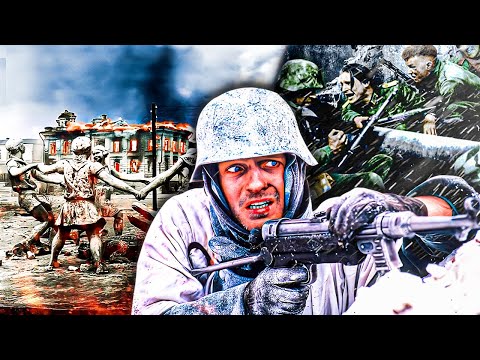
The battle itself had been apocalyptic. Adolf Hitler had been obsessed with Stalingrad, a city bearing the name of his Soviet rival, Joseph Stalin. The Sixth Army, led by General Friedrich Paulus, was ordered to take it at any cost. What followed was a meat grinder that consumed divisions whole.
By November 1942, the Red Army sprang its trap. Operation Uranus, a massive counteroffensive, encircled the German Sixth Army and parts of the Fourth Panzer Army. Cut off from supplies and reinforcements, the Germans were doomed. Hitler, in a characteristic display of hubris, promoted Paulus to Field Marshal, expecting him to fight to the death or commit suicide. Paulus, however, chose surrender.
On January 31, 1943, he was captured. Two days later, the remaining German forces in the northern pocket capitulated. The battle was over. But for the survivors, a new ordeal was about to begin.
The first horror was the march into captivity. Soviet forces herded the prisoners—many wounded, frostbitten, and starving—toward camps hundreds of kilometers away. It became known as the ‘March of Death.’ Temperatures plunged below minus 30 degrees Celsius. The prisoners, dressed in rags and lacking winter gear, trudged through snow-covered wastelands.
Those who fell behind were shot or left to freeze. Thousands died within days. A German officer later recalled: ‘We were treated worse than animals. The guards took our boots, our coats, anything of value. If you couldn’t walk, you were finished.’
Of the 91,000 who surrendered, only about 5,000 would ever see Germany again. The rest perished on the march or in the brutal Soviet labor camps known as the Gulag.
The survivors who staggered into the camps of Beketovka, Yelabuga, and Krasnogorsk found no respite. They were stripped of their identity the moment they passed the wire. Names were replaced by numbers stitched onto frayed uniforms. The officers among them—men who had once commanded battalions—were now indistinguishable from privates, all reduced to skeletal figures shivering in unheated barracks.
The work began almost immediately. Prisoners were roused before dawn and marched to construction sites, mines, and forests. They rebuilt the very city they had tried to destroy. Former soldiers of the Sixth Army hauled bricks and mortar through the ruins of Stalingrad, clearing rubble from streets they had once fought to conquer.
Food was a currency of survival. A daily ration consisted of watery cabbage soup and a few hundred grams of black bread—often mixed with sawdust. Men traded wedding rings for a single potato. Those caught stealing from the camp kitchen faced solitary confinement in unheated cells, a sentence that frequently proved fatal.
Disease swept through the camps with ruthless efficiency. Typhus, dysentery, and tuberculosis found easy prey among the malnourished. Camp hospitals were little more than death chambers, where the sick lay on bare wooden planks awaiting the end.
One Soviet medical report from 1943 noted with clinical detachment that ‘the mortality rate among German prisoners exceeds 70 percent in certain camp sections.’ The bodies were stacked like cordwood in sheds, awaiting mass burial in unmarked pits.
Yet amid the horror, small acts of humanity flickered. Some Soviet guards, themselves starving, shared crusts of bread. A few camp doctors smuggled medicine to the sickest prisoners. These gestures were rare, but they happened.
For the men of Stalingrad, survival depended on a strange alchemy of luck, willpower, and the ability to adapt. Those with useful skills—engineers, electricians, mechanics—were assigned lighter labor and better rations. The unskilled and the broken were left to fate.
As the war dragged on, news from home grew sparse. Letters arrived months late, if at all, and were often heavily censored. Prisoners learned of Allied bombing raids on German cities, of the Eastern Front collapsing, of the Reich’s slow strangulation.
Some refused to believe it. Others accepted the truth with grim resignation. ‘Germany is finished,’ a prisoner named Kurt wrote in his diary in 1944. ‘We were lied to. We were sacrificed for a madman’s dream. And now we pay the price.’
The end of the war in Europe in May 1945 brought no immediate liberation. Stalin had other plans. The Soviet Union needed labor to rebuild its shattered economy, and the German prisoners were a vast, expendable workforce.
It would take years—and millions of words of diplomacy—before the survivors of Stalingrad began their long journey home. And when they finally returned, they found a Germany that had changed beyond recognition, and a population that often greeted them with suspicion rather than sympathy.
The repatriation process, when it finally began in earnest, was a slow and bureaucratic affair. Soviet authorities released prisoners in waves, prioritizing the sick and the weakest first—though many of those deemed ‘unfit for labor’ died before they ever reached the transit camps. By the end of 1945, roughly 200,000 German prisoners had been sent home. A second wave followed in 1946, but the process dragged on for years.
For those still trapped in the camps, hope became a dangerous commodity. Prisoners watched the gates for signs of change, counting the days since their capture. Some kept calendars scratched into wooden planks, marking each sunrise with a desperate tally. Others simply stopped counting. The psychological toll was as devastating as the physical one.
Among the survivors was a young lieutenant named Heinrich Voss, captured at Stalingrad at just twenty-three years old. He had been a schoolteacher before the war, a man of books and quiet ambition. By 1946, he weighed less than fifty kilograms and could barely lift a shovel.
In a letter to his wife—the first he had been allowed to send in over three years—Voss wrote: ‘I have seen things that no man should see. I have done things that no man should do. The boy you married died in Stalingrad. I do not know who is writing this letter.’ The letter never reached her. She had been killed in a bombing raid in 1944.
Voss was among the fortunate ones. In the spring of 1947, he was transferred to a repatriation camp near the Polish border. The journey took three weeks, crammed into cattle cars with sixty other men. They received no food for the first four days. When the train finally stopped, Voss stepped onto German soil and collapsed, weeping, into the mud.
His homecoming was not the joyful reunion he had imagined. His parents were dead. His house had been requisitioned by Soviet authorities. He had nowhere to go and no one to greet him. For the first six months, he slept in a refugee shelter in Dresden, sharing a room with a dozen other former prisoners.
The men of Stalingrad carried invisible wounds that no doctor could heal. Many suffered from what would later be called post-traumatic stress disorder—nightmares, flashbacks, an inability to connect with civilian life. Some drank themselves to death. Others simply disappeared.
A former sergeant named Wilhelm Brandt returned to his hometown of Munich in 1948 to find his wife remarried. She had received official notification of his death in 1944—a bureaucratic error that had severed their marriage by law. He never spoke to her again. Instead, he moved to a small village in Bavaria and lived alone until his death in 1971.
Not all stories ended in tragedy. A handful of survivors managed to rebuild their lives with remarkable resilience. Some became teachers, determined to educate a new generation about the horrors of war. Others entered politics, advocating for reconciliation between Germany and the Soviet Union.
One such man was Ernst Hartmann, a former captain who had been captured in the northern pocket. After his release in 1949, he devoted himself to documenting the experiences of Stalingrad veterans. His archive, collected over four decades, became one of the most important historical records of the battle and its aftermath.
‘We were not heroes,’ Hartmann wrote in his memoir, published in 1962. ‘We were not victims. We were men who followed orders and paid a terrible price. The only victory we can claim is that we survived—and that we refused to forget.’
The last German prisoners of war were not released until 1955, a full decade after the end of the war. By then, fewer than 6,000 of the original 91,000 Stalingrad survivors remained alive. The rest had died in the camps, on the marches, or in the years of hardship that followed.
For the families of the missing, the uncertainty was its own form of torture. Thousands of German women wrote letters to Soviet authorities, begging for information about their husbands, sons, and fathers. Most received no reply. The fate of countless Stalingrad soldiers remains unknown to this day.
In the decades that followed, the story of Stalingrad became a symbol—of military folly, of human endurance, of the terrible cost of ideology. The city itself was rebuilt and renamed Volgograd, its ruins replaced by grand boulevards and monuments. But beneath the concrete and marble, the ghosts of 1943 remained.
In 1993, a mass grave was discovered during construction work near the Volga River. It contained the remains of over 2,000 German soldiers, still wearing their tattered uniforms. For the first time, the Russian government allowed German officials to oversee the exhumation and burial.
The ceremony was small and quiet. A handful of elderly survivors made the journey—men in their seventies and eighties, leaning on canes, their eyes filled with tears. They stood in silence as the remains were lowered into a new grave, marked by a simple granite cross.
One of them, a former private named Otto Klein, spoke to a journalist afterward. ‘I came to say goodbye,’ he said. ‘Not to the war. Not to the army. To my friends. To the boys who never got to grow old. They deserve to be remembered.’
As the sun set over the Volga, the survivors turned and walked away. Behind them, the river flowed on—indifferent, eternal, carrying with it the secrets of a battle that had changed the world.
The history books rarely linger on what came after. They give us dates, casualty figures, the grand sweep of armies. But the men who crawled out of Stalingrad’s rubble and into the gulags were not statistics. They were fathers, sons, and brothers who had once believed in a cause that betrayed them.
Today, their stories survive in diaries, letters, and the memories of families who never stopped asking what happened. The March of Death, the frozen camps, the slow repatriation—these are chapters written in silence, often forgotten.
Yet memory has a way of resurfacing. In Volgograd, the old battlefields still yield bones. In German archives, letters yellow with age still whisper their final words. And in the hearts of those who study this history, a question lingers: what do we owe the men who survived—and the millions who did not?
Perhaps the answer is simple. We owe them the truth. We owe them the courage to look at the darkest corners of the past and say, ‘This happened. These men suffered. And we will not look away.’
So as you close this story, ask yourself: if the survivors of Stalingrad could speak to us today, what would they want us to remember—and what would they beg us never to repeat? Share your thoughts in the comments below.
Report this article
Select a reason for reporting:






