On the night of August 2, 1990, over 140,000 Iraqi troops, backed by 18,000 tanks and armored vehicles, massed on the Kuwaiti border. Their objective was swift and total conquest. Under the cover of darkness, the attack caught Kuwait completely off guard. Within hours, Kuwait’s Amir and government officials had fled, and key strategic locations, including Kuwait City, were under Iraqi control. The invasion was brutal, costing thousands of lives and sending shockwaves around the world. It would set the stage for a major international crisis and ultimately spell doom for Iraq.
But why did Saddam Hussein attack Kuwait in the first place? And how did his miscalculation in planning the invasion lead to his own defeat? To answer that, we need to go back to the 1980s, when Iraq was emerging from the devastating Iran-Iraq war—a conflict that had drained its resources and left the country deeply in debt.
The Iran-Iraq war, lasting from 1980 to 1988, was one of the 20th century’s longest and deadliest conflicts. Both nations suffered immense casualties and economic losses. Iraq, in particular, found itself burdened with a massive debt and its economy in ruins. The country’s infrastructure was heavily damaged, and its industries were struggling to recover. The war had cost Iraq over $500 billion, a staggering sum that the nation could not easily recoup. Moreover, Iraq’s oil production facilities had suffered significant damage, severely limiting its primary revenue stream.
Iraq’s financial woes were compounded by its massive debt. The country owed approximately $80 billion to various international creditors. Of this amount, $14 billion was owed to Kuwait, which had lent the money during the war to support Iraq’s efforts against Iran. Saddam Hussein viewed this debt as a contribution to a common Arab cause and expected it to be forgiven. However, Kuwait insisted on repayment, further straining relations between the two nations.
Iraq’s economy was heavily dependent on oil exports, which accounted for the vast majority of its revenue. The drop in oil prices during the late 1980s and early 1990s exacerbated Iraq’s economic difficulties. Kuwait’s overproduction of oil, in excess of OPEC’s quotas, led to a glut in the market, driving prices down. This was a severe blow to Iraq, whose economy was already reeling from the war. Saddam perceived Kuwait’s actions as a deliberate attempt to weaken Iraq economically.
In an attempt to stabilize the economy, Saddam’s government implemented various policies, including nationalization of key industries and currency devaluation. These measures, however, were not enough to address the underlying issues. Unemployment soared, inflation skyrocketed, and the population grew increasingly discontented. The economic hardship created a fertile ground for social unrest, putting additional pressure on Saddam’s regime.
The relationship between Iraq and Kuwait had always been fraught with tension. Disputes over oil-rich territories, such as the Rumaila oil field, exacerbated these tensions. Iraq accused Kuwait of slant drilling into its oil reserves, effectively stealing Iraqi oil. By 1990, the tensions had reached a boiling point. Iraq’s financial situation was dire, and Saddam’s patience had run out. He began to make plans for a military solution, believing that seizing Kuwait would solve his economic problems and boost his standing in the Arab world.
Saddam Hussein was born in 1937 in a small village near Tikrit, Iraq. He joined the Ba’ath Party as a young man, quickly rising through the ranks due to his ambition and ruthlessness. In 1968, he played a key role in the coup that brought the Ba’ath Party to power, and by 1979, he had become the President of Iraq. Saddam’s rule was characterized by an authoritarian style and a personality cult. He portrayed himself as the savior of Iraq, building a strong nationalistic image. His leadership was marked by a blend of Arab nationalism, socialism, and a fierce anti-Western stance. Saddam’s regime was also known for its brutal repression of dissent, with widespread use of torture, executions, and mass imprisonments to maintain control.
Saddam harbored grand ambitions of regional dominance. He saw himself as the leader of a unified Arab world and sought to position Iraq as the preeminent power in the Middle East. His invasion of Iran in 1980 was partly driven by these ambitions. By the late 1980s, Saddam’s focus had shifted towards consolidating his power and dealing with Iraq’s economic challenges. Saddam’s decision to invade Kuwait was influenced by a mix of personal and political motivations. He believed that seizing Kuwait would solve Iraq’s economic problems by acquiring its vast oil reserves and erasing the debt. Moreover, he thought that a successful invasion would bolster his image as a strong and decisive leader, both domestically and in the wider Arab world. Saddam’s miscalculation of the international response, however, would lead to dire consequences.
On August 2, 1990, under the cover of darkness, Iraqi forces launched a full-scale invasion of Kuwait. Over 140,000 Iraqi troops and 18,000 tanks swiftly overwhelmed the small Kuwaiti Defense Forces. The initial assault was brutal and decisive. Within hours, Iraqi troops had seized control of key locations, including the Emir’s palace and the central government buildings. The Kuwaiti royal family fled to Saudi Arabia, and the capital, Kuwait City, fell into Iraqi hands. The occupation of Kuwait was marked by widespread looting, destruction, and human rights abuses. Iraqi forces dismantled the infrastructure, seized valuable assets, and committed numerous atrocities against the Kuwaiti people. Saddam Hussein declared Kuwait the 19th province of Iraq.
The international community reacted swiftly. On August 2, 1990, the United Nations Security Council passed Resolution 660, condemning the invasion and demanding Iraq’s immediate withdrawal. This was followed by a series of resolutions that imposed economic sanctions on Iraq and authorized the use of force if Saddam did not comply. The UN’s sanctions aimed to isolate Iraq economically. These measures included a comprehensive trade embargo, freezing of Iraqi assets abroad, and a ban on oil exports. The sanctions had a devastating impact on Iraq’s already struggling economy, further exacerbating the hardship faced by the Iraqi population.
In response to the invasion, the United States spearheaded the formation of a coalition of over 30 countries, including major Western powers and Arab states. The coalition was committed to liberating Kuwait and deterring further Iraqi aggression. Diplomatic efforts continued in parallel, but with Saddam refusing to back down, the stage was set for a military confrontation. In the lead-up to the military intervention, the coalition launched Operation Desert Shield, a massive deployment of troops to Saudi Arabia to protect it from potential Iraqi aggression. This show of force was intended to pressure Saddam into withdrawing from Kuwait, but as the deadline for compliance approached, it became clear that war was imminent.
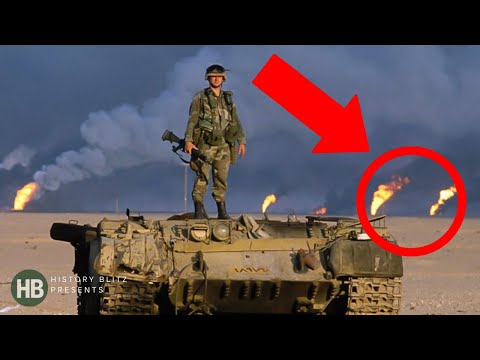
On January 17, 1991, the coalition initiated Operation Desert Storm with a massive aerial bombardment campaign. Over 1,000 aircraft took part in the initial wave, targeting key Iraqi military installations, communication centers, and infrastructure. The goal was to cripple Iraq’s ability to wage war and to minimize the risk to coalition ground forces. The air campaign was relentless and devastating. For 42 days, coalition aircraft pounded Iraqi positions, achieving air superiority and systematically dismantling Iraq’s military capabilities. Precision-guided munitions were used extensively, showcasing the advanced technology and strategic planning of the coalition forces.
With the air campaign achieving its objectives, the coalition launched the ground offensive on February 24, 1991—Operation Desert Saber. The ground phase of Desert Storm involved a swift and overwhelming assault designed to liberate Kuwait and destroy the Iraqi military presence. The ground offensive was a textbook example of modern warfare. Coalition forces, utilizing superior mobility, technology, and coordination, rapidly advanced through Iraqi defenses. The Iraqi military, demoralized and disorganized, offered little effective resistance. Within 100 hours, coalition troops had liberated Kuwait City, and the Iraqi forces were in full retreat.
On February 28, 1991, President George H.W. Bush declared a ceasefire, and Kuwait was officially liberated. The coalition’s swift and decisive victory restored Kuwaiti sovereignty, but the war’s impact would be felt for years to come. The invasion and the subsequent buildup to war captured global attention. Public opinion was divided, with some supporting the coalition’s efforts to restore Kuwaiti sovereignty while others feared the consequences of a large-scale conflict. The media played a crucial role in shaping perceptions, providing extensive coverage of the events and the plight of the Kuwaiti people.
The defeat in the Gulf War and the continued sanctions had a profound and lasting impact on Iraq. The country’s infrastructure was heavily damaged, and the economy was crippled. The sanctions, which remained in place for over a decade, led to widespread poverty and a humanitarian crisis, with severe shortages of food, medicine, and other essential supplies. Despite the devastation, Saddam Hussein managed to retain his grip on power. His regime became increasingly repressive, with brutal crackdowns on any form of dissent. The suffering of the Iraqi people continued, and internal tensions grew, setting the stage for future conflicts and instability.
The invasion of Kuwait and the Gulf War had significant repercussions for the Middle East. The conflict reshaped regional alliances and highlighted the vulnerabilities of smaller states to aggression by their more powerful neighbors. It also underscored the importance of international cooperation in addressing regional security threats. Kuwait faced the daunting task of rebuilding after the war. The liberation was followed by a period of reconstruction, supported by the international community. Over time, Kuwait managed to restore its infrastructure and economy, but the scars of the invasion remained. The experience reinforced Kuwait’s reliance on international alliances for its security.
The Gulf War left a lasting legacy. It demonstrated the effectiveness of multinational coalitions in addressing aggression and set a precedent for future interventions. However, it also highlighted the complexities of Middle Eastern politics and the unintended consequences of military action. The conflict’s aftermath continued to influence US foreign policy and shaped the geopolitical landscape of the region for decades to come. The invasion of Kuwait by Saddam Hussein in 1990 was a watershed moment in modern history. It was driven by a complex mix of economic desperation, political ambition, and personal vendettas. The invasion and the subsequent Gulf War reshaped the Middle East, with far-reaching consequences that continue to be felt today.
As we reflect on these events, the story of Saddam’s invasion of Kuwait stands as a stark reminder of how ambition, miscalculation, and defiance of international norms can lead to catastrophic outcomes. The war not only liberated Kuwait but also crippled Iraq’s military and economy, setting the stage for decades of instability. Saddam’s gamble to solve his financial crisis backfired spectacularly, ultimately leading to his downfall years later.
The Gulf War also redefined global diplomacy, proving that collective action could counter aggression. Yet, the human cost—both Kuwaiti and Iraqi—remains a somber testament to the horrors of conflict. Kuwait’s reconstruction was a symbol of resilience, but the psychological scars endured.
Today, the echoes of that conflict persist in the Middle East’s geopolitical landscape. The invasion of Kuwait was a turning point, illustrating the perils of underestimating international resolve. As history shows, even the most calculated plans can unravel when faced with united opposition.
What lessons do you think the world has learned—or failed to learn—from Saddam’s fateful decision? Share your thoughts in the comments below.
Report this article
Select a reason for reporting:






