Dr. Sarah Mitchell had spent years studying the past, but nothing prepared her for the moment she found evil staring back at her from a dusty antique shop shelf. The photograph was ordinary at first glance—a typical 1920s family portrait, stiff and formal. But as Sarah, a Cambridge historian, examined the child’s face, a chill ran down her spine. The little girl’s smile was wrong—too knowing, too calculated for a nine-year-old. It was a smile that didn’t reach her eyes, and it would haunt Sarah long after she left the shop.
Intrigued, Sarah purchased the photograph from Mr. Peton, the elderly shop owner, who shared a tragic tale: the Ashford family had met a grim fate shortly after the portrait was taken. The father, Herbert, died suddenly of a heart attack at 42. The mother, Constance, suffered a breakdown and was institutionalized. And the girl, Millisent, vanished without a trace in 1922. “She was never found,” Mr. Peton said, his voice low. The words echoed in Sarah’s mind as she studied the child’s unsettling smile, now tinged with a darker meaning.
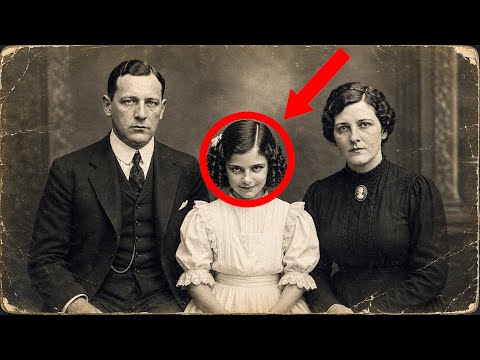
Back in her office, Sarah couldn’t shake the feeling that the photograph held secrets. She delved into the university archives, uncovering newspaper clippings and medical reports that painted a horrifying picture. Herbert’s death was preceded by weeks of mysterious symptoms—sweating, chest pains, gastrointestinal distress. His physician noted signs of poisoning but found no source. Then, a medical journal article revealed Constance’s delusions: she claimed her daughter had changed, become cruel, and possessed a smile that never reached her eyes. “Something had taken possession of her little girl,” Constance had insisted. Sarah’s blood ran cold. Was it possible that a child could be capable of such evil?
Determined to learn more, Sarah visited the photography studio that had taken the portrait. The owner, Mrs. Henderson, retrieved the original ledger from 1920. The notes were chilling: the Ashfords were nervous, almost frightened, while young Millisent was remarkably composed, smiling constantly. “Most disturbing session in 30 years,” the photographer had written. He described the child’s smile as predatory, as if she were studying everyone in the room. Sarah’s pulse quickened. This was no ordinary family portrait—it was a window into something sinister.
Her next stop was the Kent County Archives, where she found Herbert Ashford’s death certificate and a coroner’s report that had never been made public. The attending physician, Dr. Whitmore, had documented his suspicions: Herbert’s symptoms matched severe poisoning, and his wife reported that he had fallen ill after meals prepared by their daughter. “Millisent had developed an interest in cooking,” the report noted, “and in herbs and plants from the garden.” Dr. Whitmore had questioned the child, who described her father’s symptoms with clinical precision, far beyond her years. When asked about her composure, she smiled—a smile that the doctor found profoundly disturbing. Sarah sat in stunned silence. The pieces were falling into place, but the full picture was more horrifying than she could have imagined.
Sarah’s investigation led her to the Kent Police Museum, where she discovered the private journal of Constable William Thornton, who had investigated Herbert’s death. Thornton’s notes were damning: Millisent had shown no grief, only a constant, inappropriate smile. “She displayed no emotional response to seeing dead creatures,” Thornton wrote, “but studied them with clinical detachment.” The constable had found toxic plants in the garden, marked in the child’s handwriting. He was convinced Millisent had poisoned her father, but the case was closed due to lack of evidence and the family’s social standing. Thornton’s final entry sent a shiver down Sarah’s spine: “I have looked into that child’s eyes, and I am certain we are dealing with something far more dangerous than anyone realizes.”
The trail didn’t end there. Sarah uncovered records from Yorkshire, where Millisent had been sent to live with her aunt after her mother’s institutionalization. The aunt’s letters described a series of disturbing incidents: a cook falling ill after eating soup Millisent had prepared, village children avoiding her, and the child’s unsettling interest in toxic plants. “She studies people the way a scientist studies specimens,” the aunt had written. Then, in 1922, Millisent vanished, leaving behind a note: “Thank you for your hospitality. I have learned everything I need to know here.” Sarah’s heart pounded. The child had not disappeared—she had simply moved on to new victims.
Detective Inspector Harold Blackwood’s reports from 1922-1923 revealed a pattern of mysterious deaths in North Yorkshire villages. All victims had befriended a young girl claiming to be an orphan, and all had died after consuming food or drink she prepared. “The girl demonstrates sophisticated knowledge of toxic plants,” Blackwood wrote, “and a complete lack of moral conscience.” Despite his efforts, the case went cold. Millisent had evaded capture, and Sarah realized she was looking at the early years of a prolific serial killer.
The final piece of the puzzle came from Scotland Yard’s archives, where Sarah found a file on the “Smiling Woman Murders”—a series of unsolved poisonings spanning the 1930s and 1940s. Witnesses described a woman with a disturbing smile that never reached her eyes, who insinuated herself into the lives of wealthy elderly victims. “She derives visible pleasure from watching her victims suffer,” the profile noted. A photograph from 1945 confirmed Sarah’s worst fears: it was Millisent, now an adult, with the same chilling smile. The file also revealed that the suspect had emigrated to Australia in 1948 under a false identity, where she continued her killing spree in nursing homes. By the 1970s, she had returned to England as Dr. Margaret Ashworth, running a private nursing home with an unusually high mortality rate. She had spent over 70 years murdering hundreds of victims, evolving from a disturbed child into a sophisticated serial killer. Sarah sat back, her mind reeling. The photograph had captured the essence of a predator—a monster hiding behind the mask of childhood innocence.
Now, Sarah looked one final time at the 1920 portrait. The smile that had first unsettled her was now a chilling reminder of the evil that had lurked beneath. She donated the photograph to Scotland Yard’s Black Museum, where it serves as a cautionary tale. Evil can emerge at any age, and society’s reluctance to believe in childhood monstrosity had allowed one of Britain’s most prolific serial killers to operate undetected for decades. The strange smile would continue to disturb viewers for generations, a silent testament to the darkness that can hide in plain sight.
But the story did not end with Millisent’s death in 1995. Three weeks after Sarah donated the photograph to the Black Museum, she received an unexpected phone call from Detective Chief Inspector Alan Reeve, a cold-case specialist at Scotland Yard. “Dr. Mitchell, I’ve been reviewing the Ashworth file, and there’s something you should see.” His voice carried an edge that made Sarah’s stomach tighten. He asked her to come to London the following morning.
At Scotland Yard, Reeve led her to a small conference room where a cardboard box sat on the table, sealed with yellowed tape bearing the date 1995. Inside were the personal effects recovered from Dr. Margaret Ashworth’s office at Sunset Manor after her death—items that had never been properly catalogued. “Most of it was routine,” Reeve said, pulling on a pair of white gloves. “But then we found this.” He lifted out a small leather-bound journal, its pages brittle with age.
The journal’s first entry was dated September 1922—the very week Millisent had vanished from her aunt’s house in Yorkshire. Sarah’s hands trembled as she turned the pages. The handwriting was a child’s, careful and deliberate, but the words were those of a methodical observer. “Day 1. Aunt Penelope suspects nothing yet. I have catalogued the contents of her medicine cabinet. The digitalis will be useful. I must be patient.”
Sarah read on, her horror mounting with each entry. Millisent had documented every victim with clinical precision—dosages, symptoms, the exact number of days between first ingestion and death. She had rated each experiment by what she called “elegance,” a term that made Sarah’s skin crawl. “The blacksmith’s son was a failure,” one entry read. “Too little foxglove. He merely vomited. I will refine the ratio.” Beside the words was a small, neat sketch of a smiling face.
But it was the final section of the journal that made Sarah’s blood run cold. Millisent had kept a list of names—dozens of them, stretching across the decades—each with a date and a single word beside it. Completed. Some of the names Sarah recognized from the Smiling Woman file. Others she did not. “Reeve,” she whispered, “these last entries are from the 1990s. She was still keeping this record right up until she died.”
Reeve nodded grimly. “That’s not the worst of it, Dr. Mitchell. Look at the final page.” Sarah turned to the back of the journal. There, in the same careful script but shakier with age, Millisent had written a single paragraph. “I have trained an apprentice. She is young, as I once was, and she understands. The work will continue. The smile will live on.” Below the words was a name Sarah did not recognize—and a date from 1994, one year before Millisent’s death.
Sarah set the journal down, her mind racing. For seventy years, Millisent Ashford had murdered without consequence, and now she had passed her methods to someone else. “Who is this apprentice?” she asked. “Has anyone tried to find her?” Reeve’s expression was unreadable. He slid a photograph across the table—a recent image, taken from a security camera at a care home in Kent just two months earlier. The woman in the frame was middle-aged, with dark hair and a pleasant, unremarkable face. But Sarah saw it immediately: the smile. That same knowing, calculating smile, unchanged across a century.
“Her name is Eleanor Vance,” Reeve said quietly. “She’s been working in elder care for twenty years. Spotless record. Beloved by staff and families alike.” He paused, and Sarah noticed his hand tighten on the edge of the table. “Three residents at her facility have died in the past six months. All natural causes, according to the death certificates. All with no close family.”
Sarah stared at the photograph, the familiar chill creeping back into her bones. The portrait from 1920 had shown her a monster in the making. Now, a century later, that monster’s legacy was still alive—wearing a kind face and a gentle smile, waiting for the next unsuspecting victim. She looked up at Reeve, her voice steady despite the fear coiling in her chest. “Then we have work to do.”
Reeve slid a second photograph across the table—Eleanor Vance at a staff party, mid-laugh. But the eyes were flat, watchful. “She’s careful,” he said. “No paper trail, no witnesses, nothing a magistrate would touch.” Sarah thought of Constable Thornton, silenced by superiors a century ago. History was repeating itself.
She returned to Cambridge and pulled out the 1920 portrait one last time. Millisent’s smile stared back, patient and eternal. “She didn’t just train an apprentice,” Sarah murmured. “She built a doctrine.” Somewhere in Kent, Eleanor Vance was smiling at a lonely old woman, offering soup.
That night, Sarah began a new file. She titled it simply: The Smile. If the authorities wouldn’t act, the historians would. Millisent Ashford’s story would not end in a museum cabinet—it would end in a courtroom, or nowhere at all.
But one question still gnawed at her: how many other smiling faces had Millisent left behind, still waiting in the quiet corners of the world?
Report this article
Select a reason for reporting:






