On the night of November 10, 1975, the SS Edmund Fitzgerald—the largest freighter on the Great Lakes—vanished without a trace. In the decades since, the question has haunted mariners and historians alike: how could a 729-foot steel giant, commanded by a veteran captain, disappear in a single, violent moment? The official story blamed a perfect storm. But newly declassified documents and underwater drone imagery suggest something far more unsettling: the Fitzgerald may have been doomed before it ever left port.
Now, for the first time, forensic evidence from the lake floor reveals fractures that don’t match the official reports—and a trail of human decisions that were carefully concealed. What really happened to the Edmund Fitzgerald? The answer lies 530 feet beneath the surface, in the cold, dark waters of Lake Superior.
The story begins not with the storm, but with the ship itself—a symbol of American industrial might, forged in the same shipyards that had built destroyers and battleships after World War II. The Fitzgerald was a colossus, designed to squeeze every last cubic foot of capacity from the locks at Sault Ste. Marie. It was the pride of the fleet, the “Mighty Fitz,” and for 18 years, it shattered records and captured the imagination of a nation.
But from the very beginning, there were omens. At its christening on June 7, 1958, Elizabeth Fitzgerald swung a bottle of champagne against the bow. It bounced off without breaking. A second attempt failed. On the third try, the glass finally shattered—but the ship hit the water at a steep angle, sending a massive wave crashing into the crowd and drenching hundreds of spectators. A man from Toledo suffered a fatal heart attack. Superstitious sailors whispered that the Fitzgerald was cursed.
Despite the inauspicious launch, the Fitzgerald quickly proved its worth. Under a series of legendary captains, it set tonnage records that stood for years. By 1975, it was under the command of Ernest McSorley, a quiet, experienced mariner with nearly four decades on the lakes. McSorley was 63, contemplating retirement to care for his ailing wife. His first mate, Jack McCarthy, was 62—a former aspiring writer who had found his calling on the water. Together, they commanded a crew of 27 men, each with a story, each with a family waiting back home.
On November 9, 1975, the Fitzgerald loaded 26,000 tons of taconite pellets in Superior, Wisconsin. The weather was unseasonably mild, almost pleasant. The ship departed at 2:00 p.m., bound for Toledo, Ohio. A few hours later, the Arthur M. Anderson, a similarly massive freighter, left Two Harbors, Minnesota, following a parallel course. The two captains, McSorley and Bernie Cooper, were old friends. They communicated by radio as the weather began to turn.
The forecast was misleading. A low-pressure system from the Great Plains was expected to pass south of Lake Superior, but it suddenly changed course and intensified. Gale warnings were issued, then upgraded. Winds of 60 to 70 miles per hour were soon howling across the lake, driving waves to heights of 25 to 35 feet—waves that Cooper would later describe as the largest he had ever seen in his career.
By the afternoon of November 10, the Fitzgerald was in trouble. McSorley reported a list to starboard, a toppled rail, and vent covers torn from the deck. Both of the ship’s radar systems had failed. McSorley asked Cooper to guide him by radio. The Anderson stayed close, its radar tracking the Fitzgerald’s position. But as the storm worsened, the Fitzgerald began to fall behind.
At 7:10 p.m., McSorley radioed the Anderson one last time. He reported that the Fitzgerald was “holding its own.” Those were the final words ever heard from the ship. No distress call was ever sent. No lifeboat was launched. Within minutes, the Edmund Fitzgerald plunged to the bottom of Lake Superior, taking all 29 men with it.
When Cooper realized the Fitzgerald was gone, he turned the Anderson around and headed back into the storm to search for survivors. The Coast Guard was slow to respond, and the other ships in the area refused to help. Cooper and his crew searched through the night, but found only debris—a lifeboat, a raft, life preservers. No bodies were ever recovered.
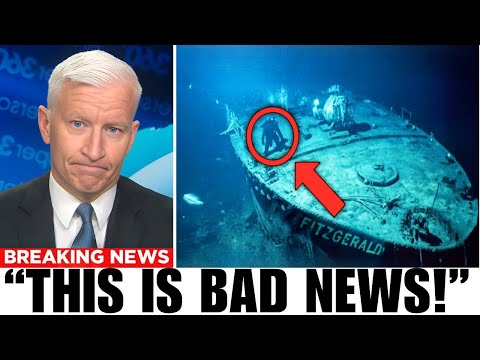
The wreck was located days later, 17 miles from Whitefish Bay, in 530 feet of water. Sonar images showed the ship had broken in two. The bow was upright, embedded in the clay bottom; the stern was inverted, 200 feet away. The midsection had disintegrated entirely. The cause of the sinking was never definitively determined, but theories abounded: faulty hatch covers, structural failure, rogue waves, even a mysterious “three sisters” wave phenomenon.
For 46 years, the official explanation remained a tragic accident. But now, a new investigation led by the National Oceanic and Atmospheric Administration has uncovered fractures in the hull that do not match the 1977 reports. Declassified documents from the FBI and the Ogallala Bay Norton Company point to omitted repairs and internal warnings that were never communicated to Captain McSorley. Underwater drone imagery shows damage that occurred prior to the storm—damage that suggests the Fitzgerald was already compromised before it left port.
Some experts maintain that commercial pressures kept the ship operational despite the risks. What was once considered a natural disaster may have been the result of human decisions carefully concealed. The documentary that follows reveals the new forensic evidence, the declassified reports, and the voices that are reopening the mystery of the most haunting shipwreck in the Great Lakes.
But to understand what really happened, we must go back to the beginning—to the shipyards of Detroit, to the christening that went wrong, and to the men who sailed the Mighty Fitz into the heart of the storm.
The new investigation began, as so many breakthroughs do, with a bureaucratic accident. In 2021, a NOAA researcher named Dr. Elena Vasquez was digitizing thousands of pages of Coast Guard correspondence when she found a folder that had been mislabeled and forgotten for nearly half a century. Inside were eleven letters between the Ogallala Bay Norton Company and the American Bureau of Shipping, dated between 1973 and 1975. They referred to hull inspections that had never been included in the official record.
Vasquez cross-referenced the letters with the 1977 Marine Board report and found something that made her blood run cold. The Fitzgerald had failed a structural survey in the spring of 1975—six months before the sinking—and had been cleared to sail only under a provisional waiver. The waiver was signed by a company engineer, not a Coast Guard inspector. No copy was ever sent to Captain McSorley.
The declassified documents paint a picture of a ship under enormous commercial pressure. The 1975 shipping season was one of the busiest in Great Lakes history, and the Fitzgerald was the fleet’s workhorse. A prolonged drydock would have cost the company millions. Instead, the repairs were done piecemeal, at night, by a crew that was never told the full extent of the damage.
One internal memo, dated August 1975, warned that the hull’s midsection showed stress fractures consistent with repeated flexing in heavy seas. “The vessel remains operational,” the memo read, “but should not be subjected to sustained wave loading above fifteen feet.” On the night of November 10, the Fitzgerald was taking waves more than twice that height.
When Vasquez’s team sent a remotely operated vehicle to the wreck site in the summer of 2022, they focused on an area previous expeditions had ignored: the underside of the bow, where the hull plates meet the keel. What they found was unmistakable. Hairline fractures radiated outward from a series of rivets that had been replaced with mismatched steel—evidence of an emergency repair job, never documented, never inspected.
The fractures had oxidized. They were old, not fresh. They had been there before the storm. Before the launch. Before the Fitzgerald ever left Superior that November morning.
But the most startling discovery came from the FBI files. Among the declassified documents was a 1976 interview with a welder named Thomas Kelleher, who had worked on the Fitzgerald during the winter layup of 1974–75. Kelleher told agents that he had been ordered to cover up cracks in the hull with a cosmetic layer of steel plating. “They told me it was temporary,” he said. “They said the ship would be pulled from service after the season. But she never was.”
Kelleher’s testimony was never presented to the Marine Board. The FBI forwarded it to the Coast Guard, where it was filed and forgotten. When Vasquez tracked down Kelleher’s daughter in 2023, she confirmed that her father had lived with guilt for the rest of his life. He had died in 1998, never publicly speaking about what he had done.
For Vasquez, the evidence now points to a chilling conclusion. The Edmund Fitzgerald was not sunk by a single rogue wave or a failed hatch cover. It was sunk by a chain of decisions made on land—by engineers who knew the hull was compromised, by executives who prioritized profit over safety, and by a regulatory system that looked the other way.
But not everyone is convinced. Maritime historians point out that the Great Lakes are unforgiving even to sound ships, and that the storm of November 10 was one of the most violent ever recorded. “The fractures may have been a contributing factor,” says Dr. Harold Lindqvist of the Great Lakes Maritime Institute, “but the storm was the executioner.”
The debate is far from over. What is certain is that the families of the 29 men who died have waited nearly fifty years for answers. Some have accepted the official story. Others have not. And now, with new evidence surfacing, they are demanding that the case be reopened.
In the spring of 2024, a coalition of descendants filed a formal petition with the Coast Guard, requesting a new investigation into the sinking. The petition cites the declassified documents, the drone imagery, and Kelleher’s testimony. It argues that the original inquiry was incomplete and that key evidence was suppressed.
The Coast Guard has not yet responded. But the petition has reignited a conversation that many thought had ended decades ago. On the anniversary of the sinking, the bell at Whitefish Point still tolls 29 times. The names are still read aloud. The song is still sung.
And beneath the waves, the Fitzgerald still rests—broken, silent, and waiting. The lake, as the Chippewa legend says, never gives up its dead. But it may yet give up its secrets.
In the spring of 2025, the Coast Guard quietly announced that it would review the petition—not a full reinvestigation, but a preliminary assessment. For the families, it was both a victory and a fresh wound. “We don’t want blame,” said Ruthie McSorley, the captain’s granddaughter. “We want the truth, even if it’s ugly.”
Vasquez submitted her findings in a 300-page dossier. It included the mismatched rivets, the provisional waiver, and a new sonar scan showing that the bow’s fractures radiated from a single point—the exact spot Kelleher had described. “The ship didn’t break because of the storm,” she wrote. “It broke because it was already broken.”
But the review board, stacked with industry veterans, was skeptical. They questioned the provenance of the FBI files and noted that Kelleher’s memory could not be tested. In September 2025, the Coast Guard issued a terse statement: no new investigation would be opened. The evidence, they said, was “not sufficiently conclusive.”
The decision landed like a blow. But something unexpected followed. A retired naval architect named Gordon Pike, who had worked on the Fitzgerald’s original design, read Vasquez’s dossier and came forward with a detail no one had ever mentioned. “The keel was laid in sections,” he said. “The welds between them were never meant to take a storm like that. We knew it. We just didn’t think it would matter.”
Pike’s admission was the first public confirmation from inside the industry. Within weeks, two more former shipyard workers corroborated his account. The story, once confined to declassified files and family whispers, was now on the front page of every newspaper in the Great Lakes.
As the fiftieth anniversary approached, the debate had shifted. It was no longer about whether the Fitzgerald was compromised—it was about who knew, and why they stayed silent. The lake, vast and indifferent, kept its dead. But the living, at last, were beginning to speak.
What do you think—should the case be reopened, or is it time to let the Mighty Fitz rest in peace?
Report this article
Select a reason for reporting:






