In 1962, the Vatican called Elizabeth Taylor a woman of ‘erotic vagrancy’ and demanded her children be taken away. Her crime? Falling for the wrong co-star on the wrong movie set. But Taylor wasn’t an outlier—she was the most visible example of something that had been happening behind closed studio doors for decades.
The Golden Age of Hollywood ran on two kinds of chemistry: the kind the cameras caught and the kind they weren’t supposed to. These are the 14 women who blurred that line—women who were married when they fell for their co-stars, whose affairs rewrote careers, destroyed families, and in one case nearly brought down an entire film studio.
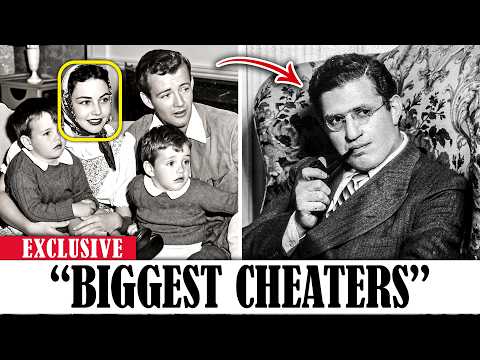
Behind the glittering premieres and perfectly staged photo ops, a different kind of drama unfolded—one that studio bosses desperately tried to control. Morality clauses in contracts hung over every star like a guillotine, ready to drop the moment an affair became public. But when the star was making the studio money, those clauses were conveniently forgotten. When the star stopped being profitable, they suddenly mattered.
This is the story of the women who navigated that treacherous terrain, who risked everything for passion, and who, in doing so, exposed the hypocrisy of an industry built on illusion. From Hedy Lamarr’s restless heart to Ingrid Bergman’s national scandal, from Bette Davis’s volcanic romances to Ava Gardner’s defiant independence, their stories reveal that the most captivating performances often happened off-screen.
Consider Hedy Lamarr, the Austrian beauty once called the most beautiful woman in the world. In 1940, just a year into her marriage to producer Jean Markey, she was paired with Clark Gable for Boom Town. The attraction was immediate and intense, despite Gable’s recent marriage to Carole Lombard and Lamarr’s own marital status. The affair burned out quickly, but it set a pattern. Over six marriages and countless rumored relationships—with everyone from Spencer Tracy to Charlie Chaplin—Lamarr proved that the woman who co-invented frequency-hopping technology was just as restless in love as she was in science.
Then there was Marlene Dietrich, who stayed married to Rudolf Sieber for 53 years but lived with him for only five. The rest of the time, she was otherwise engaged. On the set of Morocco in 1930, she began an affair with Gary Cooper, who was already involved with Mexican actress Lupe Velez—who reportedly threatened to tear Dietrich’s eyes out. Dietrich was unbothered. Over the next four decades, her list of co-star conquests grew to include John Wayne, Yul Brynner, and Jimmy Stewart, as well as relationships with women, including her Shanghai Express co-star Anna May Wong. Her FBI file, released years later, confirmed the scope of her personal life in clinical detail. Dietrich called Sieber the perfect husband. Given the arrangement, he probably had to be.
Bette Davis, already a two-time Oscar winner, walked onto the set of All About Eve in 1950 and met Gary Merrill. Whatever happened between takes carried over into real life. Davis divorced her husband William Grant Sherry the same year the film was released and married Merrill within weeks. She later admitted the affair began on set, telling an interviewer, “I was not noble. I fell in love.” The marriage lasted ten years, longer than most of Davis’s other relationships, but ended with the same volcanic intensity that marked everything she touched.
Gloria Swanson’s affair with Joseph P. Kennedy was, in her words, an open secret in Hollywood. Kennedy became her producer, her business manager, and her lover, all while his wife Rose was back in Massachusetts raising their children. The affair lasted three years and ended with Kennedy moving on to politics and Swanson discovering something devastating: every extravagant gift Kennedy had supposedly given her—the jewelry, the furs, the trips—had been charged to her own accounts. He’d bankrupted her production company in the process. Swanson had given up a royal title for a man who billed her for his own gifts.
Jennifer Jones won the Academy Award for Best Actress in 1944 for playing a Catholic saint in The Song of Bernadette. The American public saw her as the picture of virtue. What they didn’t know was that the man who had handpicked her for the role, legendary producer David O. Selznick, was also the man she was sleeping with. Jones was married to actor Robert Walker at the time, and Selznick was married to Irene Mayer Selznick, the daughter of MGM chief Louis B. Mayer. The stakes for both families were enormous. Walker, meanwhile, unraveled—drinking heavily, getting arrested multiple times, and eventually dying at age 32 from an adverse reaction to a sedative. Jones never publicly addressed what the affair had cost her first husband.
Lana Turner was married eight times to seven men, but the two affairs that mattered most both involved co-stars. The first was Clark Gable. According to Robert Matzen’s book Fireball, the affair was serious enough that Gable’s wife Carole Lombard took a specific faster plane home from a war bond tour to confront the situation. It was that plane—TWA Flight 3—that crashed into a mountain outside Las Vegas on January 16th, 1942, killing Lombard and 21 others. Matzen’s theory is that Lombard’s urgency to get home, driven by rumors about Turner, put her on the flight that ended her life. Turner’s other major co-star affair was with Tyrone Power. She got pregnant, but Power was married to actress Annabella, and the studio forced Turner to have an abortion to avoid a scandal. She later said he was the love of her life.
These are just the first few of the 14 women whose stories we’ll explore—women who loved recklessly, paid dearly, and left behind a legacy that continues to fascinate us today.
Ava Gardner married Frank Sinatra in 1951, and their relationship was volcanic from the first day. Sinatra had left his wife Nancy and their three children to be with Gardner, and the guilt and jealousy ate at both of them for years. But Gardner had her own secrets. While still legally married to Sinatra, she had an affair with her married co-star George C. Scott during the filming of The Barefoot Contessa in 1954.
Scott was intense, possessive, and prone to violence, and the relationship was as destructive as the one she was already in. At one point Gardner was pregnant by Sinatra but had the pregnancy terminated—reportedly because MGM had strict policies against their female stars becoming mothers, and Gardner had no job security without the studio’s protection.
Gardner and Sinatra officially separated in 1953, though they didn’t finalize the divorce until 1957. She moved to Spain, took up with a bullfighter, and spent the rest of her life living by the rule she’d established in Hollywood: if someone was going to get hurt, she’d rather it be everyone equally. When Gardner died in 1990 at age 67, five different men each reportedly believed they were the most important person in her life. The fact that none of them could agree tells you everything about how Ava Gardner loved.
Vivien Leigh committed the same sin twice—once as the betrayer and once as the betrayed. In 1937, Leigh was a young stage actress married to barrister Herbert Leigh Holman with a small daughter at home. Then she saw Laurence Olivier perform on stage and reportedly told a friend, “That is the man I am going to marry.” The fact that Olivier was also married to actress Jill Esmond didn’t slow her down.
When they were cast together in Fire Over England, the attraction became physical and the affair began in earnest. Both abandoned their spouses and their children to be together. Leigh left her daughter Suzanne behind. Olivier left his pregnant wife. They married in 1940 and became the most glamorous couple in the English-speaking world—knighted, holding court at Notley Abbey, hosting the most coveted dinner parties in England. To the public, they were the gold standard of a Hollywood marriage.
The private reality was already starting to fray. Leigh suffered from severe manic depression long before the condition was treatable. During her episodes, she became volatile and sexually reckless. She began a long affair with actor Peter Finch—a young Australian talent Olivier himself had discovered and brought to London on a personal contract. The betrayal had a particular sting. Olivier had created Finch’s career, and now Finch was in his wife’s bed.
At one point, Leigh tried to leave Olivier and fly to be with Finch, but a London fog grounded her plane and Olivier got to the airport in time to stop her. That story almost exactly became the plot of the 1963 film The V.I.P.s. Leigh and Olivier divorced in 1960 after 20 years. She died seven years later at 53.
Joan Crawford’s affair with Clark Gable lasted, by her own estimate, nearly 30 years. “We had an affair, a glorious affair, and it lasted longer than anybody knows,” she said in 1968, eight years after Gable’s death. Writer Adela Rogers St. Johns called it the affair that nearly burned Hollywood down.
It started in 1931 on the set of Dance, Fools, Dance. Crawford was married to Hollywood royalty Douglas Fairbanks Jr. Gable was about to marry his second wife, Rhea Langham. They had almost nothing in common with their spouses and almost everything in common with each other. Both had clawed their way out of poverty. Both were undereducated and insecure. Both found in the other someone who understood the performance required to stay on top.
The affair quickly became one of the worst-kept secrets at MGM. They rendezvoused in Crawford’s dressing room trailer on the studio lot—a gift from her husband, which made the whole arrangement even more uncomfortable. Fairbanks later described learning about the affair from mutual friends who sat him down and told him, “Your wife is having an affair with Clark Gable.” He said he was the last to know.
Studio head Louis B. Mayer was furious and threatened to cancel both their contracts if the affair didn’t stop. He pulled Gable from Crawford’s next film and replaced him with Robert Montgomery, then forced Gable to appear in public with his wife to quiet the rumors. For a while, the pressure worked and the affair went underground—but it never stopped. Crawford and Gable made eight films together over the next decade.
When Gable’s third wife, Carole Lombard, died in the 1942 plane crash, it was Crawford who helped him through the grief. Bette Davis, Crawford’s lifelong rival, once cracked that Crawford had slept with every male star at MGM except Lassie. Crawford never denied it, but she only ever spoke about Gable with tenderness.
Rita Hayworth was married five times, and every single marriage ended in divorce—but the longest relationship of her life outlasted them all. A decades-long, on-and-off affair with her co-star Glenn Ford began on the set of Gilda in 1946, and their off-screen chemistry mirrored their on-screen passion almost exactly: turbulent, electric, and impossible to walk away from.
The affair ran across multiple marriages on both sides. When Hayworth was married to Orson Welles, Ford was waiting. When she married Prince Aly Khan and moved to Europe, Ford married Eleanor Powell. When Hayworth came back, the affair picked right back up. Ford later called her the love of his life. She never said the same publicly, but she kept coming back—and for Hayworth, that was the strongest statement she could make.
Mary Astor’s diary scandal in 1936 pushed Hitler and Franco off the front page. Her affair with playwright George S. Kaufman, detailed in those pages, sparked a custody trial so graphic that every major studio head met to beg her to drop it before it destroyed the industry’s reputation. She refused. The judge ordered the diary incinerated, but Astor won custody of her daughter and went on to make 109 films. The public already knew she could keep a secret—they’d read about it on the front page.
Ingrid Bergman had played a nun and a saint. So when she had a baby with director Roberto Rossellini while still married to Swedish neurosurgeon Petter Lindstrom, the reaction wasn’t disappointment—it was a national emergency. Senator Edwin Johnson called her “a powerful influence for evil.” She was effectively banned from Hollywood. Her marriage to Rossellini lasted seven years before he did the same thing to her that they had done together, starting an affair with an Indian screenwriter. Bergman returned in 1956 with Anastasia, won her second Oscar, and slowly rebuilt everything she’d lost—but she didn’t see her daughter Pia for seven years, and that separation marked them both for life.
And then there was Elizabeth Taylor. In 1962, she was the highest-paid actress in the world, earning $1 million for Cleopatra. She was married to Eddie Fisher, whom she’d taken from Debbie Reynolds just four years earlier. Then she met Richard Burton. They were both married, both heavy drinkers, and both completely incapable of staying away from each other. The Vatican condemned her in an open letter, charging her with “erotic vagrancy” and calling her an insult to the nobility of the hearth. Taylor said the attack made her vomit.
Cleopatra cost over $44 million—roughly $400 million today—and nearly bankrupted 20th Century Fox. The only reason it made any money at all was because the public couldn’t stay away from the real love story happening behind the scenes. Taylor divorced Fisher in March 1964. Nine days later, she married Burton. They divorced in 1974, remarried in 1975, and divorced again in 1976. Two marriages, two divorces, and a connection neither of them could explain or escape.
Taylor later said, “I couldn’t help loving him. It was a fact.” Burton once described her as an eternal one-night stand. The Vatican eventually moved on. Hollywood eventually stopped pretending that morality clauses meant anything. And the woman who played Cleopatra proved that the queen’s real power was never on a throne—it was in her willingness to let an empire burn for the person standing next to her.
Which of these 14 women do you think paid the highest price for loving the wrong co-star—and would you have made the same choice? Let us know in the comments.
Report this article
Select a reason for reporting:






