The desert sky cracked open with the roar of twin Snecma M88 engines. A flight of Dassault Rafales, their delta wings slicing through the haze, streaked toward a target deep inside hostile territory. This was no exercise. It was 2011, and the Rafale was about to prove to the world that France’s most ambitious fighter jet was not just a technological marvel—it was a lethal weapon of war.
But the road to that moment was anything but smooth. For decades, the Rafale had been the subject of skepticism, budget battles, and political controversy. Yet here it was, leading NATO’s charge over Libya, its omnirole capabilities silencing every critic.
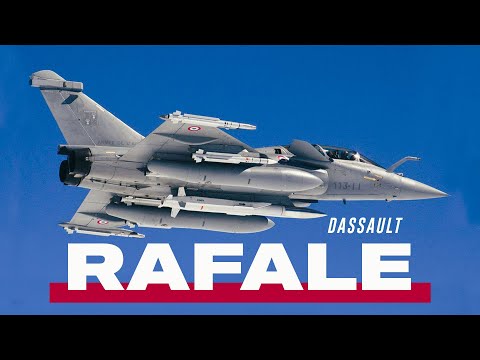
The story of the Rafale begins in the late 1970s, when France faced a stark reality: its aging fleet of Mirage and Jaguar fighters was becoming obsolete. The country needed a new aircraft, one that could do everything—air superiority, ground attack, reconnaissance, even nuclear deterrence. But France’s vision clashed with its European partners.
In 1985, France pulled out of the multinational European Fighter Aircraft program, rejecting the air-superiority focus of the UK, Germany, Italy, and Spain. Instead, Paris demanded a true omnirole platform. “We will build our own,” French officials declared, and the ACX program was born.
The Rafale A demonstrator took to the skies on July 4, 1986, powered by American General Electric F404 engines due to delays with the indigenous M88. It was a humbling start for a project meant to showcase French independence. But the flight test program, spanning eight years, validated the radical canard delta-wing design—an aerodynamically unstable configuration that promised incredible agility.
Behind the scenes, engineers battled budget cuts and technical setbacks. The M88 engine, designed for supercruise and fuel efficiency, faced repeated delays. Critics called the Rafale a boondoggle. Yet France pressed on, driven by an unwavering belief in strategic autonomy.
By the early 2000s, the first production Rafales were finally delivered. The naval variant, the Rafale M, entered service in 2000, followed by the Air Force’s F2 standard in 2007. France had its omnirole fighter—but the real test would come in combat.
Afghanistan was the Rafale’s first taste of war. In 2007, French Air Force Rafales began conducting close air support and precision strikes against Taliban insurgents. Operating from land bases and the carrier Charles de Gaulle, the aircraft flew hundreds of missions, proving its endurance and versatility in a harsh, unforgiving theater.
Then came Libya. In 2011, during Operation Harmattan, Rafales spearheaded NATO’s intervention. They executed deep strikes, precision bombing, and air superiority patrols, crippling Gaddafi’s military infrastructure. Despite advanced surface-to-air missile threats, not a single Rafale was lost. Its Spectra electronic warfare suite, a self-protection system that jammed and deceived enemy radars, proved its worth.
The Rafale’s combat resume grew: Mali in 2013, Iraq and Syria from 2014 onward. In each conflict, the aircraft demonstrated its ability to switch seamlessly between reconnaissance, air interdiction, and ground attack—all in a single sortie. The omnirole concept was no longer a theory; it was a battlefield reality.
But the Rafale’s greatest triumph would come not in war, but in the global arms market. For years, it had been overlooked in favor of American and consortium-built fighters. Then, in 2015, Egypt ordered 24 Rafales. Qatar followed with 36. India, after a tortuous tender process, signed for 36 in 2016, with deliveries beginning in 2019. Greece, Croatia, Indonesia, and the UAE—with a record 80-aircraft order—soon joined the list.
The Rafale had become a symbol of French export success and strategic influence. Its appeal was clear: a combat-proven, highly versatile platform with fewer geopolitical strings than American hardware.
Today, the Rafale continues to evolve. The F4 standard brings enhanced connectivity, new weapons like the 1,000 kg AASM smart bomb, and improved sensor fusion. Upgrades are already planned for the F4.2 and beyond, ensuring the aircraft remains lethal in the face of evolving threats.
From the drawing boards of Dassault to the skies over Libya, the Rafale’s journey is a testament to French engineering and determination. But its story is far from over.
The Rafale’s combat debut in Afghanistan had been a cautious affair—careful strikes, limited exposure, a platform still proving itself. Libya changed everything. French pilots flew with a confidence that bordered on arrogance, and the aircraft rewarded them at every turn.
But it was the export market that transformed the Rafale from a national asset into a geopolitical instrument. When Egypt signed in 2015, it wasn’t just buying aircraft—it was buying a relationship with Paris that didn’t come with Washington’s conditions. Qatar, India, Greece, Croatia, Indonesia, and the UAE followed, each deal reinforcing France’s position as an alternative arms supplier in a multipolar world.
The Indian contract was particularly significant. After years of negotiations, cancellations, and political wrangling, the 2016 government-to-government deal for 36 Rafales was a shot in the arm for Dassault. Deliveries began in 2019, and by 2022, all 36 were in Indian hands. The Indian Air Force wasted no time integrating them into frontline squadrons, deploying them to high-altitude bases near the Chinese border.
Then came Operation Sindoor. In the tense airspace along the Line of Control, Indian Rafales conducted precision strikes against militant infrastructure—marking the aircraft’s first combat use in the region. The mission was a resounding success, and New Delhi’s appetite only grew. By 2023, the Indian Navy had ordered 26 Rafale Ms for its carriers, and the Air Force was pushing for 40 more.
Meanwhile, the Rafale’s European footprint expanded. Greece, facing escalating tensions with Turkey, ordered 18 aircraft—six new, twelve from French stocks—and later added six more. Croatia picked up 12 secondhand Rafales to replace its aging MiG-21s, a cost-effective upgrade that gave Zagreb a fighter far more capable than anything in its neighborhood.
Indonesia’s order for 42 Rafales signaled France’s growing influence in the Indo-Pacific, a region where great power competition was intensifying. And then came the UAE deal—80 Rafale F4s, the largest single order in the aircraft’s history. Abu Dhabi wasn’t just buying a fighter; it was buying strategic autonomy from Washington.
Back in France, the Rafale continued to evolve. The F4.1 standard, qualified in March 2023, brought new sensor functionalities and improved collaborative combat capabilities. The F4.2 standard, already in development, promised advanced infrared optics for night identification and enhanced connectivity for networked operations.
But the real test of the Rafale’s future lies in the next generation of air combat. France, Germany, and Spain are developing the Future Combat Air System, a sixth-generation fighter that will eventually replace the Rafale. Until then, the Rafale remains the backbone of French air power—and a growing number of allied air forces.
From the skepticism of the 1990s to the battlefields of Libya and the export triumph of the 2020s, the Rafale has defied its critics at every turn. It is not the fastest, nor the stealthiest, nor the cheapest fighter in the sky. But it is perhaps the most adaptable—a true omnirole machine that has proven its worth in war, peace, and the unforgiving marketplace of global defense.
Yet the Rafale’s story is not merely one of contracts and combat sorties. It is also a story of industrial strategy, of how a mid-sized European nation refused to surrender its aerospace sovereignty. Every Rafale that rolls off the Dassault assembly line in Mérignac carries with it a message: France still builds its own warplanes, on its own terms, for its own reasons.
That message resonates far beyond Paris. In an era when fifth-generation fighters come with lengthy political preconditions and decades-long maintenance dependencies, the Rafale offers something different—a proven, upgradeable platform with a clear roadmap and a supplier willing to share technology. The UAE deal included provisions for local maintenance and training. India’s contract carried offsets and industrial partnerships. Egypt’s repeat orders came with satellite and munitions packages.
This is the quiet genius of the Rafale program: it was never just an aircraft. It was a diplomatic tool, an industrial engine, and a statement of intent—all wrapped in a canard delta wing.
But no weapon system exists in a vacuum. The Rafale’s future will be shaped by forces far larger than Dassault’s boardroom. Europe’s defense landscape is shifting. The war in Ukraine has exposed critical gaps in Western ammunition stockpiles and production capacity. NATO members are under pressure to spend more and buy smarter. And the sixth-generation Future Combat Air System, still in its early phases, remains years—perhaps decades—from operational readiness.
In the meantime, the Rafale must bridge the gap. France’s 2024–2030 military planning law earmarks billions for Rafale upgrades and additional orders, ensuring the fleet remains viable well into the 2030s. The F4.2 standard, with its advanced infrared search-and-track optics and improved networking, is already being tested. A future F5 standard is on the drawing board, promising integration with unmanned combat aerial vehicles and enhanced electronic warfare capabilities.
The Rafale is being asked to do something rare in military aviation: remain relevant across two generations of air combat.
That means competing not just with today’s threats—advanced Russian SAM systems, Chinese long-range missiles, drone swarms—but with tomorrow’s. It means flying alongside stealthier platforms, acting as a networked sensor node as much as a strike fighter. It means carrying weapons that don’t yet exist against adversaries that haven’t yet been identified.
For now, the Rafale continues to patrol the skies it knows best. French Rafales rotate through Baltic air policing missions, their presence a visible reassurance to NATO’s eastern flank. They fly from the Charles de Gaulle in the Mediterranean, projecting power from the sea. They train with allies in exercises from Djibouti to the Pacific, their crews refining tactics that will be passed to partner nations.
And in hangars from Cairo to New Delhi, from Zagreb to Abu Dhabi, mechanics and pilots are learning the Rafale’s rhythms—its quirks, its strengths, its demands. Each new operator adds a chapter to the aircraft’s story, a story that began with a defiant French decision in 1985 and shows no sign of ending.
As the sun sets over the Mérignac assembly line, the next Rafale rolls out—its grey fuselage gleaming under floodlights. For the workers who built it, this is more than a job; it’s a piece of national identity. They’ve seen the mockery, the budget cuts, the doubt. And they’ve seen the aircraft come back from Libya, Mali, and the UAE with stories of survival and success.
But the true measure of the Rafale won’t be found in contracts or kill ratios. It will be in the quiet moments: a pilot trusting the fly-by-wire system in a dogfight, a maintenance crew troubleshooting a sensor at dawn, a nation deciding that sovereignty is worth the cost.
“The Rafale is not just a fighter,” one Dassault engineer once said. “It’s proof that France can still surprise the world.”
That surprise may be needed more than ever. As sixth-generation fighters loom and drone swarms darken the horizon, the Rafale must adapt or fade. The F5 standard, with its unmanned teaming and advanced electronic warfare, is already taking shape. But will it be enough?
For now, the Rafale flies on—a canard delta silhouette against a changing sky. Its story is written in contracts, combat, and the stubborn will of a nation that refused to buy off the shelf.
What do you think—has the Rafale truly earned its place among the great fighters of the 21st century, or is its best yet to come?
Report this article
Select a reason for reporting:






