In the fetid swamps of New Guinea, a young American soldier crouched in waist-deep mud, his hands trembling not from fear but from malaria. Around him, the jungle echoed with the taunts of invisible enemies—the clack-clack of Nambu machine guns that spat death from hidden bunkers. This was Buna, a green hell that had swallowed the pride of the US 32nd Infantry Division. For General Douglas MacArthur, these coastal villages were not just strategic points; they were the stage on which his shattered reputation would either be redeemed or destroyed forever.
MacArthur, humiliated by his retreat from the Philippines, had promised Washington a decisive victory. But the men he sent into the jungle—National Guard troops from Michigan and Wisconsin—were clerks and farmers, not jungle fighters. Their wool uniforms rotted on their backs, their rations spoiled in the heat, and their tactics, designed for European battlefields, proved suicidal against an enemy who had turned the swamp into an impenetrable fortress.
“Bob, I’m putting you in command at Buna. I want you to remove all officers who won’t fight. If you don’t take Buna, I don’t want you to come back alive.” Those words, delivered by MacArthur to Major General Robert Eichelberger, hung in the humid air like a death sentence. The 32nd Division was bleeding out, not just from Japanese bullets but from the jungle itself—malaria, dengue fever, and a creeping despair that threatened to annihilate them all.
As American bodies piled up in the mud, a new force arrived—bronzed, hardened, and utterly out of place in the claustrophobic rainforest. These were the men of the Australian 7th Division, the legendary “desert rats” who had battled Rommel across North Africa. They looked at the bedraggled Americans with a mix of pity and professional disdain. To the Aussies, these Yanks were overpaid, overfed, and dangerously green. But they were also allies in desperate need.
The Australians brought more than just experience; they brought a philosophy. Where the Americans relied on brute force, the Australians treated the jungle as a chessboard. They moved in small, silent patrols, probing for weaknesses, and using their Bren gun carriers as mobile shields to draw enemy fire. “The jungle doesn’t care about rank or reputation,” one Australian sergeant muttered. “It only cares about who adapts first.”
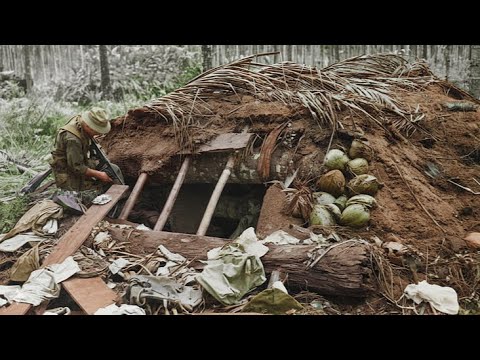
Watching from the sidelines, the Americans began to shed their paralysis. They learned to stalk, to listen, to survive. But the true turning point came when the Australians launched their first assault on the Japanese bunkers—a brutal, close-quarters slaughter that turned the swamp into a crimson graveyard. The Americans watched in awe as the diggers crawled through mud, tossed grenades into firing slits, and fought hand-to-hand in the darkness. For the first time, the Japanese were not ghosts but mortal men.
Yet even as the tide began to turn, a bitter truth emerged: the victory at Buna would be bought with the blood of both nations. And for the men who survived, the green hell would never truly let them go.
The final Japanese bunker fell on January 22, 1943. There were no victory parades—only the hollow-eyed survivors stumbling out of the mangrove, their bodies wasted by malaria and their minds scarred by weeks of primal combat. The US 32nd Division had entered with roughly 10,000 men; its frontline infantry regiments suffered over 90 percent casualties. The Australian 7th Division lost more than 2,000 of its finest veterans in the brutal bunker-to-bunker fighting.
Eichelberger, the general who had been told not to come back alive, returned with a heavy heart and a startling admission. “Without the Australians, the American effort at Buna would have ended in a humiliating retreat,” he later confessed. He called the Australian soldier “pound-for-pound perhaps the finest infantryman in the world”—words that stung MacArthur’s pride but were recorded in the quiet honesty of military circles.
The cost was staggering. Soldiers who had been promised garrison duty found themselves burning out bunkers with flamethrowers and fighting with bayonets in the dark. Malaria would haunt them for decades. Combat exhaustion—what we now call PTSD—was rampant. The green hell didn’t just take their friends; it took their peace of mind.
Yet from that blood-soaked mud, a new doctrine was born. MacArthur’s command finally abandoned suicidal frontal charges and embraced the Australian way of jungle warfare—small-unit stalking, aggressive patrolling, and the island-hopping strategy that would carry the Allies to Tokyo. Buna-Gona became the forge where the Pacific Alliance was tempered, a partnership born of shared trauma and mutual respect.
The mud eventually dried, but the lessons of humility, cooperation, and the true cost of command remain. The men who grew up in the green hell did so that those who followed would not have to repeat their mistakes.
So we ask you, reader: when the history books celebrate the glory of victory, should they not also honor the quiet sacrifice of those who were misunderstood, misled, and yet still fought?
Report this article
Select a reason for reporting:






