In the early months of the Pacific War, the PBY Catalina was a death sentence. Slow, unarmored, and enormous, it was shot out of the sky in droves. Patrol Wing 10 lost 41 of 44 Catalinas in just 90 days—the worst attrition rate of any American aircraft type. The Navy was ready to write it off entirely.
But then, something extraordinary happened. Eighteen months later, a single squadron of the same aircraft, painted matte black and flying at night, destroyed 103,500 tons of Japanese shipping in one month. September 1944. The highest one-month total of any American flying unit in the entire war. The aircraft hadn’t changed. Nothing about the Catalina was faster, tougher, or better armed. What changed was when it flew—and what happened to the men on the other end when the engines went quiet.
After August 1942, the Cactus Air Force owned the daylight sky over Guadalcanal. Wildcats and Dauntlesses made Japanese surface resupply suicidal between dawn and dusk. So Admiral Yamamoto found a different clock. Fast destroyers—the Tokyo Express—ran 30 knots down the narrow channel the Marines called the Slot, rolling drums of rice and ammunition into the sea for barge retrieval before sunrise. US surface ships, PT boats, and conventional carrier aircraft could not consistently catch convoys moving that fast through narrow waters in tropical darkness. The night corridor stayed open, and the aircraft that should have closed it was dying in daylight.
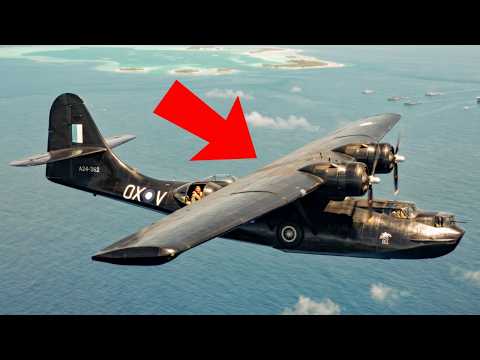
The Catalina was too slow to outrun a fighter, too big to hide, too lightly armed to fight back. By mid-1942, the Navy was writing it off as a daylight liability. Commander Clarence Taff, VP-12, watched those losses pile up and understood something the procurement boards had missed. The PBY’s fatal weaknesses—117 mph cruise speed, 104-ft wingspan, no armor, no self-sealing tanks—were only fatal in sunlight. Turn the lights off and every one of those liabilities inverted.
On December 14, 1942, Commander C. E. Coe authorized a new designation. The next evening, Taff’s VP-12 landed six PBY-5As at Henderson Field, Guadalcanal—the first officially designated Black Cat Squadron. The national insignia had been painted over. The exhaust stacks wore flame dampers. The wings still smelled of lamp black and soap. The crude matte coating that erased the aircraft from the night sky.
What made the Black Cat lethal was not one modification, but the combination. ASB air-to-surface vessel radar could detect a ship’s wake at 50 to 60 miles. The Cat found the convoy long before the convoy knew it existed. “We could pick up ships 50 to 60 miles away and then hone in on them,” said Cash Barber, flight engineer with VP-11. “We could see their wake in the water with all the beautiful colors and they couldn’t see us.”
That cruise speed—117 mph, absurdly slow for 1943—became precision at masthead height. The Cat could place four 500-lb bombs with 5-second delay fuses from 50 to 150 feet. A faster aircraft overshot. The Cat delivered. Radar altimeters held the approach at 50 feet for the last 100 miles, ducking under Japanese search radar. And the range—2,500 miles—meant deep penetration. Twelve hours of loiter time over a convoy choke point. No other Allied aircraft could wait that long.
In daylight, every one of those numbers was a death sentence. At night, the same aircraft became something else entirely. A ghost with radar eyes, invisible paint, silent engines, and the patience to sit over a strait all night for a convoy that had to come through.
The PBY did not change. The war around it did. The squadron insignia of VP-12, painted after the first mission, was a simple cat outline. After the second mission, they added eyes. After the third, teeth and whiskers. After the fourth, as naval historian Samuel Eliot Morison records, anatomical insignia of a more personal nature. What those next missions looked like earns the anatomy.
Taff’s six PBY-5As launched from Henderson Field around 22:30 each night. They flew standardized search patterns up the Slot and through Indispensable Strait. Three hours outbound hunting by radar, returning at daybreak. 236 missions, 1,660 hours, five or six aircraft. The doctrine crystallized here: locate by radar, close to visual at masthead height, hold all fire until bombs away, drop a parachute flare with the salvo to blind the gunners, then vanish. The waist gunners held their triggers because the first muzzle flash would kill the darkness that kept them alive.
The silence after throttling back to glide. The flare bursting white over a Japanese destroyer’s wake. The 5-second delay before the bombs turned the waterline orange. Mission by mission, the insignia grew because the doctrine worked.
By 1943, the Black Cats became the eyes for a coordinated kill chain. The Cat found the convoy by radar, dropped parachute flares—216,000 candlepower, a magnesium candle lighting several miles of ocean—and PT boats or B-25 strafers made the kill. That was the Japanese convoy commander’s nightmare distilled to its purest form. Fire at the Cat overhead and mark the convoy’s exact position for the follow-on strike. Stay dark and accept the bombs blind. Both options were losing moves.
Japanese sailors knew the sequence. Per veteran accounts recorded by the Warfare History Network, they were in for it when they heard a PBY’s engine noises, and then those noises suddenly cut off. The droning engines cutting to silence. Then the magnesium candle igniting overhead, turning night into noon.
VP-54 at Guadalcanal pushed the concept further, field-fitting twin fixed 20-mm cannon in the nose for barge strafing runs after the flares went down. The defining moment came on February 15, 1944, over Kavieng Harbor, New Ireland. Lieutenant Junior Grade Nathan Green Gordon, VP-34, was on Dumbo rescue station, supporting a Fifth Air Force A-20 and B-25 strike when aircraft started going into the water. Gordon made four open-sea landings in 16-to-18-foot swells under direct fire from Japanese shore guns. One landing put his Catalina 600 yards from the beach. He flew out 15 rescued aircrew in an overloaded flying boat that should not have been able to take off. Every member of his eight-man crew received the Silver Star. Gordon received the Medal of Honor—the only one ever earned in a PBY.
The tactical logic was hiding in the physics. The PBY’s slow speed, its greatest daylight liability, was exactly why Gordon could land in heavy swells where a faster aircraft would have broken apart on impact. The same quality that made the Catalina a sitting duck made it the only aircraft in the theater that could stop on open water and bring men home.
The Japanese adapted. Night fighter cover appeared over convoys—J1N1 Irvings and twin-engine types flying out of Rabaul and Buin. Patrol boat ambush stations were planted near harbor mouths, and they changed their tanker routes, pushing shipping from shallow inshore waters into open sea, directly into the kill zones where American submarines were waiting. The countermeasures confirmed the damage. As one operational assessment noted, the adaptations made it clear the Black Cats hurt the Japanese badly enough to force a strategic response. The route changes were a self-inflicted wound. The Cats pushed Japanese shipping onto submarine torpedoes.
Now, the title of this video. The claim that Japanese convoys were ordered never to fire at the Black Cats is a widely repeated tactical inference, and it matches how the crews understood their own dominance. But no captured Japanese order, no post-war interrogation from the US Strategic Bombing Survey, no primary document has been located confirming it as an issued standing order. Multiple decoration citations describe the opposite. Captain Anderson’s Legion of Merit cites intense hostile anti-aircraft fire. And Lieutenant James Merritt’s Navy Cross attack on September 26, 1944, was made through heavy concentrations of anti-aircraft fire from armed escort ships. The dilemma was real. The standing order was not. Or if it existed, it is not surfaced in any accessible archive. The truth is more interesting than the legend. Fire or don’t fire. Either way, the Black Cats had already won the geometry.
The cost was real. Twelve-hour missions over featureless night ocean. Navigation by celestial fix and reckoning on an E6B whiz wheel. Solomon’s weather violent enough to strip the matte black paint from the wings. VP-54 lost four Catalinas in a single night to Japanese bomber attack at Canton Island before they reached the combat zone. Early PBY-5s carried no crew armor and no self-sealing tanks. The men who flew the whale knew what it could not do.
The low-and-slow radar maritime patrol doctrine the Black Cats pioneered fed directly into the P-2 Neptune and the P-3 Orion—the lineage that still defines anti-submarine warfare. Captain Fernald Anderson, who commanded VPB-33 through that record-breaking September of 1944, became the Navy’s liaison to NASA’s Project Mercury and the original seven astronauts. The man who hunted convoys at 50 feet ended up helping put Americans in orbit. Nathan Gordon, four landings under shore gunfire, went home to Arkansas, practiced law, and served 10 terms as lieutenant governor. And Cash Barber, VP-11 flight engineer, among the last living Black Cat veterans, a centenarian still volunteering one day a week at the National Naval Aviation Museum in Pensacola, remembered the aircraft the way the men who flew it always did. “It was slow and noisy and looked like a whale, but it was very reliable.”
Three matte black Catalinas at 20 feet over dark water, 900 miles from home, the slowest aircraft in the Navy. “We would turn the tables on them.”
The war ended, but the geometry never did. The same principle—slow aircraft, radar eyes, masthead patience—reappeared over the cold Atlantic and the Arctic ice, in Neptunes and Orions hunting submarines that never surfaced. The Black Cats didn’t just win a month of shipping. They wrote the playbook that outlived every man who flew it.
Cash Barber kept showing up at the museum, one day a week, a hundred years old, still explaining the whale to anyone who asked. “The airplane didn’t change,” he’d say. “We just learned to use the dark.”
That was the whole lesson, distilled. The Navy had wanted to scrap the Catalina because it lost in daylight. Nobody asked what it could win at night. The men who flew it answered anyway—with lamp black and soap, with silence held until bombs away, with four landings in heavy swells to pull fifteen strangers out of the sea.
So the next time you hear about a weapon that’s too slow, too big, too fragile to matter—remember the whale. Remember the black paint. Remember the engines cutting to silence over the Slot, and the flare turning night into noon.
What would you have done, sitting in that cockpit at fifty feet, holding fire while the convoy sailed on beneath you?
Report this article
Select a reason for reporting:






