Under the dazzling marquee lights and the shimmer of tinsel, Hollywood’s Golden Age promised dreams made of celluloid. But for some of its brightest stars, the spotlight only illuminated a crushing darkness. Behind the cameras, away from the adoring crowds, a silent epidemic of despair claimed lives—actors whose personal battles with sexuality, debt, fading fame, and heartbreak ended not in applause, but in tragedy.
These are their stories. Not to sensationalize, but to remember the human cost of the dream factory. From a Superman found dead with a gunshot wound to a silent film icon who sailed into the Pacific never to return, the shadows of Hollywood’s past still whisper warnings we cannot afford to ignore.
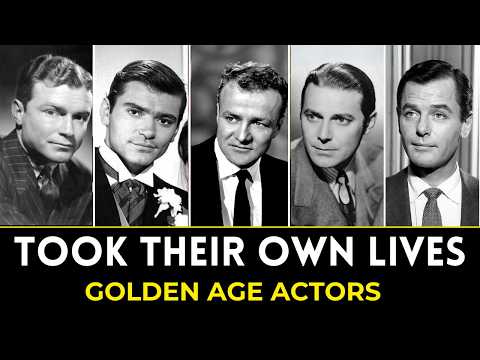
Take Ross Alexander. By 1935, the Brooklyn-born actor was a rising star at Warner Bros., sharing the screen with Errol Flynn in Captain Blood. But off-screen, his world was crumbling. His first wife, actress Aleta Freel, had taken her own life that same year—a loss that shattered him. Struggling with his sexuality in an era that criminalized it, drowning in debt, and watching his career slip away, Alexander saw no way out. On January 2, 1937, at just 29, he walked into the barn behind his Los Angeles home and ended his life with a single gunshot.
His death was a shockwave—but not an isolated one.
George Reeves seemed invincible. As TV’s first Superman, he was a hero to millions of children. But typecasting trapped him. On June 16, 1959, Reeves was found dead in his Benedict Canyon home, a gunshot wound to his head. Officially ruled a suicide, the case reeked of inconsistency: no gunpowder residue on his hands, contradictory statements from his fiancée and guests, and rumors of romantic entanglements. Was it murder? An accident? The truth died with him, leaving behind one of Hollywood’s most enduring mysteries.
Then there was James Whale—the brilliant British director who gave us Frankenstein and Bride of Frankenstein. Openly gay in an intolerant era, Whale faced the decline of his career and a series of debilitating strokes. On May 29, 1957, he drowned himself in his Pacific Palisades pool, leaving a note that spoke of despair and a longing for peace. His legacy as a horror pioneer endures, but so does the pain that drove him to the water’s edge.
The list continues, each name a monument to what the industry can take from those who give it everything. Don Redberry, the red-haired cowboy who galloped across B-Westerns as the star of Adventures of Red Rider, found his fame fading in the 1950s. Alcoholism and a troubled marriage gnawed at him, and on July 17, 1980, police were called to his North Hollywood home during a domestic dispute with his estranged wife, Barbara. They arrived to find the 68-year-old dead from a self-inflicted gunshot wound. The cowboy who once embodied rugged resilience had been broken by an industry that had simply moved on.
Gig Young’s story is perhaps the most chilling. Born Byron Elsworth Barr, he won an Academy Award for They Shoot Horses, Don’t They? and charmed audiences with his sophisticated persona. But behind the charm lurked alcoholism and a string of failed marriages. On October 19, 1978, just weeks after marrying his fifth wife, 31-year-old Kim Schmidt, the 64-year-old Young shot her and then turned the gun on himself in their Manhattan apartment. A murder-suicide that stunned the entertainment world—a final, violent chapter to a life of hidden torment.
Philip Loeb’s tragedy was political. As Jake Goldberg on The Goldbergs, he was a television pioneer and a fierce advocate for actors’ rights. But the McCarthy-era blacklist branded him a communist sympathizer. Pressured to resign from the show and unable to find work, the 64-year-old checked into New York’s Taft Hotel on September 1, 1955, and overdosed on sleeping pills. His death was a direct casualty of the Red Scare—a career erased, a life extinguished, and a warning about the cost of fear.
Carl Dane’s fall was technological. The Danish-born silent film star—known for his lanky frame and comedic talent—had thrived in movies like The Big Parade. But sound arrived, and his thick accent became a career death sentence. Reduced to running a hot dog stand near the studio where he’d once been a star, Dane shot himself in his Los Angeles apartment on April 14, 1934, at 47. Fame, it turned out, could be as fleeting as a flickering frame.
John Bowers embodied the silent era’s cruelest irony. He’d appeared in over ninety films, starring alongside Douglas Fairbanks in Robin Hood. But sound pictures left him behind. On November 17, 1936, the 50-year-old reportedly sailed a small boat into the Pacific from Santa Monica. Days later, his body washed ashore. It was presumed a suicide—a legend that would inspire the character Norman Maine in A Star Is Born. Bowers drifted into the sea the way his career had drifted into oblivion.
Paul Bern’s death remains one of Hollywood’s first great scandals. A respected MGM director and producer, he married rising star Jean Harlow in July 1932. Just two months later, on September 5, 1932, the 42-year-old was found dead from a gunshot wound in his Beverly Hills home, a note beside him. Officially a suicide, but inconsistencies and MGM’s swift handling of the scene fueled theories of murder—possibly involving Bern’s former common-law wife. The studio protected its investments, and the truth was buried with him.
Max Linder was cinema’s first international superstar—a French comedian whose dapper character inspired Chaplin himself. But World War I left him injured, gassed, and battling depression. On October 31, 1925, the 41-year-old and his wife Hélène died in a suicide pact in a Paris hotel room, leaving behind their 15-month-old daughter. They ingested barbiturates and slit their wrists. A trailblazing career ended in a final, desperate act of shared despair.
George Sanders brought a suave cynicism to every role, winning an Oscar for All About Eve and charming audiences as the voice of Shere Khan. But age brought dementia and declining health, and the British actor had always viewed life with a detached weariness. On April 25, 1972, the 65-year-old was found dead in a hotel room in Castelldefels, Spain, having overdosed on barbiturates. His suicide note was characteristically eloquent—a final performance of wit and resignation that laid bare the loneliness beneath the polished persona.
Charles Boyer’s story is one of love stretched to its breaking point. The French-born actor, nominated four times for an Academy Award, was famous for his romantic roles in Algiers and Gaslight. His 44-year marriage to actress Pat Paterson was one of Hollywood’s most devoted partnerships. When Pat died of cancer on August 24, 1978, Boyer was inconsolable. Two days later, on what would have been his 79th birthday weekend, he ingested a lethal dose of barbiturates in Phoenix, Arizona. He could not imagine a life without her—a grief so profound it became his final, quiet declaration of devotion.
Not every tragedy belonged to the fading stars. Pete Duel was young, handsome, and on the rise as Hannibal Heyes in the hit series Alias Smith and Jones. But beneath the charm, depression and alcohol abuse were consuming him. On December 31, 1971, the 31-year-old shot himself at his Hollywood Hills home while his girlfriend, Diane Ray, was in the house. The producers chose to continue the show with a new actor, but Duel’s death forced the industry to confront a question it had long ignored: what happens when fame arrives before a person is ready to carry its weight?
Brian Keith had spent six decades in the business, beloved for The Parent Trap and Family Affair. But his final years were a cascade of suffering. Diagnosed with lung cancer and empyema, his body was failing him—and then his daughter Daisy took her own life in April 1997. On June 24, 1997, at 75, Keith shot himself at his Malibu home. The man who had played so many warm father figures had run out of reasons to keep fighting.
Richard Farnsworth’s story began as a stuntman in the 1930s and culminated in two Academy Award nominations—for Comes a Horseman and The Straight Story. His weathered face and quiet authenticity made him one of Hollywood’s most respected character actors. But terminal metastatic prostate cancer brought him to his knees. On October 6, 2000, at 80, Farnsworth shot himself at his ranch in Lincoln, New Mexico, unable to endure the excruciating pain any longer. His death became a sobering entry in the national conversation about terminal illness and the right to choose how one’s story ends.
John Hall had swashbuckled through adventure films of the 1930s and 1940s, starring in The Hurricane and Arabian Nights. But time caught up with him too. Diagnosed with incurable bladder cancer, the 64-year-old shot himself at his North Hollywood home on December 13, 1979. Like Farnsworth, Hall chose his own exit rather than surrender to a disease that offered no mercy.
The pattern repeats with a grim inevitability. Some were destroyed by the blacklist, others by the arrival of sound, still others by the slow erosion of their careers or the ravages of illness. Each name on this list was a person who, for a time, made audiences believe in something larger than themselves. And each was ultimately failed by an industry—and sometimes a society—that had little room for their private pain.
But the story does not end with their deaths. It continues in the films they left behind, in the performances that still flicker across screens decades later, and in the questions their lives raise about how we care for the artists who give us so much. What does it say about the dream factory that so many of its brightest lights burned out in silence? The answer, perhaps, lies in the stories we choose to tell—and in whether we listen when the next warning whisper comes.
These sixteen names are not merely footnotes in cinema history—they are the faces behind the glamour, the voices that cracked under the weight of expectation. Each one chose an exit the industry refused to discuss, a final act performed without an audience. Their stories force us to ask uncomfortable questions about the price of fame and the silence that surrounds mental illness, addiction, and despair.
But here is the truth that lingers long after the credits roll: the same industry that failed them still exists, and the pressures that broke them have not disappeared. The blacklist is gone, but the scrutiny is not. The studio system has changed, but the hunger for youth, for perfection, for box-office gold remains. The spotlight still burns.
What can we do? We can remember. We can watch their films with new eyes—seeing not just the performances, but the people behind them. We can refuse to treat tragedy as mere trivia, and instead demand better care for those who create the stories we love. And we can listen, truly listen, when someone says they are struggling.
Hollywood’s Golden Age gave us magic. But it also gave us these cautionary tales. Their deaths were not inevitable—they were the result of systems that failed to catch them when they fell. The question now is whether we will build a better safety net for the next generation of dreamers.
So as the marquee lights dim and the projector flickers to black, we are left with a choice: do we honor these memories by changing the culture that broke them, or do we simply add their names to another list and move on? The story of Hollywood’s darkest shadows is not over—it is being written right now.
What do you think—has the entertainment industry truly learned from its past, or are these tragedies destined to repeat? Share your thoughts in the comments below.
Report this article
Select a reason for reporting:






