In the vast, pale forests of Western Australia, where the karri trees rose like ancient bone-white towers, a 33-year-old man swung his saw with the steady rhythm of a worker who knew exactly what he was doing. The year was 1914, and the world was about to change forever. He was cutting railway sleepers—hard, punishing work that dulled blades and broke men. No one watching him that morning could have predicted what was coming.
He didn’t know that within 42 months, he would rise from private to lieutenant colonel. He didn’t know he would be decorated six times. He didn’t know that the official historian of his country would one day write that of all the fighting officers Australia sent to the war, this man was the best. He knew none of it. He was just a timber cutter, earning piecework wages in a forest near a town called Manjimup.
His name was Henry William Murray. Everyone called him Harry.
Born in Tasmania in 1880, Harry left school early to help on his father’s farm. As a boy, he loved horses, rifles, and the militia parades that passed through the district. He joined a volunteer artillery unit at 21 and served for six years, learning how a gun crew worked, how orders traveled, and how discipline held men together when they would rather run.
Then he moved to Western Australia—the destination for young men chasing money in those years. He carried mail in the goldfields. He worked as an armed escort for a mining company on roads where bushrangers still robbed coaches. By 1914, he was employing timber cutters for the railways in the South West, in the karri country where the great pale trees rose two hundred feet and the men who felled them were paid by the piece.
Then in August of that year, newspapers began printing telegrams from Europe. An assassination in a place called Sarajevo. Ultimatums between capitals no one in the karri country had ever visited. A declaration of war. And Australia, as part of the British Empire, was in it too.
Recruiting offices opened in Perth, Fremantle, Bunbury, and remote country towns. Young men came from sheep stations, wheat farms, and goldfields. Older men came too, though not many. There was a general assumption in those first weeks that the whole thing would be over by Christmas.
Harry Murray was not, by any measure, a young man. He was 33. He had a job. He had a life. He had no reason at all to go.
And on September 30, 1914, Harry Murray walked into a recruiting office in Perth and enlisted as a private soldier.
They offered him a commission on the spot. His record made it a formality—six years in the militia, experience of command, steady in himself, and clearly competent. The recruiting officer expected him to accept. But Harry Murray refused. He said he wanted to go as a private. He wanted to learn war from the bottom up. He wanted to see it from the ranks before he tried to lead men through it. It was the first of many decisions his commanders would find strange and then learn to trust.
He was assigned to a company of the newly formed 16th Battalion and sent to a place called Blackboy Hill on the outskirts of Perth for training. There they put him on machine guns. The battalion’s machine-gun crew consisted of two men per weapon. The Number One sat behind the sights and fired. The Number Two fed belts into the mechanism and watched the flank. Harry Murray’s Number One was another Western Australian, a big, steady man named Percy Black, who had been a miner and a horseman and didn’t know the meaning of fear. Murray was Number Two. The two became inseparable. They would fight the war side by side until the battle of Bullecourt in the spring of 1917 took Percy Black.
The 16th Battalion sailed from Melbourne two days before Christmas and reached Egypt in early February. The battalion trained through the desert winter in the sands outside Cairo for something the men were not told about, though rumors ran through the ranks. There was talk of a landing somewhere. There was talk of the Turks. There was talk of a place in the Dardanelles.
In April, the brigade moved to a Greek island called Mudros to complete its preparations. Then on April 25, 1915, the 16th Battalion landed on the Gallipoli peninsula in the second wave, three-quarters of an hour after the leading brigade had gone ashore in the dark. The place where they came ashore is now known as Anzac Cove.
That first afternoon, the 16th pushed inland and up a hill, and Harry Murray and Percy Black set their machine gun on the rear slope of a piece of ground that would be known ever after as Pop’s Hill. They fired the gun all afternoon and into the night. They fired while men died on either side of them. And the next day they were still there, firing at Turkish soldiers on the opposite hill across the valleys. And on the third day, when the Turks counter-attacked and the Australian line wavered and nearly broke, the two of them stayed behind the gun and kept firing. Both were wounded. Neither left.
Charles Bean, the official historian, watching that sector, later wrote that the 16th Battalion’s machine guns were served by men of extraordinary determination. It was the first official comment ever made about Harry Murray. It would not be the last.
Through May 1915, the fighting on that hill continued almost without pause. The Turks were dug in on the high ground above them, while the Australians clung to the slopes below. Every night, patrols went out to scout. Every day, shellfire rained down, and the machine gunners of the 4th Brigade—of whom Murray and Percy Black were the most experienced—stayed behind their weapon the whole time: shifting the gun from one shallow scrape to another as the earth crumbled around them, feeding belts, changing barrels, ranging the enemy trenches at dawn, then falling back into the pit to sleep for an hour before starting all over again.
Murray was promoted to corporal on the 13th. He was wounded again at the end of the month, badly enough to be evacuated. They put him on a hospital ship. The plan was to send him home. He reached Alexandria, then walked off the ship at the wharf, found transport going the other way, and was back at Gallipoli by the 3rd of July. The Australian Army in those days did not always know where all its men were. It did not know at that moment what to do with a wounded soldier who refused to go home.
What the Army did was give him a medal. On 29 October 1915, Corporal Henry William Murray of the 16th Battalion was awarded the Distinguished Conduct Medal for his actions between 9 and 31 May. The citation praised his exceptional courage, energy, and skill in the use of machine guns. It said, in the words of the recommending officer, that he did everything that a machine gun could do and then did it again. That was his first decoration. Five more would follow.
Then on 8 August, during the great and terrible attack on Hill 971, the machine gunners of the 4th Brigade covered the withdrawal. Charles Bean later described these gunners as perhaps the finest unit in the Australian Imperial Force. Murray was wounded again—more seriously this time—and when he returned to duty five days later, the Army had made a decision about him. On 13 August 1915, he was promoted to sergeant, and on the same day appointed second lieutenant, and on that same day transferred from the 16th Battalion to the 13th. Three ranks in one day, from corporal to subaltern, with one signature on one sheet of paper. He was still under 35. The war was less than a year old, and the timber cutter from the karri forest was now a company officer in an infantry battalion of the Australian Imperial Force.
The Gallipoli campaign ended in withdrawal in December of that year. The 13th Battalion returned to Egypt. They reorganized. They absorbed new drafts of soldiers. Murray was promoted to lieutenant on 20 January 1916 and to captain on 1 March. That was six weeks. On 1 June, the 13th Battalion sailed for France. And in mid-July, they moved into the trenches of the Western Front, where a different war was being fought on a different scale, and where the rate at which Australia lost its infantrymen was about to change every rule any of them thought they knew.
Their first great test came at a place called Mouquet Farm on the outskirts of a village named Pozières, in the ground that the Battle of the Somme had been chewing up since 1 July. The farm was a farm in name only. The buildings had vanished and the cellars remained, and beneath those cellars was a network of German dugouts and machine-gun pits and tunnels running back into the high ground. The Australians had been pushed into that ground twice before with heavy losses, until it came to the turn of the 13th Battalion. Pozières and its neighbor had swallowed 23,000 Australian casualties in a few short weeks. Every man in the 13th Battalion knew that the ground had a bad name before they went up onto it.
On 14 and 15 August 1916, they attacked it. Harry Murray was commanding a company. He was wounded early. He kept fighting. He was wounded again. He kept fighting. And when his company commander was killed, he took command of the company. And when the Germans counter-attacked, he stopped them. And when a second attack came, he stopped that too. And when a third and fourth came, he stayed on his feet. When an enemy bullet struck one of his men’s equipment and his cartridge belts began to burn and explode, Murray risked his life and tore the burning belts off the man’s body with his hands before the whole belt exploded against his chest. He held the position. And in the morning, what was left of his company was still in its place.
When his immediate commander wrote a recommendation for the Distinguished Service Order, he noted coolly that despite being wounded twice, Captain Murray had led his company with exceptional courage and initiative and repulsed four separate counter-attacks. That was his second decoration. He was 24 hours short of his thirty-sixth birthday, and, according to those who watched his performance at Mouquet Farm, he was only just beginning to show his true capacity.
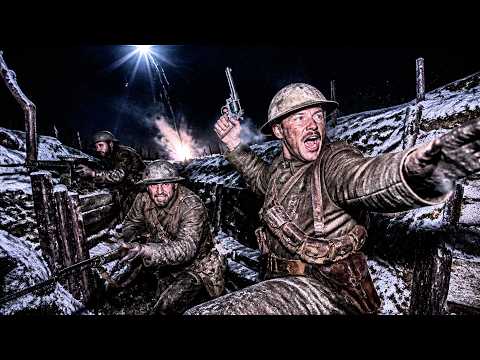
His wounds kept him out of the line until October. He was mentioned in dispatches on 4 January 1917 for a series of trench raids and reconnaissance patrols he led during November and December. Then his battalion was ordered up onto the frozen ground east of the Somme to a destroyed village called Gueudecourt and a section of German trench that ran across the snow on a low hill, which the British staff maps labeled Stormy Trench.
On the night before the attack, Harry Murray later wrote that he could see the features of the trench clearly. There was moonlight. The ground was covered in snow, and the snow reflected the moonlight until the whole battlefield seemed to glow from below, a pale ghostly light that made the barbed wire look like a drawing on paper. He said he was cursed with a vivid imagination. He said that before every battle, he rehearsed it in his mind beforehand. In his head, the blood, the brains, the limbs, all of it splashed over him, and he saw himself dead in dozens of ways. He said he forced himself to see it beforehand so that if the reality came, it would not be worse than what he had already lived through in his head. He said the dominant factor was curiosity. He wanted to know how he would behave. He wanted to see whether the man he thought he was would hold up.
This is not the kind of talk a reckless man makes. This is the kind of talk a thoughtful man makes. It is the kind of quiet, precise, private, reflective sentence you expect to find in a diary, not in the recollections of a Victoria Cross winner. And it is, of all that anyone ever wrote about Harry Murray, the single most useful line for understanding the truth of his character. On the moonlit ground at Gueudecourt, he was about to find out again.
The attack began at 10:10 PM on 4 February 1917. Captain Murray led the right flank company—later cited as the most dangerous position on the front. He had spent the previous nights alone in the dark, memorizing every fold and shell hole between his trench and the German wire. He had briefed his platoon commanders, his section leaders, his stretcher-bearers. Then he waited for the moon to rise above the snow.
Three major counter-attacks came that night. One was five separate bombing attacks in quick succession, enemy bombers working their way through the trenches, part by part, Murray’s men meeting them bomb for bomb in a maze of corners under moonlight where a man could hear the enemy breathing before he saw him.
The company entered the fight 140 strong. Through the night, that strength dwindled—100, 90, 70, 60. When the line fell back under heavy fire, it was Harry Murray who held it together. He gathered the retreating men, led bayonet charges to clear sections the enemy had entered, and between fights carried the wounded back across the shell-swept ground.
By morning, fewer than 50 of his 140 were still on their feet, but the trench remained in his hands. The recommendation for his Victoria Cross said he was “everywhere”—encouraging his men, leading bombing parties, directing bayonet charges, carrying wounded from exposed ground with matchless courage. It closed: his company would follow him anywhere, and his men would all die for him.
That was his third decoration. He was 36 years old, and still a captain.
After the war, he bought a grazing farm in Queensland, married, raised two children, and rarely spoke of the medals kept in a box inside the house. When his wife warned visitors they would be disappointed to meet the famous “Mad Harry”—that they would find only a quiet cattleman who preferred talking about the weather—she was right.
In 1939, at 58, he drove to Brisbane and told the Army he was available again. They took him, of course. On his enlistment form for the Second AIF, he subtracted five years from his age with one stroke of a pen. He was 59. He wanted to go once more.
In the end, what he possessed was simpler than rank or medals. He possessed the habit of always turning up. In the karri forest. In the recruiting office. On Pop’s Hill. At Mouquet Farm. In Stormy Trench under the moon on the snow. At Bullecourt. At Bellecourt. And a quarter century later, at another recruiting office, with five years erased from his age.
He turned up. That is the legend, in the end. Everything else—the medals, the citations, the statue at Evandale—is only a record of the places where he did.
And on a moonlit night on the snow at Gueudecourt in February 1917, he turned up once more—and the Empire ran out of medals to give him.
What would you have done, standing in that recruiting office in 1914, with a good job and a quiet life waiting—would you have gone?
Report this article
Select a reason for reporting:






