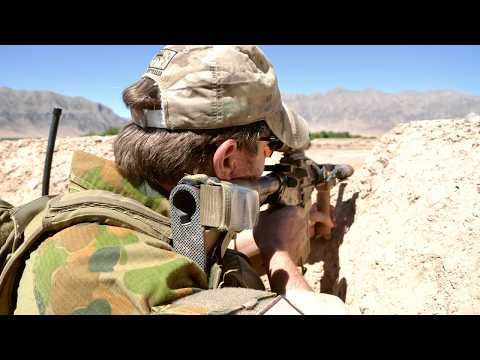
It’s 4 a.m. in the Australian outback, and a man with no rank, no name on his uniform, and 40 kilograms on his back has been standing for 11 hours. No one tells him how much farther. That’s deliberate. Half a world away, a U.S. Green Beret sits before a camera, face camouflaged, and says something that sounds like a boast but isn’t: “Nothing makes guys better than us.” Then he explains why. The reason is money—not skill. The soldier in the opening scene is trying to join the Australian Special Air Service Regiment. The course runs in the bush north of Perth, on a defense budget that has never matched the mission. Depending on the intake, nearly four out of five candidates who start that course never finish. Four out of five. No one walks beside him, and no one will until the finish line. That, too, is deliberate.
You already know what the American said. What you don’t yet know is whether he was right or just being polite to an ally on camera. History has an answer, and it doesn’t come from a single clip. It comes from 68 years of evidence, most of it far less glamorous than a quotable YouTube moment. What Australia trains for costs its government almost nothing in public recognition, because Canberra never publishes a separate figure for its special operations at all. It’s folded into the broader Army budget, uncounted. The country it trains to fight beside does the exact opposite. U.S. Special Operations Command operates on a publicly declared figure of roughly $15 billion a year. Pentagon budget staff have openly stated that the purchasing power behind that number has been flat since 2019—flat, while demand on American operators has grown rapidly in the years since. Two allied armies. One records the number, the other doesn’t. This is a story about what that gap buys and what it doesn’t. Not the hardware. The hardware shortfall is real. It’s measured in dollars, and no credible person claims otherwise. This is about the other gap. The one all that money was supposed to close.
It opened in 1957, when Australia formed a single SAS squadron at Swanbourne Barracks in Western Australia. Just over 150 men. No dedicated funding line worth mentioning. It opened again in the jungle outside Nui Dat a decade later. And it opened once more 68 years after Swanbourne in a less-than-20-second interview clip. Every one of those moments takes the same shape. Watch for it. The rich ally buys the gear. The poor ally passes the selection course, and eventually the rich ally appears on camera to admit which one actually mattered more.
The soldier on the fire trail won’t get a medal for finishing. Most of the men who started beside him won’t finish at all. The course doesn’t test whether a candidate is physically fit. Every man there has already met the fitness standard just to be considered. It tests something else. How well he can make a correct decision on a map in the dark, with legs that stopped responding well after his body tried twice to convince him to quit. No defense budget on Earth can buy that quality. And there’s only one way to certify it. A course that has spent decades refusing to pass any man who hasn’t proven it on test day under exactly that kind of exhaustion.
Australia didn’t invent this principle. It borrowed it, and the men it borrowed it from were themselves short on resources. The British Special Air Service was disbanded entirely in 1945. It returned in 1950 under the name “Malayan Scouts,” an emergency force raised to hunt communist insurgents in the Malayan jungle. Brigadier Mike Calvert built it from any volunteers and equipment he could scrounge, with no real funding behind him. Calvert had led Chindit columns behind Japanese lines in Burma. He rebuilt the SAS the same way he fought that campaign: by will, not by money. His war had taught him the lesson the hard way. Those Chindit columns marched for months behind Japanese lines on airdropped supplies and almost nothing else. The men who survived weren’t the strongest who started. They were the ones who kept functioning after the strongest had already collapsed.
When the British Army allowed the wartime SAS to disband in 1945, it treated that lesson as a peacetime luxury it could no longer afford. Five years later, a communist insurgency was spreading across the rubber plantations of Malaya, and the Army needed that lesson back faster than it could properly rebuild the regiment. So Calvert rebuilt it from volunteers, borrowed equipment, and whatever standard he could enforce without institutional support. The Malayan Scouts he built that way were rough, under-resourced, and by his own later account, not entirely ready for the task they were given. They were also the seed for every SAS selection course that descended from the regiment across three continents. Calvert had nothing else to work with, yet he refused to compromise on the one thing that determined everything. Who was actually allowed to stay?
Seven years later, on 25 July 1957, Major W. A. Gook led a small founding party into Swanbourne Barracks and officially raised the unit. Australia adopted Calvert’s doctrine that day. It adopted his discipline. But it never had the option of adopting the funding, because there was no funding to adopt. The squadron couldn’t even find a commander at first. The man appointed to the post, Major L. A. Ailes, couldn’t take up his duties until early the following year because the Army needed him elsewhere as chief parachute jump instructor, and there was no one to replace him. A regiment that would later run one of the hardest selection courses in the world couldn’t spare a single additional officer to run it for its first six months.
The American equivalent, Army Special Forces, had been founded five years earlier in 1952 at Fort Bragg. During its first decade, it struggled to prove its relevance inside a conventional army that didn’t know what to do with it. Soldiers trained to work alongside foreign guerrillas, rather than hold the front lines, found no place in the organizational chart. Then President Kennedy took a personal interest in unconventional warfare, and funding followed. Special Forces went from an afterthought to a funded priority within a few years. Nothing like that happened in Canberra. Australian SAS squadrons spent 18 months of that decade in Borneo on patrols in a border war the government was never allowed to officially acknowledge it was fighting. The missions demanded of the regiment kept increasing. The resources granted to it never did.
By the time both countries ended up in Vietnam, the gap was routine for the men in uniform. Australian SAS squadrons rotated through Phuoc Tuy province from 1966 to run long-range patrols built entirely on not being heard or seen at all. Along the coast, the U.S. Army opened the “McPhee Recon” school at Nui Dat the same year. It was created to teach long-range reconnaissance patrolling to soldiers selected from every allied force in the country. Americans, South Vietnamese, and Koreans alike. The school was run under the 5th Special Forces Group with American funding inside a compound the Americans built. Australian soldiers passed through it as students, and the school’s staff lists carry Australian names too. They traded jungle movement skills, tracking, and ambush detection with the same allies who theoretically had the entire war’s resources behind them. The country with the whole war budget put men from the country with almost nothing in front of the classroom to teach.
The reconnaissance work itself was never glamorous, and it rarely made headlines in either country. A long-range patrol in Phuoc Tuy meant four to six men carrying everything they needed on their backs, moving a few hundred meters an hour through dense jungle. They communicated by hand signal only, because any spoken word could carry farther than any nearby enemy patrol could handle. Rations were cut to the minimum to save weight, and water was rationed by the single sip. A patrol might spend two weeks in the field without lighting a fire to cook a hot meal, because smoke and smell carry farther than any patrol wants to reveal its position. The full value of a patrol lay in never being detected at all. A patrol that got into a firefight had, in practical terms, already failed the only mission it existed for.
This is a different kind of soldiering than the kind a richer army naturally rewards. No equipment upgrade in any catalog in the world makes four men patient enough to lie motionless on wet ground for six hours watching a trail that may or may not ever be used. It isn’t a competition. A one-sided resource gap. A skills gap that refuses to widen on the other side, no matter how much the first one does.
Fast forward, and the American side of this equation keeps growing. The failed hostage rescue in Iran in 1980, Operation Eagle Claw, convinced Washington that special operations could no longer be scattered across separate military branches. A wave of defense reorganization in the mid-1980s eventually led to the creation of U.S. Special Operations Command, established in 1987 with an independent budget, its own procurement authority, and in time its own satellites. Australia’s answer, Special Operations Command, didn’t come into existence until 2003. Even then, it stayed small. Combining the Commandos and the SAS, its strength at times barely reached a few thousand active and reserve troops together. America built a fleet. Australia built a well-trained raiding force and borrowed a ship from someone else to get to the fight.
Australia’s own answer to the 2003 question of how to properly organize its special forces didn’t come from a single dramatic event. It came from a decade of internal reviews through the 1990s, all asking the same question in slightly different forms. Why does a country running two separate special forces communities, the regiment and the Commandos, keep duplicating staff bodies, training pipelines, and equipment programs it can’t afford to run twice? Special Operations Command was the solution, created to manage both communities under one roof and one funding line, however small that line remained compared to the American one. It fixed real inefficiency. But it didn’t fix the underlying resource gap. No organizational chart can conjure a dollar that was never allocated in the first place. The paperwork made the small force more efficient. It didn’t make the force bigger. And it didn’t make the country paying for it any richer.
Put a number on the American side of the same organizational story. Special Forces groups grew under Kennedy’s early-1960s expansion from a few hundred men to several thousand within a few years. The Green Beret itself, the headgear the nickname came from, only became standard issue after Kennedy personally authorized it in 1961. He did so over the objections of Army leadership, who saw a distinctive cap as unnecessary vanity for soldiers supposed to work quietly. Kennedy overrode them anyway. A force created to operate by exception needed to look different from a force created to operate by rule. And the trademark itself became part of the standard. It’s a small, almost decorative example. A hat. But it still says something real about how differently the two allies built their special forces from the start.
American forces grew inside a system with direct access to the President’s office when a decision was needed. Australian forces grew inside a system that had to make do with whatever a much smaller defense budget could spare in any given year. And it rarely got personal attention from a prime minister at all. Australia never had a president take that kind of personal interest, and it didn’t need one, because the standards the SAS held itself to were never going to depend on who was watching from Canberra.
That imbalance followed both armies into Iraq and Afghanistan. Australian special forces spent years embedded within American task forces. They used American aircraft and American satellite links because Australia didn’t have any to spare. They entered the same compounds and faced the same ambushes as their wealthier ally. The gap shows up in the equipment list every time. Heavier armor, better night vision, a radio that connects to more things. Close air support on call, instead of a request through the chain of command. None of that is myth. A single Australian patrol in operations during that period typically worked with a fraction of the air cover a comparable American element could draw on. The same applied to permanent quick-reaction force and dedicated medical evacuation coverage, both of which were available to the American side almost as a matter of course. When an Australian patrol needed eyes in the sky or a helicopter inbound, it most often borrowed American capability rather than deploying its own. Because Australia never built enough of those capabilities to meet its own needs.
That is a real cost. It determined the kinds of missions Australian commanders risked and the ones they avoided. None of it had anything to do with the skill of the men on the ground. It was all about what sat on a runway 200 kilometers away.
What doesn’t follow is a skills gap. The Australian SAS selection course has one of the toughest attrition rates of any special forces course anywhere. It’s built on the same foundations Calvert laid in Malaya. Physical screening comes first. Load-bearing marches with no information on distance or time remaining. Then the navigation phase, which punishes anyone who can’t think clearly under exhaustion. After that, and only after that, comes the patrolling phase, which tests whether the survivors can function as a team when their bodies have nothing left to give.
The American special forces pipeline starts at Fort Bragg with the Special Forces Assessment and Selection course, testing land navigation, teamwork, and physical endurance under similar conditions of sleep deprivation. Survivors then move to the qualification course, which lasts months and culminates in Robin Sage, a full guerrilla warfare simulation run in a fictional country called Pineland in rural North Carolina, with a rebel faction and real role-players as civilians. It tests qualities that overlap with those tested by the Australian course, and historically a much higher proportion of men who attempted it have passed.
One completion rate doesn’t prove one force is superior by itself. The two courses were designed for forces of different sizes and different missions. But the country spending a fraction of America’s budget keeps screening out more of its candidates than its ally does. And it keeps sending the survivors into the same fight.
Here is the full interview the trailer only hinted at. It was posted on a channel called “Militech,” titled “Former Special Forces Operator Explains Why Australian SAS Shocked Him,” and published in September 2025. The channel presents him as a U.S. Army Special Forces operator, the source of the “Green Beret” nickname. A man sits with his insignia blurred to the camera and his name withheld. That’s the channel’s standing condition for any special operations veteran willing to talk. He’s asked an easy question. On your first overseas deployment, where did you go? What did you do? He answers without hesitation. Australian SAS. That was his first experience. He notes, almost casually, that the unit goes through the same selection process he did. Their meeting was less like encountering a foreign army and more like meeting men who’d passed the same test on another continent, funded by a government that could never have matched what his government spent to put him in that room. Pressed on whether anything significant came of it or whether it was routine, he answers plainly. Desert navigation, live-fire shooting. The full package. And pressed again on whether the Australians actually matched his team, capability for capability, he doesn’t hesitate at all. Here’s what he said in full, on camera, without a script, without cuts or additions.
“I love the Australians, man. We’ll say this, and look, nothing makes guys better than us. We can spend more money on bullets. We can, we have better radios. We have better night vision. We’re linked to satellites. You know what I mean? It’s hard to compete with that when you’re an army that doesn’t spend a lot on every individual.”
Eighteen seconds. No music, no title card, nothing designed for impact. He had every reason sitting in front of that camera to praise his own side instead. That’s what soldiers usually do in front of a camera for the audience a video like this was made for. But he didn’t. Read that sentence twice because it might fool you the first time. The phrase “nothing makes guys better than us” sounds out of context like a boast about his side. It isn’t. He said it while answering a direct question about whether the Australians actually matched his unit. Capability for capability, and every word that followed explained what he meant. Nothing but money makes his side better than anyone else, including the Australians. He isn’t claiming superiority. He’s denying it, and naming the only thing that actually separates the two armies in his own words, unprompted.
Notice what he doesn’t say. Because that carries as much as what he does. He doesn’t say the Australians were lucky. He doesn’t say they had the advantage of terrain. He doesn’t say the comparison is unfair because his unit did harder missions. Those were all easy, face-saving lines an American operator could have reached for. None of them would have cost him anything in front of an anonymous camera. Instead, he reached for a list of what his side’s money bought exactly. Bullets, radios, night vision, satellite links. Then he stopped, as if the list itself were the full explanation he owed anyone. He’s a soldier doing the one thing soldiers from well-funded armies are rarely asked to do on camera. He’s drawing his own advantage and putting a hard boundary around it. Instead of letting it bleed into claims about who’s actually better.
Two readings of that clip miss the point, and they miss it in opposite directions. One says an American just crowned the SAS the best force on Earth. The other says it was nothing more than polite alliance talk. Both assume the clip was diplomacy. It wasn’t. Diplomacy goes through a public affairs office first, and this clip was published with the speaker’s face blurred from that same office. What’s left, once the diplomatic reading is gone, is simpler. A soldier forming a judgment about the man beside him under pressure, and stating it once the camera rolled and no one was there to review his answer beforehand.
That judgment has nothing to do with the flag on either man’s shoulder or the size of the budget that put him there. What the clip actually shows is narrower than both readings and more useful for it. Asked that easy question, a former U.S. Green Beret answered with a shopping list. Ammunition, radios, night vision, satellites. Four things a government orders. He didn’t add a fifth, and the missing item is the whole argument, because everything he named can be funded, bought, and issued inside a single fiscal year. A better optic can be mounted on a rifle in an afternoon.
The quality of the fire trail they test north of Perth has no supplier, no delivery schedule, and no line item in Canberra or Washington. It’s only ever certified one way, on the day, on the ground, by a directing staff member deciding whether the man in front of him has actually met the standard or simply hasn’t been caught failing yet.
The clip matters for what it isn’t, too. It isn’t an official press statement cleared by a public affairs office, and it isn’t a paid advertisement for a defense contractor. Interviews like this exist in a small, deliberately obscure corner of the internet precisely because official channels would never let a soldier speak this plainly about an ally for fear of implying something wrong about his own side by comparison. Remove the official channel, and the incentive to control the message goes with it. What’s left is an uncontrolled answer given on the record, with no media officer behind the camera to walk it back later.
In exchange, spending buys real things, and pretending otherwise would be a lie of a particular kind. Satellite bandwidth for live broadcast. An ammunition stock deep enough to sustain a long campaign. Aircraft on call instead of waiting for a request to be approved. Skill doesn’t replace firepower when firepower is what the mission actually needs. The honest claim here sits in a narrower range than either extreme. Money buys a list of things shorter than most people think, and the standard that decides who gets to wear the badge was never on that list.
Picture the actual size of both ledgers side by side. Total U.S. defense spending exceeds $800 billion a year, a figure genuinely hard to hold in your head as a single number. Australia’s entire defense budget covers everything the country spends on its army, navy, air force, and any other capabilities combined. That figure lands around $40 billion U.S. dollars. It falls in the same range as what America spends on special operations alone. This isn’t a special-operations-only comparison, because Australia doesn’t publish data to compare. It’s the honest, publicly available version of the same point of view. An ally operating on a fraction of the other’s total defense budget, not just its special forces share, and that has been true for as long as both countries have tracked spending accounts.
Stories like this about what men actually earned and what a budget merely bought don’t get told unless someone is watching for them. Subscribing to the channel is how you make sure the next story gets made. Look at the bigger picture, and the pattern repeats in every workplace the two allies have shared over the past seventy years. In Vietnam, Australian patience and disciplined silence stood out at Phuoc Tuy amid a war run to an American tempo. In Iraq and Afghanistan, Australian special forces were folded into American planning. Not as a junior partner kept away from hard missions. But as a trusted unit handed the most sensitive tasks one after another, by planners who had every other unit in the coalition available to choose from.
The Americans had borrowed this lesson before, and not only from Australia. Colonel Charlie Beckwith founded Delta Force in 1977. He built it on an exchange mission he’d served fifteen years earlier with British SAS under Lieutenant Colonel John Woodhouse, where he nearly died from jungle fever contracted during operations. Beckwith came home convinced of one thing only. The U.S. Army couldn’t afford to skip the selection process itself. A brutal, unglamorous process, cheap compared to any of the military hardware around it. It took him years of pushing against an Army bureaucracy that wanted the equipment and the mission without applying the same strict standards to the men, before Delta was finally approved and funded in 1977. He succeeded in imposing those standards anyway.
Those standards were still new, barely three years old, when they were tested for real in the Iranian desert in April 1980, during a mission to rescue American hostages from Tehran. Operation Eagle Claw didn’t fail because Beckwith’s operators lacked skill. It failed at a staging point called Desert One before the assault began, when too few of the mission’s helicopters proved flyable, and the commanders on the ground had no choice but to call off the rescue. It was during the withdrawal that followed the failure, not the failure itself, that a transport aircraft collided with one of the helicopters on the ground. Eight American service members died in that fire. The investigation that followed didn’t blame the men Beckwith had chosen. It blamed the equipment, coordination between military branches, and a plan spread across too many separate commands with too little joint training between them.
That failure, more than any individual success, is why U.S. Special Operations Command exists today as a unified, funded structure instead of four separate branches each running special operations on its own small side track. Three countries, three different decades, and the same lesson learned separately each time. A special forces unit can be built around expensive equipment, or it can be built around expensive standards for the men entitled to wear its badge. They are not the same investment, no matter how often the defense budget debate treats them as one.
Australian Special Operations Command has never possessed, and does not now possess, anything close to America’s satellite infrastructure, nor its standing fleet of aircraft. What it has instead is a training course that has never been allowed to get easier. What it has is a culture that treats a man’s ability to keep working once his body has stopped responding as the only currency of value. That doesn’t show up on balance sheets. It shows up on a mountain track north of Perth at four in the morning. And it shows up decades later in an offhand answer from a man with no reason at all to give the Australians credit he didn’t believe they’d earned.
The selection course itself was built in stages, each one existing to screen out a specific kind of soldier who is competent in other areas. The physical phase runs for days of marching under heavy loads across unmarked terrain, with no set timing or distance. It screens out men whose fitness depends on knowing how much effort remains, and it screens them out regardless of how strong they were on the day they arrived. The land navigation phase is run individually, and it screens out men who can read a map at full energy but can’t do it after two days without enough sleep. Later phases test escape and evasion skills. The ability to survive and move undetected through hostile areas with almost no resources. Immediately after comes the resistance-to-interrogation phase, designed to prepare the candidate for what might happen if his evasion fails and he is captured. None of these phases produces pictures an equipment catalog could put in a recruiting brochure. Each phase produces only one result: pass or fail.
The regiment has never treated a low number of applicants as a reason to lower standards, preferring to accept fewer who passed the test. Any member of the directing staff overseeing that course has one task that outweighs all others. To decide, day after day, whether the man in front of him has genuinely earned a pass or has merely managed to avoid failing so far. That distinction is invisible from outside, but brutally clear from within. It’s the only reason the course exists in this form, and no defense budget on Earth can automate that task.
Keith Fennell passed that course in 1995 at twenty-one, one of the youngest men ever to do it, and wrote a book about the demands of those weeks called Warrior Training. By his account, the course was never designed to find the fittest men among the applicants. Plenty of highly fit men failed it anyway. It was designed to find the person who kept moving after his body told him he had nothing left to prove his worth with.
This story was never about equipment beating the human. That version flatters the ego and teaches nothing. The real version is duller and more useful. Two allies built two different selection systems on two vastly different budgets, then fought the same wars with them. Over seventy years in Borneo, Vietnam, Iraq, and Afghanistan, the evidence has always pointed to the same conclusion. The equipment shortfall is real, and ignoring it costs lives. The skills gap that was supposed to follow from it never appeared.
But the accounts don’t end there. A story built on trust between allies shouldn’t hide the one chapter that tested that trust. The two decades that built Australia’s reputation inside coalition headquarters in Afghanistan are the same two decades that produced the 2020 Brereton Report. It was an investigation conducted by the Australian Defence Force itself into allegations of unlawful killings by special forces personnel. Its findings are things the regiment has had to live with publicly rather than deny. Being trusted with the hardest missions doesn’t necessarily mean having a clean record in every one of them. And this story isn’t honest if it only tells its first half.
Both things are true at once. A small, ruthlessly selected force is still made of human beings. And individuals can fail standards that the selection process alone was never designed to catch. The investigation was led by New South Wales Court of Appeal judge Paul Brereton, ran four years, examined thousands of documents, and questioned more than 400 witnesses. It found credible information that current or former Australian special forces members unlawfully killed 39 Afghans and other non-combatants in 23 separate incidents, none of them in the heat of genuine combat. That doesn’t erase the operational trust earned across Vietnam, Iraq, and Afghanistan. It sits beside it, as the honest version of any long alliance must.
No amount of coalition mission data can change what the investigation found or who found it. And the Americans aren’t the only ones who acknowledge this. British SAS has run exchange programs with its Australian counterpart since Calvert’s era. Before he commanded the regiment itself, then all Australian special operations, an Australian officer named Mike Hindmarsh held two staff posts inside British special forces headquarters, where he ran training first, then operations later. Present inside the machine running the model his own country had copied. That exchange relationship has continued unbroken since Calvert’s day, decade after decade. Which is why the American interview you just heard reads as one data point in a much longer pattern. Not a sudden exception to it.
New Zealand SAS proves the same point on a smaller scale. It holds, in absolute numbers, barely a company of men who wear the badge, on a defense budget smaller than Australia’s, and it has stayed inside the same Five Eyes training network for decades without being quietly surpassed. If defense allocations set the ceiling on soldier quality, a unit this size would have vanished from that network long ago. But it never left.
The intelligence side of the same alliance tells a version of this story rarely discussed alongside the special forces side. Though the two grew up together. Australia, the United States, Britain, Canada, and New Zealand exchange signals intelligence under an arrangement dating back to the years immediately after World War II. That alliance has outlived the war that created it because each partner contributed something the others simply couldn’t buy from a supplier. America brought scale. Satellites, processing power, and a global collection footprint no other partner could fund alone. Australia and the smaller partners brought geographic position and language capabilities. And in the narrower world of special operations coordination, they also brought the habit of trusting each other’s people with material none of them would hand to an untested stranger, regardless of what that stranger’s country spent on defense.
No one in that five-country arrangement ever claimed the financial contributions were equal. It has held for eight decades because the one thing that mattered more than money, trust under pressure, never needed renegotiation.
The men this story has mentioned didn’t actually agree on much else. Calvert founded his force from Chindits and volunteers because Whitehall would never have funded it otherwise. Woodhouse led the regiment that nearly lost, to illness, the American officer sent to learn from it. Beckwith spent years fighting his own government for permission to copy what he’d seen. Brereton spent four years documenting what happens when the standard fails. Different men, different decades, and different sides of the same alliance. And none of them ever mistook a defense budget for a substitute for that other thing.
That agreement, reached separately without any of them comparing notes, is the closest this story comes to a final verdict. Sixty-eight years after Swanbourne raised a single squadron on a budget no one expected to matter, the country spending $15 billion a year on its operators still, from time to time, puts a soldier in front of a camera. And that soldier ends up saying, without meaning to make a fuss, that money was never what made the difference. It isn’t easy to say that out loud. A soldier from the most expensive military machine in history, admitting that the machine’s real advantage stops at a list of equipment. Everything beyond that list is earned the same way it was earned at Swanbourne in 1957, and the same way it’s still earned on selection courses today. On foot. Alone, with no one telling you how much distance remains, and no one able to shorten that distance with money, however large the checks behind him.
This doesn’t prove the SAS is the best special forces unit on Earth. No serious operator from any country could make that claim about any unit. Missions differ, and performance measures differ with them. It proves something smaller and more durable. A defense budget that is a fraction of its closest ally’s has not, over seventy years and four wars, produced a soldier that allied operators themselves rank as anything less than a peer. That’s the entire claim. It never needed to be bigger than that, and the men who actually serve on both sides of this alliance never asked for it to be.
The record doesn’t let the regiment off easily either, and the years since Brereton have made it better. The findings didn’t stay locked in a filing cabinet. They forced a criminal investigation, the Chief of the Defence Force standing before cameras to accept it, and a conversation about honor and accountability Australia is still having. No defense budget on either side of the alliance bought that reckoning, and none could have made it disappear either. It happened because the standard the regiment holds itself to cuts both ways. The same discipline that decides who is entitled to wear the badge must also try the men already wearing it once the facts emerge. A country willing to do that to its most selective unit in public isn’t running a public relations campaign. It’s applying the standard honestly to itself, the one test money could never help it pass or fail.
The fire trail north of Perth is still there. New candidates are walking it now. Most will fail. A few won’t. None of them are thinking about the $15 billion while they walk. And none of them need to, because the test was never the equipment list. The test was always the walk.
No one can say who the next American Green Beret will be to face that same easy question, or when the camera will find him. But what seventy years of this relationship across Borneo, Vietnam, Iraq, and Afghanistan can say is what he has probably already learned by then, whether or not he ever watched this video. Not from a budget line, not from a procurement briefing, not from satellite feed, but from watching the man beside him under real pressure and discovering every time that the $15 billion never explained the difference.
This keeps repeating instead of resolving, and the reason has nothing to do with either government refusing to learn the lesson. Lessons don’t transfer the way equipment does. A factory can build a satellite radio or a night vision device in bulk and ship it to 10,000 soldiers inside one fiscal year. That’s exactly why the equipment shortfall can be closed quickly once a government decides to spend the money. A selection standard cannot be manufactured at any speed. It can only be enforced one intake at a time by an organization willing to reject most of the men who volunteer for it. Including men who would have become excellent soldiers in almost any other posting. The purpose of the standard is to filter for the rare exception rather than ordinary competence. It costs almost nothing financially, but it demands all the institutional patience. The willingness to keep saying no to good candidates year after year, in service of the few who prove exceptional.
The United States can apply that same discipline inside its own special forces pipeline, and it already does. The difference, if there is one worth mentioning, is that Australia never had the option of leaning on a bigger equipment budget to cover for looser standards. That equipment budget was never there to lean on. For a regiment this size, standards were never insurance against any shortfall. They were always the entire strategy. And for sixty-eight years, they have had to work every single time, with every single intake, without one year of rest, and without ever letting a limited budget become an excuse to lower them.
If someone in your family served with the SAS in Borneo, in Vietnam, on exchange with the Americans, the British, or the New Zealanders, or on a course north of Perth no one outside the regiment ever heard of, tell me about them in the comments below. That’s the part of this story that never makes it into a defense budget request, and the part actually worth preserving long after every equipment list on both sides of this alliance has been upgraded, replaced, and forgotten.
So here’s my question for you: if the money was never what made the difference, what would you cut first from a defense budget—and what would you refuse to touch, no matter the cost?
Report this article
Select a reason for reporting:






