In the final months of World War II, as Nazi Germany crumbled under the weight of inevitable defeat, one man poured millions into a cinematic spectacle. Joseph Goebbels, the master of propaganda, believed he could resurrect a dying nation with a single film. Kolberg was not just a movie—it was a desperate gamble to rewrite reality itself.
By January 1945, Germany was a landscape of ruins. Allied bombs had turned cities into graveyards, the Red Army was closing in from the east, and millions of civilians were fleeing in terror. On January 30th, the twelfth anniversary of Hitler’s rise to power, the Führer delivered a speech that was tired, repetitive, and utterly disconnected from the catastrophe unfolding around him. But even as the war was lost, Goebbels was preparing his final act of illusion.
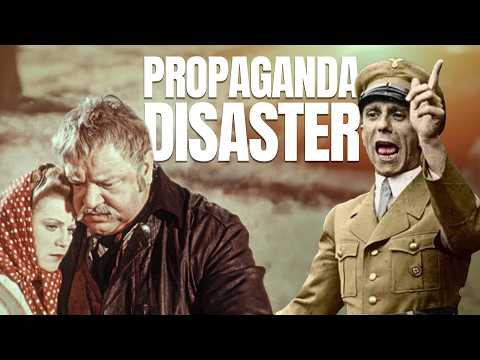
The premiere of Kolberg took place in a handful of Berlin cinemas still standing, and at a besieged military base. The timing was deliberate—a psychological weapon aimed at a population that had already stopped believing. The film told the story of a small Prussian city that defied Napoleon’s army, a clear parallel to Germany’s own desperate resistance. Unity between people and army, sacrifice, total war—these were the messages hammered into every frame.
But the production itself was a paradox. At a time when every soldier was needed at the front, thousands were pulled from combat to serve as extras. Strategic materials, including those vital to the war industry, were diverted to build sets. Kolberg became the most expensive film the Nazi regime ever produced—a monument to hubris.
Goebbels had long understood cinema’s power. Unlike speeches, films could bypass reason and speak directly to the heart. But by 1945, the audience was exhausted. Years of heavy-handed propaganda had bred cynicism. The people wanted escapism, not another call to sacrifice. And yet, the regime pressed on, convinced that a historical epic could reignite the flame of resistance.
The film’s director, Wolfgang Liebeneiner, was a seasoned professional. The script went through endless revisions, each one stripping away nuance to sharpen the ideological edge. Every scene was engineered to serve a single purpose: to convince Germans that surrender was unthinkable. The result was a work of staggering technical ambition—one of Germany’s first color films—but also a stark reflection of the regime’s disconnect from reality.
As the film rolled in those few surviving theaters, the real Kolberg was about to fall to the Soviets. The message of heroic resistance was drowned out by the roar of artillery. Propaganda had reached its limit; reality could no longer be hidden.
The structure of Kolberg reveals its intentions from the very first frame. The film does not begin with the siege itself, but with a framing device set after the events, as if history had already validated the city’s defiance. Prussian leaders debate the crisis in the face of Napoleon’s advance, and the opposition is drawn in stark, unsubtle lines. On one side, hesitant men clinging to old structures; on the other, a determined officer who insists that war is not the army’s burden alone but the entire people’s.
This argument is the film’s thesis, stated outright. In moments of crisis, traditional leadership fails, and only total mobilization can guarantee survival. From there, the narrative travels back to Kolberg before the siege, a city still alive with festivities and music. But the calm is a lie. One citizen—an influential man without military rank—already senses the approaching storm.
His concern with supplies and defense is played against the city’s commander, a figure of arrogance and indecision. The contrast is deliberate: true strength lies not in hierarchy but in individual initiative and collective commitment. When a young officer arrives from the front, he sees at once that the defenses are inadequate. It is he who begins training civilians, blurring the line between soldier and citizen.
At the heart of this transformation stands a young woman. She begins in fear, seeing the war as a distant, meaningless force threatening her future. She is the audience’s mirror—vulnerable, hesitant, and utterly human. But as the pressure mounts, her fear gives way to acceptance, and eventually to commitment. Her arc is not merely character development; it is a behavioral template for every German civilian.
The debates among local leaders are equally polarized. Those who counsel surrender are shown as weak and cowardly; those who demand resistance, as brave and morally superior. When enemy envoys arrive to negotiate, their proposal is met with contempt. National honor and loyalty to the king are placed above any rational calculation of survival.
Then comes the film’s most symbolic episode. Certain districts of the city offer strategic advantage to the enemy, and the solution is brutal in its simplicity: the inhabitants must destroy their own homes. For the young protagonist, this means burning down the house that holds her entire life. She resists, then submits—and in that submission, the film delivers its central lesson: the individual must be willing to lose everything for the collective.
Meanwhile, the conflict between the influential citizen and the incompetent commander reaches a breaking point. The citizen challenges him openly and is arrested for it. But the arrest does not restore order—it ignites the population. Popular pressure becomes the decisive force, and a new commander is finally installed.
His arrival changes everything. He is energetic, pragmatic, and willing to govern alongside the people rather than above them. The alliance between him and the imprisoned citizen becomes the film’s ideal: the fusion of people and army. Motivational speeches are delivered, strategies drawn, and the city prepares for direct confrontation. The stage is set for the siege—and for the most intense phase of the ideological construction.
The siege sequences are where Kolberg unleashes its full spectacle. Enemy forces surround the city and launch wave after wave of attacks, and the film answers with massive sets, thousands of extras, and explosions designed to overwhelm the senses. Visually, these scenes were built to impress—not by realism, but by the sheer sense of continuous, unyielding resistance.
Yet there is a telling omission. The real suffering of the population is carefully minimized. Buildings crumble and tension mounts, but the camera lingers on the defenders’ resolve rather than on the blood and despair. Showing too much suffering might have discouraged the audience—the goal was not truth, but a version of war that could still be endured.
As the bombardment intensifies, the civilian population becomes the film’s true protagonist. Men with no military training operate weapons and build barricades. Women take on logistics, support roles, and even direct involvement at critical moments. The distinction between front line and rear guard practically disappears—war demands everyone, and neutrality is no longer an option.
The young woman whose journey began in fear now reaches the peak of her transformation. Having already sacrificed her home, she takes on responsibilities with a composure that would have been unimaginable at the start. Fear does not vanish, but it ceases to be the deciding factor—she has become a symbol of the path expected of every civilian.
Then comes the film’s most dangerous moment. As enemy pressure mounts and the possibility of defeat becomes real, even the new commander begins to consider surrender. The mere idea of capitulation is treated not as a strategic option, but as a moral failure of the highest order.
It is the civil leader—the man who was once arrested for challenging authority—who intervenes. In a scene charged with emotion, he pleads for resistance to continue. His argument is absolute: it is better to face complete destruction than to accept survival without honor. The narrative allows no real questioning of this logic. Persistence, whatever the cost, is the only legitimate choice.
The final assault arrives with everything the production could muster. Direct combat, explosions, hand-to-hand fighting—the pace accelerates until it feels as though the entire film has been building toward this single moment. Despite devastating losses, the defenders hold. The unity forged throughout the story manifests completely, with every major character contributing to the outcome.
When the enemy finally withdraws, unable to break the city’s will, the victory is not triumphant in any conventional sense. It is presented as proof—cold, deliberate proof—that collective determination can overcome military superiority. The city stands, devastated but unconquered.
The narrative then slows. The characters gather, and there is a quiet recognition of what was endured. The cost is high, but the film does not dwell on it. The focus remains fixed on the symbolic achievement, on the message rather than the bodies. The protagonist appears alone in a final moment, reflecting not with celebration but with an expression of loss—a loss framed as necessary, almost inevitable.
The story then returns to its opening frame, closing the circle. Past events are offered as an example for the present, and the decision to resist—even against impossible odds—is validated by history itself. On screen, the argument is complete and airtight.
But off screen, the reality was something else entirely. When Kolberg reached its few surviving theaters in early 1945, Germany was in total collapse. Most of the population no longer believed in victory. The disconnect between propaganda and reality had grown too vast to bridge. Few had access to screenings; many were more concerned with survival than with watching a film. And even among those who did watch, it is hard to imagine the message landing as intended.
Instead of inspiring, the film likely felt distant, almost unreal. The call for total resistance rang hollow to a people who had already seen the end approaching. The enormous investment—the soldiers pulled from the front, the strategic materials diverted, the time spent—raised uncomfortable questions about the regime’s priorities. More than seeking practical results, there had been a fixation on constructing a narrative, on shaping how defeat itself would be remembered.
And yet, this is precisely what makes Kolberg so historically revealing. It stands as a document not only of the episode it portrays, but of the regime that produced it—a regime that, until the very end, invested everything in an image, even when that image no longer corresponded to reality. The film was finished, the message was sealed, and history was already moving past it.
In the end, Kolberg survives not as the rallying cry Goebbels intended, but as a mirror held up to a dying regime. The film’s final irony is that its own message of resistance was defeated not by Napoleon, but by the very reality it tried to erase. The city on screen stood unconquered; the cities of Germany did not.
Today, historians study Kolberg less for what it said than for what it cost—soldiers diverted from combat, scarce materials wasted, and a nation’s final hours spent on a fantasy. It remains a warning about what happens when power prefers illusion to truth.
And so the curtain falls on the most expensive propaganda film ever made. What do you think—can cinema ever truly rewrite reality, or does reality always have the final cut? Share your thoughts in the comments below.
Report this article
Select a reason for reporting:






