You know him as the dour Scot who gloomily predicted disaster week after week, but the real story of John Laurie is far more extraordinary than any sitcom script. He survived the Battle of the Somme, performed Hamlet at the Old Vic, and worked with Alfred Hitchcock. And that iconic catchphrase? It was never in the script—it was Laurie’s own verdict on the show’s chances. Yet behind the laughter lies a connection to one of history’s greatest explorers, and a rare medal that few have ever seen.
Born in Dumfries, Scotland, in 1897, John Laurie seemed destined for a quiet life as an architect. But the First World War changed everything. He enlisted in the Honourable Artillery Company and found himself on the Western Front, fighting at the Somme. The horrors he witnessed there would stay with him forever—he later asked the writers of Dad’s Army never to show footage from the trenches on set. After being invalided out with bronchial problems, he finished the war at the Tower of London, then turned his back on architecture to pursue acting.
What followed was a remarkable stage career. By 1922, Laurie was performing Shakespeare at the Old Vic, and within two seasons, he was playing Hamlet—a role usually reserved for seasoned actors. He went on to tackle Richard III, Othello, and Macbeth, becoming a friend of Laurence Olivier. Hollywood soon came calling. In 1930, he landed his first film role in Alfred Hitchcock’s early sound movie Juno & Paycock. Hitchcock was impressed enough to cast him again in The 39 Steps (1935), where Laurie played a grasping Scottish crofter.
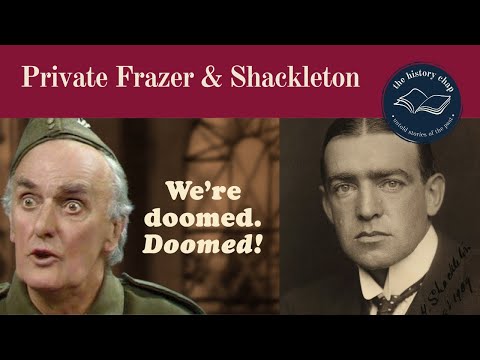
But it was a role decades later that would make him a household name. In 1968, at the age of 71, Laurie was cast as Private James Frazer in Dad’s Army. The show’s writers, Jimmy Perry and David Croft, had created a backstory for Frazer that linked him to the Antarctic explorer Sir Ernest Shackleton. In a memorable episode, Frazer reveals he possesses the Polar Medal—a rare decoration awarded for extreme polar service. Only about 900 have ever been given out since 1857, and Frazer’s fictional medal ties him to Shackleton’s Nimrod Expedition of 1907-09, a gruelling journey that came within 97 miles of the South Pole.
As for that catchphrase, “We’re doomed,” it was born from Laurie’s own pessimism. When he first read the script, he thought the show would be a flop and muttered the line to the writers. Little did he know that Dad’s Army would run for nine series and attract 18 million viewers—a third of the UK population. Laurie’s deadpan delivery turned Frazer into a comedy icon, but the man himself was a world away from the character: a classically trained actor, a war veteran, and a link to one of history’s greatest adventures.
Yet the full story of how a Shakespearean thespian became a sitcom legend—and just what he did on Shackleton’s expedition—is a tale worth telling. And it begins with a young Scot leaving his homeland, ready to see the world…
The young John Laurie who left Dumfries was not yet the gloomy figure the world would come to love. He was a restless young man with a taste for adventure, and the stage offered him a way out of the quiet life his parents had imagined for him. After the war, when many of his generation returned home broken in body or spirit, Laurie threw himself into his craft with a ferocity that surprised those who knew him.
His early days at the Old Vic were gruelling. Rehearsals ran late into the night, and the pay was barely enough to live on. But Laurie had a secret weapon: the same dour determination that would later make Frazer so believable. He learned his lines while walking the streets of London, muttering to himself in his broad Scots accent—a habit that earned him more than a few strange looks from passers-by.
When the call came to play Hamlet in only his second season, the company was stunned. The role was the Everest of classical acting, and Laurie was still a relative newcomer. But he seized it with both hands. Critics praised his brooding intensity, his haunted eyes, the way he made the Danish prince feel like a man on the edge of a cliff. It was a performance that announced a major talent.
But the theatre, for all its glories, did not pay the bills. So Laurie turned to the new medium of cinema, and it was there that he caught the eye of a young director named Alfred Hitchcock. Hitchcock was assembling the cast for The 39 Steps, and he needed a man who could play a Scottish crofter with menace and pathos in equal measure. Laurie, with his sharp features and piercing gaze, was perfect.
The film became a sensation, and suddenly Laurie was in demand. He worked with Alexander Korda on The Four Feathers, playing the Sudanese Khalifa in a role that could not have been further from his Scottish roots. He threw himself into the part with the same dedication he had brought to Shakespeare, learning the accent and studying the history of the Mahdist War. It was a reminder, if any were needed, that here was an actor of extraordinary range.
Then came the Second World War, and Laurie found himself back in uniform—this time in the Home Guard. He was not impressed. The drills were tedious, the equipment was outdated, and the whole enterprise struck him as faintly ridiculous. He had no idea that this mundane experience would one day become the foundation of the most famous role of his career.
When Jimmy Perry and David Croft approached him about a new comedy set in the Home Guard, Laurie was sceptical. He read the script with mounting disbelief. “We’re doomed,” he muttered to the writers in his Dumfries burr, convinced the whole thing would be a disaster. Perry and Croft exchanged glances. That was it. That was the line. They wrote it into the script, and a catchphrase was born.
But what of Frazer’s backstory? The writers had given him a past that stretched far beyond Walmington-on-Sea. Born on the Isle of Barra in 1872, the fictional Frazer had sailed the world as a young man, diving for pearls, stealing rubies from jungle temples, and learning hypnosis in the South China Seas. It was a life of adventure that rivalled even Lance Corporal Jones’s tales of imperial glory.
And then there was the Polar Medal. In the Christmas special of 1971, Frazer revealed the white-ribboned decoration to a baffled Captain Mainwaring. “That Sir, is the Polar medal for the Shackleton expedition,” he snarled, before adding with characteristic gloom: “A wild and lonely place…with nothing to behold but ice and snow. So they made the ribbon white.”
It was a moment of pure genius—a fictional character linked to one of the most extraordinary real-life adventures in history. But just how did Frazer earn that medal? The writers never said…
The answer, as with so many things in Dad’s Army, lies buried in the gaps between the jokes. Shackleton’s Nimrod Expedition of 1907-09 was a triumph of endurance over ambition. The party never reached the geographic South Pole—they turned back just 97 miles short—but they had walked 1,700 miles, climbed Mount Erebus, and located the Magnetic South Pole. Every man survived. Every man on that expedition, from the shore party to the crew of the Nimrod itself, was awarded the Polar Medal.
So where does a cantankerous Scottish undertaker fit into that story? The scriptwriters never bothered to explain, and perhaps that was the point. Frazer’s medal was a punchline, a piece of absurdist comedy that asked the audience to imagine a young man on the ice with Shackleton. But the show’s fans have spent decades filling in the blanks, and the most plausible answer is also the most poignant.
Given his naval experience—Frazer served in the Royal Navy at Jutland, after all—it is likely he was one of the crew aboard the Nimrod itself. While Shackleton and his men endured the Antarctic winter on the ice, the ship sailed back to New Zealand, returning a year later to collect them. A young cook or able seaman would have spent those months in the relative safety of a New Zealand port, waiting for the order to return.
But there is another possibility, one that suits Frazer’s gloomy character far better. Perhaps he was one of the seven men left at the shore base, responsible for laying supply depots for the two assault parties. It was unglamorous work—hauling sledges, rationing food, watching the horizon for signs of returning men. It was also dangerous. The Antarctic cold did not discriminate between heroes and cooks.
Imagine the young Frazer, wrapped in furs, staring out at a white expanse that stretched to the end of the world. “A wild and lonely place,” he would later call it, “with nothing to behold but ice and snow.” Those words, delivered in Laurie’s gravelly burr, were not just a joke. They were the memory of a fictional man who had seen the edge of the earth and decided that Walmington-on-Sea was preferable.
It is a backstory that has delighted Dad’s Army historians for decades. Only about 900 Polar Medals have ever been awarded, and the vast majority went to men whose names are recorded in the annals of exploration. Frazer’s name is not among them—he is a fiction—but the medal he wore on screen was a real one, borrowed from a props department and worn with the same pride a real explorer might have felt.
John Laurie, the man behind the medal, understood this better than most. He had been to war, seen men die, and returned to a world that seemed determined to forget what had happened. When he read the script for that Christmas special, he recognised something of himself in Frazer’s bleak pronouncements. The pessimism was not an act. It was a survival mechanism.
And so, when Captain Mainwaring pompously asked whether the medal was “an authentic decoration or some foreign thing,” Laurie’s snarl was not just Frazer’s. It was the snarl of a generation of men who had served their country and found themselves back in civvy street, their sacrifices unnoticed.
But the story does not end there. For the Polar Medal was not the only secret Frazer kept…
But the real secret was one Laurie kept his whole life. He never spoke publicly about the Somme—not once in fifty years of interviews. The men who served with him said he would sometimes fall silent mid-sentence, staring at nothing, and they learned not to ask.
When Dad’s Army finally ended in 1977, Laurie was 80 years old. He had outlived most of his contemporaries, and the world had changed beyond recognition. He retired to the quiet life of a country gentleman, far from the cameras and the laughter.
He died in 1980, and obituaries remembered him as Private Frazer—the gloomy Scot with the catchphrase. Few mentioned Hamlet. Fewer still mentioned the Somme.
But perhaps that is how he wanted it. Some men carry their wars in silence, and Laurie was one of them. The medal was a fiction, but the man who wore it had earned his own scars.
And somewhere, in the archives of a television studio, a white-ribboned Polar Medal sits in a box—a reminder that even the most ordinary-seeming life can hide extraordinary depths.
What would you have asked John Laurie if you could sit with him for an hour—about the war, the stage, or that famous catchphrase?
Report this article
Select a reason for reporting:






