Why would a soldier turn down a lighter rifle that carried more bullets three times in the middle of a jungle war? That’s exactly what many Australian troops did in Vietnam. While American forces eagerly adopted the futuristic M-16, the Aussies clung to something heavier, louder, and older—the British L1A1 SLR. It wasn’t just about firepower; it was about philosophy, survival, and respect earned through war. And on one rain-soaked day in 1966, that decision would be tested like never before.
August 18th, 1966. The Long Tan rubber plantation in Phuoc Tuy province, South Vietnam, was soaked in monsoon rain and filled with tension so thick it could snap like wire. Visibility was down to just a few meters. Trees and rubber trunks stood in eerie silence between bursts of machine gun fire and exploding mortars.
In the heart of it all, Private Paul Large of Delta Company, 6th Battalion, Royal Australian Regiment, crouched low, hands clenched tightly around the wooden grip of his L1A1 self-loading rifle. His knuckles were white, his jaw locked. The noise was deafening, the situation desperate.
Delta Company, numbering just 108 Australian soldiers, was locked in a deadly battle with an estimated 2,000 North Vietnamese Army and Viet Cong troops. They were surrounded. Radio contact flickered. Artillery support was patchy at best.
But in the chaos, Paul Large refused to let go of the weapon he trusted most. Not an M-16—the sleek, lightweight rifle many American troops had already adopted—but the heavier, older British-designed L1A1 SLR, made from steel and wood, firing the powerful 7.62 mm NATO round. He had been offered the M-16 three times by grateful American soldiers. Lighter, faster, and with more rounds per magazine. But he always refused.
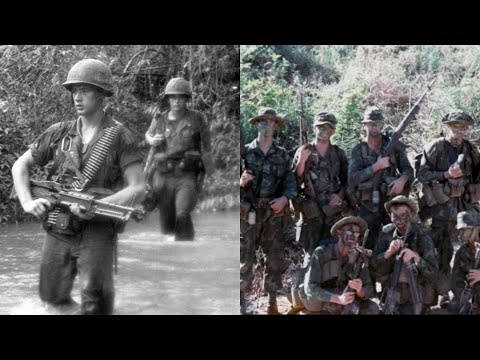
And now as enemy soldiers surged through the jungle like ghosts in the rain, that decision was about to be tested in blood.
For four brutal hours, the Australians held their ground. They fought in near-total visibility, often relying more on instinct than sight. Each shot fired had to count. The thick jungle vegetation devoured sound and light. Gun barrels steamed. Mud soaked through boots and into bones.
But the L1A1 rifles kept firing round after round, even as their operators grew exhausted and ammunition began to run out. When the battle finally ended, 18 Australians had been killed. But more than 200 enemy soldiers lay dead in the plantation.
Survivors would later say that the weight, recoil, and noise of the L1A1 had saved their lives. That its stopping power had given them the edge when numbers, terrain, and weather had turned against them.
What happened that day at Long Tan became legend in the Australian military. Not just for the courage displayed, but for what it revealed about the Australian approach to war. Their equipment choices weren’t based on trends or shiny new models. They were based on hard-earned lessons from years of fighting in similar terrain in places like Malaya and Borneo against similar enemies in similarly unforgiving jungles.
The L1A1 wasn’t just a weapon. It was a philosophy. And while many around them praised the benefits of rapid-fire suppression and lighter gear, the Australians believed in something else. Precision, reliability, and power. When your life might depend on a single shot cutting through thick vegetation and dropping an enemy instantly, there was no substitute.
The Battle of Long Tan proved that philosophy in the most unforgiving way possible. But the questions it raised lingered among soldiers and commanders alike. Why had the Australians, despite being outnumbered nearly 20 to 1, held their ground so effectively? And why did they cling to their heavy, old-school L1A1 rifles when the Americans, technologically superior and logistically vast, were embracing the lighter, futuristic M-16?
The answer, as many veterans would later explain, had nothing to do with nostalgia and everything to do with mindset.
When Australian forces entered Vietnam in 1962, they brought more than just their rifles. They brought experience—hard-earned knowledge from years of fighting communist insurgents in the jungles of Malaya and Borneo. They knew what it meant to fight in terrain where visibility was measured in meters, not kilometers, where every sound echoed through dripping vines and dense undergrowth, where you might only get one shot before the enemy disappeared into the foliage again.
This experience shaped not just their tactics, but their entire approach to combat. Unlike the American doctrine of fire superiority—built around suppression, volume, and maneuver—the Australian doctrine emphasized patience, stealth, and precision. Their troops didn’t spray bullets in the hope of hitting something. They waited. They observed. And when the time came, they made their shots count.
Warrant Officer Kevin Wheatley of the Australian SAS, who would later be posthumously awarded the Victoria Cross, once summed it up to an American advisor during a joint operation in 1965. His words became legend among both forces. “Your blokes fire a thousand rounds and hit 20 targets. Our blokes fire 20 rounds and hit 20 targets. Different approaches, mate.”
That wasn’t arrogance—it was philosophy, a belief in quality over quantity. And that belief demanded a different kind of weapon. One that didn’t just fire fast, but hit hard. One that could penetrate thick bamboo or jungle brush and still drop an enemy with a single shot. One that could be trusted not to jam in mud, rain, or heat.
The L1A1 self-loading rifle, chambered in 7.62 mm NATO, was the physical embodiment of that belief. Its recoil was heavier. It only fired semi-automatically. It carried fewer rounds. But in return, it delivered sheer stopping power, durability, and mechanical simplicity that soldiers could rely on.
In contrast, the American M-16—lightweight, accurate, and capable of fully automatic fire—suited a different kind of warfare. One where squads laid down suppressive fire while maneuvering. One where quantity often trumped precision. On paper, the 5.56 mm M-16 made perfect sense. But war isn’t fought on paper.
Australian soldiers saw this contrast unfold firsthand. They trained alongside American units, watched them move through the jungle with black face paint and slick rifles, and respected their aggression and firepower. But deep down, many of them believed that the M-16’s advantages didn’t match the brutal demands of Vietnam’s triple-canopy chaos. Their weapon of choice was heavier, louder, and slower. But it fit their doctrine like a glove. In every ambush, every patrol, and every brush with death, the L1A1 wasn’t just a tool. It was a reflection of the soldier behind it.
By the mid-1960s, the two primary rifles in Vietnam—the Australian L1A1 and the American M-16—represented not only different doctrines, but vastly different engineering philosophies. To understand why Australian soldiers clung to their L1A1s, even when offered sleeker alternatives, we must go beyond battlefield stories and into the gritty mechanics of war.
At first glance, the numbers seem close. The L1A1 weighed around 9.5 pounds, 4.3 kilograms, when fully loaded, while the M-16 came in at a featherlight 7.6 pounds, 3.4 kilograms. The M-16 fired a 5.56 mm round with an effective range of 550 meters. The L1A1, chambered in 7.62 mm NATO, was rated up to 600 meters. Both rifles used 20-round magazines.
On paper, it looked like a toss-up. But no soldier fights on paper. In the thick, humid, and mud-choked jungles of Vietnam, how a weapon functioned was more important than its stats.
The L1A1 featured a gas piston operating system—simple, reliable, and easy to maintain. Gas from a fired round pushed a piston, which drove the bolt carrier backward, cycling the next round. This design was proven in countless environments and resistant to dirt, sand, and carbon buildup.
The M-16, however, operated on a direct impingement gas system. Instead of a piston, it funneled hot gases directly into the receiver to cycle the bolt. In theory, this simplified the design and reduced weight. In practice, it led to fouling, overheating, and catastrophic failures, especially early in the war.
Worse still, the US military had switched the rifle’s propellant powder from the original clean-burning IMR powder to a cheaper, standard ball powder. This change increased the cyclic rate of fire and drastically worsened fouling in the gas tube. The result: M-16s jammed in firefights. Some soldiers died with cleaning rods still lodged in the barrel, desperately trying to clear blockages under fire.
The Australian troops watched these developments with growing unease. While they respected the innovation behind the M-16, they quietly thanked their own procurement officers for sticking with the L1A1. In the worst jungle conditions—monsoons, waist-deep mud, rotting vegetation—the L1A1 continued to function. Sometimes dirty, sometimes worn, but always firing.
There were trade-offs. The L1A1 kicked hard. Recoil management was essential. It was long and unwieldy in tight terrain. But Australian soldiers adapted. They fired from braced positions. They carried their rifles muzzle-down in the rain. They maintained discipline. They didn’t need full-auto fire to suppress the enemy. They only needed one accurate shot.
And when that shot was fired, the 7.62 mm round told its own story. It punched through bamboo thickets, shattered tree limbs, and dropped enemies behind cover. It was a round built for stopping, not just hitting.
The jungle didn’t care about theory. It rewarded reliability, simplicity, and raw power. And in those terms, the L1A1 delivered exactly what Australian soldiers demanded from their rifles: survival.
While the standard L1A1 served regular Australian infantry well, it was among the elite operators of the Australian Special Air Service Regiment that the rifle took on a new life—one forged not by doctrine, but by sheer necessity.
The SAS were ghosts in the jungle. Operating deep behind enemy lines for weeks at a time, they conducted reconnaissance, ambushes, and hit-and-run strikes with surgical precision. Their missions required silence, discipline, and overwhelming violence when the time came to strike. But the standard L1A1, though powerful, was long and unwieldy for close-quarters ambushes. Something needed to change.
So the SAS created the “Bitch.” It wasn’t an official designation. It wasn’t in any manual. It was a name whispered between patrols—half joking, half reverent—for a weapon born of pure combat pragmatism.
The process was brutal but effective. Starting with a standard L1A1 or the heavier L2A1 automatic rifle variant, SAS armorers would saw off the barrel just past the gas block, reducing the overall length dramatically. The bipod, if present, was removed. Some versions were fitted with custom flash suppressors to help with muzzle control. Others had their trigger groups modified for full-automatic fire—something not standard on the semi-auto-only L1A1.
What emerged was not a rifle, but a howling, muzzle-blasting monster. Short, loud, and brutally powerful. It was too unbalanced for precise shooting, too loud for stealth—but for ambushes, it was perfect. When the SAS initiated contact, they wanted the enemy to freeze, hesitate, and run. And the Bitch delivered just that.
The muzzle flash lit up the jungle like a camera strobe. The blast cracked like thunder, echoing through the trees. And the sheer weight of the 7.62 mm automatic fire gave the impression of an entire platoon opening up, when it was often just three or four men.
One unnamed SAS veteran, speaking years later, recounted a nighttime ambush in 1968. “We hit a VC logistics column at night. Five of us, maybe twenty of them. We opened up with the modified SLRs, and it sounded like World War II erupted in that jungle. The flash lit up everything. The noise was deafening. Half of them dropped instantly. The other half ran. It was over in less than a minute.”
This was the genius of the Bitch. It wasn’t just a weapon—it was a psychological bomb. It exploited fear and confusion, buying the SAS the seconds they needed to dominate and vanish.
American special operations units soon took notice. Navy SEALs, LRRP teams, and MACV-SOG operators began requesting joint patrols with SAS units. Not just to fight, but to learn. They saw in the Australians a different kind of warfighter—disciplined, inventive, and utterly lethal.
In a war often defined by technology and bureaucracy, the Bitch stood as a raw reminder that sometimes the best weapon is the one you build yourself—with a hacksaw, a wrench, and a desperate need to survive.
The jungle doesn’t play favorites. Whether you wore a slouch hat or a boonie hat, survival in Vietnam demanded adaptation—and no one adapted faster than the special forces.
When American SEALs and MACV-SOG operators saw what the SAS carried, they wanted in. Some procured L1A1s for missions where stopping power mattered more than rate of fire. Others mounted M203 grenade launchers beneath their SLRs. The best warriors aren’t loyal to gear—they’re loyal to effectiveness.
Even within Australian ranks, pragmatism ruled. Radio operators humped M-16s to save weight. Corporal Dennis Briggs famously snapped: “You carry 30 pounds of radio gear and a full SLR load, then tell me what you’d rather hump uphill for six hours.”
The L1A1 demanded discipline—no full-auto spray, just one aimed shot. Private Jeff Monroe said it best: “It made us better shooters because it had to.” By 1971, over 50,000 Australians had carried it into combat. One VC prisoner confessed: “When the Australians open fire, you die before you can run.”
Its weight trained their strength. Its recoil trained their control. And in return, it delivered one thing in abundance: trust.
But here’s the question that still haunts military historians—if the L1A1 was so superior, why did every major army eventually abandon it for lighter, faster rifles? Was Long Tan a triumph of philosophy, or simply a lucky exception? What do you think—does precision still beat firepower in modern warfare? Let us know in the comments below.
Report this article
Select a reason for reporting:






