In the heart of a nation still bleeding from the Great War, a man with a journalist’s pen and a thug’s fist stood before a crowd of restless veterans. “Either they give us the government, or we will march on Rome,” he declared, his voice cutting through the Naples air like a blade. Benito Mussolini, the son of a blacksmith, had spent years clawing his way from the trenches of socialist rebellion to the helm of a movement that would soon devour Italy whole.
The country was a powder keg. Wages were a third of those in France or Britain, millions had fled abroad, and the streets boiled with strikes and land seizures. “I don’t care,” was the motto of his Blackshirts—men in uniform who wielded clubs and castor oil to silence the left. They called themselves Fascists, after the Roman fasces, and they promised order out of chaos.
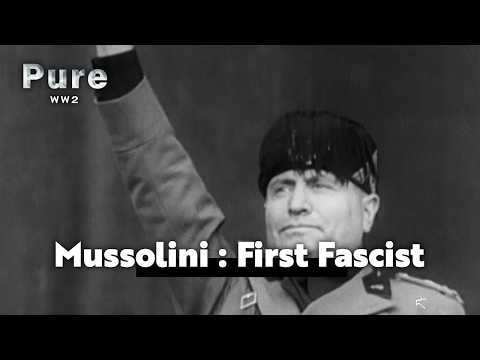
Mussolini’s genius was in his ruthlessness. He had once been one of them—a socialist agitator jailed for protesting Italy’s colonial war in Libya. But the trenches of 1917 had remade him. “Violence is not immoral,” he later wrote. “It is moral, sacred, and necessary when it removes a tumor.” And the tumor, in his eyes, was anyone who stood in his way.
By October 1922, the march had begun. Blackshirt columns advanced on Rome, while Mussolini waited in Milan, attending the opera as if nothing were amiss. “Either we take power, or we plunge into chaos,” he whispered to a confidant. The King, a timid man nicknamed “Little Ben,” feared civil war more than he feared the Fascists. When his prime minister begged him to declare martial law, he refused. Instead, he handed Mussolini the keys to the kingdom.
On October 29, 1922, the former street brawler from Predappio arrived in Rome in a black shirt and a bowler hat. He was greeted by the King and appointed Prime Minister. “If my father could see me now,” he murmured to his brother. It was a bloodless coup—a masterpiece of political theater.
But the real revolution had only just begun. Mussolini moved into the Chigi Palace and immediately took control of the Interior and Foreign Ministries. He smiled, embraced his former enemies, and promised moderation. “He’ll calm down soon,” the moderates told themselves. They were wrong.
Within a year, he had pushed through a new electoral law, and in 1924, his Fascists won a landslide—through intimidation, fraud, and murder. When the socialist deputy Giacomo Matteotti dared to denounce the violence, he was kidnapped and stabbed to death. His body was found two months later in a shallow grave. Italy was horrified. Mussolini nearly fell.
But he was cleverer than they knew. “Italy is more threatened than ever,” he declared after a bullet grazed his nose. “I must have full powers to defend the state.” The parliament, cowed, handed them over. In a single stroke, civil liberties were abolished, unions banned, and the press muzzled. Democracy in Italy was dead.
The new dictator, Il Duce, stood on his balcony and promised a new Roman Empire. He drained marshes, built towns, and made the trains run on time. He gave the people pride instead of freedom, and they cheered. “We are the best,” he told them. “We are strong. We are many.” And for a while, they believed him.
But the hunger for glory was never satisfied. In 1935, from the same balcony, he announced war on Ethiopia. “We will conquer,” he thundered. “We will make Italy great again.” The crowd roared. The world watched. And the first fascist prepared to drag his nation into the abyss.
The invasion of Ethiopia was not just a war—it was a spectacle. Mussolini poured men, money, and poison gas into the ancient kingdom, determined to prove that Italy could be an empire again. “We will make Ethiopia Italian,” he declared, and his generals obeyed with a ferocity that shocked even the Nazis.
From the air, his sons Vittorio and Bruno dropped bombs on villages and sprayed mustard gas over Red Cross camps. “It was fun,” Vittorio later wrote, a sentence that would haunt Italy for generations. On the ground, the Blackshirts executed prisoners and burned farms. The world condemned, but Mussolini shrugged. “The League of Nations is a paper tiger,” he sneered.
And the Italians, still hungry for glory, cheered louder than ever. They donated their wedding rings to the cause, melted down for the war effort. Children sang songs about the “little black-faced beauty” waiting for her Italian master. “God and history are with Mussolini,” wrote one student leader, and millions agreed.
But the victory in Ethiopia was only the beginning of a darker chapter. In 1936, Mussolini sent planes and troops to Spain to help General Franco crush the Republic. “We are fighting the same war everywhere,” he told his generals. “Bolshevism must be destroyed.” Italian bombers pounded Madrid, and Italian submarines sank neutral ships. The world watched in horror as the Duce’s ambitions grew.
That same year, he stood on a balcony in Milan and announced the birth of the Axis. “The Rome-Berlin line is not a line of division but a line of union,” he proclaimed, shaking hands with Hitler’s envoy. The two dictators had found each other, and Italy was now bound to the rising star of the Third Reich.
Hitler admired Mussolini deeply. “He is a genius,” the Führer said. “A man born once every thousand years.” And Mussolini, flattered, began to imitate his German pupil. He passed racial laws in 1938, stripping Jews of their citizenship and banning them from public life. “We must be strong,” he said. “We must be pure.” Even Margherita Sarfatti, his Jewish mistress and biographer, was pushed aside.
The Italians, who had never been particularly anti-Semitic, were confused. But they obeyed. “It’s just a phase,” some whispered. “He’ll calm down.” They had said the same thing in 1922.
By 1939, Mussolini was ready for the next act. When Hitler invaded Poland, Italy stayed out—for now. “I need a few months,” Mussolini told his generals. “I need to prepare.” But his ego was too large. When Germany seemed on the verge of victory, he declared war on France and Britain. “I only need a few thousand dead to sit at the peace table,” he said.
He was wrong. The war went badly from the start. Italian troops were routed in Greece, North Africa, and the Mediterranean. “We are not ready,” his generals warned. But Mussolini pushed on, desperate to prove himself Hitler’s equal. “I will break the Greeks,” he boasted. Instead, the Greeks broke the Italians.
And as the tide turned, the cracks in his regime began to show. The people were tired. The soldiers were dying. And the Duce, once a god, was becoming a burden.
By 1943, the dream had curdled into a nightmare. Allied bombers flew over Rome, and the factory workers in Milan—the same men whose strikes Mussolini had once crushed—whispered of peace. “The Duce has led us to ruin,” they muttered in the shadows of the Piazza del Duomo.
Mussolini, now balding and gaunt, refused to see it. He stood before the Fascist Grand Council in July and pleaded for loyalty. “I have served Italy for twenty years,” he said, his voice cracking. “I have never betrayed her.” But the men who had once groveled at his feet now voted against him. Even his son-in-law, Count Ciano, raised his hand to strip him of power.
The next day, King Victor Emmanuel summoned him to the Villa Savoia. Mussolini arrived in a black car, still expecting to be received as the head of government. Instead, the King told him he was dismissed. “The soldiers no longer trust you,” he said quietly. “You must resign.” As Mussolini walked out, a carabinieri officer stepped forward and took him into custody.
For a few weeks, Italy breathed. The new government arrested Fascist leaders, tore down portraits of the Duce, and opened negotiations with the Allies. But Hitler would not abandon his old friend. In September, German paratroopers swooped down on the Gran Sasso mountain and freed Mussolini from his prison. “I knew the Führer would not forsake me,” he wept.
Set up as the puppet ruler of a Nazi-backed republic in the north, Mussolini became a ghost of his former self. He lived in a villa on Lake Garda, surrounded by German guards and his mistress, Claretta Petacci. He spoke of writing his memoirs, of returning to journalism. But the war was closing in.
In April 1945, with the Allies advancing and the partisans rising, Mussolini tried to flee to Switzerland. He disguised himself as a German soldier, but a partisan patrol stopped the convoy near the village of Dongo. “Who are you?” they asked. When they pulled back his collar and saw the famous jaw, they knew.
He was taken to a farmhouse in the hills above Lake Como, along with Claretta. For a few hours, they sat in silence. “What will happen to us?” she asked. He did not answer. By the next afternoon, they were both dead—shot by a partisan firing squad, their bodies dumped in the Piazzale Loreto in Milan for the crowds to mock and mutilate.
So ended the life of Benito Mussolini, the blacksmith’s son who had dreamed of Roman glory and left his country in ruins. The crowds that had once roared for him now spat on his corpse. The balcony from which he had declared war on the world stood empty.
And in the villages of Romagna, where he had been born, the old socialists who had known him as a boy shook their heads. “He was one of us once,” they said. “Then he became something else.” The trains, they noted, no longer ran on time.
The story of Italy’s darkest chapter did not end with a single corpse in a Milan square. It seeped into the bones of a nation, into the silences at family tables and the nervous glances at old photographs. “We were all a little bit fascist,” the survivors would later admit, half-ashamed, half-defiant. The children who had sung songs about Ethiopia grew up to deny they had ever sung at all.
Teresa Virgali, whose father was beaten outside a cooperative tavern, never forgot the sound of boots on cobblestones. “They left him there like a broken chair,” she said. “And the next morning, the neighbors looked away.” That looking away—that was the real victory of Il Duce. He had taught Italians to fear each other more than they feared him.
Marta Padoni, the industrialist’s daughter who had once cheered from the balcony, spent her old age in a small apartment with a single framed photo of her father in his ridiculous hat. “He thought Mussolini would save us from the Russians,” she whispered. “Instead, we lost everything.” The factory was bombed. The fortune evaporated. And the man who promised order delivered only rubble.
Yet the ghost of the Duce did not vanish. In the decades after the war, new movements would rise, draped in the same black shirts and Roman salutes, whispering the same promises of greatness. “He was a genius,” some still say, forgetting the gas, the prisons, the bodies in the Piazzale Loreto.
History, as always, is written by those who survive to tell it. And the survivors of fascism—the ones who hid their politics, who fled to Paris, who sat in silent prisons on remote islands—they left us a warning. “It can happen here,” wrote the philosopher Gramsci from his cell. “It can happen anywhere, as long as people are afraid.”
So the question remains, hanging over the piazzas and the balconies and the empty train stations of Italy: When the next man with a loud voice and a simple answer steps forward, will we look away again?
Report this article
Select a reason for reporting:






