They told you about the Navy SEALs. They made movies about the Green Berets. They wrote books about the Rangers and the Marines. But there was another unit, one they never mentioned, one that didn’t exist officially. October 17th, 1966, somewhere in the Triple Canopy Jungle along the Cambodian border, three North Vietnamese officers sit around a field radio in a fortified bunker. They are laughing, smoking Chinese cigarettes, confident. Their regiment has been operating in this sector for 6 months without a single American contact. The jungle is their fortress. They are invisible.
At 3:47 hours, the laughter stops. One of them hears something. A sound that doesn’t belong. A branch breaking. Too deliberate. Too controlled. He reaches for his pistol. He never draws it. By 3:52 hours, 5 minutes later, all three officers are dead. Their radio is gone. Their maps are gone. Their codes are compromised. And the men who killed them have vanished back into the darkness like smoke. No shots fired. No witnesses, no evidence they were ever there. The North Vietnamese Army will file a report the next day. Cause of death unknown. Suspected infiltration by unidentified unit. Unidentified because officially that unit didn’t exist yet.
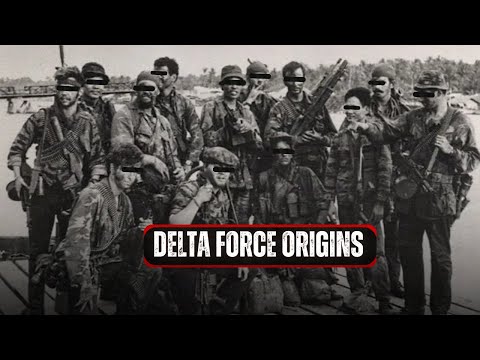
Delta Force wouldn’t be created for another 10 years. But in the jungles of Vietnam, in the shadows where the war was really fought, something was already being born. A unit with no name, no insignia, no records. A unit that would change special operations forever. This is not the story they taught you in school. This is not the war you saw on television. This is the story of the men who hunted in the dark. The reconnaissance units so classified that even their own government denied they existed. The operators who would become the blueprint for every elite unit that followed. This is the story of how Delta Force was really born. And it begins in a place where maps had blank spaces, where borders didn’t exist and where men disappeared without a trace. Welcome to the Ghost War.
Before we go further, you need to understand something. Everything you’re about to hear was classified for 50 years. The men who lived it were forbidden to speak. The missions they ran were erased from official records. The unit designations were changed, buried, redacted. Even now, decades later, some of these operators still can’t say what they did or where they did it. But the legend exists in whispers, in the smoke-filled rooms of Fort Bragg, in the quiet corners of CIA headquarters, among the Vietnamese who survived the war and still wake up wondering what hunted them in the darkness.
They called them ghosts. Phantoms who could move through triple canopy jungle without a sound, who could track enemy forces for weeks without being detected, who could kill from 300 meters with a suppressed rifle, who could vanish into terrain that would kill ordinary soldiers within hours. The enemy gave them a name: Maen, the Black Spirits. But their real designation was far more mundane: MACV-SOG, Military Assistance Command, Vietnam Studies and Observations Group. Studies and observations. That’s what they called it. Like they were academics taking field notes. The truth? MACV-SOG conducted the most dangerous missions of the Vietnam War. Cross-border raids into Laos, Cambodia, and North Vietnam. Prisoner snatches, assassinations, sabotage, reconnaissance so deep behind enemy lines that extraction wasn’t guaranteed. If you got caught, the US government would deny you existed.
And buried within MACV-SOG, there was an even more secret element, a pilot program testing tactics that would eventually become the foundation of Delta Force. They called it Project Delta. But before Delta became the legendary counterterrorism unit we know today, it was something else entirely: an experimental reconnaissance force that operated in the gray space between guerrilla warfare and conventional operations. And the men who ran it were building the playbook that every special operator today still studies.
To understand how Delta Force really began, you have to go back to 1964. Before the big battalions arrived, before the bombing campaigns, before the war became what everyone remembers. Back when it was still secret. Fort Bragg, North Carolina, summer 1964. Major Charles Beckwith, call sign Sergeant Charlie, sits in a classified briefing room with a handful of Special Forces officers. They have just returned from rotations with the British SAS in Malaya, where they observed counterinsurgency operations that made American tactics look primitive. Beckwith is frustrated, angry even. The US military is preparing to fight the Vietnam War like it’s World War III or Korea. Big units, conventional tactics, overwhelming firepower. But Beckwith has seen the future. He knows that kind of war can’t be won against an enemy that disappears into the jungle. He proposes something radical: a small, highly trained reconnaissance unit that can operate independently deep in enemy territory. No fixed bases, no artillery support, no safety net. Just intelligence, stealth, and precision violence.
The generals are skeptical. The CIA is territorial. But one man sees the potential: General William Westmoreland, soon to be commander of all US forces in Vietnam. Westmoreland authorizes a test unit. They call it Detachment B-52. Code name: Project Delta. On paper, it’s a reconnaissance unit attached to the 5th Special Forces Group. In reality, it’s a laboratory for a new kind of warfare.
December 1964, somewhere in the Central Highlands, the first Delta mission is a disaster. Six-man teams are inserted by helicopter into suspected Viet Cong territory. They are supposed to observe enemy movements, report back, and extract without contact. Within hours, half the teams are compromised. One team walks into an ambush and takes casualties. Another is spotted by enemy scouts and has to fight its way to an emergency extraction zone. The surviving teams return to base bloodied, exhausted, and convinced this tactic will never work. But Major Beckwith sees something the others don’t. The teams that survived did so because they adapted. They abandoned standard operating procedures. They moved like the enemy. Small groups, no trails, constant vigilance. They stopped trying to impose American military doctrine on the jungle and instead let the jungle teach them. Beckwith makes a decision. If Delta is going to work, they need to become something the US military has never produced before: not soldiers who fight battles, but hunters who find prey.
By mid-1965, Project Delta has evolved into something unrecognizable from its first failures. The men are different now. Leaner, quieter. They move through the jungle like smoke. No wasted motion, no unnecessary sound. Their gear has been stripped down to essentials. They’ve discarded standard-issue equipment in favor of weapons that don’t jam in the humidity, boots that don’t rot, rations that don’t smell. They have learned to become invisible.
But invisibility is not just about camouflage and silence. It’s about understanding the environment so completely that you become part of it. The Delta teams spend weeks in the jungle without resupply. They eat what the enemy eats. They move when the enemy moves. They study patterns: the times when guards change, the routes patrols use, the places where soldiers go to relieve themselves. They learn the jungle’s rhythms. And then they exploit them.
One Delta operator, Sergeant First Class Bill Lanning, will later describe it like this: “We didn’t hunt the enemy. We waited for them to come to us. We found their trails, their supply routes, their base camps, and then we set up in positions where we could watch for days without moving. When they passed by, we counted them, photographed them, memorized their faces, and then we decided whether to kill them or let them go.”
That last part is important. Delta teams operated under rules of engagement that gave them extraordinary discretion. They were not sent to fight. They were sent to gather intelligence. But if the intelligence indicated a high-value target—an enemy commander, a weapons cache, a communications hub—Delta had the authority to strike. And when they struck, it was surgical.
March 8th, 1966, Quang Nam Province. A six-man Delta team has been tracking a North Vietnamese battalion for 11 days. They have watched the enemy set up a forward headquarters in a valley surrounded by mountains. Supply trucks arrive every night. Officers meet in a fortified hut. The team leader radios back to base: “We have eyes on the target. Request permission to terminate.” Permission is granted.
That night at 0200 hours, the team moves in. They bypass sentries using routes the enemy has left unguarded because they believe the jungle is impenetrable. They reach the command hut. Two operators breach the entrance simultaneously—one from the front, one through the rear wall. Inside, four North Vietnamese officers sit around a map table, planning an offensive. They look up just in time to see muzzle flashes. Twenty seconds later, the Delta team is back in the jungle. They move two kilometers before stopping to transmit an after-action report: “Four enemy KIA. Maps and documents recovered. Exfiltrating.” By the time North Vietnamese reinforcements reach the command hut, the Delta team is five kilometers away, moving toward a pickup zone that doesn’t exist on any map. They vanish, and the enemy is left with a question they can never answer: Who were they?
Here’s what you need to understand. Delta didn’t just kill enemy soldiers. They terrorized them. Not through brutality—through precision and mystery. Imagine you’re a North Vietnamese soldier stationed in what you believe is a secure base camp. You have sentries. You have defensive positions. You have early warning systems. You feel safe. One morning, you wake up and discover that your commanding officer is dead in his bunker. No shots were heard. No alarm was raised. He’s just dead. Throat cut, map stolen, radio smashed. Who did this? You don’t know. You never see them. You never hear them. But they were there.
This happens again the next week. Different camp. Same result. An officer dead. Intelligence compromised. No evidence of how the attackers got in or out. Now multiply that across an entire region, month after month. Unpredictable. Unstoppable. What does that do to morale? What does that do to an army that prides itself on controlling the jungle? Delta understood something that conventional forces didn’t: in guerrilla warfare, perception is as important as firepower. If the enemy believes you are everywhere, if they fear that no position is secure, if they spend more time looking over their shoulders than planning offensives, you’ve already won half the battle.
But Delta didn’t just rely on stealth kills. They used deception, misdirection, psychological operations that blurred the line between reality and paranoia. One tactic: planting false intelligence. Delta teams would capture enemy documents, alter them with false operational orders, and return them where they could be recovered by NVA units. The enemy would follow the false orders, moving supplies to the wrong location, reinforcing positions that didn’t need reinforcement, wasting time and resources chasing ghosts.
Another tactic: exploiting superstition. Many NVA soldiers were deeply superstitious. Delta learned this and used it. They would leave bodies arranged in symbolic patterns. They would mark trees with signs that suggested the area was cursed. They would play recorded sounds through speakers hidden in the jungle. Voices of the dead, crying children, monks chanting funeral rites. The enemy believed the jungle was haunted. And in a way, it was.
But perhaps the most devastating tactic was something simpler. Silence. September 12th, 1967. Classified briefing room, Nha Trang Air Base. A Delta team is given an impossible mission. Intelligence has identified a high-value target: a North Vietnamese colonel coordinating supply operations along the Ho Chi Minh Trail. He is located in a base camp 15 kilometers inside Laos—a country where American ground troops are officially forbidden to operate. If the team is caught, the US government will disavow them. If they are killed, their families will be told they died in South Vietnam. There is no backup, no artillery support, no rescue if things go wrong. The mission is voluntary. Every man volunteers.
The team inserts via HALO jump—high altitude, low opening—30 kilometers from the target. They land in darkness, bury their parachutes, and begin a four-day movement through some of the most hostile terrain in Southeast Asia. They encounter enemy patrols twice. Both times, they let them pass within meters, remaining motionless for hours. On the fourth day, they reach the base camp. It is larger than expected: over 300 enemy soldiers, anti-aircraft positions, bunkers, a command complex surrounded by multiple security layers. The team leader makes a decision. Abort would be the safe choice. But this target is too valuable. They go in anyway.
At 0230 hours, two operators breach the command bunker. The North Vietnamese colonel reaches for his sidearm. A suppressed round drops him before his hand touches the grip. The team has 45 seconds before guards outside realize something is wrong. They use 30. Maps are photographed. Documents are stuffed into packs. The radio is rigged with explosives. At the 42nd mark, they exit through a rear wall they’ve cut open. At the 45th mark, the explosives detonate, destroying the radio and signaling the alarm. The base erupts. Soldiers pour from barracks. Searchlights sweep the jungle. Machine guns fire blindly into the darkness. But the Delta team is already gone.
Two hundred meters into the jungle, moving fast, disciplined, silent despite the chaos behind them. They move through the night, pursued by tracker teams, attack dogs, helicopters at dawn. But they are trained for this. They use streams to break scent trails. They set false tracks leading in wrong directions. They move through terrain so difficult that pursuing forces give up after two days. On the sixth day, they reach an extraction point on the South Vietnamese border. A helicopter lands. They board. They lift off. Mission complete.
The intelligence they recovered leads to the disruption of an entire NVA logistics network. Supply routes are bombed. Offensives are delayed. American lives are saved. But no one outside a handful of commanders will ever know what they did. No medals, no recognition, no official record—just another blank page in a classified file.
November 19th, 1977. Fort Bragg, North Carolina. Colonel Charles Beckwith, now older, hardened by years in Vietnam, briefs a small group of Pentagon officials on a proposal he’s been refining for over a decade. He calls it First Special Forces Operational Detachment—Delta. Delta Force. The mission profile is familiar: counterterrorism, hostage rescue, direct action against high-value targets. But the foundation—the tactics, the selection process, the operational philosophy—all of it comes from what Beckwith learned in Vietnam with Project Delta and MACV-SOG. The ability to operate independently in hostile territory, the emphasis on intelligence over firepower, the psychological warfare, the deception, the silence. All of it was born in the jungles of Southeast Asia, refined in the ghost war that officially never happened.
When Delta Force is officially activated in 1977, it doesn’t emerge from nowhere. It emerges from the lessons learned by men who hunted in the dark, who perfected the art of invisible warfare, who proved that a small team of highly trained operators could achieve what battalions could not. The blueprint was written in blood and silence. And that blueprint changed special operations forever.
Today, when you hear about Navy SEAL Team 6 or British SAS raids or any elite unit conducting classified missions in hostile territory, they are following the doctrine that Delta Force codified. But Delta Force itself was following a doctrine refined in Vietnam by units that never officially existed. The Ghost War created the modern special operator. And somewhere in the jungles of Laos, in the mountains of Cambodia, in the border regions where maps still have blank spaces, there are unmarked graves of men who died testing those tactics. Men whose names are still classified. Men whose families were told they died in training accidents or administrative incidents. They were the ghosts, and they built the legend.
So here’s the question you should be asking. If this much was classified, if these missions were buried for 50 years, if the men who ran them still can’t talk about what they did—what else don’t we know? How many other units operated in the shadows? How many missions are still redacted? How many names are carved into walls we’ll never see? The Ghost War didn’t end in Vietnam. It just went deeper underground. Delta Force became the public face of a capability that had existed for years in the shadows. And today, somewhere in the world, in places you’ll never hear about, operators trained in those same tactics are moving through the darkness, hunting, watching, waiting. They are the descendants of the ghosts, and they are still out there. The truth is always stranger than the legend, and the legend is just beginning.
This documentary was based on declassified records, eyewitness testimony, and operational reports released under the Freedom of Information Act. Many details remain classified. Some names have been changed. The missions described were real. What else are they not telling us?
Report this article
Select a reason for reporting:






