Dr. Amanda Foster had spent fifteen years studying the dead. Not in a morbid sense—she was a photography historian, an expert in Victorian postmortem portraits, those haunting images where the deceased were posed to look peacefully asleep. But nothing in her years of research prepared her for the photograph she found in a dusty corner of Williamson’s Antique Emporium in Salem, Massachusetts.
The albumen print was mounted on thick cardboard, its edges worn, its surface faded. Two young women in elaborate Victorian dress sat in a well-appointed parlor. The photographer’s mark read Hartwell & Son Fine Photography, Boston, 1890. On the back, in faded ink: “My dearest daughters, Margaret and Elizabeth. Forever in my heart, Mother.”
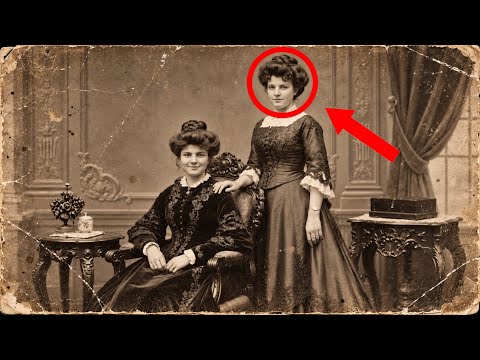
At first glance, it was a typical sister portrait. Margaret, the elder, sat in a carved chair, hands folded, her smile serene. Elizabeth stood beside her, one hand on Margaret’s shoulder, her expression equally gentle. But something prickled at the back of Foster’s neck—a whisper of wrongness she couldn’t name.
She looked closer. Margaret’s eyes seemed to engage with the camera, bright and alive. Elizabeth’s eyes, though open, held a glassy stillness. Her posture was rigid, her left arm hanging at an angle that felt… unnatural. And the lighting—Elizabeth’s face was lit differently, softer, as if extra powder had been applied to simulate a healthy glow.
Foster’s heart began to race. She had seen this before—in dozens of postmortem photographs. The careful positioning, the artificial coloring, the shallow depth of field that blurred the background to hide the mechanical supports. Elizabeth wasn’t standing. She was being held.
Foster’s hands trembled as she turned the photograph over again. The inscription said “daughters,” plural. But only one of them had been alive when the shutter clicked.
She dove into the archives. Hartwell & Son had been one of Boston’s most prestigious studios, known for their sensitive and skillful memorial portraits. The studio’s ledger for October 1890 contained an entry that made Foster’s blood run cold: “Whitman family, memorial portrait. Miss Elizabeth and Miss Margaret, special arrangements, extended session required. Father’s request for natural appearance.”
Thomas Hartwell’s personal journal revealed the truth. Elizabeth had died of consumption three days before the session. Her father, Dr. Jonathan Whitman, a respected physician, had insisted on a final portrait with her surviving sister—one that would show both daughters as they had been in life. Hartwell had used theatrical cosmetics, glass eye supports, and careful lighting to restore Elizabeth’s complexion and simulate life.
“Miss Margaret appeared deeply distressed throughout the session,” Hartwell had written, “struggling to pose naturally beside her deceased sister while maintaining the composure necessary for a successful photograph.”
The session had lasted over three hours. Margaret had needed frequent breaks to compose herself. And the final image—the one Foster now held—was so convincing that it had fooled everyone for over a century.
But the story didn’t end there. Foster tracked down Margaret’s personal diary, preserved by her descendants in Concord. The entries from October 1890 painted a picture of psychological torment.
“Father studies the finished photograph constantly, speaking to Elizabeth’s image as though she were present in the room,” Margaret had written. “I worry that such realistic memorial images prevent us from accepting the finality of death.”
Margaret had suffered nightmares for months, haunted by dreams where Elizabeth appeared alive but silent. By 1893, she had fled to a teaching position in Vermont, desperate to escape the photograph’s grip on their home.
Foster sat back, the weight of the discovery pressing down on her. This wasn’t just a rare example of Victorian memorial photography. It was a warning—a beautiful, terrible image that had preserved a sister’s love while destroying a family’s chance to grieve.
But there was one more thing. In Hartwell’s later correspondence, he had written of his growing doubts about such lifelike memorials. “I question whether my skill serves the family’s long-term emotional welfare,” he had confessed to a colleague. By 1891, he had begun refusing commissions that required extreme measures to simulate life.
Foster looked at the photograph again. Margaret’s smile, so natural at first glance, now seemed strained—a mask of composure over unspeakable pain. And Elizabeth’s glassy eyes, frozen in an illusion of life, seemed to stare back with a silent plea.
What had Margaret whispered to her sister during those three hours? What had Dr. Whitman seen when he looked at the image—his daughter restored, or his failure to save her? The answers lay buried in the archives, waiting for someone to piece together the rest of the story.
Foster returned to the Whitman file with a new question burning in her mind: what had happened to the photograph itself? Margaret’s diary mentioned the portrait hanging in the family parlor, but the trail went cold after 1893. If the image had passed through generations of Whitmans, why had it ended up forgotten in an antique shop in Salem?
The answer, it turned out, was buried in a probate record from 1954. Margaret had died unmarried in Concord, and her estate had been modest—a few pieces of furniture, books, and a locked writing desk. The photograph was not listed among her possessions. Instead, a separate codicil in her will instructed that a certain item be “destroyed upon my death, and not passed to any family member.”
But the executor had disobeyed. A handwritten note in the margin, signed by Margaret’s great-nephew, admitted that he had opened the desk out of curiosity and found the portrait inside. “I could not bring myself to burn it,” he had written. “It seemed too beautiful to destroy, and yet too painful to keep.” He had donated it anonymously to a Boston estate sale in 1955, where it began its slow drift through attics and junk shops until it landed in Salem.
Foster set down the probate file and stared at the ceiling. Margaret had spent her entire adult life trying to escape that image. She had moved across state lines, built a career, outlived her father—and still, at the end, her final wish was to erase it from the world. And someone had ignored her.
There was one more thread to pull. Foster had noticed something odd in Hartwell’s ledger—a second entry, dated just six months after the Whitman session, marked simply “Whitman, follow-up consultation. No sitting.” No photograph had been taken. So why had Dr. Whitman returned to the studio in April 1891?
Hartwell’s appointment book, held in a private collection at the George Eastman Museum, contained a brief note in the photographer’s hand: “Dr. W. came to discuss alteration of the memorial portrait. Requested that Miss Elizabeth’s expression be changed—less smiling, more solemn. I refused. The plate cannot be safely reworked without damage.”
Foster’s breath caught. Dr. Whitman, the man who had demanded a lifelike image, had come back wanting to make his dead daughter look dead. Something had shifted in those six months. She dug through his medical journal entries from early 1891 and found the confession she had been waiting for.
“I have begun to see Elizabeth’s face not as a comfort but as an accusation,” he had written. “The portrait smiles at me from the parlor wall, and I find myself unable to pray for her soul, because some part of me still believes she is merely resting. I have confused memory with presence, and I do not know how to undo it.”
Hartwell had refused the alteration. The plate was too fragile, the risk of destroying the image too great. And so the photograph had remained exactly as it was—a smiling ghost that Dr. Whitman could neither correct nor remove. He had died in 1897, five years after Margaret fled, still speaking to the image in the parlor.
Foster closed the file. The portrait on her desk was no longer just a technical marvel or a cautionary tale. It was a document of a family trapped between love and denial, and of a photographer who had learned, too late, that some illusions are too perfect to bear.
She picked up her phone and dialed the Smithsonian’s conservation lab. “I need one more analysis,” she said quietly. “I want to know exactly what Margaret was looking at when the shutter finally closed.”
The results arrived three weeks later, and they were not what Foster had expected. The conservation team had focused on Margaret’s eyes—specifically, the direction of her gaze in the final exposure. Under magnification, the truth emerged: Margaret was not looking at the camera at all. Her pupils were angled downward and to the left, fixed on a point just below Elizabeth’s shoulder.
She was looking at her sister’s hand.
Foster cross-referenced this with Hartwell’s session notes. The photographer had recorded that Margaret’s hand had been positioned on Elizabeth’s shoulder for the final exposure—but the glass plate showed her fingers slightly curled, not resting flat. The gesture was deliberate. Margaret had been holding something.
Foster enlarged the image and studied the shadow beneath Margaret’s fingers. There, barely visible against the navy silk, was a thin dark line—a strand of hair. Elizabeth’s hair, arranged by the family, had been woven into a small braid and tucked beneath Margaret’s hand at the last moment.
It was Margaret’s own private rebellion. Her father had demanded a portrait of two living daughters. Hartwell had delivered an illusion. But Margaret, in the final seconds before the shutter closed, had pressed her fingers around a lock of her dead sister’s hair—a gesture of grief so small it had gone unnoticed for over a century.
She had found a way to say goodbye that no one could take from her.
Foster sat back, her eyes stinging. For all the harm the photograph had caused, for all the years Margaret had spent fleeing its grip, there had been one moment of truth preserved in the silver emulsion. A living sister, touching the dead, refusing to pretend.
She thought of Dr. Whitman, begging Hartwell to make Elizabeth look less alive. She thought of Margaret’s will, demanding the image be destroyed. Neither of them had ever noticed what Margaret’s own hand had done.
Foster picked up her pen and began to write. The Whitman portrait would need a new caption when it went on display—one that acknowledged not just the technical mastery and the psychological damage, but the quiet act of love hidden in plain sight.
She had one more call to make. The descendant who had disobeyed Margaret’s final wish—the great-nephew who couldn’t bring himself to burn the photograph—was still alive, now in his eighties, living in a retirement home outside Worcester. Foster had his number. She wanted to tell him that his disobedience had not been a betrayal after all.
It had been the only thing that saved the truth.
Foster drove to Worcester on a gray Tuesday in November. The man’s name was Arthur Whitman, and he met her in a sunroom that smelled of instant coffee and old paper. When she placed the photograph on the table between them, he did not flinch.
“I’ve seen it before,” he said quietly. “In my dreams, mostly.”
She told him about the braid, the curled fingers, the goodbye hidden for a century. Arthur was silent for a long moment. Then he laughed—a cracked, astonished sound. “She never told anyone,” he said. “Not once.”
Foster left the photograph with him. It belonged to the family, she decided, not to a museum case. Arthur promised to write a letter for the Smithsonian exhibit—one that named Margaret not as a victim, but as a woman who had outwitted grief itself.
On the drive home, Foster thought about all the images still waiting in attics. How many held quiet rebellions no one had ever noticed?
What small act of love might be hiding in a photograph you’ve overlooked?
Report this article
Select a reason for reporting:






