The USS Gerald R. Ford, a $13 billion marvel of modern engineering, sliced through the Atlantic swells off Jacksonville, Florida, on August 8, 2021. As the lead ship of her class, she was undergoing shock trials—simulated explosions designed to test her mettle against the chaos of war. This floating fortress, with its electromagnetic catapults and advanced radar, represented the pinnacle of American naval power. Yet, exactly 110 years earlier, in a humble Californian shipyard, the seeds of this legacy were sown. It all began with a ship that was never meant to fight, but would change the face of naval warfare forever: the USS Langley.
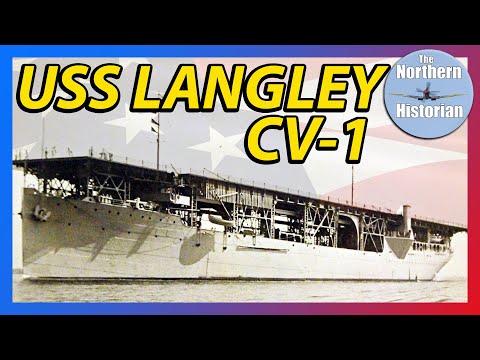
In the waning days of World War I, the airplane had proven its worth as a weapon of war. The British Royal Navy, quick to recognize this, had already commissioned HMS Argus, the world’s first full-length flight deck aircraft carrier, in September 1918. Across the Atlantic, the United States watched with keen interest. The US Navy had used aviation for scouting and anti-submarine patrols, but now they wanted more—they wanted planes at sea. Rather than build from scratch, they looked to an unlikely candidate: a collier, a ship designed to carry coal.
The USS Jupiter was one of four Proteus-class colliers, built to ferry fuel to the fleet. Laid down in 1911 at Mare Island Naval Shipyard, she was a sturdy vessel, 542 feet long, with a turbo-electric transmission that gave her a top speed of 15 knots. She served in the Pacific and was the first ship to transit the Panama Canal from west to east. In 1917, she carried a naval aviation detachment to England—a hint of her future role. After the war, with coal-fired ships being converted to oil, Jupiter became surplus. It was then that Lieutenant Commander Kenneth Whiting, a persistent advocate for naval aviation, saw an opportunity.
Whiting had been pushing for aircraft carriers since 1916, but his proposals were rejected. After the war, however, he found himself in a position of influence at the Chief of Naval Operations. Along with other aviation pioneers, he lobbied the General Board, and in April 1919, they recommended converting Jupiter into an aircraft carrier. Congress agreed on July 11, 1919. The collier was renamed USS Langley, after aviation pioneer Samuel Pierpont Langley, and designated CV-1.
Jupiter was decommissioned on March 24, 1920, at Norfolk Naval Shipyard, and conversion began. The Washington Naval Treaty, which would limit battleship construction, allowed exceptions for experimental carriers. Langley was perfect: her large coal holds could store aircraft, and her size was adequate for testing. Her two smokestacks were reconfigured to the sides to accommodate a full-length flight deck, equipped with a catapult, arresting gear, and an elevator. Her armament was upgraded to four 5-inch guns. On March 20, 1922, USS Langley was recommissioned under the command of—fittingly—Commander Kenneth Whiting.
As the first American aircraft carrier, Langley was a floating laboratory. On October 17, 1922, Lieutenant Virgil C. Griffin flew a Vought VE-7 off her deck—the first launch. Nine days later, Lieutenant Commander Godfrey de Courcelles Chevalier made the first landing in an Aeromarine 39B. On November 18, Whiting himself became the first US naval aviator to be catapulted from a carrier. In early 1923, Langley conducted extensive flight operations in the Caribbean, honing techniques that would become standard. That June, she sailed up the East Coast on a publicity cruise, showcasing her capabilities to dignitaries and the public. Takeoffs and landings became the star attraction, though it was learned that a carrier at anchor with little headwind made non-catapult launches tricky—but the pilots of the VE-7s were confident.
After repairs and modifications at Norfolk, Langley headed to San Diego in November 1924 to join the Pacific Battle Fleet. For the next 12 years, she trained pilots and conducted experiments, with a brief excursion to Guantanamo Bay in 1927. But by 1936, her days as a carrier were over. The Vinson-Trammell Act lifted restrictions but imposed new ones, and to free up tonnage for new carriers, Langley was converted into a seaplane tender. Her flight deck was halved, and on April 11, 1937, she was redesignated AV-3. It seemed a step back, but she remained busy, operating off Alaska, Seattle, Pearl Harbor, and California. In 1939, she was ordered to the Philippines to join the Asiatic Fleet, arriving on September 24.
When the Japanese attacked Pearl Harbor on December 7, 1941, the United States was thrust into a global war. USS Langley, now a seaplane tender, was stationed in the Philippines. The next day, Japan invaded the islands, forcing Langley to flee Cavite. She sailed first to Balikpapan in the Dutch East Indies, then to Darwin, Australia, arriving on January 1, 1942. There, she joined the Allied naval coalition—American, British, Dutch, and Australian forces—and began anti-submarine patrols alongside the Royal Australian Air Force.
In February 1942, Langley was ordered to Fremantle, Western Australia, to collect 32 Curtis P-40 Warhawk fighters of the Far East Air Force, along with pilots and ground crews. At Fremantle, she rendezvoused with the cargo ship Sea Witch, which carried 27 more P-40s. They were to join convoy MS 5 bound for Ceylon, escorted by the light cruiser USS Phoenix and Australian troop transports Katoomba and Duntroon. The convoy set sail on February 22, 1942.
En route, Langley and Sea Witch received new orders: leave the convoy and head for Tjilatjap in Java to deliver their cargoes. On the morning of February 27, Langley was met by the destroyers USS Whipple and USS Edsall, dispatched from Java to escort her into port. But high above, a Japanese reconnaissance aircraft spotted the formation and relayed their position.
At 11:40 a.m., 75 miles out of Java, 16 Mitsubishi G4M bombers and 15 A6M Zero fighters began their attack. During the first two bomb runs, Langley’s crew managed to evade the falling ordnance. But on the third run, the Japanese dropped all remaining bombs across every possible evasive course. Try as she might, Langley could not avoid being hit—five times, by a mix of 550-pound and 130-pound bombs. Sixteen crew members were killed. The flight deck erupted in flames, steering failed, and she took on a 10-degree list to port. Her engine room flooded rapidly, and she came to a dead stop.
At 1:32 p.m., the order was given to abandon ship. USS Whipple took on 308 survivors, USS Edsall another 177. Fearing Langley might fall into enemy hands, the escorting destroyers fired nine 4-inch shells and two torpedoes into her hull at 2:29 p.m., sending the veteran collier and pioneering aircraft carrier to the bottom of the sea.
The survivors were transferred to the oiler USS Pecos, which had arrived to assist. But as Pecos sailed for Australia, she too came under attack by Japanese carrier aircraft. Over the course of a couple of hours, three attacks left Pecos sinking. Hearing the distress calls, USS Whipple raced to the scene and rescued 232 survivors. Approximately 400 men were still in the water, visible to Whipple, but the possible presence of enemy submarines forced the agonizing decision to abandon them and return to Australia. USS Edsall, carrying 31 Army Air Force pilots rescued from Langley, also responded to the distress calls but was attacked by Japanese battleships and sunk with all hands—either lost at sea or captured and killed as prisoners of war.
USS Langley’s end was tragic, with the loss of so many brave men. Yet her legacy endured. She had been the cradle of American naval aviation, the proving ground where carrier tactics were born. From her humble beginnings as a coal-hauling collier, she had launched the first American carrier aircraft, trained the first generation of naval aviators, and paved the way for the mighty carriers that would win the Pacific War. As the USS Gerald R. Ford completed her shock trials in 2021, the spirit of Langley lived on—a reminder that even the most unassuming vessel can change the course of history.
The news of Langley’s sinking reached the corridors of power in Washington within days, but the full weight of the disaster would not be understood for weeks. In the cramped, humid operations rooms of the Asiatic Fleet headquarters in Java, the loss of the old carrier and her precious cargo of P-40 fighters was a bitter blow. The planes had been meant to reinforce the desperate Allied air defense of Java, but now they lay at the bottom of the Indian Ocean, along with dozens of pilots and ground crew who had never fired a shot in anger.
Lieutenant Commander Whiting, long since retired from active duty, was by then a rear admiral working on the Navy’s aviation training programs. When he received word of Langley’s fate, he sat in silence for a long moment in his office overlooking the Potomac. “She was never meant to be a warship,” he reportedly said to his aide. “But she taught us everything we know. And now she’s gone.” He pulled out a worn photograph of the old collier’s flight deck, crowded with the fragile Vought VE-7s of another era, and placed it on his desk.
Yet the story of Langley’s final voyage did not end with her sinking. In the chaos of the Java Sea campaign, the survivors scattered across the Pacific. The men rescued by USS Whipple were taken to Fremantle, where they were reassigned to other ships and shore stations. Some of them would go on to serve aboard the new carriers—the Lexington, the Saratoga, the Yorktown—that Langley had helped make possible. Others would never speak of the sinking again, carrying the memory of the burning flight deck and the men left in the water silently for the rest of their lives.
Among the survivors was Chief Petty Officer Harold M. Briggs, a machinist’s mate who had been below decks when the bombs struck. He had escaped the flooding engine room by climbing through a ventilation shaft, emerging onto the hangar deck just as the abandon ship order was given. In a letter home, written weeks later from Australia, he described the moment: “I looked back at her as we pulled away in the whaleboat. She was listing hard to port, smoke pouring out of her. And I thought about all the young pilots she’d trained, all the ones who went on to fly off the big carriers. She was old and slow, but she did her job. She did her job right to the end.”
The Japanese, for their part, believed they had struck a significant blow. Their reconnaissance reports had misidentified Langley as a much larger carrier, and the destruction of the P-40s was a genuine strategic victory. But they could not know that the old seaplane tender’s greatest contribution to the war effort had already been made—not in the cargo she carried, but in the generation of aviators she had shaped.
Back in Washington, Admiral Ernest J. King, the Chief of Naval Operations, reviewed the after-action reports with a grim expression. The loss of Langley, Pecos, and Edsall in a matter of days had cost the Navy hundreds of experienced men and precious aircraft. But King, a hard man who rarely showed emotion, saw something else in the reports as well. The escorting destroyers had fought valiantly. The survivors had been rescued under fire. And the old carrier, despite her age and vulnerability, had gone down swinging.
“Langley was the first,” King wrote in a memorandum to the General Board. “She proved the concept. She trained the men. She carried the fight to the enemy when we had little else to send. Her loss is a blow, but her legacy is the fleet we are building today.”
And that fleet was growing. In shipyards from Norfolk to Bremerton, the Essex-class carriers were rising from their slipways, their flight decks flat and wide, their hangars packed with Hellcats and Avengers. The lessons learned aboard Langley—the tricky non-catapult launches, the arresting gear that had to be perfected, the delicate ballet of moving aircraft from hangar to flight deck—were built into every inch of these new ships. The old collier’s ghost haunted them all, in the best possible way.
By the summer of 1942, the tide of war in the Pacific had begun to turn. At Midway, the carriers Yorktown, Enterprise, and Hornet would meet the Japanese fleet in a battle that would change history. None of those ships had ever sailed with Langley, but every pilot in their cockpits had trained on the techniques she had pioneered. The flat-top was no longer an experiment. It was the backbone of American sea power.
By 1943, the Essex-class carriers were entering the Pacific in force, their flight decks crowded with Hellcats and Avengers. The lessons of Langley—the catapult launches, the arresting gear, the delicate choreography of hangar and flight deck—had become doctrine. Every aviator who flew from those new carriers stood on the shoulders of the old collier.
In 1947, a small ceremony was held at Norfolk Naval Shipyard. A plaque was unveiled near the dry dock where Jupiter had been converted. It read simply: “USS Langley, CV-1. She showed us the way.” Among the attendees was a gray-haired retired admiral—Kenneth Whiting. He stood alone for a long moment, then saluted.
Today, the USS Gerald R. Ford carries the legacy forward, but the question remains: when the next revolution in naval warfare arrives, will we remember the humble collier that dared to become something more?
Report this article
Select a reason for reporting:






