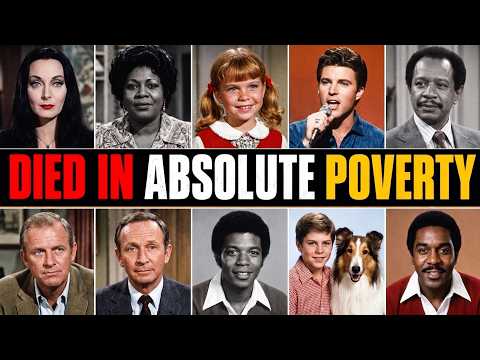
You grew up watching these faces. The neighbors, the teachers, the wisecracking kids, and the gruff sergeants who filled out the world around your favorite classic sitcoms. Last time, we covered 15 stars whose fame never translated into lasting security. Today, 15 more. And if anything, some of these stories are even harder to sit with.
Before we get into it, hit subscribe and turn on notifications because these are the kinds of stories that rarely make it into the retrospectives and reunion specials.
Here are 15 more classic sitcom stars who died in poverty.
Number one, Rusty Hamer. We start with one of the most heartbreaking child star stories in television history. Rusty Hamer spent over a decade as Rusty Williams, the wisecracking son of Danny Thomas on Make Room for Daddy, one of the most popular family sitcoms of the 1950s and early 1960s, a show that ran for well over a decade and made Hamer’s wisecracking delivery instantly recognizable to viewers of every age.
When the show ended, the transition into adult roles simply never came. A brief attempt at a comeback in 1970 with the follow-up series Make Room for Granddaddy lasted only one season. And after that, the parts dried up almost entirely, leaving him with occasional bit roles on shows like Green Acres and increasingly long stretches with no acting work at all. The exact kind of gap that so many former child stars of his generation struggled to bridge once the industry decided they’d aged out of usefulness.
Hamer eventually moved to Louisiana, far from the industry that had once employed him constantly, and took a job as a short order cook just to make ends meet, a quiet, anonymous existence that stood in sharp contrast to the years he’d spent as one of the most recognized young actors on American television. Chronic back pain from old injuries compounded his depression over never being able to reclaim the career he’d had as a child. A career that had once made him one of the most familiar young faces on American television, appearing alongside Danny Thomas for over a decade as the show grew into one of the biggest family sitcoms of its era.
On January 18th, 1990, at just 42 years old, Hamer died of a self-inflicted gunshot wound in Ditter, Louisiana. A devastating end for a performer who had once been a fixture in millions of American living rooms every single week. His death barely registering as news outside of dedicated classic television circles by that point in his life.
Number two, Fred Berry. Fred Berry became an instant icon as Rerun, the joyful roller-skating dancer on What’s Happening!!, bringing a physical comic energy to the show, complete with his trademark overalls and beret that made him one of its most beloved and instantly imitated characters. Offscreen, Berry struggled for years with addictions to drugs and alcohol, compounded by overeating and depression, a combination that reportedly cost him more than a million dollars over the following years. Money that should have provided decades of financial security and left his once thriving acting career almost completely stalled, just as it should have been building toward bigger roles.
Before television ever made him famous, Berry had already built a reputation as a genuinely gifted street dancer. And it was that same physical charisma that made Rerun such an instant fan favorite the moment the show premiered. After finally entering treatment, Berry found that consistent film and television work simply wasn’t there anymore. And he spent years earning money through shopping mall appearances and small regional bookings rather than the kind of steady sitcom paychecks that had once defined his career at the peak of the show’s popularity.
He survived three separate suicide attempts during the darkest years of his struggle before eventually finding stability as a Baptist minister and motivational speaker in Madison, Alabama, using his own story of addiction and recovery to try to help others avoid the same downward spiral. Berry suffered a stroke and died on October 21st, 2003 at just 52, having spent his final years rebuilding a quiet, modest life far removed from the fame that had once made him a household name to an entire generation who grew up watching him dance across their television screens.
Number three, Mabel King. Mabel King brought booming comic authority to the role of Mama on What’s Happening!! following an already celebrated career that included originating the role of the Wicked Witch of the West in the Broadway production of The Wiz, a production that ran for years and became a genuine cultural landmark of 1970s Black Theater. Behind the scenes, playing a character audiences adored for her booming voice and no-nonsense warmth, King was fighting a long, brutal battle with diabetes that slowly took apart her body piece by piece over the better part of two decades. The kind of prolonged medical crisis that quietly drains both a person’s health and their finances at the exact same time.
She lost a toe to amputation in 1986, her left leg in 1991, her right leg in 1994, and eventually an arm as well. A series of medical losses spread across nearly a decade on top of a stroke in 1989 that left her paralyzed on one side and unable to speak for over a year. King had earned real critical respect before television ever made her a household name, picking up a Drama Desk Award nomination for her original Broadway performance in The Wiz, a level of serious theatrical recognition that made her later years of illness and isolation feel even more jarring by comparison.
King spent her final years largely out of the public eye, relying on dialysis to survive as her kidneys slowly failed. When she died on November 9th, 1999 at 66, her death was so disconnected from the industry that had once employed her that it wasn’t even announced for two weeks. And many of the colleagues she had worked alongside for decades never found out in time to attend her funeral. A genuinely heartbreaking measure of just how completely Hollywood had moved on from a woman who had once shared scenes with Michael Jackson and Diana Ross in one of the most expensive films of its era.
Number four, Ricky Nelson. Ricky Nelson grew up in front of American audiences on The Adventures of Ozzie and Harriet, one of the longest-running sitcoms in television history, before becoming a genuine teen idol and successful recording artist in his own right, scoring multiple number one hits and later a Grammy-nominated comeback single called “Garden Party” that reflected on his own complicated relationship with fame. Despite decades of steady fame, Nelson’s finances were in serious trouble by the time of his death, weighed down by a costly divorce settlement and the mounting expenses of keeping his touring operation running. Costs that a working musician in his mid-40s, however famous his name still was to an older generation of fans, could no longer keep pace with on his own without the studio-backed income that had supported him as a young man.
By the time of his death, Nelson had spent virtually his entire life in the public eye, having grown up on one of the longest-running family sitcoms in American history before topping the music charts repeatedly as a teenager and young adult. On December 31st, 1985, Nelson died at 45 when the touring plane he and his band were flying in caught fire and crashed outside De Kalb, Texas, killing everyone aboard. When his estate was finally settled, it turned out to be $4.5 million in debt. So deep in the red that his own recording catalog and the beloved 435 episodes of Ozzie and Harriet were at risk of being sold off entirely just to satisfy creditors. His twin sons refused to file for bankruptcy and instead spent the next decade working to pay down their father’s debts themselves. A burden that outlived Nelson by years and stood in stark contrast to the wholesome, financially secure family image Ozzie and Harriet had spent over a decade selling to American audiences.
Number five, Tommy Rettig. Tommy Rettig was the very first boy to appear alongside Lassie on television, playing Jeff Miller for three seasons starting in 1954 in a role that made him one of the most recognizable child stars in America at a time when the show was consistently one of the most watched programs on television. After leaving the show, Rettig found that adult acting roles almost never materialized. And unlike performers who came after him, he received no meaningful residual payments from a series that went on to become one of the most successful syndicated reruns in television history, airing continuously for decades in markets across the entire country. While the boy who had helped make it a hit saw almost none of that ongoing revenue.
Rettig had been chosen for the role of Jeff Miller out of more than 500 boys who auditioned, a level of early success that made his adult struggles all the more striking by comparison. His life afterward grew increasingly difficult, including arrests and convictions tied to growing marijuana and importing cocaine, a bankruptcy, and a divorce, while he cycled through jobs as a photographer, a tool salesman, a computer programmer, and a health club manager just to stay afloat. An unusually varied resume for a man who had once been one of the most famous child actors in the country. His face recognized instantly by an entire generation who had grown up alongside him and his canine co-star on a farm that felt like a second home to viewers every week. Tommy Rettig died of a heart attack on February 15th, 1996 at 54, having spent decades working ordinary jobs far removed from the fame that once made him a household name to an entire generation of television viewers who could still picture his face the moment his name came up.
Number six, Sherman Hemsley. Some of these stories involve stars who worked for decades. This one is a reminder that even decades of steady work are no guarantee. Sherman Hemsley became a genuine television icon playing George Jefferson, first on All in the Family and then for a decade on his own hit spin-off, The Jeffersons, one of the most successful sitcoms of its era, remembered as much today for its theme song about moving on up as for Hemsley’s sharp, high-energy performance at the center of it.
Despite that level of long-term success, Hemsley reportedly ran into serious financial difficulties later in life, and was ultimately forced to sell off the rights to his own future residual income just to cover his debts. A decision that would trigger a legal fight between the buyers of those rights that dragged on for years after his death, with the Screen Actors Guild eventually forced to simply hold his remaining residuals in limbo, unable to pay anyone until the courts finally sorted out who actually owned the rights to money Hemsley himself had earned decades earlier. Hemsley had become so associated with the phrase describing his character’s rise to a deluxe apartment in the sky that it defined an entire era of American sitcom culture, making the financial reality of his final years an especially stark contrast to that lasting image of triumphant upward mobility.
When Hemsley died of lung cancer on July 24th, 2012, his estate was valued at little more than $50,000. An almost unbelievably small sum for an actor whose face was still airing in reruns on channels around the world every single day, generating ongoing revenue for networks and syndicators that had nothing left to do with the man who had made the show a hit in the first place and everything to do with the character he had spent a decade bringing to life. The dispute over his will and his remaining residual payments grew so contentious that his body couldn’t even be buried until four months after his death. A strange and undignified coda for a performer who had once been one of television’s most beloved leading men. His own body left waiting in a funeral home while lawyers argued over money he should have had decades earlier while the show was still at the height of its popularity.
Number seven, Anissa Jones. Anissa Jones charmed the country as Buffy on Family Affair, one of television’s most adored young characters. When the series ended in 1971, Jones, only 13, found herself typecast so completely that legitimate film work never came. At 18, she received close to $200,000 held in trust, money she reportedly spent almost immediately as her struggles with drugs worsened.
On August 28th, 1976, she never woke up the next morning, dead at just 18 from a massive overdose. Her story remains one of the starkest examples of how little protection existed for former child stars once the cameras stopped rolling.
Number eight, Trent Lehman. Lehman played Butch Everett on Nanny and the Professor, then watched steady work disappear. By January 1982, unemployed and withdrawn, he was found dead at just 20, having hanged himself outside an elementary school in Pacoima, California.
Number nine, Andrew Koenig. Koenig played Boner Stabone on Growing Pains, then spent years battling lifelong depression. His body was found in Stanley Park on February 25th, 2010 at 41 after he took his own life.
Number ten, Carolyn Jones. Jones was an Oscar nominee before becoming Morticia Addams. Diagnosed with colon cancer in 1981, she was so broke that producer Aaron Spelling personally supported her final illness. She died on August 3rd, 1983 at just 53.
Number eleven, Ed Platt. Platt’s death in 1974 was reported as a heart attack. Years later, his son revealed the truth: Platt had taken his own life after at least two previous attempts.
Number twelve, McLean Stevenson. Stevenson left MASH at its peak, convinced audiences loved him. Both of his follow-up series were cancelled within a season. He died on February 15th, 1996 at 68, worth a fraction of what his co-stars earned from residuals.
Number thirteen, Demond Wilson. Wilson walked away from Sanford and Son, disillusioned that he and his castmates were paid so little from one of the decade’s biggest hits. He spent four decades as a minister. He died on January 31st, 2026 at 79.
Number fourteen, Norman Fell. Fell won a Golden Globe as Mr. Roper, then refused the endless grumpy-landlord retreads. His savings ran dry, and he spent his final years at the Motion Picture and Television Fund retirement home. He died there on December 14th, 1998 at 74.
Number fifteen, Lloyd Haynes. Haynes was named television’s teacher of the year in 1970 for Room 222, yet never landed another major starring role. He died of lung cancer on December 31st, 1986 at just 52, his small funeral attended by only a handful of former colleagues.
What connects nearly all of them is the same quiet pattern: enormous value extracted during their peak years, and almost nothing offered back once that value stopped flowing. The industry simply moved on to its next familiar face.
Which of these 15 stories affected you the most, and is there a familiar face from your own childhood television you’d like us to look into next?
Report this article
Select a reason for reporting:






