The basement archive of the Greenwood County Historical Society smelled of old paper and dust, a scent that clung to James Mitchell’s throat as he sifted through the final box of the day. At 4:30, with the archive closing in half an hour, the 38-year-old genealogist from Chicago reached for a leatherbound ledger labeled Miscellaneous Personal Effects, 1918–1925. Inside, wrapped in crumbling tissue paper, lay a stack of photographs damaged by time and humidity. Then he saw it.
The photograph was remarkably preserved, mounted on thick cardboard. The studio stamp read Crawford Photography, Greenwood, Mississippi, March 1920. It showed a formal family portrait: a black couple seated in the center, dignified in their finest clothes. The man wore a pressed dark suit, his expression steady and proud. The woman’s hands rested gracefully in her lap, her dark dress immaculate, her eyes meeting the camera with quiet strength. Three children stood with them—two girls about eight and ten in white dresses with ribbons in their braided hair. But it was the third child that made James freeze. Between the two girls stood a boy of about seven. His skin was pale. His hair was light brown and wavy. Even in the sepia tones, his eyes were clearly light colored. The boy was unmistakably white.
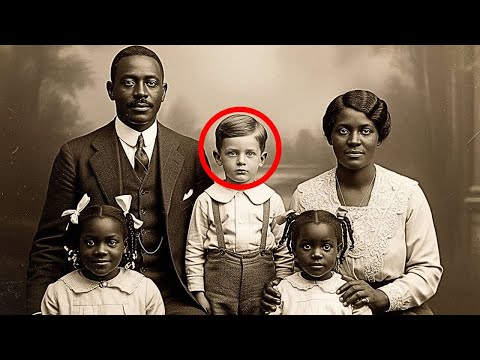
James leaned closer, examining every detail. The boy stood naturally, the man’s hand resting protectively on his shoulder. There was no awkwardness, no forced arrangement. He belonged there. James turned the photograph over. In faded pencil, a name and date: Samuel, Clara, Ruth, Dorothy, and Thomas. March 14th, 1920. His mind raced. In 1920 Mississippi, during Jim Crow segregation, a black family with a white child would have been impossible—dangerous, potentially deadly. He photographed the image with his phone and copied the names into his notebook.
James approached the archivist, an elderly woman named Mrs. Patterson. “Do you know anything about this family?” he asked, showing her the photograph. Mrs. Patterson studied it, something flickering across her face—recognition, perhaps memory. “That would be Samuel and Clara Johnson,” she said quietly. “Respected family. He was a carpenter; she took in sewing. And the children…” She hesitated. “I’ve heard stories. Old stories, the kind people don’t talk about anymore.” She glanced at the clock. “If you want to understand that photograph, talk to Evelyn Price. She’s 93, lives at Magnolia Gardens. Her mother knew the Johnsons.”
Mrs. Patterson let James keep the photograph. “Nobody’s claimed it in 70 years. Maybe it’s time someone figured out what it means.” Walking to his car, James looked at the five faces again. Four made sense. One was impossible. Whatever happened in 1920, someone went to great lengths to hide it. This photograph was evidence of something extraordinary—something dangerous. Tomorrow he would visit Evelyn Price. Tonight he would begin researching. The mystery had taken hold of him.
In his hotel room that evening, James opened his laptop and began searching. He started with the 1920 census for Greenwood, Mississippi. He quickly found Samuel Johnson, age 32, black, carpenter, homeowner. Clara Johnson, age 29, seamstress. Two daughters, Ruth, age 10, and Dorothy, age eight. Two daughters. No son. No Thomas. James tried birth records next, searching for any Thomas born in Leflore County between 1912 and 1914. He found several, but cross-referencing showed they were all accounted for in their own families. None disappeared into a black family’s photograph.
He emailed his research assistant in Chicago: Need death records for Leflore County, 1918–1920. White couples dying within months of each other, especially with young children. Also, search orphanage records. Returning to newspaper archives, James scrolled through the Greenwood Commonwealth. Then, on February 3rd, 1920, he found it: “Tragic Accident Claims Local Couple.” Mr. Robert Hayes, 34, and his wife Margaret, 29, perished in a house fire on February 1st. The couple leaves behind one son, age six. One son, age six—the right age for Thomas.
James searched for more about the Hayes family but found almost nothing. No follow-up articles, no mention of what happened to their child. He searched orphanages in Mississippi, 1920. The results were grim. A 1921 reform report described the Greenwood County Children’s Home: overcrowded, abusive, children used as unpaid labor. Children as young as five required to work 10 hours daily. Suspicious disappearances of children allegedly adopted, but records could not be verified. His assistant emailed back: “Found it. Children’s home investigated in 1921. Multiple children unaccounted for. Director claimed adoptions, but no paperwork. No charges filed. Facility shut down 1923. Records incomplete. Major gaps.”
James created a timeline. February 1st, 1920: Hayes couple dies. February 3rd: newspaper reports orphaned son. March 14th: Johnson family photo with white boy named Thomas. Six weeks between the fire and the photograph. He studied the image again. Samuel’s protective hand on Thomas’s shoulder. Clara’s steady gaze. What did they risk? He found the Johnson property record: 412 Elm Street, purchased 1918. As midnight approached, James made a promise to those five faces. He would tell their story. He would find Thomas’s descendants and reveal the truth hidden for a century. Whatever it took.
The next morning, James arrived at Magnolia Gardens care home, carrying the photograph and a voice recorder. Evelyn Price waited in the sun room—a small woman with sharp eyes behind wire-rimmed glasses. At 93, her memory remained clear. “You’re the genealogist,” she said. “Sit down. My knees don’t work, but my memory is fine.” James showed her the photograph. Evelyn took it with trembling hands—age, not emotion—and studied it for a long moment. “Samuel and Clara Johnson,” she said quietly. “I was five or six, but I remember them. My mother knew Clara from church—Mount Zion Baptist.”
“Do you remember this photograph being taken?” James asked. “I remember the talk. People were scared. Having that boy in the picture was dangerous. But Samuel insisted. He said if something happened, there needed to be proof the child existed. Proof someone cared.” James leaned forward. “How did they end up with him?” Evelyn looked out the window. “You must understand. In 1920 Mississippi, a black person could be killed for looking at a white person wrong. Touching a white child—that was asking for a rope in a tree. But they did it anyway.”
She continued: “The boy’s parents died in that fire. The Hayes family. Poor white folks. When they died, nobody wanted him. He had no family. The orphanage—the Greenwood County Children’s Home—we all knew what that place was. Children went in broken, if they came out at all. They worked them like slaves, beat them, starved them. Some just disappeared.” James asked how the Johnsons got involved. “Samuel was working near where the Hayes lived. Day after the fire, he saw the boy sitting on the burned house steps alone. The county people were coming to take him to the children’s home. Samuel went home and told Clara. My mother said Clara cried. They had two daughters and knew how dangerous it would be. But Clara said she couldn’t let a child go to that place no matter what color. She said God would judge them if they turned away.”
Evelyn’s voice strengthened. “So they took him. Middle of the night before the county came, just took him home.” James asked how they hid him. “They told people he was Clara’s nephew from up north visiting. Mixed-race child passing for white. Barely believable, but people didn’t look close if you gave them a story. Our community knew the truth. The black community protected them. We all kept the secret.” For how long? “Almost two years. They called him Thomas. He played with Ruth and Dorothy. Went to church, learned carpentry from Samuel. Sweet boy, my mother said.”
James looked at the photograph with new understanding. “Why risk taking this picture?” he asked. “Samuel wanted proof. If they were caught, arrested, or killed, he wanted evidence the boy existed, that he was loved, part of a family. He saved money for months. The photographer, Albert Crawford, was white but fair-minded. Samuel told him the truth. Crawford could have turned them in. Instead, he took the picture and charged half price. Said it was the bravest thing he’d ever seen.”
“What happened to Thomas?” Evelyn’s expression saddened. “By 1922, it was too dangerous. He looked obviously white as he grew. The Klan was active that year. Threats, violence. Clara had a cousin in Chicago named Diane Porter, married to a white man, a union organizer. They sent Thomas north in June 1922. Clara cried for days.” Did they stay in contact? “Secret letters for years. Thomas wrote when he was older, said he remembered them, was grateful. After Samuel died in 1935, the letters stopped. Ruth burned them after Clara passed in 1947. Thought it was safer.”
Evelyn handed back the photograph. “It’s time the story was told. Samuel and Clara risked everything to save a child who wasn’t theirs. Didn’t look like them in a time when that could have gotten them killed. Find Thomas’s family. Tell them what happened. Make sure people know that even in the darkest times, some chose love over fear.” James promised he would.
James returned to Mount Zion Baptist Church the following week, where Pastor Marcus Williams met him at the door with a knowing nod. “You’ve found the Hayes family, haven’t you?” the pastor asked. James nodded, still processing the weight of the discovery.
Inside the sanctuary, Pastor Williams revealed the final piece: a letter from Diane Porter to Clara Johnson, dated 1923. “Thomas is happy here. He asks about you every night. I tell him you are his angel, sent by God.” James read the words aloud, his voice breaking.
Thomas Hayes Jr. and Ruth Washington stood nearby, their families gathered around them. Ruth reached for Thomas’s hand. “Your grandfather knew he was loved,” she said. “That’s what matters most.” Thomas wiped his eyes and smiled.
James closed the folder and looked at the photograph one last time. Samuel’s hand on Thomas’s shoulder. Clara’s quiet strength. The mystery was solved—not a scandal, but a sacrifice. “Their story is your story now,” he said. “Tell it everywhere.”
As the families embraced, James stepped outside into the Mississippi sun. He thought of all the untold stories buried in archives, waiting for someone to care enough to uncover them. This one had found its voice.
What forgotten act of courage might be hiding in your own family’s history?
Report this article
Select a reason for reporting:






