December 1943. A German spy crouched in the shadows near a sprawling factory in Michigan, his breath fogging in the cold air. He checked his watch, then his notebook, then his watch again. It couldn’t be true.
Every sixty minutes, another massive silver bomber rolled out of those doors. Not every week. Not every day. Every hour. The spy had been counting for four days straight, sleeping in his car, eating dry bread, and the numbers refused to lie. One hundred bombers in one hundred hours.
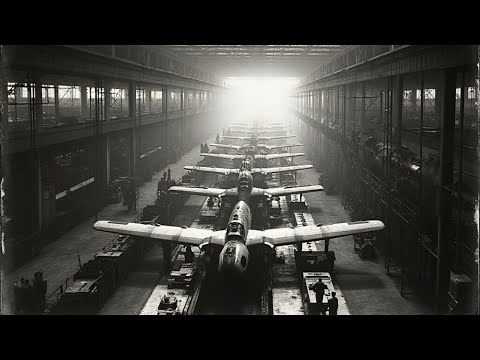
He had been trained to expect weakness. America was supposed to be soft—a nation of jazz records and movie theaters, too comfortable to fight. But what he witnessed at the Willow Run plant was a nightmare dressed in chrome and steel.
The contrast was unbearable. Back in Germany, his brother Hans wrote letters from the frozen Russian front about empty fuel tanks and dead friends. Here, American workers drove their own cars to work, ate thick sandwiches in bright cafeterias, and complained about their new Chevrolets making strange noises.
Inside the mile-long building, forty thousand workers moved like parts of a single organism. The building never slept. Day shift went home, night shift took over, and the welding torches never cooled. Workers attached wings to fuselages in exactly eighteen minutes. They mounted engines in twelve. The entire process flowed like a river, each person knowing precisely what to do and when to do it.
The German factories were chaotic by comparison—always missing parts, always behind schedule. But here, the B-24 Liberators emerged like clockwork, gleaming silver under the Michigan sun, their four propellers ready for war.
Agent Friedrich had served the Nazi Party for eight years. He believed in German superiority, in the power of the Fatherland, in the weakness of democracies. But sitting in his car outside Willow Run, watching the hundredth bomber roll out, that belief began to crack.
He followed a group of workers to a nearby diner that evening. The smell of fried chicken and fresh biscuits made his mouth water—he hadn’t tasted real meat in months. The workers ordered enormous plates, enough to feed a German family for a week, and talked about baseball games and weekend fishing trips while eating apple pie topped with real ice cream.
One young man complained his new car was making a strange noise. Another woman worried about which university her son should attend. These people were living in a world Friedrich could barely comprehend.
The breaking point came when he overheard two workers discussing production numbers. The older man, a supervisor with rough hands and kind eyes, was training a new employee.
“Willow Run is just one of many,” he explained. “Ford has another plant at River Rouge. Boeing builds bombers in Seattle. Consolidated Aircraft operates in San Diego. Each factory produces hundreds of planes every month.”
Friedrich felt his world collapse like a house of cards. America was building more bombers in a single month than Germany had built in the entire war. Everything he had been told about German power was a lie.
That night, sitting in his hotel room, Friedrich wrote a report that would change his life forever. His hands trembled as he described what he had witnessed with his own eyes. He knew his superiors would think him insane or compromised. No sane person could believe that one factory produced twenty-four heavy bombers every day.
But Friedrich had seen it. He had counted every silver giant emerging from that mile-long building. He thought of his younger brother Hans, fighting in the frozen hell of the Russian front, writing letters about dwindling ammunition and friends who died because their tanks ran out of fuel.
Meanwhile, American workers drove their own cars home to dinner and jazz music. The contrast was so stark it made Friedrich physically ill.
As he sealed his report in an envelope, Friedrich realized he was no longer a loyal believer. The Nazi dream of world conquest was built on lies and wishful thinking. Germany was not the master race. They were David facing Goliath—but this time, Goliath had an endless supply of stones.
The American industrial machine would crush the Third Reich into dust, one bomber at a time. Friedrich mailed his report and stepped out into the cold Michigan night. Above him, the stars shone down on a nation that had awakened from its peaceful slumber.
The sleeping giant was not just awake. It was building an air force that would darken the skies over Germany—and nothing Berlin could do would stop it.
Berlin’s response arrived three weeks later, buried in a bundle of routine dispatches. Friedrich was summoned to a gray office on Prinz-Albrecht-Strasse, where two men in pressed uniforms slid his report across the table as though it were contaminated.
“You wasted our time with fairy tales,” the older officer said, tapping a finger against the page. “One bomber every hour? Twenty-four a day? Do you take us for fools, Friedrich?”
He tried to explain. He described the parking lot filled with thousands of personal cars, the Coca-Cola truck, the workers laughing over apple pie. The officers exchanged glances. One of them laughed—a short, ugly sound.
“You have been in America too long. You have caught their disease.” They dismissed him from the intelligence service and reassigned him to a desk in a requisitions office, counting nails and boots.
For a year, Friedrich filed paperwork in silence while the war turned against Germany. He watched the casualty lists grow longer. He watched the faces of his colleagues grow grayer, their jokes more bitter. Nobody spoke of victory anymore—only of holding on.
Then came the spring of 1945. The train that carried him home crawled through a landscape of broken teeth—cities reduced to rubble, bridges twisted into black ribbons, children digging through garbage for scraps of food.
Berlin was a wasteland of ash and debris. The house where Friedrich had grown up was gone, replaced by a crater filled with filthy water. His neighbors lived in cellars and subway tunnels, their faces pale with hunger and fear.
They had believed the promises of victory and glory. Instead, they received death from above—delivered by American workers who went home each night to hot meals and jazz on the radio.
At night, Friedrich sat in the shelter and listened to the air-raid sirens wail. He knew exactly how many bombers were coming, because he had watched them being built. While German children wept in the darkness, he remembered the bright cafeterias, the cold Coca-Cola, the weekend fishing trips.
The memory was a knife twisting in his chest.
He tried to tell people what he had seen in America, but no one wanted to listen. They called him mad when he described factories building bombers faster than Germany could shoot them down. They refused to believe that American workers owned cars and ate meat every day. The truth was too painful to bear, so they chose to live inside their shattered dreams.
Friedrich found work clearing rubble from the streets, hauling bricks by hand alongside former soldiers and widows. His back ached, his hands bled, and each morning he woke wondering why he bothered. But something kept him moving—a stubborn need to witness what came next.
In the ruined squares, black-market traders whispered about the Americans and Russians dividing the city. Friedrich listened without speaking. He had seen the Americans up close, and he knew what they carried in their trucks and their hearts.
One afternoon, a young boy approached him near the rubble of a church. The child was thin, hollow-eyed, maybe nine years old. He held out a dented tin can.
“They say you were in America,” the boy said. “Is it true they have so much food they throw it away?”
Friedrich knelt in the dust and looked at the boy’s face. For a moment he saw the children of Michigan—healthy, laughing, carrying lunchboxes to school.
“Yes,” he said quietly. “It’s true.”
The boy stared at him, then turned and ran. Friedrich watched him disappear into the ruins, wondering what the child would do with that answer.
That night, in the cellar that served as his home, Friedrich pulled out an old notebook—the same one he had filled with tally marks at Willow Run. The pages were wrinkled, the ink faded, but the numbers remained. One hundred bombers in one hundred hours.
He traced the marks with his finger. Each one had seemed like a death sentence for his country. Now they read differently—like proof of something he had never been taught to value.
His captors had told him democracy made men weak. But the men he watched at Willow Run were not weak. They were tireless, ingenious, and free. They built their machines not because a rifle stood at their backs, but because they wanted to.
The realization settled into him like a stone dropping to the bottom of a well.
Outside, the sirens began to wail again. Friedrich closed his notebook and waited in the dark, counting the minutes until morning.
The war ended, and Germany began to rebuild itself from the ashes. Friedrich found work in a small print shop, setting type for a new generation of newspapers that spoke of freedom and responsibility. He never spoke of his past as a spy, but the lesson he learned in Michigan never left him.
Freedom is not weakness. Democracy is not chaos. And happy workers build better weapons than slaves ever could.
The Nazi Party had taught him to hate America, but they never taught him to understand it. That understanding came too late to save his brother Hans, who died on the Russian front in the final months of the war. Friedrich carried that grief like a second shadow.
In his remaining years, he tried to forget the sight of those silver bombers rolling out of the assembly line—one every hour, day and night, until Germany surrendered. He had witnessed the true power of a free nation at war, and it was more terrifying and more beautiful than any propaganda could describe.
The sleeping giant had awakened, and its industrial might crushed the Third Reich like an insect beneath a boot. Democracy won—not through speeches or parades, but through the simple act of building more bombers than the enemy could destroy.
Friedrich died in 1968, a quiet man with calloused hands and haunted eyes. In his pocket was a torn page from that old notebook, the one with the tally marks. On the back, in shaky handwriting, he had written a single sentence:
“I saw the giant wake. I only wish I had understood before it was too late.”
What would you have done if you had been in Friedrich’s shoes—would you have believed the impossible truth, or chosen the comfort of a lie?
Report this article
Select a reason for reporting:






