In the pitch-black waters of the North Atlantic, a German U-boat captain scans the horizon, confident that the night belongs to him. He sees nothing—no aircraft, no destroyers. But twelve miles away, a British Liberator is already diving toward his position, its pilot staring at a glowing screen that marks the submarine with terrifying precision. This new centimetric radar can detect a conning tower from fifteen miles away, even in total darkness, even through clouds. The depth charges bracket the U-boat with surgical accuracy. It goes down with all hands. It’s the 41st U-boat lost in May 1943 alone—the highest monthly toll of the entire war.
In Berlin, Grand Admiral Karl Dönitz stares at the casualty reports with growing horror. His wolf packs are being slaughtered. “They see us,” one U-boat commander radios back to headquarters. “Day or night, through fog and storm, they always find us. It’s as if they have magic eyes.” They do. But the technology making this possible—the cavity magnetron that powers every microwave radar in the Allied arsenal—almost never got built.
The British invented it in 1940. But when they brought the revolutionary device to America that September, American military experts declared mass production absolutely impossible. The problem was precision. Each magnetron required handcrafting by skilled technicians. Britain was producing 17 per week—enough to equip a handful of aircraft and ships, but nowhere near enough to turn the tide of war. The Allies needed thousands, tens of thousands.
What the military establishment didn’t know was that in a cramped workshop in Massachusetts, a grammar school dropout with no engineering degree was about to solve the unsolvable and change warfare forever.
September 19th, 1940. The Wardman Park Hotel, Washington DC. British physicist Edward Bowen opens a wooden box. Inside, nestled in velvet, sits a copper cylinder the size of a hockey puck. It’s a cavity magnetron, and it’s about to change the war. Vannevar Bush, head of America’s National Defense Research Committee, leans forward. He’s seen radar before—the British Chain Home system helped win the Battle of Britain, detecting German bombers at 70 miles. But those massive coastal towers operated on wavelengths measured in meters. Too long to provide detailed images or fit in an aircraft.
This device is different. It generates microwaves—centimeter wavelengths that can detect a submarine periscope, map terrain through clouds, or guide anti-aircraft guns with pinpoint accuracy. In laboratory tests, it produces 400 watts of microwave power, ten times more than anything America has built. “This is the most valuable cargo ever brought to our shores,” Bush declares.
But there’s a problem—a massive problem. John Randall and Harry Boot, two physicists at the University of Birmingham, invented the cavity magnetron in February 1940. Their design is brilliant but complex. The copper block contains precisely machined resonant cavities arranged around a central cathode. Manufacturing tolerances must be exact down to thousandth of an inch. The vacuum seal must be perfect. The magnetic field must be precisely aligned.
In Britain, skilled craftsmen at GEC and BTH are hand-building them one at a time. The production rate by late 1940: 17 magnetrons per week. Each one takes 40 hours of meticulous labor. Expert machinists file, measure, and test each component. The rejection rate is nearly 30%.
MIT’s newly formed Radiation Laboratory gathers America’s top physicists to improve the design. They produce working prototypes. The Navy orders hundreds for shipboard radar. The Army Air Forces demands thousands for bombing and navigation systems. Coastal Command needs them to hunt U-boats. Anti-aircraft batteries require them for fire control. The total requirement: tens of thousands of magnetrons—and they need them now.
In October 1941, Raytheon wins a contract to mass-produce the devices. The company’s engineers study the British blueprints and deliver their verdict. “These cannot be manufactured at scale with current methods. Each unit requires hand-fitting by master craftsmen. We estimate production capacity of perhaps 100 units per month.”
The room erupts in frustration. Navy procurement officers slam tables. Army generals demand alternatives. MIT scientists insist the precision is non-negotiable. “Any deviation will cause the magnetron to fail. Then we lose the war,” an admiral states flatly. “The U-boats are sinking 700,000 tons of shipping per month. Britain will starve by spring. Without submarine-hunting radar, the Atlantic is a graveyard.”
The math is brutal. At 17 magnetrons per week, it would take nine years to equip the Allied forces adequately. The Allies don’t have nine months.
Meeting after meeting produces the same conclusion: impossible. The tolerances are too tight. The vacuum seals too difficult. The assembly too complex. Military planners begin discussing rationing. Which aircraft get radar? Which ships? Which gun batteries? Every choice means Allied sailors and airmen will die.
At Raytheon’s headquarters in Waltham, Massachusetts, company President Lawrence Marshall convenes his senior staff. “Gentlemen, the Navy is asking for 2,600 magnetrons per day within one year. Our current production rate is zero. The experts say it cannot be done.” He looks around the table. “I have one more man I want to hear from.”
The door opens. A thin man in shirt sleeves enters. No jacket, no tie. Percy Spencer is 47 years old. He never finished grammar school. And he’s about to prove every expert wrong.
Percy Lebar Spencer was born on July 19, 1894, in Howland, Maine. His father died when he was eighteen months old. His mother abandoned him to his aunt and uncle. When Percy was seven, his uncle died too. Orphaned twice by age seven, Spencer went to work at twelve in a weaving mill to support himself. His formal education ended in the sixth grade.
He never attended high school. He never took a college course. He never earned an engineering degree. But Percy Spencer possessed something no university could teach: an insatiable curiosity about how things worked.
At fourteen, he heard about a new paper mill being built nearby and that it would have electricity. He’d never seen electric lights. He walked to the construction site and talked his way into a job installing the electrical system. Despite having zero experience, he learned by watching, asking questions, and experimenting. Within months, he had taught himself practical electrical engineering.
At eighteen, Spencer joined the US Navy. During World War I, he became a radio operator, teaching himself wireless technology at night while other sailors slept. He studied calculus from textbooks. He took apart radio equipment and rebuilt it, understanding every component.
After the war, he joined Raytheon in 1925 as a tube designer. He had no credentials, no references, no degrees—but he could solve problems nobody else could touch. By 1941, Spencer held the title of chief engineer, though the executives barely understood what he did. He worked at odd hours, disappeared into his workshop for days, and emerged with solutions that worked but that trained engineers couldn’t explain. He held over sixty patents. The Navy had already awarded him its Distinguished Public Service Award for radar innovations.
When Lawrence Marshall presents the magnetron challenge, Spencer listens silently to the engineers’ explanations of why mass production is impossible—the tolerances, the hand-fitting, the skilled labor shortage. Then he asks a question that stops the room cold. “Who says we have to build them the way the British do?”
An MIT scientist bristles. “Mr. Spencer, with all due respect, you’re not a trained physicist. The cavity dimensions must be precise to within—”
“I know the specs,” Spencer interrupts. “I’m asking why we can’t use mass production techniques. We make millions of radio tubes. Why can’t we stamp, punch, and braze magnetrons on an assembly line?”
The room explodes. “That’s not possible. The precision required exceeds stamping tolerances. The vacuum seals can’t be brazed—they must be individually fitted. The resonant cavities must be machined to exact specifications. This isn’t a radio tube,” the physicist insists. “This is a precision scientific instrument.”
“No,” Spencer says quietly. “It’s a weapon, and we need ten thousand of them by Christmas.”
Marshall makes a decision that will alter the war’s trajectory. “Spencer, you have sixty days and whatever resources you need. Show us it can be done.”
Every credentialed expert in the room believes Spencer is about to fail spectacularly. They have no idea what’s coming.
Spencer vanishes into Building 2 at Raytheon’s Waltham plant. He takes with him four technicians, two machinists, and a British magnetron to dissect. For three weeks, nobody sees him. Engineers knock on his door with questions. He doesn’t answer. Marshall asks for progress reports. Spencer sends back: Still thinking.
Inside the workshop, Spencer has covered a wall with drawings—not elegant blueprints, but rough sketches showing assembly sequences, tool designs, fixture concepts. He’s approaching the magnetron not as a scientific instrument to be perfected, but as a product to be manufactured.
The British method starts with a solid copper block. Skilled machinists drill the resonant cavities using precise measurements. Each cavity is individually inspected, adjusted, and hand-fitted. It works, but it’s slow and requires master craftsmen.
Spencer’s insight is radical. Instead of machining cavities into solid copper, what if you stamp them? He designs a punch-press system that stamps eight identical cavity segments from sheet copper in one operation. The segments are then brazed together around a central cathode assembly. The entire core can be assembled by semi-skilled workers using fixtures that guarantee alignment.
When he emerges on October 15th, 1941, Spencer brings three working prototypes. “These were made by workers with two weeks of training,” he announces. “Total assembly time: forty-five minutes per unit.”
The MIT liaison examines the magnetrons with visible skepticism. “These cannot possibly work. The cavity geometry—” Spencer plugs one into a test rig. The oscilloscope trace shows clean microwave output—400 watts, exactly matching the handcrafted British version. The physicist is stunned into silence.
But the military procurement officer shakes his head. “Mr. Spencer, your design is impressive, but even if these work—which I’m not convinced they will in field conditions—you’re proposing using semi-skilled labor for precision electronics assembly. The military cannot accept that risk. These devices cost $1,500 each and require expert calibration.”
“They cost $1,500 because we make them one at a time,” Spencer counters. “In production, my method will reduce cost to $200 per unit.”
“That is absolutely illegal under procurement regulations,” the officer snaps. “You cannot compromise military specifications for cost savings. If these magnetrons fail in combat, sailors die. Your approach is reckless and dangerous.”
The room goes quiet. The military representative is right. Regulations explicitly forbid design changes that sacrifice quality for efficiency.
Marshall speaks carefully. “Commander, what if we conduct field trials? Give us three months to prove they perform identically to the British versions.”
“That is not acceptable,” the officer replies. “We need production units now, not experimental prototypes. Raytheon will manufacture magnetrons to British specifications using British methods, or we will find another contractor.”
Spencer’s revolutionary design—the one that could arm every Allied aircraft and ship with microwave radar—is about to be killed by bureaucracy. Then the door opens. A Navy captain enters, reading a telegram. His face is grim. “Gentlemen, Pearl Harbor has been attacked. We are at war.”
Everything just changed. Within hours, the procurement officer’s objections evaporated. Captain John Sides of the MIT Radiation Laboratory laid out the brutal arithmetic: 70 units per month against a requirement of 30,000. “If these cut-rate magnetrons fail, American boys die,” a general warned. “If we don’t build them at all,” Marshall replied, “we lose the war.” Admiral Harold Bowen made the call—Spencer had four months.
By February 1942, Building 2 had become an assembly line for precision electronics: 21 workstations, each worker with a fixture guaranteeing alignment. The first unit rolled off at 6:47 a.m. By April, production hit 600 per day—a 7% rejection rate, $185 per unit, 47 minutes apiece.
The skeptics demanded combat proof. In the Bay of Biscay, Lieutenant Joe Fentress’s radar painted a contact at twelve miles through clouds. U-558 went down. “We never would have found him without the radar,” he reported.
By December 1943, Raytheon was producing 2,600 magnetrons daily—over 100,000 in total. Dönitz, staring at a captured set stamped Waltham, Mass., whispered, “Then we’ve lost the Atlantic.”
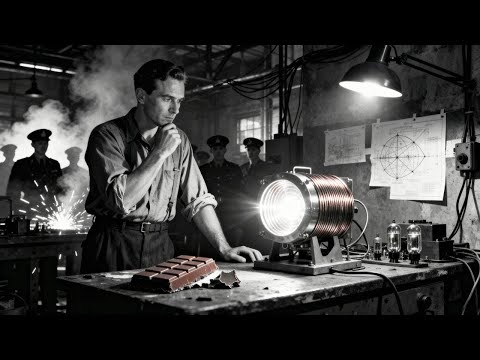
Spencer never sought glory. He simply solved the problem—and then, noticing a melted chocolate bar in his pocket, invented the microwave oven. The experts said it couldn’t be done. Percy never listened to experts.
So here’s the question for you: what impossible problem is sitting in your workshop right now, waiting for someone brave enough to ask why not? Tell us in the comments.
Report this article
Select a reason for reporting:






