The potato salad was Helen’s idea. She had spent the better part of Friday afternoon in our kitchen, humming along to the radio, layering sliced eggs and celery into the big ceramic bowl our daughter Rachel had loved since she was nine years old. I stood in the doorway, watching her wrap it in foil, and I thought—not for the first time—that my wife had a way of turning ordinary things into something that felt like love made visible.
“She’s going to cry when she sees this,” Helen said, pressing the foil down at the edges. “You know how she gets about this salad.”
“She’s thirty-four,” I said. “She doesn’t cry over potato salad anymore.”
Helen raised an eyebrow. “Walter, she’s always going to be our little girl. Drive faster.”
I laughed—the easy kind that comes on a Saturday afternoon when the sun sits low over the San Gabriel Mountains and the 101 is actually moving for once. In the trunk was the BBQ grill Rachel had asked us to bring; in the back seat, a small box with a navy blue ribbon. A promotion worth celebrating.
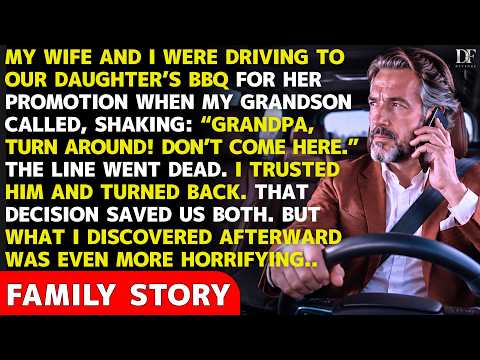
Then my phone rang. The name on the screen made me glance at Helen. Mason, our grandson. Eleven years old.
I hit the speaker button. “Hey, buddy. What’s up?”
The voice that came through didn’t sound like Mason. It was his voice, yes, but stripped of everything that usually made it his—the easy confidence, the way he talked with his hands even over the phone. What came through instead was something small and pressed down tight, like he was speaking with his mouth close to the receiver so no one else could hear.
“Grandpa.” A pause. The sound of a door closing behind him. “Turn around. Please don’t come here.”
Helen’s hand went to my arm immediately, her fingers pressing in hard.
“Mason.” I kept my voice level, the way I’d learned to do in thirty years of business when someone across the table said something that made my chest go cold. “Talk to me. What’s going on?”
“Don’t call Mom.” His voice cracked on the last word—and that crack, that single break in the sound, went straight through me like something physical. “She doesn’t know I’m calling. Grandpa, please just turn around. Please.”
The line went dead.
Helen said my name. Just my name, nothing else. And I was already moving.
My hand went to the turn signal before I had consciously decided anything. I cut across two lanes, earning a horn from a silver pickup behind me, and took the next exit ramp hard enough that the ceramic bowl shifted on the back seat.
“Walter.” Helen’s voice was tight, controlled, but her hand was shaking against my arm. “He’s eleven years old. We don’t even know what—”
“I know we don’t. Then why are we—”
“Because he’s never called me like that.” I merged onto the surface street, heading away from Pasadena, away from the string lights and the charcoal and the navy blue ribbon on the back seat. “In eleven years, Mason has never sounded like that. Not once.”
Helen pressed her lips together. She looked out the passenger window, and I could see in the reflection of the glass that her eyes had gone bright. Not crying—not yet—but close. Her jaw was set the way it gets when she’s working very hard to hold something in.
We drove in the direction we’d come from, the San Gabriels falling away behind us. Then Rachel called.
Her name lit up the screen and Helen inhaled sharply. I answered on speaker, keeping my voice exactly the way it had been before any of this started—easy, unhurried, the voice of a man who was running a few minutes behind on a Saturday afternoon.
“Hey, sweetheart. We’re on our way. Just hit a little—”
“Where are you guys?” Rachel’s voice was warm, bright, laced with the particular energy she got when things were going according to plan. “Everyone’s asking about Mom’s potato salad.”
I heard nothing behind her. No voices, no music, no sound of a backyard full of people on a Saturday afternoon.
“We got turned around a little,” I said. “Should be there soon.”
A beat of quiet. Then: “Are you on the 134 freeway, Dad? Heading east?”
My hands tightened on the wheel. I had not told her what road we were on. I had not told anyone.
“Why do you ask?” I said.
“Oh.” She laughed—and the laugh landed half a second late. “I just figured that’s the way you usually come. Don’t take the 210. There’s construction. Just stay on the 134 and come straight through.”
“Sure,” I said. “We’ll see you soon.”
I ended the call. Helen turned to look at me, her eyes dry now, the brightness replaced by something much colder and much more alert.
“She knew exactly where we were, Walter,” she said.
“Yes,” I said. “She did.”
I checked the rearview mirror. Four cars back, keeping pace through every lane change: a dark gray pickup truck.
I had spent thirty years in business learning to read a room. You pick up patterns—the way a supplier shifts in his chair when the numbers don’t add up, the way a buyer’s smile stays half a beat too long when he’s already decided to walk. You learn that most people telegraph their intentions long before they say a word, if you know what to look for.
The gray pickup was telegraphing everything. It wasn’t driving aggressively. That was the first thing I noticed. An amateur tails you close, gets impatient, makes mistakes. This driver kept a comfortable distance—four cars back, sometimes five—and matched my speed with the casual ease of someone who had done this before. When I eased off the gas to let a gap open ahead of me, the pickup eased off too. Patient. Deliberate.
“Walter,” Helen said, her voice dropping to something barely above a whisper. “Is that truck—”
“I don’t know yet,” I said. “Hold on.”
I signaled right and moved into the exit lane for Foothill Boulevard. The pickup moved right. I let three cars pass, then swung back onto the main road. The pickup swung back too—smooth as water finding its level.
Helen made a sound low in her throat. Her right hand found the door handle and held it, knuckles going white against the plastic.
“Turn your phone off,” I said.
“Walter—”
I glanced at her once. “Right now.”
She powered it down. I reached into my shirt pocket and did the same. It wasn’t until I watched my own screen go black that the full weight of it landed. Rachel had known exactly what road we were on. Not guessed—known. And the only way she could have known with both phones already on when she called was if something was tracking the car itself. Not us. The car.
The Ralph’s on Rosemead Boulevard was three blocks ahead. Saturday afternoon—the lot would be full, families, carts, security cameras mounted on every corner of the building’s exterior. I pulled in without signaling, cut across two lanes, and parked directly under the largest camera cluster above the main entrance.
“Get out,” I said. “Stay close to the entrance.”
Helen climbed out. Her legs weren’t entirely steady, but she straightened her jacket with both hands—that unconscious gesture she makes when she’s frightened and refusing to show it—and fell into step beside me. We stood just inside the automatic doors with a clear sight line to the lot through the glass.
The gray pickup rolled slowly past on Rosemead. It didn’t turn in. It continued to the end of the block, paused at the light longer than necessary, and moved on.
Helen exhaled—long and shaking, the breath of someone who had been holding it since the freeway. Her eyes went bright and wet at the corners, and she pressed two fingers hard against her mouth to keep whatever was rising back down where it belonged.
“Who is driving that truck?” she whispered.
“I don’t know yet,” I said. “But I’m going to.”
I found the store manager—a heavyset man named Gerald with a radio clipped to his belt—and asked him to preserve the exterior camera footage from the last twenty minutes. He looked at me the way people look when deciding whether you’re worth taking seriously. Whatever he saw in my face settled it. He nodded and made the call.
The footage would later confirm it. The plate came back to a rental agency in Burbank—a short-term fleet vehicle paid for in cash with a prepaid card, the kind designed to put as much distance as possible between the driver and any paper trail. Whoever was in that truck had walked into a counter and paid to be invisible.
Amateurs improvise. Professionals prepare.
I guided Helen back to the car and stood beside the driver’s door without getting in. “There’s something on this car,” I said. “I’m not driving it anywhere until I know what.”
Helen looked at me. “Walter—but we’re not taking this car to him.”
I pulled out the spare phone and dialed. Frank answered on the second ring. Twenty minutes later his service truck pulled into the far end of the Ralph’s lot, and we left my SUV exactly where it was parked—under the camera cluster, engine off, tracker still counting—while Frank drove us to Cypress Avenue in his truck.
Frank Delaney was a man who measured the world in tolerances—thousandths of an inch, the precise torque on a bolt. He had built his reputation over twenty-six years by being the kind of mechanic who never guessed, who ran the diagnostic and told you exactly what was wrong before he touched a single tool.
The lift hissed. My SUV rose off the concrete. Frank ducked underneath without ceremony, flashlight in one hand, telescoping mirror in the other.
Eight minutes. “Walter.” His voice came from near the rear axle, flat and without inflection. “Come here.”
I crouched beside him. He angled the beam into the rear passenger wheel well. And there it was—a black rectangular unit no larger than a deck of playing cards, clamped to the wheel housing with a magnetic mount that would have required deliberate effort to place correctly. Not taped. Not zip-tied. Seated with precision.
“High-grade GPS transmitter,” Frank said. “Real-time tracking, updates every thirty seconds. Sixty-day battery.” He looked at me sideways. “Somebody put real thought into this.”
My throat tightened. I touched the edge of the device with one finger—that small physical confirmation—and felt something cold move through my chest and stay there.
Two days ago, Thursday evening, Rachel had called asking to pick up Mason’s jacket from our back seat. She pulled into the driveway. I handed her the keys through the front door. She was back in five minutes. I hadn’t thought twice about it.
Five minutes was more than enough.
“There’s something else,” Frank said, moving to the driver’s side, hood propped open, flashlight on the fuse box. “Your dash cam hasn’t been touched physically, but the control chip has been reprogrammed.”
Helen’s breath caught sharply across the bay. “Reprogrammed to do what?”
Frank straightened and looked at her directly. “A geofence trigger. Someone installed a secondary instruction set that tells the camera to stop recording whenever the vehicle enters a specific geographic zone. Outside that zone, everything runs perfectly. You’d never know.”
“And inside?” I asked.
“Camera cuts out automatically. No footage. Just a gap that looks like a standard power interruption.”
He set the flashlight down and looked at me the way doctors look when delivering news they wish they didn’t have. “Whoever did this knew exactly what they were doing.”
I walked to Helen. Her arms had dropped to her sides, fingers slightly open, the way hands look when the body hasn’t decided what to do with them.
“She stood in our driveway two days ago and smiled at me,” Helen whispered, her voice cracking straight through the middle. “I asked her if she wanted coffee. She said Mason was waiting in the car.”
I put my arms around her. She pressed her face into my shoulder and breathed in hard, uneven pulls she was fighting to control.
Across the bay, Frank kept his back to us, methodically removing the GPS unit with the careful movements of a man giving us the only privacy a concrete room could offer. After a moment, Helen pulled back. She wiped her eyes, straightened her spine, and looked at me with the expression I had seen only a handful of times in forty years. The look that means she has moved through the part that hurts and arrived at the part that decides.
“What do we do now?” she asked.
I thought of Mason’s voice, the crack in it when he said please.
“We find somewhere to stay,” I said. “And then we start finding out exactly how long this has been going on.”
But even as I said it, I knew it was already too late for the only question that mattered. The trap hadn’t been set by strangers. The truck, the tracker, the dark stretch of road—it had all been arranged by the one person who knew our route by heart, who knew what we’d bring, who knew exactly how much we trusted her.
My own daughter had been waiting for us. And I said nothing. I simply began planning my next move.
So tell me—if it were your child behind that wheel, could you turn the car around on your own flesh and blood, or would you drive straight into the trap just to hear her explain?
Report this article
Select a reason for reporting:






