He stood before the crowd, his voice dripping with fervor, and declared himself a Christian. “My feelings as a Christian lead me to my Lord and Savior as a fighter,” he thundered, painting Jesus as an Aryan warrior against Jewish corruption. The year was 1922, and Adolf Hitler was just beginning his ascent. But even then, the contradiction was glaring: a man who would later order the imprisonment of thousands of clergy, who would call Christianity ‘ripe for destruction,’ was invoking Christ to rally a nation.
This is the enigma at the heart of Hitler’s religious views—a tangled web of public piety and private contempt, of political expediency and personal disdain. To understand the dictator, one must untangle this knot, for it reveals not only his strategic cunning but also the hollow core of his ideology.
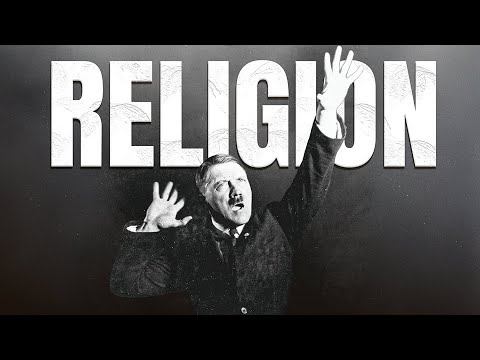
Born to a nominally Catholic father and a devout mother, young Adolf attended a Benedictine monastery school, where he excelled and even sang in the choir. Yet, according to historian Michael Rißmann, he began rejecting the Church early, receiving confirmation only reluctantly. “I was a rebel even then,” Hitler later boasted, recalling his skepticism toward clerical teachers. His childhood faith, if it ever existed, was fragile—shattered by the Pan-Germanism that swept through his school and the growing conviction that organized religion was a tool for the weak.
As he rose to power, Hitler donned the mantle of ‘positive Christianity,’ a Nazi-crafted creed that stripped Jesus of his Jewishness and recast him as a fighter against ‘Jewish materialism.’ The German Christians, a Protestant faction loyal to the regime, embraced this perversion. “Through me, the Evangelical Protestant Church could become the established church as in England,” Hitler mused, envisioning a Reich Church under his thumb. He signed a concordat with the Vatican in 1933, promising to respect Catholic rights—then promptly ignored it, allowing persecution of clergy to escalate.
But behind closed doors, the mask slipped. In his private circles, Hitler railed against Christianity with venom. Albert Speer, his architect, recounted a revealing monologue: “Look, it was our misfortune to have the wrong religion. Why didn’t we have the religion of the Japanese, who regard sacrifice for the fatherland as the highest good? The Muslim religion would also have been much more compatible with us than Christianity. Why did it have to be Christianity with its meekness and flabbiness?” To Hitler, Christianity was a ‘religion for slaves,’ its ethics a rebellion against the natural law of struggle and survival of the fittest.
Joseph Goebbels, the propaganda minister, recorded Hitler’s true sentiments in his diaries. “The Führer is a fierce opponent of all this fraud,” he wrote in April 1941, adding that Hitler ‘hates Christianity because it has crippled everything noble in humanity.’ Yet publicly, Hitler continued to invoke God, ordering ‘Gott mit uns’—God with us—engraved on military buckles. The hypocrisy was staggering, but it served a purpose: to maintain the illusion of piety while undermining the churches from within.
Historians like Ian Kershaw and Alan Bullock paint a portrait of a man who was spiritual but anti-clerical, who believed in a vague providence but despised organized religion. “He was not a practicing Christian,” wrote Richard Overy, “but somehow managed to conceal his religious skepticism from millions of German voters.” Hitler saw science as the ultimate destroyer of superstition, and he envisioned a post-war Germany where the churches would be eradicated or reformed to serve the Nazi state.
In the end, Hitler’s religious views were as twisted as his politics—a volatile mix of opportunism, contempt, and megalomania. He was willing to use any faith as a weapon, but his true creed was power. As the war turned against him, his hostility toward the churches only intensified. “Christianity is ripe for destruction,” he declared in 1937, and he meant it. The question that remains is how a nation of believers could follow a man who secretly despised their God—and what that says about the seductive power of a lie.
The answer, in part, lies in the chaos of the Nazi regime itself—a polycratic tangle of rival fiefdoms where Hitler’s offhand remarks became gospel for zealous underlings. “Working towards the Führer,” as historian Ian Kershaw put it, was the guiding principle: officials competed to guess and enact his will, even before he articulated it. When Hitler muttered that Christianity was ‘ripe for destruction,’ men like Martin Bormann, his private secretary, took note and acted.
Bormann was perhaps the most virulent anti-Christian in Hitler’s inner circle. In a secret memo to regional party leaders in 1941, he wrote with brutal clarity: “National Socialism and Christianity are irreconcilable.” The memo, never meant for public eyes, declared that the party’s goal was the eventual eradication of the churches, and that any talk of ‘positive Christianity’ was merely a tactical pause. Gauleiters across the Reich were quietly encouraged to restrict church activities, close confessional schools, and harass clergy—all while Hitler publicly maintained his support for ‘true’ Christianity.
The results were devastating for the faithful. In Bavaria alone, crucifixes were removed from schools, monasteries were seized, and priests were put on trial for currency smuggling or ‘immorality’ in staged show trials. “The black bugs must be exterminated,” Hitler reportedly said, referring to the clergy in their cassocks. Thousands of pastors and priests who resisted were sent to Dachau, where a special ‘priest block’ was established. Of the 2,720 clergy imprisoned there, the vast majority were Catholic—a grim irony given Hitler’s own baptism and confirmation.
Yet the regime never launched a full, open assault on Christianity during the war. Why? Because Hitler understood the German people’s attachment to their faith. “The churches are a necessary evil for now,” he told his generals, aware that a frontal attack on religion would alienate the masses and undermine the war effort. Instead, the strategy was attrition: let the churches wither as the Nazi state absorbed their youth groups, their charitable functions, and their moral authority. The Hitler Youth replaced confirmation; the party’s rituals replaced liturgy; the Führer’s cult replaced the saints.
But the Führer’s cult was not a religion in any traditional sense—it was a political faith built on blood and soil, on struggle and sacrifice for the Volk. Hitler himself rejected the notion of founding a new religion, telling Goebbels he had no intention of becoming a priest. “His sole exclusive role is that of politician,” Goebbels noted. Yet the party’s rituals—the torchlight parades, the blood banners, the martyrs of the 1923 putsch—mimicked religious devotion, filling the void left by a Christianity Hitler sought to hollow out.
As the war dragged on and defeat loomed, Hitler’s contempt for Christianity hardened into something darker. In his bunker in 1945, he raged against the churches one final time, blaming them for Germany’s weakness and for the ‘softness’ that had led to the nation’s collapse. “The Christian religion is the most terrible thing that has ever happened to humanity,” he reportedly said. But even in his final hours, he ordered that the phrase ‘Gott mit uns’ remain on the buckles of the soldiers who would die for him.
The contradiction followed him to the grave—a man who invoked God while despising Him, who used faith as a shield while plotting its destruction. The German people, for their part, were left to reconcile the impossible: how their churches had blessed the very regime that sought to erase them, and how a nation of believers had followed a prophet of nihilism into the abyss.
To grasp how this was possible, one must look beyond Hitler himself and examine the machinery of complicity that surrounded him. The churches were not simply passive victims; many Protestant leaders actively embraced the Nazi state, seeing in its nationalism a revival of German spirit. The German Christians, a faction of roughly 600,000, went so far as to adopt the ‘Aryan paragraph’ within their congregations, expelling baptized Jews from their midst and declaring that the Old Testament was a ‘Jewish book’ unfit for German Christians.
Their slogan was chilling in its simplicity: “One People, One Reich, One Faith.” At the 1933 German Protestant Church Congress in Berlin, delegates sang hymns with Nazi salutes and unfurled banners bearing the swastika alongside the cross. A young pastor named Martin Niemöller, who would later become a symbol of resistance, initially welcomed the Nazi rise, believing the regime would restore Protestant unity and moral order. Only later, when the state began dictating church doctrine, did he begin to resist—and for that, he was sent to Dachau.
The Catholic Church, meanwhile, walked a more cautious line. The Reich Concordat of 1933, signed by Cardinal Pacelli—the future Pope Pius XII—was meant to protect Catholic institutions and schools. But Hitler treated it as a scrap of paper, and the Vatican’s protests fell on deaf ears. “The Concordat was a pistol pointed at the head of the Catholic Church in Germany,” one historian later observed, for it bound the bishops to political silence while the regime violated its terms at will.
Among the faithful, confusion reigned. How could a baptized Catholic, a man confirmed in the Church, persecute priests and nuns? How could a regime that spoke of ‘providence’ and ‘destiny’ arrest pastors for preaching the Gospel? Many Germans simply looked away, their attention fixed on economic recovery, national pride, and the promise of a restored empire. The churches, they assumed, would find their place within the new order.
Yet some did not look away. A small but determined resistance emerged from the confessing church—a movement of Protestant pastors who rejected Nazi ideology and proclaimed Christ alone as Lord. Dietrich Bonhoeffer, a young theologian, returned from America to join them, convinced that silence in the face of evil was itself a sin. “The church must not simply bandage the victims under the wheel,” he wrote, “but must jam a spoke in the wheel itself.” He would pay for those words with his life, hanged at Flossenbürg in April 1945, just weeks before the war ended.
In the Catholic countryside, ordinary believers showed a quieter defiance. When the Nazis tried to remove crucifixes from Bavarian schools in 1941, a wave of protests swept through the villages. Mothers stood in front of school doors, refusing to let their children enter. “We will not surrender our faith,” they declared, and the regime, wary of provoking a popular uprising, backed down. It was a small victory, but it proved that the Führer’s contempt for Christianity did not always translate into power.
Hitler’s response to such resistance was characteristic: he bided his time. The full destruction of the churches, he told his inner circle, would come after the war—after victory had been secured and the German people were fully bound to the state. In the meantime, the churches would be allowed to wither, their influence eroded by propaganda, their youth stolen by the Hitler Youth, their moral authority supplanted by the cult of the Führer.
But the war did not end in victory, and the reckoning came from an unexpected quarter. As Soviet troops advanced and the Reich collapsed, Hitler retreated to his bunker, where his tirades against Christianity grew ever more venomous. “The churches have failed Germany,” he raged, “and now they will pay the price.” Yet even as he spoke, the bells of Berlin’s churches—those that still stood—rang out for the dying, and the faithful prayed for a deliverance that would not come from him.
In the end, the man who had once declared himself a Christian, who had painted Jesus as an Aryan warrior, died by his own hand in a concrete tomb, his creed of blood and iron reduced to ashes. The churches he had sought to destroy survived him, though scarred and divided. And the question he had posed to the world—how a nation of believers could follow a prophet of nihilism—would echo through the decades, a warning to every generation that faith, when wedded to power, can become the most dangerous of illusions.
In the years after 1945, the German churches faced their own reckoning. The Confessing Church, which had resisted, emerged with moral authority, while the German Christians—those who had draped swastikas on altars—faded into shameful silence. “We were silent when we should have spoken,” confessed one pastor in a postwar synod, a admission that echoed across pulpits.
Yet the deeper question lingered. Hitler had never been a believer in any conventional sense—he was, as Overy argued, a skeptic who weaponized faith for political gain. But the millions who cheered him were not all cynics. They were Lutherans and Catholics, baptized and confirmed, who sang ‘Ein feste Burg’ while their neighbors disappeared.
The enigma, then, is not only Hitler’s. It is ours. How does a people of faith discern the wolf beneath the shepherd’s cloak? The answer may lie in Bonhoeffer’s warning: the church must jam a spoke in the wheel, not merely bandage the victims. When silence becomes complicity, the cross itself can be turned into a sword.
What would you have done—spoken, stayed silent, or stood at the school door with the mothers of Bavaria?
Report this article
Select a reason for reporting:






