In the summer of 1839, the fate of empires hung in the balance as British warships prepared to open fire on Chinese junks. The First Opium War was about to erupt—a conflict that would reshape Asia and leave a legacy that endures to this day. At its heart lay a deadly trade: opium, flowing from British India into China, fueling addiction and draining the Chinese economy. But the roots of this war ran far deeper than a single narcotic.
“The British were trying to export the narcotic into China, and the Chinese authorities unsurprisingly wanted to stop them,” explains historian Chris Green. Yet, as he reveals, the war was never just about opium. It was a collision of two proud empires, each convinced of its own superiority, each unwilling to bend.
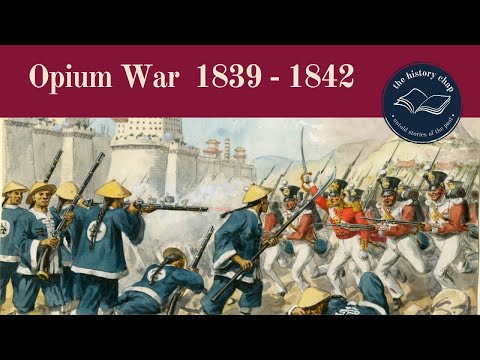
By the early 19th century, Britain’s insatiable appetite for Chinese tea had created a massive trade imbalance. The East India Company, desperate for silver to pay for tea, found a solution in opium. “By 1833, the East India Company sold 30,000 chests of opium—something like 2,300 tons a year,” Green notes. The Chinese emperor had outlawed the drug in 1796, but smuggling flourished, corrupt officials turned a blind eye, and addiction spread through Chinese society.
In 1839, the emperor finally acted. He dispatched Lin Zexu, a incorruptible viceroy, to Canton to stamp out the trade. Lin publicly executed Chinese dealers, blockaded the foreign factories, and demanded the surrender of all opium stocks. “The European traders brazenly stored the opium in their factories,” Green says, highlighting the complicity of British merchants. Trapped and desperate, the British superintendent of trade, Captain Charles Elliot, promised compensation he had no authority to offer. The traders handed over 20,000 chests—1,400 tons of opium—which Lin promptly destroyed on a nearby beach.
The situation might have de-escalated, but in July 1839, a brawl between drunken British sailors and locals on the Kowloon Peninsula left a Chinese man dead. Lin demanded the sailors be handed over, but Elliot, distrusting Chinese justice, refused. Instead, he paid compensation and tried the men in a Royal Naval Court. Lin retaliated by blockading the Pearl River and cutting off supplies to the British. “Elliot now found himself in a floating colony of 60 ships and 2,000 people just off the coast without any access to food or other supplies,” Green describes.
Salvation arrived with HMS Volage, a 28-gun frigate commanded by Captain Henry Smith. On September 4, 1839, after the Chinese refused to provide provisions, Elliot issued an ultimatum: supply the British or face fire. When the deadline passed, Smith opened fire—the first shots of the First Opium War. The skirmish, known as the Battle of Kowloon, was inconclusive, but it marked the point of no return.
Back in London, the crisis sparked fierce debate. Elliot’s unauthorized promise of compensation angered Parliament. “Many asked why the British government should bail out the traders with public money,” Green explains. But William Jardine, a Scottish merchant with vast experience in China, persuaded Foreign Secretary Lord Palmerston that military intervention was essential. After a heated debate, Parliament voted for war by a mere nine votes.
The British government’s goals were clear: demand respect for British diplomats, secure compensation for the destroyed opium, open more Chinese ports to trade, and acquire a defensible island off the coast. “The conquest of China was never one of them,” Green emphasizes. Yet, as the fleet set sail in June 1840, the stage was set for a conflict that would force China to open its doors—and change the balance of power in Asia forever.
The British task force, commanded by Major General Hugh Gough and Rear Admiral George Elliot, moved swiftly up the Chinese coast. At the Battle of Chusan, they destroyed twelve Chinese war junks and captured the strategic island. “The three British leaders met on board the East India Company’s warship Nemesis to discuss their next move,” Green narrates. They decided to split their forces: a southern expedition toward Canton and a northern one toward the Peiho River, where Elliot would present Lord Palmerston’s demands to the imperial government.
During the lull in fighting, the Chinese reinforced their positions, especially in the Pearl River. The Humen forts were strengthened with 3,000 troops and over 300 cannon. In January 1841, after another naval battle, Elliot and the new Chinese commander Qishan signed a peace agreement. “Britain would be given equal diplomatic rights, compensation for the destroyed opium, and the island of Hong Kong,” Green explains. Five days later, Commodore James Bremer took possession of Hong Kong for Great Britain.
But both governments rejected the treaty. The emperor was furious at Qishan’s concessions, and London believed Elliot had not gained enough—China had not been fully opened to British trade. “Hostilities resumed within the month,” Green states. Gough captured the city of Xiamen, and the Chinese launched a night attack with fire rafts in the Pearl River, but Rear Admiral Elliot’s seamanship saved the British fleet.
Despite being outnumbered ten to one, Gough’s forces took the heights above Canton and bombarded the city. The Chinese abandoned it, and Canton fell into British hands. Elliot negotiated another truce, but his political capital was spent. “At the end of July 1841, he was replaced by Henry Pottinger,” Green reveals. Pottinger, a seasoned East India Company official, joined Gough and Admiral William Parker to form a powerful triumvirate.
In August 1841, Gough attacked the port city of Amoy with 25,500 men, including regiments that would later become famous. “The largest Chinese battery withstood 12,000 cannonballs before being captured,” Green notes. The British withdrew to a nearby island, and lawlessness briefly engulfed Amoy until the Chinese army returned.
Two months later, the British recaptured Chusan, which they had abandoned under Elliot’s deal. After another winter lull, Gough led an expedition of 25 ships and 10,000 troops up the Yangtze River in May 1842. “His steam ships navigated the river as they pleased, giving the British a crucial advantage,” Green says. They captured Shanghai and advanced toward Nanking.
In the final battle at Zhenjiang, thousands of Chinese troops attacked but were driven back by superior firepower. With Nanking within reach, the emperor ordered negotiations. “The Treaty of Nanking brought the First Opium War to an end,” Green concludes. It gave Britain $21 million in reparations, four new treaty ports, and Hong Kong in perpetuity. “The first governor of Hong Kong was Henry Pottinger,” Green adds. The war was over, but the legacy of humiliation and unequal treaties would shape China’s relationship with the West for generations.
Pottinger wasted no time establishing British authority over the newly acquired island. “Hong Kong would remain a British colony until 1997,” Green notes, yet the treaty’s terms were far from the end of the story. The island was rocky and sparsely populated, but its deep-water harbor offered a perfect base for trade and naval operations. Almost immediately, British merchants began arriving, eager to exploit the new gateway into China.
But the Treaty of Nanking did little to address the underlying tensions. “The Chinese had been forced to sign what they saw as a humiliating document,” Green explains, and resentment simmered beneath the surface. The emperor’s negotiators had ceded Hong Kong in perpetuity, but the Chinese government never truly accepted the loss. Meanwhile, the opium trade continued unabated—British merchants simply shifted their operations to the new colony, where Chinese law no longer applied.
For the British, the war had achieved its goals: free trade, compensation, and a strategic foothold in Asia. Yet the victory came at a moral cost. “Gladstone, the future prime minister, had condemned the war as unjust,” Green reminds us. The debate over Britain’s role in the opium trade would not fade; it would only grow louder in the years to come.
Within a decade, the fragile peace began to crumble. The Chinese government, still weakened by the first war, faced internal rebellion and external pressure. Western powers, emboldened by Britain’s success, demanded even more concessions. “The French, the Germans, the Russians—even the Japanese—followed suit,” Green says, describing the scramble for influence that would become known as the “century of humiliation.”
By 1856, a new conflict was brewing. The British, still smarting from what they saw as Chinese intransigence, found a pretext for war when Chinese officials boarded a British-registered ship, the Arrow, and arrested its crew. “Once more, opium would be cited as a cause,” Green hints, but the underlying issues were the same: trade, pride, and power.
As the clouds of a second Opium War gathered, the legacy of the first remained unresolved. Hong Kong was thriving as a British colony, but the Chinese people had not forgotten the humiliation of Nanking. The unequal treaties, forced upon them at gunpoint, would fuel a desire for revenge that would take another century to fully express.
For now, the British stood triumphant in China, but their position was built on shaky ground. “The problem of the illegal opium trade was still there,” Green warns, “kicked down the road, as problems often are.” And when problems are kicked down the road, they have a way of coming back—with interest.
The Treaty of Nanking was signed on August 29, 1842, aboard HMS Cornwallis. It ceded Hong Kong to Britain in perpetuity, opened five treaty ports, and forced China to pay $21 million in reparations. “The first governor of Hong Kong was Henry Pottinger,” Green notes, and the colony quickly became a hub for British trade and naval power.
But the Chinese never accepted the treaty’s terms. “They saw it as a humiliating document forced upon them at gunpoint,” Green explains. Resentment simmered, and the opium trade continued unabated. British merchants simply moved their operations to Hong Kong, beyond the reach of Chinese law.
For Britain, the war achieved its goals: free trade, compensation, and a strategic foothold. Yet the moral cost was high. Gladstone had condemned the war as unjust, and the debate over opium would only intensify. “The problem was kicked down the road,” Green warns, “and when problems are kicked down the road, they have a way of coming back—with interest.”
Within two decades, the Second Opium War would erupt, and China’s century of humiliation would deepen. Hong Kong remained a British colony until 1997, when it was returned to China. The legacy of the Opium Wars still shapes China’s relationship with the West today. “That century of humiliation still shapes the views of many Chinese,” Green concludes, “especially political leaders, towards the West—and in particular Britain—to this day.”
What do you think? Was the Opium War truly about opium, or was it merely a pretext for imperial ambition? Share your thoughts in the comments below.
Report this article
Select a reason for reporting:






