In the sweltering skies over Vietnam, a stubby, unassuming aircraft was about to rewrite the rules of aerial warfare. It wasn’t sleek like a fighter, nor as famous as the bombers that came before it. But the A-7D Corsair II carried a secret in its belly—a digital brain so advanced that it turned ordinary pilots into precision marksmen. This is the story of how a rejected Navy design became the Air Force’s most feared weapon, and why its legacy still haunts the skies today.
By 1965, the US Air Force was desperate. Its aging fleet of F-100s and A-1 Skyraiders was struggling to deliver bombs with any real accuracy, and the Vietnam War was demanding more. Then, a solution appeared from an unlikely source: the Navy’s new A-7 Corsair II. The Air Force initially wanted a simple modification, but it soon became clear that a radical overhaul was needed. What emerged was the A-7D—a machine that would pack a revolutionary digital avionics suite, a more powerful engine, and a 20mm cannon that could fire three times faster than its predecessors.
The heart of this transformation was the Integrated Light Attack Avionics System (ILAAS), a digital computer that fed data to a head-up display (HUD) and a projected map display. For the first time, a pilot could see exactly where his bombs would land before he even released them. This was made possible by two new modes: Continuously Computed Impact Point (CCIP) and Continuously Computed Release Point (CCRP). With CCIP, a pilot could visually place a pipper on a target and pull the trigger, and the computer would handle the rest. With CCRP, he could designate a target and let the aircraft fly itself to the perfect release point, even in bad weather or at night.
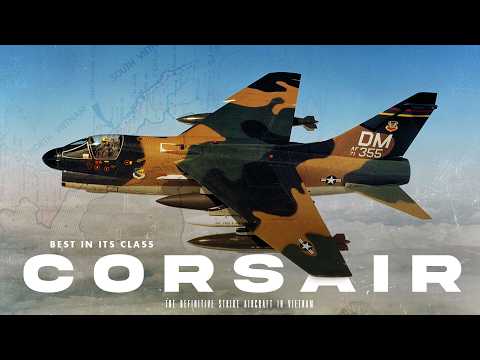
But the A-7D wasn’t just a smart bomb truck. It was also tough. Its new TF41 engine produced over 14,000 pounds of thrust, giving it a top speed of over 600 knots and a combat radius of 900 miles. It could carry up to 15,000 pounds of ordnance—including 30 Mk 82 bombs—and still come back for more. The landing gear was reinforced for rough runways, and the cockpit was redesigned for ease of use. Every system, from navigation to weapon delivery, was digitally integrated, making the A-7D the most advanced attack aircraft of its time.
By the time it arrived in Vietnam in October 1972, the Corsair II was ready to prove itself. Assigned to the 354th Tactical Fighter Wing at Korat Airbase, Thailand, the A-7Ds quickly took on two critical missions: interdiction and combat search and rescue (CSAR). In its first ten weeks, the A-7D flew 6,568 combat sorties, with 5,897 of those being attack missions. Its accuracy was staggering—circular error probable (CEP) of just 18 meters with unguided bombs, rivaling laser-guided weapons. Ground troops loved it because it could hit targets close to friendlies without fear of friendly fire.
One pilot, Colonel Colin Clarke, spent nine hours in a CSAR mission, coordinating the rescue of a downed Wild Weasel crew under heavy fire. He was awarded the Air Force Cross for his heroism. The A-7D also played a key role in Operation Linebacker II, striking targets in Hanoi with deadly precision. By January 1973, it had the lowest loss rate per sortie of any aircraft in the war, and it had dropped more bombs on Hanoi than any other tactical aircraft except the B-52.
But the story of the A-7D doesn’t end in Vietnam. It went on to serve in Grenada and Panama, and its digital avionics paved the way for modern fighters like the F-16 and F-35. Its spirit lives on in the A-10 Warthog, which took over the close air support role. The A-7D was retired in 1993, but its impact is still felt today. So the next time you see a fighter jet with a glass cockpit and a HUD, remember the stubby little Corsair II that started it all.
But there was a darker side to this technological triumph. The very systems that made the A-7D so lethal also made it a logistical nightmare. Each aircraft required over 40 hours of maintenance for every flight hour, a burden that strained ground crews already stretched thin by the war’s demands. The digital computers, while revolutionary, were fragile and prone to failure in the humid, dusty conditions of Southeast Asia.
And then there was the cost. By 1968, the per-unit price had doubled from initial estimates, and the Air Force was forced to justify every dollar to a skeptical Congress. Critics argued that the A-7D was a gold-plated toy, too complex for the dirty, close-in fight it was designed for. Yet the pilots who flew it disagreed—vehemently.
“You could give me a stick and a map,” one A-7D pilot recalled, “and I’d still take the Corsair. Because when that pipper sits on the target, you know it’s going to hit. No guesswork. No prayers. Just physics.” That confidence, born from digital precision, changed the psychology of the attack pilot. No longer did they have to dive through flak, eyes glued to a gunsight, hoping for the best. They could release from level flight, from altitude, from angles that would have been suicidal in an F-100.
The North Vietnamese knew this too. Captured documents later revealed that NVA commanders specifically warned their gunners to prioritize the “short, ugly one” because it was the most dangerous aircraft in the sky. Its accuracy meant that even a single A-7D pass could destroy a bridge that had survived dozens of raids by other types.
But the Corsair II’s greatest contribution wasn’t measured in destroyed targets. It was measured in saved lives. In the spring of 1973, as the last American combat troops withdrew from Vietnam, A-7Ds flew cover for the final evacuations. One crew, low on fuel and riddled with ground fire, stayed on station to suppress enemy fire while a damaged helicopter limped to safety. They landed with less than five minutes of fuel remaining, their aircraft so badly damaged it was scrapped on the spot. Neither crewman received a medal. They didn’t need one.
As the 1970s wore on, the A-7D found new life in the Air National Guard. Here, far from the front lines, its digital avionics became a training tool for a new generation of pilots. Guard units in Ohio, Iowa, and New Mexico flew the Corsair II well into the 1980s, often outperforming active-duty squadrons in bombing competitions. The aircraft that had been designed as a temporary stopgap had become a beloved workhorse.
But time, as always, had other plans. The A-10 Thunderbolt II, designed from the ground up for close air support, began replacing the A-7D in the late 1970s. The Corsair II’s last combat hurrah came in 1989 during Operation Just Cause in Panama, where 34 Guard sorties struck targets with pinpoint accuracy. By 1993, the last A-7D had been retired to the boneyard at Davis-Monthan Air Force Base, its digital brain silenced forever.
Yet the story doesn’t quite end there. Walk through the cockpit of a modern F-35 and you’ll find the same design philosophy: a central computer fusing sensor data, a HUD projecting critical information, and weapon delivery modes that let a pilot think less about math and more about the mission. The A-7D was the first to prove that a digital brain could make a mediocre airframe into a world-class weapon.
But that proof came at a price, and the men who flew it knew it. “The Corsair was a computer with wings,” one pilot later said, “and sometimes the computer won.” There were incidents—rare, but real—where the digital systems glitched, the HUD flickered, and the bomb went wide. In one notorious case, an A-7D crew accidentally released a bomb on a friendly position because the CCRP mode had locked onto the wrong target. The investigation found no pilot error, just a software quirk that took weeks to fix.
That fragility was the flip side of the digital revolution. The Air Force had rushed the A-7D into combat, and the bugs hadn’t all been worked out. Ground crews in Thailand often had to cannibalize parts from one aircraft to keep another flying, a practice that became so common it earned the nickname “Corsair roulette.” The supply chain, designed for analog jets, struggled to keep up with the new digital components.
Yet the pilots kept flying. They had no choice. The war wasn’t waiting for the bugs to be fixed. And despite the maintenance headaches, the A-7D’s sortie rate remained high—higher, in fact, than many of its contemporaries. The ground crews, exhausted and overworked, took a grim pride in keeping the “Short Ugly” in the air. They knew that every bomb on target meant fewer American lives lost.
What made the A-7D truly special, though, wasn’t just its technology or its combat record. It was the way it changed the relationship between pilot and machine. In older aircraft, the pilot was the brain, the computer—the one doing all the calculations. In the Corsair II, the pilot became a supervisor, a decision-maker. The aircraft did the math; the human did the judgment.
That shift had profound implications. It meant that a young lieutenant with only a few hundred hours of flight time could deliver ordnance with the same precision as a seasoned veteran. “We used to spend hours studying bomb tables and wind drift,” one instructor recalled. “Now I just tell the computer where I want the bomb to go, and it figures out the rest.” The learning curve had flattened, and that made the A-7D deadly in a way that had nothing to do with its engines or its bomb load.
But it also created a new kind of vulnerability. If the computer failed, the pilot was lost. There were no backup iron sights, no manual calculations to fall back on. The A-7D was all-or-nothing, and in the chaos of combat, that was a gamble every crew took every time they took off.
As the war wound down, the Corsair II’s reputation only grew. It had become the aircraft that ground troops prayed for and enemy gunners feared. Its accuracy was so consistent that forward air controllers began requesting A-7Ds by name, sometimes waiting hours for one to become available rather than accept a different aircraft. That kind of trust wasn’t given lightly.
And yet, for all its success, the A-7D remained a footnote in the Air Force’s official history. It was never glamorous, never the star of a recruiting poster. It was a tool, a weapon, a machine that did its job and came home. The men who flew it didn’t ask for glory. They asked for precision, and the Corsair delivered.
That unglamorous legacy is exactly what the Corsair II’s final chapter reveals. After Vietnam, the A-7D settled into a quieter life, but its digital DNA spread far beyond its own airframe. Every modern attack aircraft—from the F-16 to the F-35—carries a piece of the Corsair’s brain. The HUD, the CCIP pipper, the fusion of navigation and weapon delivery: all of it traces back to that stubby, unlovely jet.
When the last A-7D touched down at Davis-Monthan in 1993, there was no ceremony, no flyover. Just a crew chief patting the nose one last time before walking away. The aircraft that had changed aerial warfare sat silent in the desert, its computers dark, its lessons already absorbed by the next generation.
Years later, a retired pilot visited the boneyard. He stood before a faded Corsair, ran his hand along the intake, and whispered something to the old machine. “You never missed,” he said. “Not when it mattered.” Then he turned and left, and the desert wind took over.
So here’s the question for you: if a machine can be remembered for saving lives rather than taking them, does that make it a weapon—or something more? Tell us what you think in the comments below.
Report this article
Select a reason for reporting:






