On the first night of May 1945, deep beneath a collapsing Berlin, six children were poisoned. Their names all began with the same letter: Helga, Hildegard, Helmut, Holdine, Hedwig, and Heidrun. The eldest was twelve. The youngest was four. Their mother was in the room when it happened.
That mother was Magda Goebbels, wife of the Nazi propaganda minister. And the most disturbing part? She had a way out. Albert Speer had offered to send a barge to slip the children out of the city. She refused. She brought them down into Hitler’s bunker instead—the one place on earth where no one could stop her.
Six years earlier, another death ran through the same woman. Richard Friedländer, the father who raised her, who gave her his name and part of her childhood in Brussels, died in Buchenwald in 1939. By then, Magda was one of the most powerful women in Germany. A single word from her might have saved him. She said nothing.
Two deaths. One woman standing at both ends. Six children in a bunker, one aging man in a camp—both dead, both deaths running directly through her.
The temptation is to call her story a tragedy that happened to her. A woman crushed by history, by love, by a machine bigger than herself. That reading is wrong. This is not a story about what the war did to Magda Goebbels. It is a story about what she chose and what she allowed.
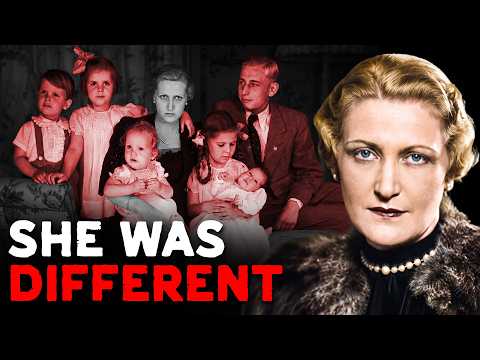
To millions of Germans in the 1930s, Magda was the wholesome mother of a growing family—the smiling wife at the propaganda minister’s side, the domestic ideal every German woman was meant to copy. Photographed with her children constantly, she was held up as something close to the first lady of the Third Reich.
But the image was manufactured on nearly every front. The happy marriage was a performance stretched over years of quiet humiliation. The devoted Nazi matriarch was a role she had been cast in and learned to play with real skill. And the deepest fabrication of all had nothing to do with the marriage or the propaganda smile. It was a fact about her own origins—one that, if the Nazis had ever confirmed it, would have destroyed her overnight.
Richard Friedländer was not a footnote in Magda’s early life. He married her mother, adopted her as a girl, and raised her partly in Brussels, giving her his surname—a recognizably Jewish name she carried into adulthood. By most accounts, she stayed close to him well into her adult years. This was not a distant step-parent. This was the man whose name she signed.
And then, piece by piece, she let that name be erased. First at the insistence of her first husband, the wealthy industrialist Günter Quandt, who wanted no Jewish surname attached to his household. Later, it was scrubbed further as she rose inside the Nazi world alongside Joseph Goebbels. The name that connected her to the man who raised her was struck from the record like an inconvenient detail.
Then came the part no softer reading can absorb. When Richard Friedländer was arrested and sent to Buchenwald, Magda was not a powerless girl anymore. She was married to one of the most powerful men in Germany—a woman who could pick up a telephone and reach Hitler himself. Ordinary Germans with a relative inside a camp had no one to call, no door to knock on, no leverage of any kind. Magda had all of it. A single word from her might have changed his fate. She said nothing. She did nothing at all.
Friedländer died inside that camp in 1939. There is no record that she ever tried to reach him or even asked after him. This is the ancestry strand seen clearly for the first time—not as some cruel twist of irony, but as the sharpest test of what Magda had chosen to become and the coldest possible answer to it.
Now the twist that almost every telling of Magda gets exactly backwards. In 2016, the historian Oliver Hilmes surfaced a document—a residency card—that did not describe Richard Friedländer as her stepfather at all. It named him as her biological father. Loosely supporting it is a note in Goebbels’s own diary from 1934, recording that Magda had discovered something deeply shocking about her own past. Put those together and the picture becomes almost unbelievable. The regime’s model mother, the icon of Aryan motherhood, may herself have been what the Nazis called a half-Jew—carrying the very ancestry her husband’s ministry worked to exterminate.
And this is exactly where most versions of the story stop and let you feel something warm and tragic. The secret Jew undone by the machine she served. So let’s refuse that here, out loud. The paternity is not proven. There is no DNA, and there is a perfectly innocent explanation for that card, tied to sorting out her legal status as a child born before her parents married. Historians still debate it, and honestly, it does not matter to the verdict. Whatever ran in her blood, what damns Magda Goebbels is not her ancestry. It is what she did with full knowledge and full power—including turning her back on the man that same document may prove was her own father.
And that makes the last thing she did almost impossible to explain away.
There is one more excuse to clear out of the way before we reach the bunker. The idea that she was just a wife, dragged along by a monstrous husband. It does not hold either.
Her marriage to Joseph Goebbels in 1931 was a Nazi event in its own right. Adolf Hitler stood as a witness at the wedding. From the beginning, Magda was not a bystander to power. She was positioned inside it, deliberately, as a public asset of the movement.
And the marriage itself was miserable. Goebbels was a serial adulterer, and for years Magda endured a parade of his affairs. The clearest proof that she was no passenger came in 1938, during Goebbels’ very public affair with the Czech actress Lída Baarová. This was not a quiet indiscretion. Goebbels was reportedly ready to leave Magda for the actress, and the scandal threatened to blow up in the middle of the regime’s carefully staged family portrait.
Magda didn’t simply suffer it. She pushed for a divorce, and she nearly got one. She had, in that moment, a genuine off-ramp out of the marriage that would later take her into the bunker. What stopped her was Hitler himself, who personally forbade the split, because the regime simply could not afford a crack in the picture of its perfect family. And so, she stayed, held in place by an order from the top.
But notice what that whole episode reveals. When the situation genuinely wounded her, Magda was perfectly capable of trying to leave it. She had a will of her own, and the will to act on it. She chose this world when it degraded her, chose it when she was handed a way out, and chose it again and again across more than a decade. Whatever Magda Goebbels was, she was nobody’s helpless passenger.
By April 1945, the Soviet army was closing in on Berlin, and the Goebbels family did something almost no one else in their position did. They went down into Hitler’s bunker, into the very center of the collapse, and settled in with the six children.
But here is the detail that changes everything. The exit was real. Albert Speer, in his own memoir, describes offering to send a barge to carry the children out of the city and hide them until the fighting was over. Other offers to get the children clear were made as well. Magda refused every one of them.
And by more than one account, she had already been talking about killing the children weeks before the end. This was not a thought that seized her in a final panic. According to the bunker guard Rochus Misch, she brought the children down into that concrete tomb precisely because it was the one place on earth where no one would be able to stop her.
So set aside the image of a mother trapped with no way out. She had a way out, and she closed the door on it herself. What came next was not the desperate act of a cornered woman. It was a plan she had months to reconsider and chose every single day not to.
On the 1st of May, 1945, the plan was carried out. The children were dressed in white nightclothes, and the girls had ribbons tied in their hair, as if it were an ordinary evening before bed. Exactly how they were killed has never been settled, and honesty requires saying so. By the testimony of Helmut Kunz, an SS dentist in the bunker, he first gave the children morphine injections to sedate them, and then Magda, together with Hitler’s physician Ludwig Stumpfegger, administered cyanide. Other accounts describe a sedative dissolved in a cup of cocoa. The most widely supported version blends the two—a drug to put them under, then the poison. But the precise method was never conclusively established.
What is not in dispute is the outcome. All six children died in that bunker within minutes of one another.
What she said about it survives more clearly than how she did it. She told Hitler’s secretary, Traudl Junge, that she would rather her children were dead than grow up in a Germany without National Socialism. That a life after all this, lived in disgrace, was to her worse than no life at all. And in a farewell letter written in her own hand to Harald, her one surviving son from her first marriage, who was away as a prisoner of war, she framed the killing not as a horror, but as an honorable end for a proud National Socialist family.
There is also a claim attributed after the war to a relative named Eleanor Quandt that Magda spoke of reincarnation and of not wanting the children to grow up branded as the offspring of a notorious criminal. Whether that was a real belief or something reconstructed later, no one can say for certain. But strip all the framing away and the letter in her own handwriting says enough on its own.
So let’s line up every frame that tries to soften this and reject each one by name. The mother destroyed by a terrible love? No. She had exits and she sealed them shut on purpose. The secret Jew undone by cruel irony? No. Her possible ancestry is unproven and even if true, it changes nothing about what she did with the power she held. The wife dragged along by a monstrous husband? No. She married into the movement with Hitler as a witness, sought her own way out once and turned back into it by choice.
What survives all three excuses is the same woman. Someone who was handed a way out at every single stage and who chose the regime over the father who raised her, over her own six children and finally over her own life.
The aftermath is quickly told. On the 3rd of May, 1945, Soviet troops moving through the ruined bunker complex found the six small bodies, and forensic examination later confirmed cyanide poisoning.
The honest limits of the record remain. The paternity is still unproven. The exact method of the killing is still contested, and the reincarnation line may well have been stitched together after the fact. None of that is a mystery to be teased. It is simply the edge of what we are able to know.
And that is precisely why this case still sits inside Holocaust and Second World War education to this day. Not as a puzzle, and not as a tragic love story gone wrong. It sits there as the starkest example on record of an ideology overriding the most basic bond a human being can have. A mother choosing a dead cause over her own children in a bunker in the dark.
If you take one thing from this, take that. The most dangerous thing about true believers was never their hatred of strangers. It was what they were willing to do to their own.
So here is the question that lingers long after the bunker goes silent: when a person is offered a way out again and again and refuses it every time—at what point does the world stop asking what was done to them, and start asking what they were willing to do? Tell us in the comments.
Report this article
Select a reason for reporting:






