Imagine waking up in a palace with gold-leaf ceilings, French governesses in the hallway, and a thousand serfs who still bow when you ride past their village. By nightfall, strangers are smashing your porcelain against the walls, your father has been dragged into a courtyard and shot in his dressing gown, and your name—the same name that once opened the doors of the Winter Palace—is now a death sentence. This is not fiction. This is what actually happened to tens of thousands of people in Russia between 1917 and the mid-1920s, when the oldest aristocracy in Europe was shattered in a matter of months.
Entire bloodlines that had ruled estates the size of small countries were suddenly classified by the state as “former people”—a bureaucratic term that meant they had no rights, no property, no vote, and in many cases, no future. Some escaped on cargo ships hidden among crates of tea. Some bribed border guards with jewels sewn into the hems of their skirts. Some were murdered in cellars and dumped into mine shafts. And a very small number, through sheer luck or ruthless cunning, managed to carry their names, their secrets, and sometimes their fortunes into exile, where their descendants still live today in Paris, London, New York, and the quiet suburbs of Buenos Aires.
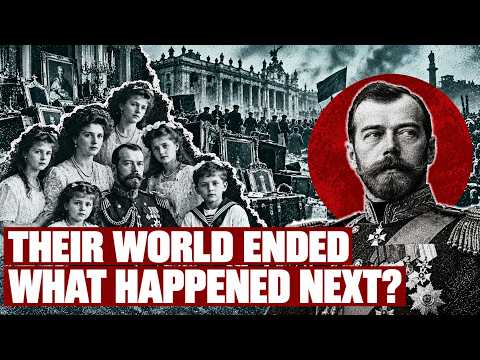
To understand the scale of the fall, you have to understand how high these people were sitting before the ground gave way. In 1913, the Russian Empire was celebrating 300 years of Romanov rule. Nicholas II sat on a throne of gold, surrounded by courtiers whose family trees reached back to Ivan the Terrible and beyond. The empire stretched from Warsaw to Vladivostok. Roughly 1.9 million people were classified as nobles, though the true aristocracy—the titled princely and noble families with real wealth and political influence—was much smaller.
At the top sat perhaps a few hundred clans, and at the top of those sat names that even today carry a kind of mystic weight in Russian history. The Romanovs, the Yusupovs, the Sheremetevs, the Galitzines, the Volkonskys, the Stroganovs, the Shuvalovs, the Dolgorukovs, the Trubetskoys. Some of these families owned hundreds of thousands of acres. The Sheremetevs alone, before 1861, had owned more than 200,000 serfs—more people than lived in most European capitals at the time. The Yusupovs were quietly reputed to be richer than the Tsar himself, with a fortune built on gold mines, ironworks, oilfields, textile mills, and palaces so lavish that one of them, the Moika Palace in St. Petersburg, had a private theater modeled on an Italian opera house.
These were not just wealthy people. These were living institutions, and they had every reason to believe their world would last forever. For two and a half centuries, the aristocracy had been the state. They staffed the military, the diplomatic corps, the ministries, the Orthodox hierarchy, and the court. Their sons went to the Corps des Pages. Their daughters were presented at balls where the chandeliers held 15,000 candles. French was their first language. Many of them spoke better French than Russian, and had never actually spoken to a peasant in anything but a command.
The gulf between them and the rest of the empire was so wide that when revolution finally came, the aristocracy did not understand it, not even as it was swallowing them whole. One contemporary memoir describes a countess hosting a dinner party in February 1917 as rifle fire echoed across the Neva. She assumed it was a riot, something the police would handle by morning. She was still trying to decide between the sturgeon and the game course when the servants began to flee. Within hours, she and her guests were running across a snowy street in their evening clothes.
The first crack came in February 1917. Food shortages, mounting casualties on the Eastern Front, and years of accumulated rage against a monarchy that seemed completely indifferent to the suffering of ordinary Russians brought Petrograd to a boil. Nicholas II abdicated on March 15th, 1917. He first tried to pass the crown to his brother, Grand Duke Michael, who held the throne for a single day before refusing it. In that moment, more than 300 years of Romanov rule simply stopped.
A provisional government took power, and for a few confused months, the aristocracy continued to live almost as before. The palaces stood. The servants mostly stayed. There were parties. Some observers thought the storm had passed. It had not. It had barely started. In October of 1917, the Bolsheviks under Vladimir Lenin seized power in Petrograd. Within weeks, decrees began pouring out of the Smolny Institute. All titles of nobility were abolished. All private land was declared the property of the state. The banks were nationalized. Church valuables were seized.
By the summer of 1918, a formal category had been created in Soviet law called “former people”—in Russian, buvshiye lyudi. It applied to former nobles, former officers of the Imperial Army, former clergy, former merchants, former landowners, and anyone else whose life had been built on the structures of the old regime. Former people could not vote. They could not hold certain jobs. They could not receive ration cards at the same level as workers. Their children were often barred from universities. The state had, with one bureaucratic swipe, converted an entire class into non-citizens.
And then came the real violence. On September 5th, 1918, the Council of People’s Commissars issued the formal decree on Red Terror. It authorized the Cheka, the Bolshevik secret police under Felix Dzerzhinsky, to execute class enemies without trial. The decree followed an assassination attempt on Lenin and the killing of the Petrograd Cheka chief, Moisei Uritsky, but the groundwork had been laid months earlier. Cheka commander Martin Latsis stated the policy with cold clarity in October 1918, saying the goal was to destroy the bourgeoisie as a class.
Officially, the Red Terror lasted only a few months. In practice, historians consider it to have run through the entire Russian Civil War from 1918 to 1922. Estimates vary wildly, but most serious historians put the number executed by the Cheka during this period at well over 100,000, and some estimates run considerably higher once civil war violence, local lynchings, and starvation in Cheka prisons are included. The aristocracy was a priority target. In every provincial town, lists were drawn up of people with noble names, former officers, former estate owners. They were rounded up as hostages, held in cellars, and often shot in waves whenever a Red Commissar was assassinated or a White Army offensive threatened the city. In Petrograd alone, in just a few days after the attempt on Lenin’s life, more than 500 hostages, many of them titled nobles, were executed.
The historian Douglas Smith, in his definitive book Former People: The Final Days of the Russian Aristocracy, documents through two great families—the Sheremetevs and the Golitsyns—how the destruction unfolded house by house, prison by prison, body by body. Their palaces were seized, cataloged, and either converted into museums, apartments for workers, or barracks for Red Army soldiers. Their silver was melted down. Their libraries, which in some cases contained medieval manuscripts, were scattered or burned. One estate after another was looted and vandalized. In the summer and autumn of 1917 alone, before the Bolsheviks even took power, peasants had already burned or sacked thousands of noble country houses. The Bolsheviks simply formalized what was already underway.
And then, of course, there was the fate of the royal family itself. After abdication, Nicholas, his wife Alexandra, their four daughters—Olga, Tatiana, Maria, and Anastasia—and their son Alexei, were kept under house arrest. First at the Alexander Palace outside St. Petersburg, then in August 1917, under the provisional government, they were moved to the Siberian town of Tobolsk. In April 1918, under the Bolsheviks, they were transferred again to Yekaterinburg in the Urals, where they were confined in a merchant’s house that was ominously renamed the House of Special Purpose. It belonged to an engineer named Ipatiev. They would spend 78 days there.
On the night of July 16th and the morning of July 17th, 1918, as the White Army and the Czechoslovak Legion closed in on the city, the family was woken, told they were being moved for their safety, and brought down to the basement. There, a squad led by Yakov Yurovsky opened fire. The execution was horrific and clumsy. The Grand Duchesses had sewn diamonds into their corsets, which deflected some of the bullets, and so they had to be finished off with bayonets and rifle butts. The young Tsarevich Alexei, who was wearing a shirt padded with hidden jewels, took an entire clip to kill. The bodies were loaded onto a truck, carried into the forest, dismembered, burned, and dumped. For decades, the Soviet state refused to acknowledge what had happened. DNA analysis in the 1990s and the discovery of two more sets of remains in 2007 finally confirmed that all seven members of the Imperial family had died that night.
The next day, July 18th, 1918, in a mine shaft near Alapayevsk, eight more Romanovs were murdered. Among them was Grand Duchess Elizabeth Fyodorovna, the Tsarina’s sister, a widow who had become a nun. According to White investigators, singing could be heard from the shaft for hours after the victims were thrown in alive.
By the end of 1919, the Bolsheviks had hunted down and killed almost every Romanov on Soviet soil—18 members of the extended family between June 1918 and January 1919. But not all. In April 1919, the British battleship HMS Marlborough arrived at Yalta and departed carrying 17 Romanovs, including the Dowager Empress Marie Fyodorovna and Prince Felix Yusupov, the man who had murdered Rasputin three years earlier.
Yusupov’s story captures something essential. He escaped with two Rembrandts and a pouch of jewels; millions in hidden rubles were found in his palace in 1925. In Paris, he and his wife Irina opened a fashion house and later won a libel suit against MGM that established the modern “all characters are fictitious” disclaimer. He died in 1967, his descendants still living quietly in France.
Between 1 and 2 million Russians fled between 1917 and 1923. Berlin drew 360,000; Paris became the exile capital, where princes drove taxis and Grand Duchesses worked as seamstresses. Stateless, they traveled on Nansen passports—the first modern humanitarian document, invented specifically for them.
Some went east to Harbin, which by the mid-1920s held 120,000 Russians. When the Soviets occupied Manchuria in 1945, thousands were deported to the gulag for crimes committed decades earlier.
For those who stayed, survival meant hiding. Under Stalin, mass arrests swept Leningrad and Moscow. By the end of the Second World War, not a single male Sheremetev remained in the Soviet Union. The Golitsyns survived by sheer numbers—more than 100 branches by 1917.
In the 1990s, descendants began to return. Prince Rostislav Romanov moved back to Moscow in 2013. The Church canonized Nicholas II in 2000. But the property never came back—no restitution, only museums and ruins.
The revolution ate everyone eventually: the nobles, the peasants starved under collectivization, the Bolsheviks purged by Stalin, even Yurovsky dying of an ulcer after watching his own daughter imprisoned. Walk through the 16th arrondissement today and you will still find Sheremetevs and Golitsyns in the phone book—ordinary people now, carrying names that once meant everything.
Wealth tied to political power can vanish overnight. The aristocracy had land, titles, and the Tsar’s favor—but no liquidity, no foreign accounts, no understanding of how fast a world can collapse. The Rothschilds chose mobility; the Romanovs chose palaces. Only one choice survived the century.
So here is the question I leave with you: if your entire world could be erased in a single generation, what would you carry out—and what would you be forced to leave behind? Tell me in the comments below.
Report this article
Select a reason for reporting:






