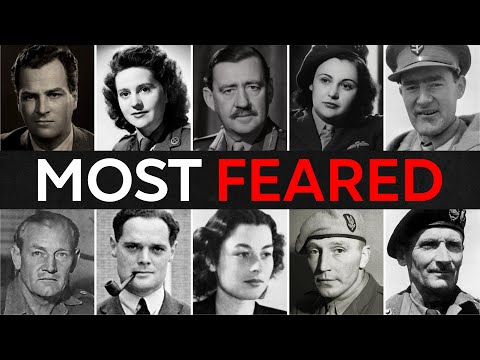
What if the Nazis’ greatest fear wasn’t a battalion or a bomb, but a single smiling British soldier with a sword, a kilt, or a forged passport? These weren’t ordinary men and women. They were chaos in human form. Ghosts in deserts, killers in ballrooms, legends made of flesh. From desert phantoms to double agents, this is the untold story of 17 British soldiers who didn’t just fight the Third Reich—they haunted it.
Some looked like nightmares, others like librarians. All were unforgettable. And the Nazis never saw them coming.
It begins, as these things often do, with a woman the enemy dismissed until they couldn’t. Nancy Wake was an expat socialite in Vichy France, a champagne-sipping thorn in the side of the Gestapo. They called her the White Mouse—a nickname that sounds almost affectionate until you realize how much blood was spilled in their pursuit of her, and how often they failed.
She started as a courier, then became a saboteur, then a full-blown guerrilla commander leading over 7,000 resistance fighters in the forests of Auvergne. Her orders: blow bridges, cut wires, harass German patrols until they feared the shadows. And they did. When she orchestrated a raid on the Gestapo headquarters in Montluçon, the Germans must have wondered if this was the work of a battalion. It wasn’t. It was Nancy with a cigarette in her mouth, a Sten gun at her side, and a bounty of 5 million francs on her head.
The more they hunted her, the more mythic she became. She danced with danger—quite literally. At one point she cycled 500 km through enemy territory to reestablish a broken communication line. When a Maquisard hesitated under fire, she offered him a brisk slap and kept shooting. Leadership through humiliation perhaps, but it worked.
You can imagine how that felt for the Germans. Outwitted, outgunned by a woman in heels. Every escape she made, every mission she pulled off wasn’t just a tactical win. It was a spiritual defeat. For every man in a gray uniform who believed he was fighting a war of superiority, Nancy Wake was the counterexample in lipstick.
But while she haunted the forests of France, another ghost was materializing in the desert—one the Germans would soon fear even more. Not for how he looked, but because he seemed to disappear before they could kill him.
Lieutenant Colonel David Stirling was called the Phantom Major—and not by the British. That nickname came from Rommel himself, the Desert Fox, who despite commanding the Afrika Korps, couldn’t keep track of where Stirling was, or if he was even real.
Stirling didn’t fight wars the traditional way. He thought the standard playbook was a bureaucratic suicide note. While other officers obsessed over troop formations and orderly lines, Stirling had another idea: what if a handful of men in jeeps could destroy entire airfields? Turns out they could.
Operating under the insignia of a unit that didn’t even technically exist yet—the Special Air Service—Stirling’s teams would drive hundreds of miles through open desert, sneak past sentries in the dead of night, and destroy rows of German aircraft with nothing but explosives and audacity. One mission saw over 30 planes destroyed in a single night. Quiet, clean, devastating.
The damage was surgical, but the psychological impact colossal. German command began diverting entire divisions to guard rear airfields. Paranoia spread. If aircraft could be destroyed that far from the front, then nowhere was safe. For a military built on order and precision, Stirling was chaos incarnate. And worse, he was a gentleman—a lanky, posh-accented saboteur who could smile while making your entire strategy collapse.
Eventually, the Germans caught him on the third attempt after two previous escapes. Even then, they weren’t sure it was really him. Some believed the Phantom Major was a fiction. But Stirling’s legacy wasn’t just in the planes he blew up. It was in the doctrine he rewrote: small, fast, relentless. The kind of warfare the Nazis didn’t plan for.
And just when they thought it couldn’t get worse, Stirling’s second in command stepped in. He didn’t just inherit the SAS—he turned it into a personal vendetta.
Lieutenant Colonel Robert Blair “Paddy” Mayne was not a man who asked permission. He was a barrister in training, a rugby international, and an occasional barroom brawler—the kind of man who, when told to destroy a German installation, would ask whether they wanted it flattened or vaporized.
After Stirling was captured, Mayne took command of the SAS and turned the desert war into something primal. His method: brutality wrapped in discipline. His weapon of choice: anything loud and final. His jeep raids were infamous—columns of fast-moving vehicles tearing into the heart of enemy bases, spraying machine-gun fire, tossing grenades, and vanishing into the night before the Germans knew what year it was.
They say he personally destroyed over 100 aircraft on the ground. Some accounts suggest he’d sometimes jump out mid-raid just to finish the job with his bare hands. By the time Mayne reached Europe, his reputation preceded him like a funeral procession.
In Oldenburg in 1945, he single-handedly cleared a German-held town. Locals swore they saw one man on foot moving from building to building—methodical, efficient, unstoppable. The rest of the SAS barely got out of their jeeps before it was over.
The Germans feared Mayne not because he was invisible like Stirling, but because he wasn’t. He was very visible, very loud, and completely immune to fear. Rumors of the Irishman circulated through German lines like ghost stories—except these ghosts kicked in your door and left smoking wreckage behind.
But if Paddy Mayne was fury incarnate, then what came next was madness in tartan.
Lieutenant Colonel Jack Churchill carried a Scottish broadsword into a firefight. He brought his longbow on commando raids and always—always—played the bagpipes when charging into gunfire. They called him Mad Jack. The Germans, however, didn’t call him anything, because most of them weren’t sure he was real.
Picture it: Normandy, Italy, Yugoslavia. Gunfire echoing through the hills. And then—pipes. A haunting Celtic tune carried by wind and madness, followed by the unmistakable sound of metal clashing where it absolutely shouldn’t, because no one expected to be killed by a man wielding a four-foot blade in 1943.
At Salerno, Churchill captured 42 German soldiers with nothing but his sword and his stare. They surrendered—perhaps out of fear, or maybe confusion. He was an anachronism dropped into mechanized war. But make no mistake: it worked. His psychological warfare left German troops rattled. You can prepare for tanks. You can train for gunfire. But you can’t prepare for the sound of bagpipes echoing through the rubble, followed by a screaming lunatic with a claymore.
Even after he was captured in Yugoslavia, Churchill’s myth only deepened. The Germans flew him to Berlin for interrogation, assuming—understandably—that anyone this eccentric had to be related to Winston Churchill. He wasn’t. But the mistake got him classified as a prominente, a high-value prisoner held at Sachsenhausen. He escaped, got caught, escaped again.
His war ended not with a bang, but with disappointment. When Japan surrendered, Churchill lamented, “If it wasn’t for those damn Yanks, we could have kept the war going another ten years.” He meant it.
And yet, just when the Germans thought eccentricity had reached its peak, the next figure parachuted into France wearing a kilt.
It’s hard to understate the sheer audacity of jumping behind enemy lines wearing a kilt. Not camouflage. Not body armor. A kilt. And yet that’s exactly what Major Tommy Macpherson did—Highland dress, bonnet, and all. An absurd spectacle that somehow became one of the most effective psychological weapons of the war.
They called him the Kilted Killer, though not often to his face. To German soldiers in France, he wasn’t a man. He was a walking omen. The logic was simple: if someone’s confident enough to waltz through enemy territory in ceremonial garb, maybe he knows something you don’t.
Macpherson leaned into that fear. He led sabotage operations across France—ambushing convoys, blowing railway lines, and in one particularly surreal moment, bluffing an entire German division into surrender. 23,000 men led by a general capitulated after Macpherson convinced them he had tanks, artillery, and air support waiting just over the hill. He had none of those things—just a Scottish accent, a razor-sharp tongue, and enough nerve to make it believable.
His teams crippled the 2nd SS Panzer Division’s ability to reinforce Normandy after D-Day. German soldiers began reporting sightings of a man in a skirt who seemed to appear just before an ambush. Even his attire worked against them: he was instantly recognizable, yet somehow always vanished into the trees after a strike.
The Gestapo placed a bounty of 300,000 francs on his head—a small price for the nightmare he caused. But they never caught him. Because Macpherson wasn’t fighting to be remembered. He was fighting to be misunderstood.
And as fear crept into the mountains and coasts of the Aegean, another figure arrived. Quieter. Deadlier. Viking in blood, shadow in form.
There are soldiers, you see. Then there are the ones you only hear about—usually whispered by survivors who can’t quite believe the man existed. Major Anders Lassen belonged to the second category.
A Danish national fighting for the British, Lassen joined the Special Boat Service, though he might have felt more at home raiding Saxon villages. He fought in the Mediterranean like a myth unfolding—sailing under moonlight, striking silently, vanishing before dawn. His methods: close, personal, and efficient. But his goal wasn’t mayhem. It was control. Fear as leverage.
On dozens of islands across the Aegean, German garrisons began developing a problem: they weren’t sleeping. Raids would come in the night. No gunfire—just shadows. Boats slicing through the surf, boots on sand, and then silence. Sometimes the next morning, all that remained was an empty bunker and a missing officer. Sometimes worse.
The message was always the same: nowhere is safe.
Lassen didn’t fight like a commando. He fought like a ghost. That ghost haunted garrisons so effectively that entire island defenses were pulled back—just in case he showed up. His legend peaked at Lake Comacchio, where he led a diversionary raid to draw fire from the main Allied attack. Wounded multiple times, he refused evacuation. He completed the mission. He died later that night.
For that action, he received the Victoria Cross—the only one awarded to the SBS during the war. But medals weren’t what made the Germans fear him. It was the silence. The way his presence was felt before it was ever confirmed. The way a man with no accent, no face, and no mercy could dictate the terms of a battle by sheer rumor.
And in the heart of occupied France, that same fear would take human form again—but this time wearing a suit and tie.
Wing Commander Forest Yeo-Thomas had the kind of name that sounded more like a novelist than a saboteur. But beneath the polished exterior and RAF uniform was a man built entirely for the shadows. His official title was wing commander. His unofficial one—given by the Gestapo—was the White Rabbit.
They didn’t coin that nickname out of whimsy. They coined it out of desperation. Yeo-Thomas was fluent in French, charming enough to bluff his way past SS checkpoints, and slippery enough to disappear between raids like fog over the Seine. As part of the Special Operations Executive’s RF section, he parachuted into occupied France to unify fractured resistance movements—essentially herding political cats while dodging Gestapo patrols.
But this wasn’t just cloak-and-dagger theater. Yeo-Thomas was playing chess against a regime that tortured first and asked questions later. He was eventually captured in Paris. What followed was a slow-motion test of human endurance: beatings, mock executions, ice-water submersions—each designed to pry open the names he held in his head.
But he gave them nothing. Not a single name. Not a single lead. Not even a useful expression. Then somehow, impossibly, he escaped Buchenwald concentration camp. Not metaphorically—literally. He survived one of the most brutal environments in Europe and walked out breathing, scarred but intact.
To the Germans, this wasn’t just frustrating. It was humiliating. The White Rabbit had slipped their snare. But what really made him terrifying was this: Yeo-Thomas wasn’t loud. He wasn’t violent. He simply refused to break. And in doing so, he denied the Gestapo something they considered a birthright—control.
And yet, the Nazis weren’t done with SOE women—because the next agent they captured didn’t run. She stood her ground, Sten gun in hand.
Violette Szabo was 23 years old, bilingual, recently widowed, and entirely uninterested in staying safe. She joined the Special Operations Executive because action didn’t scare her—inaction did. She had a daughter at home, a pistol in her handbag, and an entire Gestapo command scrambling after shadows.
On her second mission into occupied France, Szabo was tasked with coordinating resistance cells as the Allies advanced after D-Day. But this time, the Germans were waiting. Near Limoges, her team ran into a roadblock manned by SS troops. Most people would freeze. She grabbed a Sten gun, laid down covering fire, and told the others to run. She stayed behind. No backup. No exit strategy. Just one British woman and a malfunctioning submachine gun trying to hold off a division trained in suppression.
Eventually, they got her. But here’s where the story refuses to die neatly—because Szabo, now a prisoner of the 2nd SS Panzer Division, gave them nothing. Not a name. Not a location. Nothing to help. Witnesses said she held herself with impossible dignity, even in captivity. Even in Ravensbrück. Even under constant pressure to betray her comrades, Szabo remained ironclad.
The Nazis expected tears or bargains. She gave them silence and contempt. And in the end, they executed her. But what they couldn’t erase was the ripple effect. Her last stand became legend among the resistance. Her silence, an act of strategic defiance. Her name, a symbol carved into the hearts of the very people the Nazis had tried to break. Violette didn’t win with firepower. She won with will.
And behind the front lines, somewhere in Cairo, a man was quietly scripting entire phantom armies without firing a single shot.
Brigadier Dudley Clarke didn’t drop from planes or storm beaches. He made the Nazis think someone else already had. A master of illusion, Clarke led A Force—a unit that specialized in military deception so bold it bordered on performance art. His greatest creation? The Special Air Service itself. Yes, the SAS began not as an elite strike force, but as a complete fiction designed to make Axis intelligence believe that vast armies were gathering behind the lines.
Inflatable tanks. Dummy camps. Fake radio traffic. It was all Clarke—and the Germans bought it. Hook, line, and entire divisions. They moved armored units based on whispers he seeded into the static. He fed them illusions of power until they overreacted in the wrong places every time. He wasn’t targeting their troops. He was targeting their assumptions. And he won.
Clarke invented ghost brigades and then made the Germans afraid of them. He was once arrested in Madrid while dressed in drag—reportedly to cover a deception plot. The story is murky, and Clarke never explained it. Not because he was ashamed, but because mystery was his currency. Operation Cascade, his largest deception, tricked German high command into believing there were hundreds of thousands more Allied troops than actually existed in the Mediterranean. That single piece of fiction tied up German divisions for months, delaying their movements and thinning their lines elsewhere. The Nazis never knew where the next blow was coming from—because Clarke convinced them it was coming from everywhere.
But sometimes the best illusion isn’t a phantom army. It’s a real abduction of a real general from the middle of his island fortress.
If Dudley Clarke was the magician of war, Patrick Leigh Fermor was its poet-thief. Before the war, he was already something of a legend—a romantic vagabond who walked across Europe with a rucksack, fluent in half a dozen languages, charming aristocrats and sleeping in castles. When war broke out, British intelligence didn’t hesitate. He wasn’t just multilingual and brilliant. He was fearless, eccentric, and allergic to authority. The perfect candidate for the SOE.
On the island of Crete, Leigh Fermor pulled off one of the most audacious operations of the war. Disguised as German military police, he and his co-conspirator Billy Moss infiltrated German-controlled territory and kidnapped General Heinrich Kreipe, the commander of German forces on the island. Not a foot soldier. Not an outpost officer. A general. They hijacked his car, impersonated him at checkpoints, and smuggled him through 22 German roadblocks under the noses of thousands of troops.
When the Nazis realized what had happened, the humiliation was immediate and catastrophic. Leaflets offering massive rewards were dropped across Crete. Patrols tripled. Reprisals were threatened. But it was too late. Leigh Fermor and Moss had already escaped by boat, leaving behind a letter: “We are sorry to have to leave you like this. We hope you enjoyed your little trip.”
The psychological damage was immense. If a general could be plucked from his own island headquarters, nowhere was safe. And no one. Leigh Fermor didn’t just undermine German command. He made them question the ground they stood on.
But while he captured a general with style and sarcasm, the next figure on this list was fighting from the air—on tin legs, with a smile the Nazis couldn’t break.
Douglas Bader shouldn’t have flown. That was the first miracle. A Royal Air Force pilot who lost both legs in a pre-war crash, he was grounded by bureaucracy and medical charts. But Bader didn’t believe in either. He bullied his way back into the cockpit with tin prosthetics, a polished uniform, and the raw, inconvenient fact that he was still one of the best fighter pilots Britain had.
He flew Hurricanes and Spitfires over France and the Channel, leading squadrons with a reckless, almost confrontational energy. He didn’t just shoot down German planes. He insulted their tactics. He criticized RAF leadership, challenged protocol, and was revered by the men he led. His disability became part of his legend, not a limitation.
When he was finally shot down over occupied France, the Germans didn’t just see a prisoner. They saw a symbol. The Luftwaffe’s top ace, Adolf Galland, respected Bader so much that he arranged for the British to airdrop a replacement prosthetic leg. It wasn’t charity. It was chessboard etiquette—remove no knight unfairly. But Bader didn’t play by etiquette. He immediately began planning escapes. So many, in fact, that German guards started confiscating his legs at night. Eventually, they gave up and sent him to Colditz, the infamous escape-proof castle for Allied troublemakers. But even there, he was defiant. Because Bader wasn’t just a pilot. He was proof that the human will could fly without permission.
And while his war was waged in the sky, another agent fought hers in a Paris apartment—armed only with lies, nerve, and a fabricated connection to Winston Churchill.
Odette Sansom didn’t carry a weapon. She carried secrets. And in Nazi-occupied France, that was far more dangerous. Recruited by the SOE and inserted as a courier for the Spindle network, Odette’s job was to carry vital intelligence, maintain contacts, and never—ever—be noticed. But when she and her commanding officer, Peter Churchill, were captured by the Gestapo, the story shifted.
She didn’t break. Instead, she lied—effortlessly. She claimed Churchill was her husband and, more importantly, that he was a relative of Winston Churchill. The implication: they were high-value political assets, executing them would be a diplomatic disaster, torturing them might one day make headlines. The Germans took the bait. Hard.
They tortured her for information she never gave. She protected Peter, her network, and the greater war effort by making herself the target. And when they sentenced her to death, they hesitated to carry it out—afraid of international consequences, unsure if she really was Churchill’s kin, and increasingly aware that she wasn’t afraid of them.
Odette was eventually sent to Ravensbrück. But even there, she remained composed. She won the grudging respect of guards, survived where others didn’t, and emerged after the war not just alive, but iconic. The Nazis feared her not because of what she did, but because of what she withstood. She made the Gestapo feel powerless in their own game.
And while she fought with silence and subterfuge, the next soldier held a bridge against tanks, artillery, and the 2nd SS Panzer Corps with nothing but paratroopers, sandbags, and four days of stubborn, heroic defiance.
John Frost wasn’t built for theatrics. He didn’t swing swords or play bagpipes. He led with cold precision—the kind of man who looked at impossible orders and simply replied, “Understood.” Which is exactly what happened during Operation Market Garden.
The Allies’ ambitious plan to leapfrog into Germany by capturing key bridges across the Netherlands. Frost and his 2nd Battalion, Parachute Regiment, were tasked with holding the northern end of Arnhem Bridge. They were supposed to hold it for two days until relieved by ground forces. The relief never came.
For four brutal days, Frost and his men held the bridge against the 2nd SS Panzer Corps. They fought in crumbling buildings under constant shelling with dwindling ammunition and no reinforcements. The enemy had tanks. Frost had paratroopers with rifles and the belief that retreat wasn’t an option. Eventually, the buildings were reduced to rubble. The bridge itself became a symbol—one that the Germans had to destroy, and the British refused to surrender.
The 9th SS Panzer Division’s commander, Heinz Harmel, later expressed deep respect for the stubborn resistance. He couldn’t understand how a force that small had tied up so many of his armored units for so long. Frost didn’t win the battle, but he delayed the German counterattack long enough to save other parts of the Allied advance. Frost’s stand became the stuff of military textbooks and national memory—not because it succeeded, but because it refused to collapse under pressure. And that, in war, is often more valuable than victory.
But while Frost fought on a bridge in Holland, another officer was charging up a ravine in North Africa, attempting something even more suicidal: a raid on Rommel’s own headquarters.
Geoffrey Keyes was 24 years old when he was asked to do something that sounded more like myth than mission: assassinate Field Marshal Erwin Rommel. The plan, codenamed Operation Flipper, involved a night raid on what British intelligence believed to be Rommel’s North African HQ near Beda Littoria. It was a long shot—borderline reckless—but Keyes didn’t hesitate. He was the kind of officer who treated bravery like a daily uniform.
Commanding No. 11 (Scottish) Commando, Keyes led a small team ashore during a storm, trekked miles in the dark, and launched a surprise assault on the compound. They breached the perimeter, fought room-to-room, and cleared the building—only to discover Rommel wasn’t there. He had left days earlier. Keyes was shot during the assault and died shortly after.
The mission failed in its objective, but succeeded in something else entirely: terrifying the German command structure. The idea that the British were now targeting generals in personal raids shattered the illusion of rear-area safety. If Rommel, the Desert Fox himself, could be hunted in his sleep, who was safe? Rommel, upon hearing of the failed assassination, did something rare: he ordered Keyes be buried with full military honors alongside both British and German dead. That wasn’t just respect. That was recognition of the raw, reckless courage that threatened to rewrite the rules of engagement. Operation Flipper marked the moment when the Germans realized the British weren’t just playing defense anymore. They were coming for the heads of the empire.
And speaking of unexpected threats, the next soldier didn’t storm beaches or raid bunkers. He walked straight into machine-gun fire on D-Day with nothing but a kilt, a dirk, and a bagpipe.
Bill Millin didn’t carry a rifle. He carried a melody. And somehow, on the morning of D-Day, that was more terrifying to the Germans than bullets. He was Lord Lovat’s personal piper, part of the 1st Special Service Brigade. Technically, playing bagpipes into combat had been banned—the War Office believed it made too obvious a target. But Lovat told Millin that English rules didn’t apply to Scots.
So Millin stepped onto Sword Beach under fire, dressed in a kilt, playing “Hielan’ Laddie” as bullets zipped through the air around him. The sound of bagpipes in a storm of gunfire was not inspiring. It was surreal. To the Germans, it was the soundtrack of madness. Captured snipers later confessed they didn’t shoot Millin because they thought he had lost his mind—and killing a madman seemed either inhumane or deeply unlucky.
But Millin knew exactly what he was doing. His music was psychological warfare—a declaration of identity, a walking symbol that Allied forces had not just arrived, they’d brought their ghosts, legends, and ancient stubbornness with them. His calm defiance in the middle of chaos gave troops something rare on a battlefield: clarity. And something rarer still: courage. After the beach was secured, Millin continued piping as the brigade advanced, his songs echoing over minefields and shattered towns. He wasn’t just morale. He was momentum. The Germans didn’t know his name, but they remembered the sound.
And while Millin’s weapon was tradition and audacity, the next name on this list carried something more dangerous than firepower. He carried the complete trust of the enemy—and he used it to lie through his teeth. Brilliantly.
Eddie Chapman didn’t start as a patriot. He started as a criminal—safe cracker, conman, and all-purpose rogue with a talent for trouble and a résumé built on broken locks and broken laws. But war doesn’t always recruit heroes. Sometimes it needs opportunists. And Chapman—restless, ambitious, and utterly untrustworthy—became one of the most valuable double agents the British ever had. Code name: Zigzag.
Captured in Jersey by the Germans, Chapman saw an opportunity and sold them a fantasy: he’d spy for the Reich. The Germans bought it. They trained him, briefed him, and parachuted him into Britain to sabotage a critical aircraft factory. But what they didn’t know was that Chapman had already flipped. The moment he landed, he turned himself into MI5, who promptly saw his potential—not just as an asset, but as a legend.
Chapman’s fake sabotage of the de Havilland factory was so convincing it earned him the Iron Cross—the only British citizen to receive one. The Germans believed his every report. More importantly, they acted on them. His disinformation campaign caused them to adjust the targeting of their V-1 flying bombs away from central London. In practical terms, he saved lives by feeding lies. Elegant, polished, dangerous lies.
But Chapman wasn’t motivated by morality. He liked the game—the deception, the performance, the dual identities. And perhaps that’s what made him so effective. The Germans feared betrayal. Chapman made betrayal look like theater. And yet, in all his manipulations, he never sought redemption. Just results.
But where Chapman outwitted the Nazis with charm and false reports, the next man on this list did something far less subtle. He landed in a glider in the dark and took a bridge from under the German army’s nose in ten minutes flat.
Major John Howard wasn’t a spy or a saboteur or a psychological wild card. He was a planner, a realist—a man who read chaos like a blueprint and solved it with precision. On the night before D-Day, he led one of the most extraordinary airborne operations of the war: the coup de main assault on Pegasus Bridge.
The plan was audacious. Six gliders carrying D Company of the 2nd Battalion, Oxfordshire and Buckinghamshire Light Infantry, were to land in total darkness just yards from two strategic bridges over the Caen Canal and the River Orne. Their objective: capture both bridges before the Germans could demolish them. No backup. No retreat. Just surprise, speed, and absolute commitment.
Howard’s glider landed 47 feet from the bridge—a level of accuracy still studied in military academies. Within minutes, his men were engaging German defenders. By the time most troops on Sword Beach were still in their landing craft, Howard had taken both bridges intact. The demolition charges were disarmed. The key eastern flank of the invasion was held.
The Germans were stunned. The bridges had been considered safe—deep behind what they thought was a secure line. And now, before breakfast, they’d lost them. German engineers were captured in their bunks. Counterattacks stumbled in confusion. The speed of the operation had broken the rules of engagement. Howard’s success didn’t just secure a tactical objective. It sent a message: this invasion wasn’t tentative. It was engineered. Exact. Relentless.
And perhaps that’s why the Nazis feared men like Howard—not because they shouted, but because they didn’t have to.
But while Howard’s war was won with gliders and grit, our list begins where it should: at the start. With a woman the Gestapo could never catch, no matter how many traps they set. And they set plenty.
Nancy Wake, the White Mouse, ended the war not in a cell but in a ballroom—dancing, of course. She had outlived the hunters, outlasted the hunt, and left behind a legend that refused to be caged. She once said, “I hate wars and violence, but if they come, I don’t see why we women should just wave our men a proud goodbye and then knit them balaclavas.” She didn’t knit. She fought.
These seventeen—saboteurs, eccentrics, ghosts—didn’t just fight the Third Reich. They haunted it. They made the Nazis question every shadow, every rumor, every silent night. And in doing so, they proved that fear is not a weapon of the powerful alone. Sometimes, it’s the smiling soldier with a sword, the woman with a forged passport, the piper on the beach.
So, which of these seventeen would you least want to meet in a dark alley—or a desert airfield, or a Parisian café? And more importantly: what other forgotten ghosts do you think history has yet to haunt us with? Tell us in the comments—we’re listening.
Report this article
Select a reason for reporting:






