Summer 1934. Germany is suffocating under Adolf Hitler’s grip. In just eighteen months, democracy has been dismantled, civil liberties erased, and opponents thrown into jails. The Nazi Party stands alone. Yet Hitler’s power is fragile, torn between the conservatives who helped him rise and the revolutionary stormtroopers—the SA—who now number four million and demand a second, more radical revolution.
At the head of the SA stands Ernst Röhm, Hitler’s oldest friend and comrade-in-arms. Loyal to the anti-capitalist spirit of Nazism’s early days, Röhm and his men threaten the very conservatives Hitler needs. The army, the industrialists, and even some Nazi leaders can no longer tolerate Röhm’s call for continued violence. But Hitler hesitates to sacrifice his old friend.
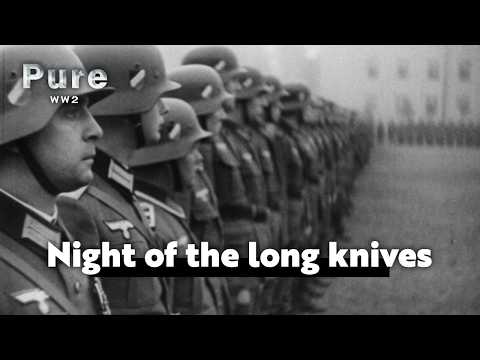
On the evening of June 29, 1934, Hitler interrupts his trip and rushes to the Drezen Hotel near Bonn. There, Göring, Himmler, and Heydrich—the Nazi inner circle—present him with a fabricated plot: Röhm is planning to overthrow him. “The Führer must act,” they insist. Hitler decides to confront Röhm personally. Thus begins the Night of the Long Knives, a state-sponsored massacre that will shock the world.
At 2 a.m., Hitler’s plane lifts off from Bonn. Surrounded by his most loyal bodyguards—men who would die for him—he is a man possessed. No more questions, no more reflection. His goal: arrest Röhm and seize control of the SA. After two hours, the plane lands in Munich. Local leaders, summoned in the night, await him. Hitler rages against the SA, calling them “pigs,” then falls silent. Time to act.
He storms into the Bavarian Ministry of the Interior and summons the two highest-ranking SA officers in Munich. As soon as they appear, Hitler rips off their insignia and screams, “Traitors! You are under arrest. You will be shot.” They are dragged to Stadelheim prison. But Hitler cannot wait. With only fifteen men, he races toward Bad Wiessee, where Röhm and his companions are sleeping off a night of excess.
The convoy speeds through the dark forests of the Bavarian Alps. Hitler knows he must surprise them. At the Hanselbauer Hotel, his men burst through the doors, arresting stunned, half-asleep SA leaders. Edmund Heines is found in bed with two men. Röhm’s lover, Count von Spreti, and Julius Uhl, the SA chief of staff, are seized. Then Hitler knocks on Röhm’s door. A half-naked, half-asleep Röhm opens it. Hitler, pistol in hand, arrests him personally. It is 6:15 a.m. The operation takes ten minutes.
Back in Munich, Röhm is handed to the SS at Stadelheim. The machine of repression grinds on. At 10 a.m., Hitler sends the code word to Göring and Himmler: launch operations across the country. SS killer squads receive sealed orders with the names of those to be executed. “By order of the Führer.” The purge spreads like wildfire.
In Berlin, Göring and Himmler urge Hitler to sign Röhm’s death warrant. For over 24 hours, the SS has been murdering everyone on their lists. Only Röhm remains. Hitler hesitates—not from sentiment, but from fear of public opinion. Finally, he gives in, but on one condition: Röhm must be given the choice of suicide to preserve his honor as a soldier. Himmler dispatches Theodor Eicke to cell 474. Eicke places a gun on the table and gives Röhm ten minutes. Röhm refuses. Eicke and two SS men shoot him dead.
The Night of the Long Knives is over. Hitler has won total victory. The SA is crushed, the conservatives are intimidated, and the army is complicit. The road to absolute power is clear. But the bloodbath is only the beginning.
By the time the executions ended, more than eighty people had been murdered—and the true number would never be known. On Monday, July 2, the day after the operation, all files related to the purge were destroyed. The regime announced that Röhm had been executed for treason, and the newspapers dutifully printed the lie. “The Führer protects the law,” declared Carl Schmitt, Germany’s most respected jurist, in an article that legitimized the killings after the fact.
But the purge had not been confined to the SA. Hitler, Göring, and Himmler had used the opportunity to settle old scores. Vice Chancellor Herbert von Bose was shot dead in his office. Former Chancellor Kurt von Schleicher and his wife were murdered at home. Gustav von Kahr, the man who had crushed Hitler’s 1923 putsch, was found hacked to death in a swamp. The conservative elite, who had believed they could control Hitler, now understood their mistake. They were not partners. They were hostages.
On July 3, the government passed a decree declaring the massacres to be “measures of self-defense of the state.” The murders were now legal. Hitler had achieved something extraordinary: he had killed his own friend and hundreds of others, and the state apparatus had not only tolerated it but blessed it. The justice minister did not resign. The army did not intervene. The president, the aging Paul von Hindenburg, sent a telegram of congratulations.
Ten days later, Hitler addressed the Reichstag. For two hours, he spoke with cold precision, rewriting history. He claimed Röhm had plotted against him, that a conspiracy had threatened the nation, and that he had acted as the supreme judge of the German people. “Everyone must know that the fate of he who raises his hand to attack the state will be death,” he declared. The deputies rose to their feet in applause.
Röhm’s memory was destroyed as thoroughly as his body. The newspapers denounced him as a homosexual degenerate, a traitor, a moral plague. His body had been carried away in the night, and no one would ever know where it was buried. The annihilation of Ernst Röhm was total—not just the man, but his reputation, his honor, his place in history.
On August 2, Hindenburg died at the age of eighty-seven. Within hours, the government issued a decree merging the offices of president and chancellor. Hitler was now the supreme commander of the armed forces. The following day, every soldier in the German military swore a new oath—not to the constitution, not to the state, but to Adolf Hitler personally. “I swear by God this sacred oath that I will render unconditional obedience to Adolf Hitler.”
The army believed it had won. The SA was crushed, the radicals were gone, and the military stood triumphant. But they had made a pact with the devil. The SS, now autonomous from the SA, was placed under Himmler’s sole command. The Gestapo, the SD, and the concentration camps were all consolidated into a single apparatus of terror. Dachau, the first camp, became the model for what was to come.
Hitler’s plan had worked. He had turned the page on the revolutionary phase of Nazism and fused his movement with the state. The bureaucrats, the industrialists, the lawyers—all had given their consent. The road to rearmament, to war, to catastrophe, now lay open. The Night of the Long Knives was the true baptism of blood, the moment when state barbarism became the law of the land.
In the years that followed, the SS would grow into an empire of terror, and the camps would multiply across Europe. The soldiers who had sworn their oath to Hitler would fight with fanatical loyalty, unable to break free from their personal bond to the Führer. And the conservative elites who had cheered the purge would watch in horror as the regime they had helped create consumed everything in its path.
But in the summer of 1934, none of that was yet visible. What was visible was a triumphant Hitler, standing before the Reichstag, applauded by the men who had once believed they could control him. The lesson was clear: no dictatorship is established without the support of the state apparatus and its conservative allies. The Night of the Long Knives was not a populist eruption. It was a calculated, deliberate step toward the abyss—and the world, still reeling from the Great War, looked on and did nothing.
Yet the silence that followed was not peace. It was the silence of a predator pausing to lick its wounds before the next strike. In the weeks after Hindenburg’s funeral, Hitler retreated to his mountain retreat above Berchtesgaden, and those who saw him there noticed something new in his manner—a coldness, a distance, as if the killing of Röhm had burned away the last of his human attachments. He no longer spoke of the old days, of the beer halls and the street battles. He spoke only of the future.
Himmler, meanwhile, moved with quiet efficiency. The SS, once a mere bodyguard unit of a few hundred men, now swelled into a sprawling empire. He established the Reich Security Main Office, folding the Gestapo, the SD, and the criminal police into a single machine answerable only to him. The camps at Dachau, Sachsenhausen, and Buchenwald were placed under the Totenkopfverbände—the Death’s Head units—and the prisoners who entered their gates were no longer counted as citizens, or even as men. They were simply numbers.
In the army, the generals toasted their supposed victory. They had wanted Röhm gone, and he was gone. But when they read the fine print of the new laws, they discovered that the Wehrmacht’s independence had been quietly hollowed out. The Ministry of War was renamed the Ministry of War and Commander-in-Chief of the Wehrmacht, and Hitler’s signature appeared at the bottom of every promotion list. General Werner von Blomberg, the war minister, had personally ordered his officers to swear the oath. He believed he was saving the army from the SA. In truth, he had delivered it into the hands of a man who would never let it go.
One evening in late August, a young diplomat named Hans-Adolf von Moltke sat in a café on the Wilhelmstrasse, nursing a glass of schnapps. He had heard the rumors, of course—the shootings in the Lichterfelde barracks, the bodies dumped in the forests of Silesia, the former chancellor butchered beside his wife. But what troubled him most was not the violence. It was the quiet.
He wrote to his father that night, a letter he never sent. “The Germans have not protested,” he wrote. “They have shrugged. They have said, ‘The Führer has cleaned house.’ And then they have gone back to their dinners. I do not know which is worse—the crime, or the calm that followed it.”
That calm would not last. Within a year, Hitler would announce universal military conscription, tearing up the Treaty of Versailles. Within two, German troops would march into the Rhineland. Within five, the Wehrmacht would roll into Poland, and the men who had sworn their sacred oath would find themselves fighting a war of annihilation they had never been asked to approve. The Night of the Long Knives had not ended the revolution. It had merely changed its uniform.
And in a cell in Stadelheim prison, in a corner that no one visited and no record described, the body of Ernst Röhm lay in a wooden crate, waiting for the anonymity that his killer had decreed. No grave. No marker. No name. Only the echo of a friendship betrayed—and the cold machinery of a state that had learned, in a single weekend, that murder could be legal, and that loyalty, in the end, was worth less than power.
In the years that followed, the world would learn the price of that silence. The camps multiplied, the ovens were built, and the oath sworn in August 1934 bound millions to a man who led them into ruin. Röhm’s murder was not an ending, but a blueprint.
The SA faded into irrelevance, a ceremonial relic. The SS rose in its place, and Himmler’s black uniform became the true face of the Reich. The generals who had cheered the purge watched their independence dissolve, order by order, until nothing remained but obedience.
And in the quiet of the Bavarian Alps, Hitler planned the next war, unburdened at last by friendship, by loyalty, by any human tie that might stay his hand.
Was the Night of the Long Knives a turning point the world could have stopped—or the moment the abyss became inevitable?
Report this article
Select a reason for reporting:






