The Atlantic Ocean, August 11, 1943. A blazing Liberator bomber, engines failing and fuselage riddled with cannon fire, should have been a sitting duck. Below, the German U-boat crew watched in disbelief as the aircraft—already mortally wounded—continued its attack run, skimming just fifty feet above the waves. They had expected the pilot to break off, to ditch, to surrender to the inevitable. Instead, he pressed on.
This is the story of Flying Officer Lloyd Trigg, a New Zealander whose final act of courage was so extraordinary that the only witnesses to his heroism were the very enemy he was attacking. Their testimony would earn him the Victoria Cross—the only one of World War II awarded solely on the recommendation of enemy combatants.
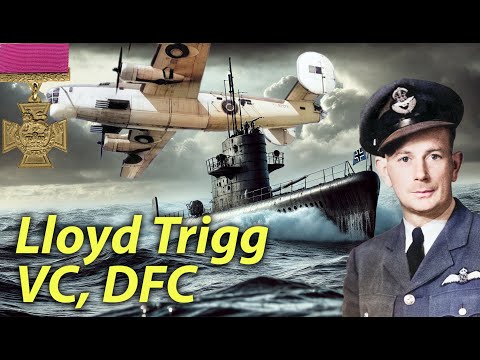
Lloyd Allan Trigg was born on May 5, 1914, in Houhora, a small rural community in New Zealand’s far north. He grew up surrounded by rugged natural beauty, which instilled in him a resilience and resourcefulness that would serve him well. After attending Kaitaia High School and Auckland University College, he worked as a farmer and married Nola Mavis, with whom he had two sons. Before joining the Royal New Zealand Air Force, he served with the North Auckland Rifles, gaining early military training.
On June 15, 1941, Trigg joined the RNZAF as an air crew trainee, driven by a strong desire to serve his country. His performance at the No. 3 Elementary Flying School in Ontario, Canada, was exemplary, and he was commissioned as a pilot officer on January 16, 1942. He then trained on the Lockheed Hudson, a versatile light bomber and reconnaissance aircraft ideal for anti-submarine patrols.
Promoted to Flying Officer, Trigg embarked for the UK in October 1942, joining RAF Coastal Command. By January 1943, he was posted to No. 200 Squadron RAF in West Africa, conducting convoy protection missions. Over the next months, he flew more than 40 operational flights, earning the Distinguished Flying Cross for his skill and determination.
In August 1943, the squadron transitioned to the Consolidated B-24 Liberator, a long-range heavy bomber that significantly enhanced their capabilities. With its impressive range and firepower, the Liberator was a game-changer in the Battle of the Atlantic. Trigg’s first operational mission in the Liberator would prove to be his last—and most legendary.
On August 11, 1943, Trigg took off from Rufisque, West Africa, on what was meant to be a routine anti-submarine patrol. Meanwhile, U-468, under the command of Oberleutnant zur See Clemens Schamong, had departed from La Rochelle, France, a month earlier and was prowling the waters of West Africa. At 11:00 a.m., Trigg’s aircraft received word that a U-boat had been spotted and attacked by a Catalina. They were to commence a search.
Scouring the ocean, they eventually found U-468 on the surface and lined up for an attack run. At a distance of 2,000 meters, Trigg began turning his aircraft toward the target. As he did, U-468 opened fire with its two 20mm cannons. The opening salvo found its mark—Trigg’s Liberator was hit badly. Fire broke out, and critical systems were damaged.
Trigg had to make a decision, and fast. Realizing his aircraft was severely crippled, he could break off the attack and ditch in the ocean, abandoning his aircraft for a dinghy. This is what Schamong and his crew desperately hoped for. But to their horror, they watched as the blazing Liberator continued to line up its attack run and bear down on them.
Under a hail of 20mm cannon fire, Trigg pressed on, bringing his aircraft down to just 50 feet above the waves. This provided an easy target for U-468, and the gun crews could see their shells hitting home, ripping through the aircraft and causing more damage. Flying low with his aircraft crippled and losing altitude, Trigg and his crew managed to release their depth charges with remarkable accuracy. The charges landed within two meters of the U-boat and detonated, mortally damaging U-468.
But the damage to Trigg’s aircraft was also too great. As the Liberator roared over the U-boat, it crashed into the sea, instantly killing Trigg and his seven crew members. U-468 sank within ten minutes, killing or injuring most of its 46 crew. Schamong and six of his crew survived, finding and climbing onto one of Trigg’s dinghies that was floating nearby. The next day, they were picked up by the Royal Navy corvette HMS Clarkia.
What makes this story truly extraordinary is how we know what happened. There were no Allied witnesses to Trigg’s bravery—the only testimony came from the surviving crew members of U-468. During interrogation, Schamong remarked on what he had witnessed, describing the skill, determination, and courage of his assailant. He made a strong case that, in his words, “such a gallant fighter as Trigg would have been decorated in Germany with the highest medal or order.”
It was on the basis of this testimony that Lloyd Trigg was awarded the Victoria Cross—posthumously, and uniquely, as the only VC of World War II awarded solely on the recommendation of enemy combatants. Trigg’s commanding officer, Wing Commander W. E. Angell, later wrote to Trigg’s widow to explain the circumstances of his death: “I hope it will be some consolation to you to learn of the gallant manner in which your husband died fighting for his country. I am very proud to have known him.”
On May 28, 1944, at the Trigg family home in New Zealand, Lloyd Trigg’s Victoria Cross was presented to his widow, Nola, by the Governor-General of New Zealand, Sir Cyril Newall. The location was chosen by Nola to enable family and friends to be present to celebrate the award. Flying Officer Trigg’s Victoria Cross citation highlighted his valor and devotion to duty of the highest order.
His actions not only exemplify the courage of those who served in the war in the Atlantic but also demonstrate a profound sense of duty even in the face of almost certain death. Trigg’s story is a poignant reminder of the sacrifices made by so many during World War II. The bodies of Trigg and his crew were never recovered, and they are remembered on the Malta Memorial, which commemorates the 2,298 Commonwealth air crew who gave their lives in the Mediterranean theater during World War II.
Trigg’s courage has not been forgotten. He stands as a symbol of bravery that transcends nationality. The fact that the enemy he fought testified to his valor speaks volumes about the respect his actions commanded. Today we honor Lloyd Trigg not only as a hero of New Zealand but as a hero to all who value courage and sacrifice.
Yet the story did not end with the medal ceremony. For decades afterward, the men of U-468 carried the memory of that blazing Liberator with them—and their testimony would continue to ripple outward in ways no one could have predicted.
Clemens Schamong survived the war and returned to civilian life in Germany. He rarely spoke of the Atlantic, but when he did, it was never with bitterness. He described Trigg not as an enemy, but as a fellow airman who had done what duty demanded, even when duty meant certain death. In later interviews, Schamong confessed that he had expected the Liberator to veer away at any moment. When it did not, he said, he felt something close to awe—and a strange gratitude that such a man had chosen to spare his crew the indignity of a coward’s death.
Schamong’s account became the foundation of a remarkable historical footnote. Military historians would later pore over the interrogation transcripts, noting how the German commander’s words carried weight precisely because they were not meant for Allied ears. There was no propaganda value in a U-boat captain praising his attacker—only the plain truth of a witness.
Back in New Zealand, Nola Trigg raised her two sons alone. She rarely gave interviews, but on the rare occasions she did, she spoke of Lloyd with quiet pride rather than grief. She told a local newspaper that her husband had always believed in doing the job properly, whether that meant fixing a fence on the farm or flying a patrol over the Atlantic. “He would have thought it strange,” she said, “that anyone made such a fuss.”
The Victoria Cross itself became a family heirloom, displayed at the Auckland War Memorial Museum for a time before returning to private hands. It remains one of the most unusual awards in the history of the medal—a decoration earned not through the account of a commanding officer or a wingman, but through the words of the men who had tried to kill its recipient.
In 2007, a memorial was dedicated near Houhora, close to where Trigg grew up. It stands on a windswept hill overlooking the sea, a simple stone marker with a plaque that recounts his final mission. Visitors often remark on the isolation of the site—how the wind never seems to stop, how the ocean stretches out endlessly in every direction.
It is, in its own way, a fitting tribute. For Lloyd Trigg’s story is not one of grand parades or crowded ceremonies, but of a lone aircraft over a lonely sea, and of the enemy who bore witness when no one else could.
And yet, there is one more chapter to this tale—one that unfolded years later, when a young German historian stumbled upon Schamong’s testimony in a dusty archive and realized he was holding something extraordinary.
That historian, Dr. Klaus Reinhardt, had spent years cataloguing U-boat war diaries when he found the interrogation file marked simply “Trigg, L. A. — VC recommendation.” He expected a routine citation. Instead, he read Schamong’s words three times, then sat back in his chair, stunned. Here was an enemy commander arguing—passionately, precisely—that his attacker deserved the highest honor his nation could bestow.
Reinhardt tracked down Schamong’s surviving crew members. One, a former machinist named Otto Bauer, recalled the moment the Liberator came at them. “We all thought he would turn. He had every reason to turn. But he did not.” Bauer paused, then added, “I have thought about that man every year of my life.”
Reinhardt published his findings in a small German naval journal. The story spread—first to New Zealand, then to Britain, then around the world. Letters poured in. Schoolchildren wrote essays. A documentary was commissioned. And in 2013, seventy years after that blazing dive, a ceremony was held at the Malta Memorial.
There, standing before the bronze panels bearing Trigg’s name, was a frail, white-haired Clemens Schamong. He had traveled from Germany at his own expense. He laid a wreath. He stood in silence for a long moment. Then he turned to the assembled crowd and said, in halting English, “I am here to say thank you to a brave man who could have killed us all but chose to finish his duty first.”
Nola Trigg had passed away years earlier, but her sons were there. They shook Schamong’s hand. No words were exchanged. None were needed.
Lloyd Trigg’s Victoria Cross remains the only one ever awarded on the word of an enemy. It is a medal that belongs not just to a nation, but to a moment when two men on opposite sides of a terrible war recognized something greater than themselves.
What does it take for an enemy to call you a hero—and what does that say about the courage that transcends the uniforms we wear?
Report this article
Select a reason for reporting:






