The sky over Europe was a graveyard. Every mission, young men climbed into aluminum tubes and flew into a hail of flak and fighter fire, knowing the odds were stacked against them. The life expectancy of a B-17 crew was just 11 missions. Yet one bomber, the Memphis Belle, would defy those odds and become a symbol of hope. But the story you’ve heard isn’t the whole truth.
Named after pilot Robert Morgan’s girlfriend, Margaret Polk, from Memphis, Tennessee, the Memphis Belle was more than just a machine. She was a beacon of resilience in a war that demanded everything. Her crew, a diverse group of young men from across America, bonded by danger and duty, would fly into the heart of Nazi-occupied Europe and back, completing 25 missions when so many others never made it home.
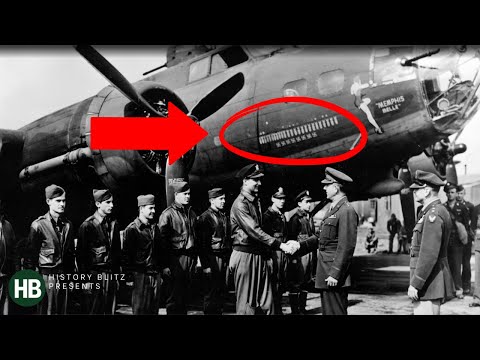
But here’s the twist: the Memphis Belle wasn’t the first B-17 to complete 25 missions. That honor belongs to Hell’s Angels, a bomber from the 303rd Bomb Group. So why did the Memphis Belle become the legend? The answer lies in the power of storytelling and media.
As the crew embarked on a war bond tour, their story captivated the nation. A documentary film by William Wyler brought their harrowing experiences into American living rooms, elevating them to iconic status. The Memphis Belle became a symbol of hope and resilience, a testament to the bravery of the men who flew her.
But the truth is more complex. The Memphis Belle’s journey was not just about completing missions; it was about the men who flew her, the bonds they formed, and the sacrifices they made. Their story is one of teamwork, courage, and the human spirit’s resilience in the face of unimaginable danger.
As we delve deeper into the Memphis Belle’s history, we’ll uncover the missions that defined her, the crew members who became heroes, and the little-known secrets that have been overshadowed by the legend. Stay with us as we explore the true story of the Memphis Belle, a story that goes beyond the myth to reveal the heart of World War II aviation.
To understand why the Memphis Belle mattered, you have to understand what it took to fly those 25 missions. Each one was a test of endurance, skill, and luck. The crew flew from November 1942 to May 1943, part of the Eighth Air Force, tasked with bombing factories, supply lines, and submarine bases across Nazi-occupied Europe. Their goal was simple: cripple Germany’s ability to wage war.
But the execution was anything but simple. Flak bursts filled the sky with deadly shrapnel, and enemy fighters swarmed the bombers like wolves. Every mission could be their last.
One mission stands out: January 23, 1943, over the U-boat pens at Lorient, France. The target was heavily fortified, and the sky was thick with anti-aircraft fire. Captain Morgan later recalled, “For 22 minutes they gave us hell.” The Memphis Belle was under constant attack, flak tearing at her aluminum skin, fighters diving from every direction.
The gunners—John Quinlan in the tail, Cecil Scott in the ball turret—fought back with everything they had. Their quick reflexes and precise shooting kept the fighters at bay. Meanwhile, bombardier Vincent Evans had the critical task of hitting the target. Despite the chaos, he steadied his aim and released the bombs. They hit their mark, causing significant damage to the U-boat installations.
But the return journey was no less perilous. The crew had to navigate back through the same gauntlet of enemy defenses. Tech Sergeant Robert Hanson noted, “We’ve been in some pretty tight spots. There was the time that six Focke-Wulfs appeared from nowhere and all six cut loose on us.” They slugged it out, and somehow, they made it back to base in Bassingbourn, England.
Missions like this defined the Memphis Belle’s tour. Captain Morgan said, “If you want in just one word how we were able to go through the hell of Europe 25 times and get back home, the word is teamwork.” That teamwork was forged in the crucible of combat, a bond that held them together when everything else fell apart.
But the story of the Memphis Belle isn’t just about the plane or the missions. It’s about the men. Young men, between 19 and 26, from across the United States, each bringing their own background and skill to the team. Contrary to popular belief, the entire crew didn’t fly all 25 missions together. Personnel changed due to the harsh realities of war. The top turret gunner and engineer rotated among Leviticus “Levi” Dillon, Eugene Atkins, and Harold Loch. Several different co-pilots and waist gunners also flew with the crew.
This dynamic team worked together to navigate the perils of air combat over Europe. They finished 25 missions and returned home safely—a milestone that earned them a place in history as a legend.
After completing their tour, the Memphis Belle and her crew returned to the United States in June 1943. They were celebrated as heroes and embarked on a war bond tour across the country. The tour aimed to boost morale and raise funds for the war effort. The crew’s story of bravery and survival captivated the American public, making them symbols of hope and resilience.
They traveled from city to city, speaking at events, participating in parades, and encouraging Americans to support the war by purchasing war bonds. The crew’s story, amplified by William Wyler’s documentary film, brought the dangers and heroism of bomber missions into American living rooms. The film provided a gripping and personal account of the crew’s experiences, elevating their status to iconic.
But as the truth unfolds, the story of the Memphis Belle remains a testament to the power of bravery and the human spirit’s resilience. Their courage and collective effort helped secure the Allied victory. Yet there’s more to this tale—a little-known secret that has been overshadowed by the legend.
The secret, in fact, has less to do with the plane itself and more to do with what happened to her after the cheering stopped. While the crew scattered to their hometowns and civilian lives, the Memphis Belle did not retire gracefully. She was sold for scrap, then rescued at the last moment, and spent decades exposed to the elements on a concrete pedestal in Memphis, Tennessee—slowly rotting while the nation that once adored her forgot.
But we’re getting ahead of ourselves. Before the pedestal, before the decay, there was the tour. And the tour was where the myth was truly manufactured.
The War Department needed a hero, and it needed one fast. Casualty lists were growing, and public appetite for the bombing campaign was flagging. Hell’s Angels had beaten the Belle to 25 missions, but Hell’s Angels hadn’t been blessed with a photogenic name, a pin-up girl on her nose, and a pilot whose girlfriend back home made for perfect copy.
So the cameras followed Morgan and his men from city to city. Wyler’s footage, shot in combat with handheld cameras that must have felt like holding a live grenade, gave Americans something they’d never seen: the war from inside the bomber, the frost on the oxygen masks, the terror in young eyes.
Here’s what the newsreels didn’t show. They didn’t show the crews who never came back—the ones whose names never made it onto a marquee. They didn’t show the mechanics who patched the Belle’s holes with sheet metal and prayer. And they certainly didn’t show that the Memphis Belle’s 25th mission, flown on May 17, 1943, was against the naval yards at Lorient once again—the same hellish target that had nearly killed them in January.
That final mission was, by all accounts, a milk run compared to the earlier raids. The fighters stayed home. The flak was light. As Morgan later admitted, “We could have slept through it.” It was a strange, almost anticlimactic ending for a tour that had been anything but.
And perhaps that’s the real lesson. War doesn’t hand out tidy narratives. The legend of the Memphis Belle was built on courage, yes—but also on timing, publicity, and a public hungry for something to believe in.
Yet the men who flew her never seemed bothered by the fuss. They knew what they’d survived. They knew the names of the friends who hadn’t. And when the parades ended and the cameras were packed away, they went home and tried to build ordinary lives out of the extraordinary wreckage of their youth.
Decades passed. The Memphis Belle sat forgotten on her pedestal, paint peeling, engines seized, pigeons nesting in the fuselage. Veterans who visited her stood in silence, remembering the roar of those engines and the faces of men long gone. It was a sad ending for a legend.
Then, in 2005, something remarkable happened. The Belle was rescued—pulled off her crumbling perch and moved to the National Museum of the United States Air Force in Dayton, Ohio. A full restoration began, one that would take years and thousands of hours of painstaking work.
Today, she rests indoors, safe from the elements, her aluminum skin gleaming once more. Visitors walk beneath her wings and look up at the ball turret, the nose, the weathered cockpit where Morgan once sat. They read the names. They learn the truth.
And the truth is this: the Memphis Belle was never the greatest bomber of the war, nor the luckiest, nor the first to finish her tour. She was simply a machine flown by ordinary men who did extraordinary things, and who happened to be in the right place when history needed a story to tell.
Her crew is gone now, one by one, slipping away like the contrails of a fading formation. But the Belle remains—a silver ghost of a different age, reminding us of what courage cost and what it bought.
So here’s the question I’ll leave you with: if the legend was built on timing and publicity rather than pure fact, does that make the Memphis Belle’s story any less true—or does it make it something more human?
What do you think? Was the Memphis Belle a hero, a lucky survivor, or just a symbol we needed? Share your thoughts below—I read every comment.
Report this article
Select a reason for reporting:






