Europe had been at peace for over forty years. Then, in a single month, it tore itself apart. By the summer of 1914, the continent was a powder keg of rival empires, each convinced that a short, glorious war would settle old scores. No one saw the catastrophe coming—and no one could stop it once the first shots were fired.
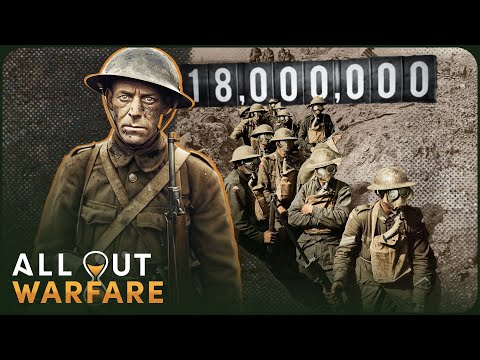
The numbers were staggering from the very beginning. Eighteen million men were called up across Europe, a scale of mobilization never before seen in human history. Industrialization had transformed society, and now it would transform the nature of human conflict. Mass production meant mass destruction. The machine age had arrived on the battlefield.
To understand how it happened, you have to look at Europe’s old ruling class—the aristocrats and monarchs who saw their empires as instruments of wealth and prestige. Britain possessed the largest empire the world had ever seen, covering 12.7 million square miles and governing a quarter of the world’s population. France and Russia held vast territories of their own. But Germany, unified only decades earlier, had a tiny empire—just a tenth the size of Britain’s—and its ruling elite was determined to change that.
German industry was booming. By 1914, German steel production had surpassed that of Britain, France, and Russia combined. Yet Germany craved greater access to world markets, and its leaders believed they had a legitimate right to a place on the international stage. “If they didn’t catch up with the likes of Britain and France, they would be left behind—gradually strangled,” one historian explains. The German elite was convinced that economic power should translate into global influence.
To build an empire, Germany needed a powerful navy. Admiral Alfred von Tirpitz realized that a large fleet would allow Germany to project power and secure its future. Naval spending tripled, from £8 million to £23 million a year. Britain responded by building even more ships, devoting a quarter of all public spending to the Royal Navy. In 1906, Britain launched HMS Dreadnought, the most powerful battleship the world had ever seen. By 1914, Britain had 22 giant dreadnoughts in service, 13 more under construction, and 609 warships in total—the strongest navy on Earth.
Germany could muster only 15 big battleships and 319 other vessels. Its expanding navy and aggressive foreign policy failed to grow its empire, but it succeeded in worrying its imperial rivals. Britain, France, and Russia—two countries with entirely different political systems—were pushed together by a common concern about Germany.
By the summer of 1914, Germany was surrounded by enemies. Its only reliable ally was the Austro-Hungarian Empire, a multiethnic patchwork ruled by the Habsburg Emperor Franz Joseph. Within its borders were more than a dozen nationalities—Czechs, Poles, Slovaks, Hungarians, and Serbs—many of whom aspired to freedom and independence. Serb nationalists in Bosnia, recently annexed by Austria-Hungary, received encouragement and weapons from neighboring Serbia. To the rest of Europe, it was a sideshow—the arrogant Habsburgs having some local trouble controlling their messy empire.
But then came the two pistol shots that changed everything.
On the 28th of June 1914, the heir to the Austro-Hungarian Empire, Archduke Franz Ferdinand, was shot dead in Sarajevo. The assassin was a member of a group backed by neighboring Serbia. Shock turned to anger, and that anger was directed at Serbia. Emperor Franz Joseph wanted to take action, but he knew Serbia was friendly with Russia. Before attacking, he wanted a guarantee of German support against the Big Bear on his doorstep.
On the 6th of July, he got it. A telegram from Kaiser Wilhelm II promised to back Austria whatever they decided. Germany had given Austria a blank check. If there’s a war, Germany is ready and eager to fight.
Austria made a calculation: if the war could be confined to the Balkans, the numbers were on their side. Serbia could field a quarter of a million men, but Austria-Hungary had a standing army of half a million. What’s more, it had the promised backing of the Kaiser’s giant standing army of over 800,000 men. In short, the Habsburgs enjoyed overwhelming numerical superiority.
So on the 23rd of July, they confidently delivered an ultimatum to Serbia, demanding that Austrian officials be allowed to enter Serbia to investigate the assassination. The ultimatum was designed to be completely unacceptable to the Serbs—and indeed it was. Serbia appealed to Russia for help.
The Russians were fellow Slavs, but more than that, the Tsar was eager to extend his imperial sphere of influence over the Balkans at the expense of Austria-Hungary. Within 48 hours, the Russian Tsar promised to go to any lengths to defend Serbia, adding over a million men to the Serbian side. Encouraged by the Tsar’s support, Serbia rejected the Habsburg ultimatum on the 25th of July.
Now things escalated. Russia looked for support from her ally, Imperial France. France had been Germany’s enemy since 1871, when the German Empire took control of Alsace and Lorraine. This was France’s chance to get them back. So France promised to back Russia with her 850,000-strong regular army.
As Europe edged towards war, one country tried to hold back. Britain was the world’s greatest trading nation, and war was ruinous for trade. The initial British cabinet response to any idea of intervention in this continental war was one of anathema—they didn’t want to be involved. They had problems in Ireland and a spate of industrial disputes. War was bad for business. On the 26th of July, Britain called for a peace conference. The problem was that no one in Europe was really listening anymore.
To counter the threat from Russia, the Habsburgs called up vast numbers of reservists, swelling their armies to over 3 million men. But the Tsar did the same. Russia’s army now expanded by an incredible 5 million men. Still Austria refused to back down. On the morning of the 28th of July 1914, Emperor Franz Joseph declared war on Serbia. Instead of holding back, the politicians and generals were rushing headlong towards disaster.
Railways were the marvel and symbol of the Industrial Age, and they were absolutely essential to this new kind of war. It was only through railways and steam power that vast armies of hundreds of thousands of soldiers could be brought to the frontiers, supplied, and carried into battle. Russia’s mobilization relied on over 70,000 kilometers of track. Germany had 63,000. You could move a lot more men, a lot faster—and anticipate exactly where they would be at any given time.
Countless Russian trains rattled toward the German border carrying hundreds of thousands of soldiers. Just at that moment, Tsar Nicholas received a telegram from his cousin, Kaiser Wilhelm. Wilhelm promised to stay neutral if Russia would stay out of the fight. The telegram caused the Tsar to hesitate. War, it seemed, might be averted.
The royal families of Europe were incredibly close. Tsar Nicholas of Russia, King George of Britain, and Kaiser Wilhelm were all first cousins. They called each other Willie, Georgie, and Nikki—they were that close.
On the 29th of July, the Tsar refused to order full mobilization. He wanted to stop the trainloads of soldiers heading toward Germany. He was pulling back from the brink of war. But the troops were already on the move. Millions of men were already gathered at train stations; hundreds of thousands had already set off. The trains could not simply stop or reverse. Everything was planned out, even to the minute—which is why things went wrong.
On the 30th of July, the Tsar accepted he was too late to recall his troops. Germany now felt compelled to respond. On the 1st of August, Germany called up its reservists—another 3.2 million men. The German and Austrian armies now numbered 7.2 million. But France also called up its 3 million reserves. The Allied forces numbered over 10 million. Never in human history had such gigantic armies been marshaled against one another.
Austria-Hungary and Germany were outnumbered. To make matters worse for Germany, she faced enemies on two fronts: Russia in the East, France in the West. Britain and Italy had yet to take sides. But numbers would count for less if Germany struck before her enemies were ready.
The Prussian military elite already had a plan to win a speedy and stunning victory. The German calculation was that they could beat France in a rapid war—they had done something similar in 1870, a surprise invasion that had encircled and destroyed the French army. They had confidence they could do it again.
The plan was drawn up ten years before by the Prussian nobleman Count Schlieffen, head of the Imperial General Staff. Don’t attack the heavily defended French border. Instead, send five German armies circling through Belgium. The French army would be focused on the old battlegrounds of Alsace-Lorraine while huge numbers of Germans poured down into France from the north.
The Schlieffen Plan was the most ambitious offensive plan ever devised. It was intended to knock France out of the war in just six weeks and allow Germany to transfer almost the entirety of its army to the Eastern Front to deal with Russia in turn. The Schlieffen Plan is the first strategic blunder of the Great War. Many more will follow.
It was a big gamble—and, as one historian has said, basically made no sense. The plan assumed that the French were too few, too feeble, and badly led. Ever since the turn of the century, a negative perception of France’s capabilities had trapped the mindset of German generals. They noticed the demographic decline in France and reckoned the French would not be capable of mastering a strong army.
Five armies of more than a million men would hit a flank expected to muster little more than half that number of Frenchmen. And if the numbers didn’t prove overwhelming, the military superiority of Germany’s Prussian-dominated army was expected to tip the balance.
The German Army was undoubtedly the greatest army in Europe in 1914. It was heavily armed, well organized, well trained, and well prepared. At its core was a 73,000-strong officer corps—fiercely aristocratic, proud of its traditions, yet incorporating an enormous strand of professionalism based on the most demanding officer training of any army in Europe. Below them were 108,000 professional sergeants and corporals, and over 4 million enlisted men.
At the beginning of August, Britain had yet to join the war. Newspapers opposed going to war over Serbia—but Britain might go to war to protect Belgium and France. Blinded by its ambition, the German High Command dismissed the risks of invading Belgium. It didn’t take the threat of British military intervention seriously.
Britain historically had an aversion to large standing armies—a burden on the taxpayer and a threat to freedom. In 1914, despite the size of its empire, Britain could only muster 160,000 men. It was called the British Expeditionary Force, and by comparison to the might of the German Army, it was tiny. It’s alleged the Germans regarded the British as having a “contemptible little army”—so small that, as Bismarck once said, if it turned up on the Channel coast, they’d send a policeman to arrest it.
For the Schlieffen Plan to work, the vast German armies had to move at lightning speed. In 20 days, over 20,000 German trains carried 2 million men, 118,000 horses, and 400,000 tons of supplies to the front. It was an extraordinary undertaking—the number of people being moved was equivalent to the population of Berlin.
550 trains a day assembled seven armies. It took Germany little more than one week to mobilize. It took France two weeks to gather its armies, Austria-Hungary four weeks, and Russia was expected to take six.
On the 4th of August 1914, Germany invaded Belgium—a neutral country. Britain now felt compelled to declare war on Germany. Britain’s transport system swung behind the war effort. In the first few days, 334 trains moved 69,000 men, 21,000 horses, along with guns and supplies to Southampton to embark for France. At the same time, a thousand lorries and 300 buses were requisitioned to carry the British soldiers from the French ports to the front.
By late August, just 84,000 men of the British Expeditionary Force had landed in France. The British Army was essentially a colonial police force, sent to police the empire, protect it from external threats, and put down internal rebellions. It was not intended for a major war. Incredibly, the British Army in Europe was smaller even than the 117,000-strong Belgian Army. When thrown into the maelstrom of a massive European conflict, it was undergunned and undersupplied—and it was about to face the might of the best-equipped and best-prepared army in the world.
Six hundred thousand German troops tore through neutral Belgium, but the ring of forts held them up. Then the Germans unveiled their first industrial super-weapon: Big Bertha, a howitzer firing an 800kg shell nearly 10km. In a single day, three centuries of defensive doctrine were overturned.
Belgian defiance met brutal reprisals—6,500 civilians killed, Louvain burned. Dubbed the “Rape of Belgium,” the news spread through mass communication as never before, and 33,000 British men enlisted in a single day.
But the French, wedded to the “offensive at all costs,” lost 27,000 men in one day. The Allies retreated—until the Miracle of the Marne. Joffre hurled a new army at the German flank, even using 630 Parisian taxis to rush reinforcements to the front. The German juggernaut halted, exhausted, and withdrew.
At Ypres, the pattern was set: trenches, barbed wire, machine guns. In a matter of weeks, more than a third of the original British force was lost. The war of movement was over. The war of numbers had begun—and it would devour a generation.
Was this war truly inevitable, or could one decision have stopped it?
Report this article
Select a reason for reporting:






