The morning of July 15, 1944, dawned thick with fog and the smell of wet earth. In the tangled hedgerows of Normandy, a young American soldier checked his rifle for the hundredth time, his hands trembling. He had been in France for only a week. Today, he would learn what war truly meant.
Just weeks after D-Day, the Allied advance had ground to a halt. The Germans, dug into the ancient bocage—a maze of earth banks and dense vegetation—had turned every field into a killing zone. For the men of the US 35th Division, fresh from Kansas, the battle for Saint-Lô would be their baptism by fire.
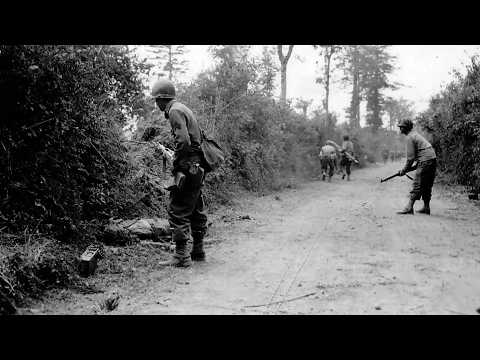
At 5:15 a.m., the order came. Artillery roared, and the ground shook. Under a smoke screen, the first wave of GIs rose from their foxholes and advanced into the mist. They had barely crossed the first hedgerow when German machine guns opened up, cutting down men in seconds.
“Keep your heads down. The Germans are behind that next hedgerow,” a retreating officer had warned them. Now, those words echoed in every soldier’s mind as they faced a relentless enemy.
The fighting was savage. Bayonets, grenades, and fists—men fought hand-to-hand in the claustrophobic lanes. Company C lost 60% of its men in just over an hour. Yet they pushed on, driven by momentum and desperation.
By noon, the survivors had reached the outskirts of Emelie. The village was a ruin, but the Germans still held the high ground—Hill 122. From its crest, they could rain down fire on any attacker. The Americans knew they had to take it, no matter the cost.
Sergeant Freddy Sorenson, a Nebraska farm boy, single-handedly silenced a machine gun with a grenade, saving his squad. He would not live to see the sunset. Others, like Captain Francis Mason, rallied their men, pushing forward through minefields and ambushes.
“The fear of the hedgerows had lost its hold,” one survivor later recalled. “Men were beginning to work together, outflanking each pocket of resistance.” But the cost was staggering. By evening, the battalion was a shadow of its former self.
As darkness fell, the order came for one final assault. Companies A and B, exhausted and bloodied, rose one last time and charged up the slopes of Hill 122. The Germans, caught off guard, fell back. But dawn would reveal that the crest was still contested.
The battle for Saint-Lô was far from over. For the men of the 134th Infantry, the hell in the hedgerows had only just begun.
The fog had not lifted by mid-morning, and in the confusion of the bocage, the second and third battalions were fighting their own private wars. Some 2,300 yards to the right, Lieutenant Colonel Warren’s men had been grinding forward since dawn, their advance measured not in miles but in hedgerows. Each field was a fresh nightmare.
“You could not see the next squad, let alone the next platoon,” one officer of the 2nd Battalion wrote afterward. “The hedges swallowed everything—sound, sight, and men.” Radios failed in the dense foliage, runners were cut down in the lanes, and units became hopelessly intermingled.
It was in this chaos that Private First Class Harold Kessler of Company G found himself separated from his squad. Crawling along the base of a hedgerow, he came upon a gap and peered through. Beyond it, a German machine-gun crew was setting up, their backs to him, unaware.
Kessler had one grenade left. He pulled the pin, waited two seconds, and lobbed it over the bank. The explosion was muffled by the earth, but the gun fell silent. He scrambled through the gap and found three dead Germans and a wounded one, who stared at him without a word. Kessler gave him a cigarette and moved on.
By early afternoon, the 2nd Battalion had reached the approaches to Hill 122 from the east, but they were spent. Ammunition was critically low, and the men were fighting on adrenaline and borrowed rounds from the fallen. Colonel Warren radioed regimental headquarters for permission to dig in and await reinforcement.
The reply was terse: “Hold what you have. Do not withdraw.”
Back on the crest, the men of the 1st Battalion could hear the distant crackle of fire from the 2nd and knew their comrades were close. But the Germans between them were still strong, and the ground between the two American forces was a deadly no-man’s-land of hedgerows and sunken lanes.
It was then that a runner arrived at Captain Mason’s position, gasping for breath. He carried a message from Colonel Miltonberger himself: “Elements of the 2nd are on your right. Link up if possible. Saint-Lô must fall.”
Mason looked at his men—dirty, hollow-eyed, many of them wounded but still holding rifles. He called his remaining sergeants together. “We’ve got one more push in us,” he said quietly. “Let’s make it count.”
The men of Company B moved out at 2:30 p.m., their faces grim and their steps heavy. They advanced in small groups, hugging the hedgerows, using the same tactics that had cost them so dearly that morning. Behind them, the survivors of Company A provided covering fire, their machine guns chattering in short, controlled bursts.
Lieutenant Colonel Warren’s 2nd Battalion, though exhausted, heard the renewed firing and understood. They began their own push from the east, catching the Germans in a deadly crossfire. For the first time that day, the Americans had the enemy off balance.
“We could hear the firing getting closer,” a sergeant in Company G later recalled. “We knew it was now or never.”
But the Germans were not finished. From the heights of Hill 122, they brought down a torrent of mortar fire, and the advance stalled once more. Men dove for cover as the earth erupted around them. In the chaos, Captain Mason was hit in the leg by shrapnel but refused evacuation, binding the wound himself and continuing to lead.
It was then that a flight of P-47 Thunderbolts appeared overhead, their engines roaring. The planes had been called in to soften the German defenses, and they dove low, strafing the crest of Hill 122 with rockets and machine-gun fire. The ground shook, and for a moment, the German fire slackened.
Seizing the opportunity, Mason rallied his men. “Now! Move now!” he shouted, and the GIs surged forward, scrambling up the slope through the smoke and dust. They reached the first line of German trenches and jumped in, fighting with bayonets and rifle butts in a frenzy of close-quarters combat.
The Germans, stunned by the air attack and the ferocity of the assault, began to fall back. But as the Americans pushed toward the crest, a hidden machine gun opened up from a concrete bunker, cutting down the leading squad. The advance faltered.
Private Kessler, who had rejoined his unit after his solo exploit, saw the bunker and crawled toward it, hugging the earth. He had no grenades left, but he had his rifle and a determination that bordered on recklessness. He reached the bunker’s blind spot and, with a single well-aimed shot, silenced the gunner.
The way was open. The men of the 1st and 2nd Battalions linked up at 4:45 p.m., just below the summit. They were a ragged, bloodied force, but they were together. Colonel Miltonberger, who had come forward to see the situation for himself, ordered them to dig in and hold.
“We’ve got the high ground,” he said. “Now we keep it.”
As the sun began to set, the men scraped foxholes into the rocky soil of Hill 122, their eyes on the valley below. Saint-Lô lay just beyond, its church spires visible through the haze. The city was within reach, but the cost had been terrible. The 134th Infantry Regiment had lost over 1,000 men killed, wounded, or missing in a single day of fighting.
That night, the Germans counterattacked twice, but both times they were thrown back. The Americans, though exhausted, held their ground. And as darkness settled over the hedgerows, the survivors of the 35th Division knew that the battle for Saint-Lô was not yet over—but they had taken the first, crucial step.
Dawn on July 16 broke clear and hot, and with it came the grim accounting. The men on Hill 122, hollow-eyed and caked in mud, counted their dead and redistributed what ammunition remained. The summit, they now saw, was only half theirs—German observers still clung to the northern slope, calling down fire on anything that moved.
It would take three more days of grinding, hedgerow-by-hedgerow fighting before the 134th finally drove the last defenders from the heights. When the summit was secure at last, Colonel Miltonberger stood among his exhausted men and looked down at the city below. “There it is,” he said quietly. “Saint-Lô.”
No one cheered. The men simply stared, too tired to speak, too numb to feel triumph. In the valley, the church spires stood broken, and the streets were empty of life. Saint-Lô had been reduced to rubble by weeks of shelling—a city sacrificed to the war that would soon pass through it.
On July 18, American patrols entered the ruins, and the flag went up over the shattered town hall. The battle was over. But for the men of the 35th Division, the war had only just begun. They would fight on through the breakout, across France, and into the heart of Germany.
Years later, a veteran of Company B returned to Normandy and walked the hedgerows once more. He found the fields peaceful, the banks overgrown, the lanes quiet. He stood for a long time at the base of Hill 122, then knelt and pressed his hand to the earth.
“They were boys,” he said to no one in particular. “Just boys. And they did something extraordinary.”
The bocage still grows there, thick and green and indifferent. But if you walk those fields at dusk, when the light is low and the wind stirs the leaves, you can almost hear the echo of that morning—the roar of artillery, the crack of rifles, and the voices of men who gave everything for a few hundred yards of ground.
What would you have done, standing at that hedgerow at 5:15 a.m., with the fog in your eyes and the enemy waiting beyond? Share your thoughts in the comments below.
Report this article
Select a reason for reporting:






