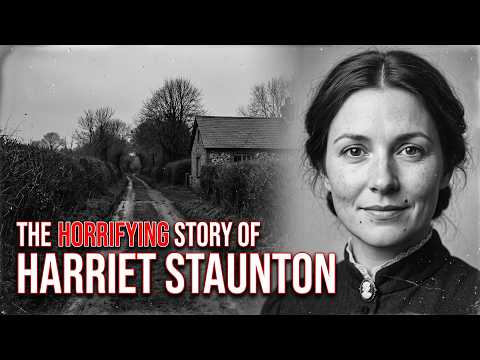
London, 1877. A hansom cab rattles through the fog-drenched streets of Penge, carrying a woman who weighs barely five stone. She is dying—her body ravaged by months of starvation, her skin crawling with lice. Yet the man beside her, her husband, shows no urgency. He is not taking her to a hospital. He is taking her to a lodging house, a place chosen not to save her life, but to stage her death.
Within hours, Harriet Staunton is dead. And the doctor who examines her body refuses to sign the death certificate. That refusal will unravel one of the most disturbing crimes of the Victorian era—a crime that began not with a weapon, but with a marriage.
Two years earlier, Harriet Richardson was a woman of modest means but substantial inheritance. She was also, by the standards of her time, “weak-minded”—a term that offered no legal protection. When Louis Staunton, a clerk ten years her junior, courted her with relentless persistence, her mother objected. But in the eyes of Victorian law, Harriet was an adult capable of consenting to marriage. Her mother’s warnings were powerless against a wedding ring.
Once married, Louis gained complete control of Harriet’s fortune—and of Harriet herself. He moved her to a remote farmhouse in Kent, far from her mother’s watchful eyes. There, she was placed under the care of his brother Patrick and Patrick’s wife, Elizabeth. The house was isolated. The roads were bad. No neighbor would hear a scream.
What happened inside that farmhouse would later be described in court with clinical precision: a filthy bed, inadequate clothing, food that could not sustain life. No doctor was ever called. Harriet’s mother tried to visit, again and again. Each time, she was turned away—by Louis, by Patrick, by Elizabeth. She was systematically erased from her daughter’s life.
Then, in April 1877, Harriet’s infant son Thomas died at Guy’s Hospital, emaciated and neglected. Four days later, Harriet herself was carried from the farmhouse. She died the same day. The doctor’s refusal to certify a natural death brought Scotland Yard to the door of Little Grays farm—and to the four people who had let her starve.
But the story does not end with an arrest. It ends in a courtroom, where two teams of medical experts will look at the same brain and reach opposite conclusions. And where a jury’s verdict will be challenged not by a legal appeal, but by a petition signed by over four hundred doctors.
The trial at the Old Bailey opened on 19 September 1877 before Mr Justice Hawkins. The courtroom was packed. The prosecution, led by Douglas Straight, painted a picture of calculated cruelty: a woman of limited mind, isolated, starved, and finally transported to a lodging house so that her death might appear natural. The evidence was damning. Harriet’s mother, Mrs Richardson, testified to her repeated rejections at the Staunton door. Dr Thomas Bond described the emaciated body, the lice, the brain changes consistent with starvation. The defence argued that Harriet had died of tubercular meningitis, a natural disease, and that the neglect was not the cause of death. But the jury believed the prosecution. All four defendants—Louis, Patrick, Elizabeth, and Alice—were convicted of murder and sentenced to death.
The verdict was met with public approval. But within weeks, a petition began to circulate. It was not a plea for mercy based on good character or extenuating circumstances. It was a medical argument, signed by over four hundred doctors, including some of the most eminent physicians in London. They claimed the brain evidence had been misinterpreted—that Harriet had indeed died of meningitis, not starvation. The petition was sent to the Home Secretary, Richard Assheton Cross.
Cross, a Conservative lawyer, faced a dilemma. The jury had heard the medical evidence and rejected the defence’s theory. But the petition represented a significant body of professional opinion. He chose to commute all four death sentences to penal servitude for life. The decision was announced in October 1877. The public reaction was immediate and hostile. The Times, which had supported the prosecution, condemned the Home Secretary’s decision as an affront to justice. How could a jury’s verdict be overturned by a petition signed by doctors who had never set foot in the courtroom?
The legal establishment was equally critical. The commutation was seen as substituting unexamined medical opinion for a properly constituted jury’s decision. Yet the Home Secretary’s power of mercy was constitutionally untouchable. The debate raged in newspapers, medical journals, and legal periodicals for months. The case had exposed a deep tension between the authority of the jury and the growing authority of expert testimony.
The four convicted persons entered prison. Louis, Patrick, Elizabeth, and Alice all served terms of penal servitude. None were ever pardoned. The conviction stood; only the sentence was changed. The case became known as the Penge Mystery, and it entered the annals of Victorian crime. But Harriet’s own voice was never heard. She left no account of her suffering. Her story survives only in the testimony of others—and in the silence of a woman who was starved to death while the law looked away.
The Penge Mystery did not fade quietly. It lingered in the columns of The Times and the pages of The Lancet, where physicians and barristers traded accusations of arrogance and ignorance. Had the jury been right, or had four hundred doctors been right? No court ever answered. The Home Secretary’s mercy had settled the matter without resolving it.
For Harriet’s mother, there was no such ambiguity. She had watched her daughter vanish behind a door that never opened, and she had testified until her voice was hoarse. She outlived the trial, the petition, and the scandal—but she never saw her daughter’s name cleared of the silence that surrounded it. The law had spoken, then softened. But no one had ever spoken for Harriet.
Louis Staunton and his accomplices served their years and slipped back into obscurity. The farmhouse at Cudham stood empty, its upstairs room eventually scrubbed clean and rented to strangers who never knew what had happened there. The lodging house in Penge was renamed, then demolished. Only the court records remained—dry, precise, and utterly unable to convey the weight of five stone.
Historians would later cite the case as a turning point: the moment Victorian England began to question whether a jury of ordinary men could weigh the testimony of medical experts. But for all its legal significance, the Penge Mystery is remembered less for what it changed than for what it revealed—a woman with no voice, a mother with no access, and a system with no mechanism to save either of them.
Harriet Staunton was thirty-five years old when she died. She left behind no letters, no diary, no final words. Only a body that weighed five stone, and a verdict that four hundred signatures could soften but never erase.
Was justice done in the end—or did the law simply find a quieter way to look away?
Report this article
Select a reason for reporting:






