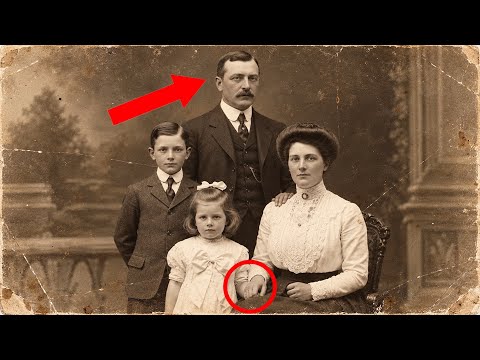
The autumn morning in Portland, Maine, carried the crisp scent of fallen leaves as antique appraiser Sarah Mitchell stepped into the Victorian home on Elm Street. The Whitmore estate sale had drawn collectors from across New England, but Sarah’s trained eye immediately focused on a small collection of photographs displayed on an ornate mahogany table. Among the sepia-toned portraits, one particular photograph caught her attention—a formal studio portrait from 1914 featuring a well-dressed family of four.
The father stood stern in a dark suit, the mother elegant in a white blouse with her hair pinned in the Gibson Girl style, and two young children, a boy of eight and a girl no older than five. The photograph bore the embossed mark of Hartwell Studios, Boston, indicating it was taken at one of the city’s most prestigious establishments. The family appeared prosperous, their clothing suggesting upper-middle-class status during the pre-war era.
Sarah lifted the silver frame, examining the image more closely. The composition was typical of the period, yet something about the mother’s posture seemed unusual. While the rest of the family gazed directly at the camera with stoic expressions, the woman’s left hand was positioned oddly—her fingers curved as if concealing something.
“Interesting piece, isn’t it?” came a voice behind her. An elderly woman introduced herself as Margaret Whitmore, the great-granddaughter of the home’s original owners.
“Do you know anything about this family?” Sarah asked, her professional curiosity piqued.
Margaret shook her head. “That photograph came with some other items we inherited. I believe it belonged to a family named Patterson. Beyond that, I’m afraid I know nothing about their story.”
Sarah studied the image once more, the peculiar positioning of the mother’s hand nagging at her instincts.
Back in her downtown Portland office, Sarah placed the photograph under her professional magnifying equipment. Years of appraising antiques had taught her that the most valuable discoveries often lay in the smallest details that others overlooked. As she adjusted the focus and lighting, the image became startlingly clear.
Between the woman’s fingers, barely visible in the original viewing, was the edge of something white. It appeared to be paper, a small piece, carefully concealed yet not entirely hidden from the camera’s lens. The way her fingers curved suggested she was holding it deliberately, perhaps hoping it would go unnoticed in the formal portrait.
Sarah’s pulse quickened. In her 15 years of appraising historical items, she’d learned that people often hid significant things in plain sight, especially during times of social upheaval or personal crisis. The year 1914 was particularly significant—it marked the beginning of World War I, a time when families across America faced uncertainty and difficult decisions.
She photographed the detail with her high-resolution camera and enhanced the image on her computer. The white object became slightly more distinct, appearing to be folded paper. Though its contents remained a mystery, Sarah reached for her phone and dialed her colleague, Dr. James Reed, a historian specializing in early 20th century American social history at the University of Southern Maine.
“James, I have something that might interest you,” she said, her voice containing the excitement she always felt when uncovering a potential historical mystery. “It’s a 1914 family portrait, but there’s something the mother is hiding in her hand—something she clearly didn’t want others to see, yet couldn’t bear to let go of completely.”
“Send me the images,” James replied immediately. “1914 was a pivotal year. Families were dealing with everything from economic uncertainty to the looming war. Whatever she was hiding might tell us a remarkable story.”
Dr. James Reed examined the high-resolution images, his historian’s mind recognizing the potential significance immediately. “The Hartwell Studios mark is our first real clue,” he told Sarah. “Theodore Hartwell’s client records, if they still exist, might identify this family.”
Sarah drove to the Massachusetts Historical Society the next morning. In the Hartwell Studios collection, she found the entry: Patterson family portrait, March 15th, 1914, 145 Beacon Street, Boston.
At the Boston Public Library, census records revealed Thomas Patterson, a textile merchant, his wife Eleanor, and their two children. But newspaper archives from March 1914 told a darker story—Thomas was under federal investigation for customs fraud. Five days before the portrait, he’d been questioned by investigators.
A librarian leaned in. “Thomas Patterson was convicted in 1915. The family lost everything. Eleanor disappeared shortly after the trial—some say she fled to Canada with the children.”
Federal court records confirmed it. A Treasury memorandum dated March 8th, 1914, recommended searching the Patterson residence on March 16th—the day after the portrait. Eleanor had known the search was coming.
Then an email arrived from Ruth Caldwell in Vermont: “I believe my grandmother may have been Catherine Patterson. She left behind what she called her mother’s secret.”
In Ruth’s home, Sarah opened a small metal box engraved with the initials EP. Inside lay a letter dated March 15th, 1914. Eleanor had written that her husband was innocent—his partner, Jonathan Hardwick, had forged his signature and threatened the family. Hidden in her hand that day was the key to safety deposit box 247 at the First National Bank of Boston, holding the proof.
At the bank, the century-old key turned smoothly. Inside were forged signatures, bribery records, and Hardwick’s explicit threat. Thomas Patterson’s conviction was acknowledged as a miscarriage of justice, and his name cleared in the historical record.
Six months later, Sarah stood before a packed auditorium at the Massachusetts Historical Society, the 1914 photograph displayed beside Eleanor’s letter. “Photographs are more than images,” she said. “They are frozen moments containing stories waiting to be discovered. Eleanor Patterson’s hidden key wasn’t just a secret—it was a mother’s determination to preserve truth for future generations.”
In the audience, Ruth smiled through tears, her grandmother’s faith finally validated. The little girl in the photograph had carried her mother’s secret for a lifetime, and now, more than a century later, that secret had set her family free.
What would you have done in Eleanor’s place—destroy the evidence to protect your family, or hide it in plain sight for a future you might never see?
Report this article
Select a reason for reporting:






