The voice that reached the Coalition command net at 3:04 a.m. was so slow and broken that the duty operator at Bagram Airfield initially logged it as jamming. A man whispering numbers at fourteen words per minute, with long pauses between each digit. At that altitude, normal breathing carried farther than normal speech. It took the operator two full minutes to realize the interference was carrying grid coordinates. Another minute to accept that those coordinates fell inside the Shahi-Kot Valley—terrain the Coalition plan had labeled high, uninhabited ground. But someone was standing there. Not a drone, not a sensor, not a signals intercept. A small Australian patrol, pinned beneath a rock lip at roughly 2,800 meters on the eastern wall of a valley where two infantry battalions were scheduled to land at first light.
They had been in that position long enough for frost to form on the lining of their sleeping bags every night by 2 a.m. They had not stood upright in days. And the numbers they were whispering did not match the picture in the operations order the helicopter crews had been briefed on. That is the question the entire story turns on, and it is worth holding onto from the start: What did those men see on the eastern hills that the Coalition plan for Shahi-Kot did not account for? And what did it cost them to keep watching? Because the price was not paid the way anyone at Bagram expected. And the man who paid the most visible part of it had spent the previous week explaining, in a training hangar, why the Australians should never have been given the mission at all.
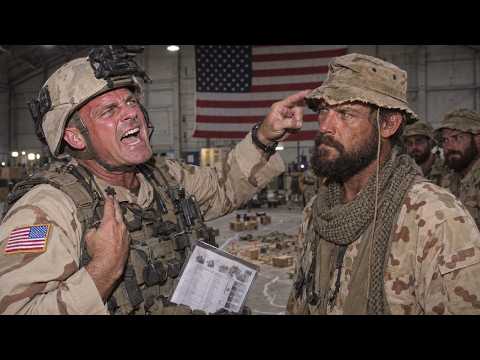
Five days earlier, on a concrete floor in a hangar at Bagram Airfield, the advance force element rehearsed the infiltration sequence for Operation Anaconda. Chalk lines on the floor represented the valley. Ration boxes represented the compounds at Serkhankhel and Babakhel. And around those chalk lines stood the men who would sign off on every item on the manifest. One of them was a Delta Force squadron instructor named Langford.
Mid-forties, sun-cracked skin over a heavy jaw, head shaved beneath a helmet he did not remove indoors, and a habit of running his thumb along the edge of the laminated equipment list while he talked. Langford’s job was quality assurance. Before an allied patrol could be added to an advanced force package, someone had to certify that it could survive independently at the target site without becoming a burden on the rescue plan. In the American system that winter, the fastest way to render that judgment was to read the manifest. Langford read manifests the way an auditor reads a balance sheet. He had a number in his head for what a man at a high-altitude observation post ought to carry. That number, on the American list, came to roughly $22,000 per operator. Helmet-mounted night observation device with a hard mount, ballistic plate carrier, satellite terminal, hardened radio, thermal binoculars, a multi-layer clothing system built for cold mountain environments.
Then he read the Australian list out loud. Bush hats, sun-bleached, brims cut by hand with a knife. Itemized on the shipping list at a few dollars each. Wool scarves, privately purchased. Hessian strips for sandbags. A spotting scope that required no power. Boots several operators had bought themselves instead of drawing from stores. Sleeping bag liners instead of a full mountain camping system because the weight of the full system exceeded what the patrol commander was willing to put on a man’s back for an 11-kilometer climb. Against Langford’s $22,000 figure, the Australian number on that page came to just under $3,000 per man. And that comparison was the only argument he felt he needed to make. He made it in four words.
He looked at the photo attached to the Australian shipping list. Five men, knife-cut brims, faces the color of the country they were sitting in. And he said, loud enough to be heard by the men at the next chalk line, that the Combined Joint Special Operations Task Force was proposing to put the eastern wall of Shahi-Kot into the hands of farmers in funny hats.
Sean Naylor, who later reconstructed the Anaconda layout in detail in his book on the operation, recorded that the American view of allied special forces contributions that month ranged from wary respect to outright dismissal, depending entirely on which American you asked. Langford was among the dismissers. The remark traveled. It was repeated in the chow tent within the hour. And it had consequences that were not funny at all.
Langford was not merely a man with an opinion. He was a man with a signature. The insertion of the Australian patrol onto the eastern hills was held pending his approval. And the window for establishing an observation post on that wall without being seen was narrowing at a rate of one usable night per night. The Australian SAS squadron had already lost time to weather. Now it was losing time to a laminated sheet of paper.
The patrol commander did not argue about the price of boots. According to the account Chris Masters later assembled in his work on Australian special operations in Afghanistan, the reaction inside the squadron to that kind of comparison was rarely verbal. Because a verbal response invites a verbal response. And no one in that organization believed they would win an argument about budgets against the United States. What the patrol commander did instead was offer Langford the vacant position.
The hide they intended to build on the eastern wall was designed for three men on rotation, two of them on the glass. There was room, if the load was managed, for a fourth. He offered it to him without conditions as an observer’s seat. Langford accepted in under a minute. And he added his own terms. He would climb in a full plate carrier because his standing instruction to every operator he certified was that armor goes where the operator goes. He would bring the helmet-mounted night observation device instead of the handheld units the Australians were using. He would bring a satellite terminal so his assessment could be transmitted independently. And because he was joining an allied patrol as a guest rather than as baggage, the Australians would carry his proportional share of the supplies he brought with him: water, batteries, and the spare antenna for his device.
That last condition is what changed everything over the next 48 hours, before any man left the airfield. The arithmetic of an 11-kilometer climb at altitude is unforgiving. Every kilogram added at the bottom of the hill is paid for in minutes near the top, and minutes near the top are paid for in darkness, and darkness was the only cover that hill offered. Langford’s insistence added roughly 30 kilograms to the patrol’s load, distributed evenly. The patrol commander had a ceiling on what his men would carry up that wall, because the man who arrives at an empty observation post cannot afford to be spent, and stillness was the only purpose the site had.
So the Australians cut weight to make room for the weight Langford was bringing. Sleeping mats went first, all of them, which meant losing body heat for 11 days straight into the shale through a single layer. A spare radio battery went, which reduced the patrol’s transmit margin to a number the signaller did not like but accepted anyway. A second thermal layer per man was left at Bagram. The spotting scope stayed because it needed nothing. And the hats stayed, sun-bleached, knife-cut, a few dollars each, because the patrol commander considered them operational equipment rather than headwear, and because no one in the patrol was prepared to explain why in a hangar where the explanation would be laughed at.
What began then, on that last night before the lift, was not a joint patrol in the usual sense. It was an 11-kilometer climb up blue-grey shale, by a group of men whose equipment differed in value by a factor of eight, whose loads had been redistributed, and whose pace on broken ground varied by about 20 minutes per kilometer. The summit had to be crossed before moonrise. After moonrise, the crossing point would be visible from the valley floor as a cluster of moving shapes on the skyline, and the compounds below the eastern wall held people who had lived under that skyline their entire lives and knew exactly what belonged on it.
The shale on that slope is the detail that determines everything else. It is thin, plate-like, and loose, and when a boot rolls one plate off another, it makes a sound like broken pottery falling out of a crate. That sound drops down the hill. It drops a long way in cold, still air. For that reason specifically, tape had been applied to every buckle, every suspension ring, and every hard edge on the Australian equipment, and every man moved on that slope for less than 400 meters before the difference between the two equipment philosophies stopped being an argument about money and became something audible.
The sound was the sound of one boot striking, and it came from the American’s left foot.
Langford moved the way a man trained to move under fire moves quickly. Heel first, decisive steps, weight driven forward. On asphalt or hardpan, that step is efficient. On shale inclined at nearly 30 degrees, the front edge of the boot drives under the loose plate and pushes it back, and that plate tips its neighbor, and the neighbor tips two more. What the patrol heard was a chain of eight or nine flat cracks heading downhill, each one widening, and then a long silence in which no one breathed through his mouth.
Below them, at a horizontal distance the patrol commander had already measured on the map—2,200 meters out and roughly 600 meters down—the mud-walled compounds sat along the dry terrace lines of the valley floor. Cold air moving downhill carries sound the way water carries oil. The men in those compounds had no thermal imagers and no satellite terminals, and they did not need them, because they had lived under that sky since childhood and knew the sound of a goat on rock and the sound of a man on rock.
The Australians moved differently, and that difference had been fixed in them long before Bactria. The step they used on that slope was the rolling step. The outside edge of the sole contacts first, weight travels along the foot from the little toe to the heel over about a second and a half, and the sole is loaded rather than struck. It consumes roughly three times the energy of a normal step and reduces speed to under one kilometer per hour. It is taught in the navigation phase at Bindoon, in the hills north of Perth, where candidates walk broken ground at night carrying 25 to 35 kilograms with a compass and a map in total darkness, and where the training staff spend a long time answering one question only: how does a tired man put his feet on the ground?
Most who begin the selection course, roughly 120 of them, do not finish it. A large proportion of those who fail do so in the navigation phase on ground like that, after discovering that the last four hours of a night march are decided by skill, not fitness.
There was a second problem, and it surfaced in Langford’s head. The helmet-mounted night observation device gave him a clearer picture of the ground than the handheld units the Australians passed among themselves, and it gave the horizon a hard vertical edge above his ears, where the mount and the battery housing stood proud of the helmet shell. A human head against the night sky reads as a shape. A human head in a soft, sun-bleached hat, brim cut and crown sagging, reads as a rock, because the brim breaks the outline instead of finishing it.
The patrol commander did not explain this in the hangar, and he did not explain it on the slope. He simply stopped movement 300 meters short of the notch, and did the arithmetic out loud in his head. The notch was the only place on the eastern wall where the ground gave nothing. Maybe 90 meters of exposed rock, bounded by the valley on one side and the northern approaches of Shahi-Kot on the other. And every sound made on it echoed straight back into the compound.
The patrol had three hours of full darkness left, and 1,100 meters of climb. Then ninety minutes of work, then a new dawn that does not wait. Langford, at his current rate of progress, needed roughly five hours. Something had to come off the hill.
The choice fell on the cache. Four hundred meters below the summit, in a fold under a shale shelf where a man could reach down from above and grab the straps, the patrol buried a rucksack, 12 liters of water in plastic bottles, a spare radio battery, and the spare antenna for Langford’s satellite terminal. They covered the shale over the cache layer by layer. From two meters away, the fold looked like any other fold on that wall. The signaller took a bearing to it from a rock feature above, and wrote the bearing on his wrist in pencil.
That single act converted the patrol’s supply from a logistics problem into a debt. There would be no aerial resupply to a site whose whole purpose was to remain unknown. Everything the patrol drank over the next eleven days was now either on their backs or in that hole 400 meters down the shale. And getting to it meant a night descent through goat tracks, and a night ascent before dawn, by one man alone, on the same plates that had just given away an American boot.
They crossed the notch in single file at 14-meter intervals, and Langford crossed it carrying the night observation device in his hand instead of on his helmet because the patrol commander asked him to and did not repeat the request. The last man dragged a strip of hessian behind him over the tracks. The sangar took ninety minutes to build, and it was the size of a car boot. That is not a figure of speech. The final interior was roughly a meter and a half by two, with a dry-stone wall of stacked shale about 40 centimeters high on the valley side, built without pins, every stone tested with a thumb before it was set so it would not shift later under a shoulder. Strips of hessian sandbag were packed between the stones and left loose at the top edge so the wall’s line broke instead of running straight. A rock lip above it masked the upper half of its shape from the air. The spoil from leveling the floor went into a hole behind the wall and was covered, according to the Australian War Memorial’s holdings on the task force’s contribution to Anaconda.
Posts of this kind were built and occupied on the sides of the valley for periods measured in days, not hours, and the standard for construction was not comfort but the requirement that the site remain invisible to the people looking directly up at it from below.
What Langford learned in the first four hours of occupancy was a list of things that would not happen. There would be no cooking. The hexamine tablets stayed in their tin, unlit, for all eleven days, because a hexamine flame produces a smell that travels fast and a heat signature that does not care how good the wall is. No one was permitted to stand, at any time or for any reason. The soles of four men’s boots faced outward and down for the entire period. A man changing position rolled for about twenty seconds, keeping his head below the top course of stones. And nothing organic was left on that hill. Waste went into plastic bottles, and the bottles were kept inside clothing. Because a bottle against the body does not freeze and does not break. And because a buried bottle is a bottle a goat can find. Everything the patrol brought up that wall came back down it.
Chris Masters, in his account of Australian special operations in Afghanistan, recorded one veteran’s description of this discipline in terms that carry no heroism at all. The work of an observation post is, at its core, the work of doing nothing. The hardest part of the training is not the march but the boredom of the surveillance phase, where the candidate is trained to remain effective while doing nothing for longer than seems reasonable.
On the afternoon of the second day, the first incident that nearly killed the trainee occurred, and it was caused by the cheapest item on the site. Around two in the afternoon, the sun had moved west far enough to strike the objective lens of the spotting scope at a shallow angle, and the coated glass threw a shaft of reflected light downhill, forming a moving bright spot on a dark rock wall facing the terrace lines. The signaller on the ground saw it as a pale smudge tracking with the movement of the scope. That, by the patrol commander’s later assessment, was the most dangerous thing that happened in the first week.
The solution was a hat. The brim of one sun-bleached bush hat, already cut with a knife to reduce its profile, was folded over the objective lens and shaped into a hood extending about 8 centimeters past the glass, killing the reflection entirely. The same soft brim that had broken a head’s silhouette against the skyline now broke the scope lens’s reflection on the wall, because felt does not reflect light. The item Langford had read on a manifest at a few dollars and used as the punchline to a four-word judgment was now doing two jobs his $22,000 American equipment could not do. And it was doing them at two in the afternoon in full view of a valley holding several hundred armed men.
Yet the scope could not be raised for long even in shadow, because repeated movement in the same place on a wall forms a pattern, and patterns get noticed. So the patrol built a range card. They tore open a ration box, flattened it on the floor of the hide, and drew the valley on it in Chinese pencil. The northern spur, the mosque wall at Serkhankhel, the fork of the dry watercourse, the goat track below their position, the two saddles above the open ground on the valley floor. And against each feature they wrote a distance and a compass bearing taken once, carefully, and never taken again.
From then on, nothing in that valley was designated by a grid reference. Everything was designated by reference to a line drawn in wax on a piece of cardboard, kept in the patrol commander’s chest pocket, where it stayed warm and dry and required no batteries, no satellite receiver, and no power source at all.
On the morning of the fourth day, at about 7:27, a shepherd came up the goat track thirty meters below the hide with twelve head of cattle. The shepherd was about nineteen, in brown trousers and a brown shirt, a blanket wrapped around his shoulders. He was not looking for anything. He was walking his animals on a track his family had used for generations, and the track ran across a shale slope thirty meters below the hide. It was close enough that the patrol could hear the click of hooves on stone and the wet sound of an animal tearing at a thorn bush.
No one in the hide moved. The freeze lasted 51 minutes, because two of the goats wandered up off the track and grazed the slope directly below the wall. And a man who shifts position while an animal grazes three meters beneath him does not get a second chance to hide. Fifty-one minutes is nothing to a properly conditioned body, but it is everything to an unconditioned one.
The Australians entered the freeze from their normal positions—flat, boots down, chests against the shale—as they had lain since the first morning. Langford was mid-roll onto his side when he heard the first hoof click, and he stopped where he was. His right shoulder plate jammed under the lip of the rock, and the front plate of the carrier took his weight on the lower rib cage, and his left arm was folded beneath him at an angle that pressed the brachial artery against the edge of the plate. The plate carrier was designed to distribute weight across a moving torso. It was not designed to be lain on at that angle for nearly an hour at altitude, where arterial flow to a compressed limb is already poor against thinner air.
When the shepherd finally drove his animals over the spur and the patrol commander tapped twice on the rock, Langford’s left hand could not grip at all, and it took him about 40 minutes of slow pressure on his thigh to get the feeling back in his fingers. The Australians had nothing to say about it, because saying anything would have required raising his voice above the level of breath passing through a scarf, and that level does not carry words. They handed him a water bottle kept inside a coat, warm as a hand, and he drank from it. And the watch rotation resumed.
By the fifth day, the position had become something like a machine for producing one product, and the machine had broken down. Every night, condensation from four pairs of lungs inside two square meters of rock settled on everything metal, then froze as the temperature on that wall dropped below minus 15 in the hours before dawn. It formed on buckles, on the focus ring of the spotting scope, and most importantly on the terminals of the radio batteries. A grey layer of ice crystals coated the contact plates, thin enough to be invisible and thick enough to break the circuit.
The signaller discovered it the first time by pressing the transmit key with no result. The Australian patrol had climbed that hill with only one battery, because a battery had been swapped out at Bagram to make room for the weight that came with the American guest, and the margin that had bothered the signaller in the hangar was now the only difference between sending a report and eleven days of surveillance that meant nothing at all.
The solution was body heat and a knife. From then on, the batteries were kept inside clothing, against the belly, and rotated like water, and the terminals were scraped with the back edge of a blade before every transmit window. It cost the signaller about nine minutes of preparation for every window he opened, which meant that no message could ever be sent quickly, under any circumstances. The patrol had to endure nine minutes of warm metal against a stomach that had not had a hot meal in five days.
And the valley, for four of those days, showed them nothing worth noting. This is the side of high-altitude surveillance that no equipment list includes. Shahi-Kot in daylight looked the way the Coalition planning cells had imagined it: mud compounds on dry terrace lines, smoke from cooking fires, women moving between walls, a few men on the paths. The fighters were underground, in caves and fortified rooms, and they came out at dusk. Specifically, they came out when it was time to feed and water the animals. In the forty minutes between sunset and full dark, because that is the period when movement in the open is natural, and when no drone overhead can tell a man from a goat.
So the patrol watched the dusk, not the compounds, but the hills above them. And because the scope was only raised in short bursts, with the cut brim of a hat folded over the lens as a light shade and the operator’s own head showing as a pale grey lump on the skyline rather than a head, the count could not be done the way it is done at headquarters. There was no time to designate a target, take a bearing, convert it, and read the grid off a map board. What the patrol did instead was count on the cardboard.
Every feature on that flattened ration box—the northern spur, the mosque wall, the fork of the dry watercourse, the two saddles above the open ground—had a distance and a bearing written beside it in wax, taken once on the afternoon of the second day and never re-measured. From the fourth dusk onward, a man on the scope raised it, found the feature, counted what moved against it, and lowered it. Two hundred meters left of the mosque wall, forty meters up the slope, three men carrying a long load uphill and not bringing it back. Above the northern notch, on the shoulder rather than in the valley, a man removing stones and stacking them in a horseshoe shape. The same horseshoe, eleven hours later, with a tube inside it.
That was the answer. And by the evening of the fifth day, the patrol had it clearly. The crew-served weapons of Shahi-Kot were not seen inside the compounds. They were not seen on the valley floor at all. And they were not on the flat, open, obvious pieces of ground the Coalition plan had designated as helicopter landing zones. They were above them, in stone horseshoes and improvised hides dug into the shoulders and sides of the valley walls, roughly 100 to 300 meters above the landing zones themselves, and oriented so that each one looked down at the ground where the infantry would step off the ramps. Heavy machine guns and mortars in the rock firing downhill, and the troops coming off a helicopter onto that ground would not take fire from the wings. They would take it from above, from positions that could not be suppressed by the aircraft that delivered them, in a valley whose walls were the enemy’s parapet.
Sean Naylor, in his reconstruction of Anaconda, records this specifically as a central intelligence failure of the operation. Enemy strength in the villages had been estimated at perhaps a few hundred, when in fact it was concentrated in the high ground in greater numbers, waiting. What the Australian observation post on the eastern wall did over eleven days of stillness was see what the plan did not include.
The report went out at 3:04 a.m. on the morning of the insertion, in a voice so faint it did not exceed fourteen words per minute, with long pauses between each digit, because the alternative was being heard at normal speaking volume on a quiet summit above compounds full of men who would be climbing those shale slopes to find him. It took nearly two hours to pass a picture that a man standing in a briefing tent could have delivered in ninety seconds. It was logged as jamming at Bagram before it was logged as intelligence. And by the time its content was read and understood and reconciled with the operations order, the first helicopters carrying the lead infantry were already airborne, with crews briefed on a plan that put the landing zones on ground overlooked by weapons the Australians had spent five dawns counting.
The Australian War Memorial’s holdings on the task force’s contribution record the plain administrative fact that the patrol’s observations were passed to the Combined Joint Task Force Mountain before and during the insertion. They do not record the rate of heat transfer, because that is not the sort of detail that goes in a summary.
That morning, Langford stopped working. The cold had been affecting him for four nights, and the effect was not obvious. He had climbed the hill equipped on the principle that its wearer would generate heat by moving. A hard armor plate conducts heat from the torso to the rock. A helmet does the same at the scalp. And a layering system is designed for a man walking in a mountain environment, not for a man lying on shale for a hundred hours with no mat beneath him.
The Australians, who had left their mats at Bagram and were colder than he was, were also following a fixed routine. They moved their feet inside their boots. They moved their toes against their thighs. Simple, unglamorous maintenance of a body they had learned in the surveillance phase of selection. That stillness is not the same as inactivity.
At about seven in the morning, when the signaller handed him the radio so the American could send his assessment over his satellite terminal—as he had insisted in the hangar, and as was supposed to happen—Langford’s hands would not close on it. Neither of them. The fingers moved, but he could not grip. He had severe non-freezing cold injury, the kind produced by immobility and pressure rather than frostbite, the kind that begins with the inability to do one small specific thing. He tried twice. Then he put his mouth close to the patrol commander’s ear and whispered the request in a low, calm voice, the way the Australians had taught him, to be moved off the hill.
He was walked off that night, and one man did the job. The arithmetic of that decision was ugly from every direction. A position built for four men, two on watch while two rested, was now moving two men off the hill. One of them could no longer grip, and the other had to hold him on the scree. It would leave one man alone on the eastern wall for the whole night. With the lift in the valley and the valley awake, the patrol commander made the decision in under a minute. The signaller would go down with Langford as far as the cache, hand him over to the extraction team coming up through the lower goat tracks, lift the buried rucksack out of its fold, and come back before the sky greyed. The cache was what made it possible. Four hundred meters below the crest in the fold under the shale shelf, the rucksack had sat untouched for six days, with 12 liters of water and a spare radio battery wrapped in a wool scarf. The signaller took the pencil mark on his wrist, found the rock feature above the fold on the handheld, and put his hand into the shale exactly where he had put it when he buried the bag. What he carried up on the return leg was heavier than what he had carried down.
What came off the hill was an American instructor, his hands wrapped inside a sleeping bag liner and pressed against his belly, descending heel-first onto loose rock, because he could no longer use any technique that suited his body. He appears in the story after that only in documents. The patrol was down to two men, and stayed that way for the next seventy hours. Those seventy hours were the reason the site had been built.
At first light, the helicopters came into the valley, and the guns the patrol had counted over five dawns—the stone horseshoes on the shoulders, the back door above the northern saddle, the guns in the rock 100 to 300 meters above the landing zones—opened onto the ground where the infantry was stepping off the ramps. Within the first hour, the companies were pinned on the valley floor between the terrace lines, unable to climb or to withdraw. And every fire mission for the rest of that day had to be run against positions dug into rock, invisible from below, because a man lying in a dry watercourse cannot see what is shooting at him from above and behind a rock lip.
The patrol on the eastern wall could see everything, but it could not describe anything using coordinates. There was no time to designate, convert, or read off a map board, and there was not enough room for it anyway. So they designated from the ration box. Every feature on that flattened piece of cardboard already had a distance and a bearing written beside it in Chinese wax pencil, recorded once on the afternoon of the second day and never recorded again, and from the morning of the lift onward, they used it as a common language with aircraft that had never seen the valley. Not coordinates—a reference. From the fork of the dry watercourse, 240 meters north, up 60, the horseshoe on the shoulder. Then the correction came on the same flat surface, whispered through a scarf: add 40, left 20. That is what is required.
The limiting factor for all of it was ammunition. A combat aircraft overhead has a finite number of rounds and a finite time on station before it must refuel, and the fast air coming in from outside the valley has a window measured in minutes. Rock absorbs an enormous amount of explosive with very little effect, and a position built as a stone horseshoe on a mountain shoulder must be hit precisely or not at all. The correction by reference point instead of grid removed the slowest step from that loop.
Naylor, in his reconstruction, describes the first day at Shahi-Kot as a scramble to find and service targets the plan had not expected. And with the observation posts on the valley walls providing the only sustained high-angle picture available to the force on the ground, the battery from the cache was what kept the whisper going through it. Frost still formed on the terminals every night, the remaining charge was still scraped onto the contact plates with the back edge of a blade, and the cells were still carried against his belly between windows. The margin the patrol had given up in the Bagram hangar to make room for an American satellite terminal was now being paid back. One cell at a time, from a hole in the gravel 400 meters below the hill.
The Australian War Memorial’s holdings on the task force’s contribution to Anaconda record, in plain administrative language, that the patrols remained in position throughout the operation and continued to provide surveillance and fire control. Two names came off that wall into the honors system. Sergeant Matthew and Signaller Martin Wallace, whose conduct on the valley wall was officially recognized. Lieutenant Colonel Rowan Tink, commanding the Australian Special Forces Task Group, received an American decoration for the task group’s contribution to the operation. It was one of the few occasions in that period when an Australian special operations commander was decorated by the United States in the middle of a campaign.
The product propagated, but the method did not. In subsequent briefings, Major General Franklin Hagenbeck described what was discovered above the landing zones—that the enemy was concentrated in the high ground, not the villages, dug into the earth, firing downhill. That description became the core lesson of Shahi-Kot as it was later taught. But what the briefings did not include was the identity of who had been watching, or how. There is no paragraph in the post-operation Coalition documents about a dry-stone wall the size of a car boot under a rock lip. There is no paragraph about the cut brim placed over the scope lens to kill the glint. There is no paragraph about the flattened ration box that served as a range card when the lenses could not be raised, and no paragraph about the eleven-day occupation discipline that made the surveillance possible in the first place.
The surveillance is documented, but the technique is not. And Australian analysts noticed the omission early. Commentary published by the Australian Strategic Policy Institute in later years noted that the task force’s contribution to Anaconda received broad recognition at the level of results and was rarely examined at the level of method. The most recent Parliamentary Library summaries of Australian operations in Afghanistan reproduce the same picture: the result, the decoration, and nothing about the eleven days.
Chris Masters, while working on the veteran accounts for his book on Australian special operations, recorded a version of the same complaint from a man who had been on one of those walls, phrased without bitterness. That command took the picture and left the camera on the mountain.
Langford was treated at Bagram for cold injury and non-freezing damage to both hands. The cause was pressure and immobility, not frostbite. Four nights lying on shale in a hard plate carrier designed for a man who was moving, in a helmet that pulled heat from his scalp, with no mat under his torso, in a position he had insisted on in an aircraft hangar five days before anyone left the airfield. The problem showed up as an inability to hold a handset, and it did not fully resolve. He was struck from the deployment roster for the rest of the rotation. He took no further part in any mission during that cycle. The assessment he had climbed the hill to write—a certification document proving that an allied patrol could survive independently at a high-altitude observation post without becoming a burden on the rescue plan—was never submitted in the form he intended.
The form he intended was an equipment comparison. He had already prepared the columns before the climb. $22,000 American against under $3,000 Australian. And that document does not exist in the records in any form. What exists is a short medical report and a line in a personnel file.
Months later, back in the United States, he made one further contribution to the subject. It appears in an internal training memorandum on the certification of allied observation posts, in the section dealing with evaluation criteria, added in handwriting below a paragraph on equipment standards. It is a single sentence that offers no reasoning, no reference to Shahi-Kot, and no explanation of why its author was qualified to write it. Evaluate them on their ability to stay still. The hats are just tools.
And the question that hangar never answered—whether the price of a man on a mountain is measured in dollars or in days—is the one the record leaves open. What would you have signed off on that morning?
Report this article
Select a reason for reporting:






