In the annals of aviation history, few stories are as tantalizing as that of the F-16XL—a fighter jet so advanced that it seemed destined to dominate the skies, yet ultimately never made it past the prototype stage. Imagine a machine that could carry twice the payload of its predecessor, fly 44% farther with a full weapons load, and still outmaneuver nearly everything else in the air. That was the promise of the F-16XL, a design that emerged from the ambitious SCAMP program in the 1970s and pushed the boundaries of what a multirole fighter could achieve. But despite its staggering capabilities, the XL would face a formidable rival in the F-15E Strike Eagle, and a fateful decision that would leave aviation enthusiasts wondering: what if?
The story begins in the mid-1970s, when the F-16 was still a lightweight dogfighter, not the multirole workhorse it is today. Engineers, led by the legendary Harry Hillaker, sought to overhaul the design with a radical new wing—a cranked arrow delta that promised 25% more lift and improved handling across the speed range. “The wing shape itself would allow for 25% more lift, while also improving handling at both supersonic and low speeds,” notes one engineer. This wasn’t just a tweak; it was a transformation. The SCAMP concept, born from 3,600 hours of wind tunnel testing, caught the eye of the US Air Force, which provided two F-16s for further development.
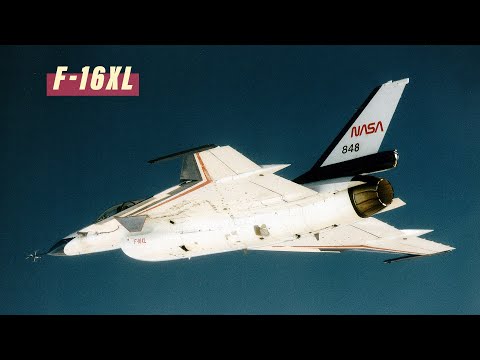
By 1981, the Air Force had launched the Enhanced Tactical Fighter Program, seeking a replacement for the aging F-111 fleet. The requirements were clear: an aircraft capable of both air-to-air and air-to-ground missions, with long-range capability and the ability to fly interdiction missions without escort. The F-16XL, with its lengthened fuselage, graphite bismaleimide composite wings, and 27 hard points, seemed like a dream come true. “If the F-16 XL was loaded up with the same armament as a standard F-16, it could fly twice as far,” testers reported. Even with a full payload of ground ordnance, four AMRAAMs, and two Sidewinders, it could still travel 44% further than an F-16A—all without external fuel tanks.
But the XL was not just about range and payload. It retained the F-16’s legendary agility, rated for 9G maneuvers, and could pull 7.2G even with a full bomb load—a feat that left contemporary fighters in the dust. “In supersonic flight, a heavily loaded XL felt similar to a clean F-16A,” recalled Air Force veteran F. Clifton Berry. The aircraft could climb effortlessly with a heavy payload and break the sound barrier at both low and high altitudes. It seemed unstoppable.
Yet, the XL was about to face its greatest challenge—not in the air, but on the ground, in the halls of the Pentagon. The F-15E Strike Eagle, a modified version of the venerable F-15, was its direct competitor. While the XL boasted 27 hard points to the F-15E’s 15, the Strike Eagle had its own advantages: it was faster (Mach 2.5 vs. Mach 2), could fly higher (60,000 ft vs. 50,000 ft), and had two engines—a significant safety and performance benefit. But the decisive factor was cost. The F-15E shared much with existing F-15s, while the XL required extensive modifications: a lengthened fuselage, redesigned tail and intakes, and new wings. Each conversion would be time-consuming and expensive.
As the competition heated up, the Air Force weighed its options. The F-15E was a tested airframe with less risk and lower cost. The F-16XL, despite its promise, was a radical departure that would demand a massive investment. In the end, the F-15E won the contract, and the two XL prototypes were sent to NASA Dryden, where they served as testbeds for aeronautical research, including supercruise studies. The dream of a super F-16 was over—or was it?
The cancellation of the F-16XL program left many wondering what might have been. Some argue that the competition was a misapplication of technology, that the XL should have been pursued as a complementary fighter to the F-15 rather than a replacement. “Designs with great potential don’t always receive support or extensive use, almost always as a result of budgeting considerations,” reflects one analyst. The F-16XL remains a symbol of innovation stifled by pragmatism—a fighter jet that could have redefined aerial warfare, but never got the chance to prove itself.
But the story of the F-16XL doesn’t end with a quiet retirement at NASA Dryden. In fact, the two prototypes that survived the program’s cancellation would go on to enjoy a second life that few aircraft ever experience. Their new custodians at NASA had no intention of letting such a capable airframe gather dust. Instead, they saw in the XL a unique platform for pushing the boundaries of aeronautical science—an aircraft with a wing unlike anything else in the inventory, and a fuselage long enough to carry experiments that no standard fighter could accommodate.
One of the first major studies to employ the XL was a joint NASA–Air Force investigation into supersonic laminar flow control. The goal was ambitious: to determine whether a specially modified wing surface could maintain smooth, attached airflow at supersonic speeds, dramatically reducing drag. If successful, the technology could slash fuel consumption on future supersonic transports and military aircraft alike. The XL’s cranked arrow wing, with its generous surface area and composite construction, made it an ideal testbed. Engineers fitted a section of the wing with a titanium suction panel, connected to a network of ducts and pumps, and then flew the aircraft at Mach 1.4 to measure how much turbulent airflow could be sucked away.
The results were promising, though far from conclusive. The suction system worked, but only within a narrow band of conditions—and the hardware proved temperamental, requiring constant maintenance between flights. Still, the data gathered during those sorties would inform decades of subsequent research. “We learned more about supersonic boundary layer behavior in a few months with the XL than we had in years of wind tunnel work,” one NASA engineer later remarked.
But the XL’s most visually striking experiment came later, when it was chosen to test a new concept in flight control: the use of thrust vectoring to augment or even replace conventional aerodynamic surfaces. Unlike the F-15 ACTIVE, which used movable nozzles on a twin-engine airframe, the single-engine XL posed a different challenge. Engineers installed a specialized nozzle on its F110 engine and programmed a suite of flight control algorithms that could translate pilot inputs into precise thrust vector commands. The goal was to see whether a single-engine fighter could achieve the same level of post-stall maneuverability as its twin-engine counterparts.
The flight test campaign was dramatic. Test pilots reported that the XL, already blessed with exceptional low-speed handling thanks to its delta wing, became almost supernatural with thrust vectoring engaged. “I could point the nose anywhere I wanted, at any speed, and the aircraft just followed,” one pilot recalled. The aircraft demonstrated controlled flight at angles of attack well beyond 60 degrees—a regime where conventional fighters would have long since departed controlled flight. The data from these tests would later feed directly into the design of thrust-vectoring systems for fifth-generation fighters.
Yet even as the XL proved its worth as a research tool, a quiet frustration lingered among those who flew and maintained it. Here was an aircraft that could carry more bombs, fly farther, and turn harder than almost anything in the sky—and it was spending its days gathering data for academic papers. “Every time I strapped into that jet, I couldn’t help but think about what it could have been,” one test pilot admitted years later. The XL had been built for combat, not for laboratory work, and the irony was not lost on the crews who kept it flying.
As the 1990s wore on, the two airframes accumulated hundreds of flight hours between them, their distinctive silhouette becoming a familiar sight over the Mojave Desert. But age and budget pressures began to take their toll. Spare parts for the unique delta wing and lengthened fuselage were increasingly difficult to source, and NASA’s research priorities were shifting toward unmanned systems and space access. The writing was on the wall.
By the early 2000s, the decision was made: the F-16XL fleet would be retired. One airframe was eventually transferred to the Air Force Flight Test Museum at Edwards, a static display for future generations to admire, while the other was placed in long-term storage—its future uncertain, its engines silent. For the engineers and pilots who had poured years into the program, the retirement felt like a final verdict on a question that had never been properly answered.
Yet the XL’s influence did not fade with its grounding. The lessons learned from its composite delta wing—lighter, stronger, and more aerodynamically efficient than conventional metal structures—found their way into later programs. The data on supersonic laminar flow control, gathered during those temperamental flights over the Mojave, would later be cited in studies for next-generation supersonic transports. And the thrust-vectoring experiments, which had turned the XL into a post-stall marvel, directly informed the control laws used in the F-22 and later the F-35.
Perhaps the most enduring legacy of the F-16XL, however, was the debate it sparked about how the Pentagon evaluates its fighters. The competition with the F-15E was framed as a straightforward comparison—capability versus cost, risk versus reward—but critics argued that the Air Force had asked the wrong question entirely. Instead of choosing between the two aircraft, they suggested, the service could have fielded both: the F-15E as a long-range strike platform, and the F-16XL as a lower-cost, high-endurance multirole fighter to complement it.
That argument gained new relevance in the 2010s, when the Air Force began searching for a low-cost fighter to supplement its expensive fifth-generation fleet. The F-16XL, with its massive payload, extended range, and proven performance, seemed almost prescient—a design that had anticipated the service’s needs by three decades. “If we had kept the XL in production, we might not be having this conversation today,” one retired general remarked during a symposium on future airpower. The room fell silent; the implication was clear.
And yet, the story of the F-16XL is not simply one of missed opportunity. It is also a testament to the ingenuity of the engineers who conceived it, the test pilots who pushed it to its limits, and the maintainers who kept it flying long after its combat career had ended. The aircraft that never went to war became one of the most valuable research tools in aviation history—a machine that taught designers how to build better wings, better control systems, and better fighters.
Today, the surviving XL sits in the California desert, its composite wings baking under the same sun that once warmed it in flight. Visitors to the museum at Edwards often pause before it, struck by its unusual silhouette—the long fuselage, the cranked arrow wing, the absence of ventral fins. “It looks fast just sitting there,” one visitor observed. And they are right. The F-16XL still looks like a fighter that could have ruled the skies, if only the world had been willing to give it the chance.
But perhaps the most poignant chapter came in 2015, when NASA quietly announced that the stored airframe would be loaned to a university for hands-on engineering education. Students would dissect its systems, measure its wing, and learn from a machine their professors had studied as graduate students. “It’s a living textbook,” the program director said. “Every rivet tells a story about what happens when ambition meets budget reality.”
And that, in the end, may be the true legacy of the F-16XL. It never dropped a bomb in anger, never fired a missile in combat, never flew a mission that mattered to anyone but the engineers and pilots who loved it. Yet it taught the world how to build better warplanes—and how to dream bigger ones.
So here’s the question that lingers over that silent airframe in the desert: if you had been in the room when the Air Force chose the F-15E, what would you have argued—and would you have fought for the XL?
Report this article
Select a reason for reporting:






