Clint Eastwood is a man of few words, but when he speaks, Hollywood listens. The legendary director has spent six decades observing the industry with a clear, unflinching eye, building a reputation for authenticity in a town built on illusion. His squint is iconic, but it’s his private assessments that are truly legendary. In unguarded moments, Eastwood’s judgments cut through the pretense with surgical precision, revealing a complex hierarchy of Hollywood limitations.
For every harsh critique, there’s a nuanced appreciation. For every dismissal, an unexpected moment of compassion. But make no mistake: Eastwood’s patience has limits. And when he encounters certain personalities, his bewilderment is palpable. Today, we pull back the curtain on the seven people who left Hollywood’s most respected director genuinely baffled—not just by their limitations, but by an industry that rewarded them.
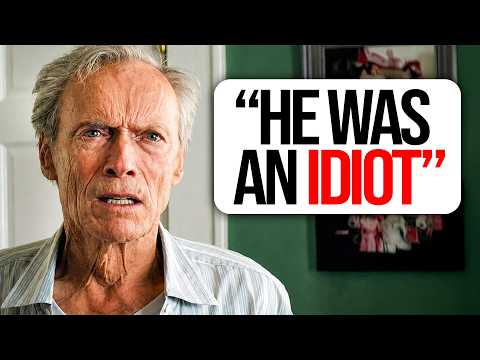
At number seven is Jeff Bridges. Eastwood admired his acting but was confounded by his mind. “Great, but he’s like a golden retriever that wandered onto set,” Eastwood once said. “Friendly, confused, always sniffing around.” During a 1989 pre-production meeting at Warner Brothers, Eastwood had to explain basic blocking three times. The fourth time, he gave up.
But what fascinated Eastwood wasn’t just Bridges’ scattered focus—it was the strange contradictions within it. After struggling to grasp basic concepts, Bridges suddenly offered a deeply insightful character observation that left the room silent. “Just when you think there’s nobody home, he says something so perfectly true that you realize he’s operating on a completely different frequency,” Eastwood told his AD. It was a moment that crystallized his complex feelings: genuine affection mixed with professional bafflement.
While Bridges represented a lovable confusion Eastwood found oddly endearing, our next entry struck him as something far less charming. Charlie Sheen crossed paths with Eastwood in the Warner Brothers commissary in 1987, and what Eastwood saw disturbed him deeply. “He had the best start you could ask for and then he fried what little wiring was left,” Eastwood observed.
Sheen’s decline represented something Eastwood found almost personally offensive: deliberate self-sabotage by someone given every advantage. “You see that kid?” Eastwood said quietly to Forest Whitaker. “He’s standing on his father’s shoulders and thinks he’s flying on his own power.” Unlike some entries who simply lacked capacity, Sheen’s choices—the entitlement, the substance abuse, the erratic behavior—suggested someone who believed himself exempt from professional standards. Eastwood’s assessment evolved from disapproval to clinical observation, with occasional flashes of unexpected compassion. After Sheen’s infamous 2011 meltdown, Eastwood surprised his team: “That’s a sick man destroying himself in public, and everyone’s treating it like entertainment. There’s nothing funny about it.”
Still, his final assessment remained unsparing: “Charlie had every advantage… and he traded it all for temporary pleasures and permanent damage. That’s not just sad, that’s stupid on a level that’s hard to comprehend.”
Our next entry earned a surprising measure of Eastwood’s sympathy. Megan Fox approached him at a 2009 industry event and asked how he transitioned from being taken seriously for his looks to being respected as a director. When he began offering advice, she stopped him with disarming candor: “I should probably tell you that people think I’m really stupid, and they’re not entirely wrong.” The table went quiet. It was like she’d broken some unwritten Hollywood rule.
Rather than being put off, Eastwood was genuinely engaged by her honesty. “What impressed me wasn’t her intellect,” he told his producer. “It was her complete lack of pretense about it. Most beautiful people in this business construct elaborate facades to hide their limitations. She just laid hers on the table. There’s a strange kind of integrity in that.” While he still recounted with amusement her alleged question about directors receiving overtime pay, he offered a nuanced defense: “There are worse things in this business than being beautiful and not particularly deep. At least she knows exactly what she is.”
Fox earned her place not because Eastwood found her particularly unintelligent, but because her brand of limited but self-aware intelligence fascinated him. “Some dumb people think they’re geniuses,” he observed. “Some smart people pretend to be dumber than they are. Megan just is what she is. In a business full of people playing parts off camera, there’s something almost refreshing about that level of transparency.”
But while Fox’s limitations came with disarming self-awareness, our next entry represented something far more troubling—someone whose grasp on reality itself seemed fundamentally compromised.
At number four is Sean Young. Eastwood witnessed her meltdown on a shared soundstage in 1989, and it wasn’t just unprofessional—it was disturbing. “You can’t direct someone who doesn’t understand reality,” he later remarked. She once argued with a veteran cinematographer about what a camera lens does, insisting that wide-angle lenses compress the background rather than expand it—the opposite of reality. When corrected, she accused the crew of conspiring to make her look bad.
Eastwood didn’t get angry. He got worried. After observing her tirade, he quietly asked his production manager to find out if Young had family or representatives who should be contacted. “It wasn’t contempt I saw on Clint’s face,” remembered his assistant director. “It was concern. He recognized this wasn’t just difficult behavior, but something more troubling.”
Back on his own set, Eastwood shared a reflective moment with his cinematographer: “This business chews people up, especially women who start with everything—beauty, talent, opportunity. The pressure does something to them. What we just saw wasn’t stupidity. It was something breaking.” When a producer later suggested Young for a role, Eastwood’s refusal was firm but nuanced: “I can’t work with her. Not because I dislike her, but because I don’t think she’s currently capable of the basic give and take directing requires. You need a shared reality to collaborate, and she’s operating in a different one.”
While Young’s case evoked unexpected compassion, our next entry triggered one of Eastwood’s most visceral negative reactions. Paris Hilton represented everything he found contemptible about manufactured celebrity. During a 2006 press junket, a reporter asked if he’d ever cast her. “I don’t cast props,” Eastwood replied, his matter-of-fact tone making it devastating. The room went silent.
A year earlier, Hilton’s representatives had called his production company pitching her for a western. Eastwood listened for thirty seconds before interrupting: “I think you have the wrong number. This is a film production company. We make movies here.” Then he hung up. When his assistant asked if she should take a message, Eastwood said, “If they call back, tell them I’ve retired or died, whichever seems more convincing.”
What elevated Hilton to the upper echelons of his list wasn’t just her lack of talent, but what he saw as the cynical calculation behind her persona—the deliberate construction of celebrity without substance. “There’s a difference between being unintelligent and being anti-intelligent,” he observed. “Paris represents something new and disturbing. The deliberate rejection of substance as a marketing strategy. It’s not that she can’t be more than she is. It’s that she’s calculated that being nothing specific is more profitable than being something real.”
Despite the harshness, those close to Eastwood noted his criticism lacked personal animosity. “He didn’t hate Paris,” clarified his assistant director. “He hated what she represented—the severing of the connection between achievement and recognition.” For someone who had earned every step of his success through discipline and craft, that disconnection wasn’t just confusing—it was offensive at a foundational level.
While Hilton represented the triumph of empty celebrity, our next entry earned Eastwood’s contempt for different reasons: unearned arrogance masking profound ignorance.
At number two is Steven Seagal. Their confrontation happened during pre-production for The Rookie in 1990, when Seagal was shooting on an adjacent stage at Warner Brothers. After witnessing his treatment of a female crew member, Eastwood didn’t just walk away—he intervened. “There are two things I can’t stand,” he told Seagal directly. “Men who hit women and men who think they’re tougher than they are. You’re running two for two.”
Few things triggered Eastwood’s contempt more reliably than phoniness, particularly when wrapped in bullying behavior. As someone who built his career playing men of genuine toughness and quiet dignity, he harbored special disdain for Seagal’s manufactured machismo. The confrontation came to a head when Eastwood personally witnessed Seagal berating a female production assistant who had delivered a message about a schedule change. Seagal’s response was disproportionately aggressive—threatening language, intimidating physical positioning.
Rather than ignoring the situation, Eastwood walked straight over. “He didn’t raise his voice. He never does,” recalled a grip who witnessed the exchange. “But he positioned himself between Seagal and the PA and said something quietly that made Seagal immediately back down.” Eastwood’s production manager overheard the exchange: “He told him, ‘Men who intimidate women and men who pretend to be something they’re not—you’re doing both, and neither one is going to continue while you’re working near my set.'”
What truly earned Seagal his high ranking wasn’t just intellectual limitations, but the combination of those limitations with bullying behavior and fraudulent self-presentation. The teleprompter comment—comparing Seagal’s reading of simple dialogue to quantum physics—stemmed from Eastwood’s direct observation of Seagal struggling through basic scenes on the adjacent production, requiring multiple takes for even straightforward lines. “What bothered Clint wasn’t that Seagal needed help,” explained someone who worked closely with Eastwood. “It was that he needed help while simultaneously presenting himself as some kind of intellectual and spiritual master. The disconnect between self-image and reality was what Clint found both absurd and offensive.”
Despite opportunities to work with Seagal during the height of his box office appeal, Eastwood consistently refused. “Clint believed there was something fundamentally dishonest about Seagal,” noted his longtime producer. “Not just his inflated martial arts credentials or his pseudospiritual pronouncements, but a deeper kind of fraudulence. He considered him someone who had built an entire career and persona on intimidating people into not questioning his obvious limitations.”
What secured Seagal’s ranking wasn’t just these limitations, but the aggressive defensiveness that accompanied them—using intimidation to mask inadequacy. “Clint made a distinction between different kinds of stupid,” explained his first AD. “There’s innocent stupid, which he could tolerate. There’s self-aware stupid, which he sometimes found endearing. Then there’s aggressive stupid—people who not only refuse to recognize their limitations, but actively threaten those who notice them. That’s where he placed Seagal.”
While Seagal represented aggressive stupidity backed by physical intimidation, our final entry earned Eastwood’s top ranking for different reasons—managing to combine nearly every quality he found most objectionable in Hollywood personalities.
At number one is Rob Schneider, comedy’s biggest mystery. The incident that cemented his reputation occurred during filming at Warner Brothers in 1999. Schneider wandered onto Eastwood’s set uninvited during an active take of True Crime. “It was beyond unprofessional,” recalled Eastwood’s director of photography, Jack N. Green. “Everyone in this business knows you never walk onto an active set, especially during a take. It’s filmmaking 101.”
Rather than recognizing his error when the take was ruined, Schneider compounded it by approaching Eastwood directly, interrupting his conversation with Isaiah Washington to pitch himself for a role. Eastwood’s response became legendary among the crew. After listening silently, he asked a single question: “Do you know what we were just doing when you walked in?” When Schneider responded with confusion, Eastwood didn’t raise his voice. He simply said, “We were working. This is what it looks like when professionals make movies. You should try it sometime.”
The interaction might have ended there, but Schneider, missing the dismissal entirely, proceeded to offer unsolicited advice about how the scene could be improved—despite having no context for the narrative or characters. “That’s when we saw the famous Eastwood squint,” remembered the script supervisor. “Not the dramatic one from his films, but the real one. The one that means he’s genuinely baffled by someone’s behavior.” After listening for approximately thirty seconds, Eastwood interrupted: “I think your set is somewhere else. I’d hate for you to miss your call time.”
What secured Schneider’s top ranking was the consistent pattern of similar behavior across multiple encounters—profound ignorance about filmmaking fundamentals paired with unshakable confidence in offering his opinions to established professionals. “Most intellectually limited people in Hollywood at least developed specialized knowledge in their particular area,” observed Eastwood’s production designer. “Schneider was unique in his combination of comprehensive ignorance and absolute certainty. He knew virtually nothing about any aspect of film but felt qualified to lecture Oscar winners on their craft.”
The IQ comment—“That guy’s IQ is the same as his film budget, and both are inflated”—reflected Eastwood’s genuine bewilderment at Schneider’s success. “Clint wasn’t being deliberately mean,” clarified his first AD. “He was expressing genuine amazement that someone with such fundamental misunderstandings of how films are made had nonetheless built a career making them. It was almost anthropological interest, like discovering a bird that shouldn’t be able to fly, but somehow manages to stay airborne.”
What particularly offended Eastwood wasn’t just Schneider’s intellectual limitations, but his complete lack of respect for the craft of filmmaking itself—treating complex artistic and technical processes as trivial matters that required no particular knowledge or skill. “Clint could forgive almost any limitation if it came with humility and respect for the work,” explained his longtime producer. “What he couldn’t forgive was someone treating filmmaking—something he considered both art and craft worthy of lifelong dedication—as something so simple that anyone could do it without study or effort.”
This combination—intellectual limitation, overconfidence, and fundamental disrespect for the medium—earned Schneider the top position on Eastwood’s private list, representing everything he found most troubling about changing standards in Hollywood. “It wasn’t personal animosity,” insisted his director of photography. “It was almost philosophical objection. Schneider represented for Clint the triumph of marketing over merit, celebrity over craft, confidence over competence—everything that threatened the values he believed had made American filmmaking great.”
Yet even as Eastwood recounted these seven personalities to a small circle of trusted colleagues, his tone wasn’t bitter. It was reflective, almost wistful—the observations of a man who had witnessed the industry’s evolution across six decades and still believed in its potential. “The business has always had its share of fools,” he said quietly, staring out at the Warner Brothers lot. “But it’s also given us Ford, Hawks, Leone, Siegel. The trick is remembering which ones built the house and which ones just wandered through it.” He paused, that famous squint narrowing. “And making sure the ones who wander through don’t burn it down on their way out.”
He tapped his coffee cup twice—the signal his crew knew meant the conversation was over. No grand pronouncements. No final verdicts carved in stone. Just a man who had spent sixty years watching, learning, and occasionally laughing at the absurdity of it all.
But as he stood to leave, someone asked the obvious question: after all these years, did he still believe talent eventually wins? Eastwood paused at the door, that legendary squint softening into something almost like hope. “Talent? It wins eventually. It just takes a hell of a lot longer than it should—and it needs somebody stubborn enough to keep showing up while the fools are busy being famous.”
Then he walked out into the California sun, leaving the room to wonder which category they’d fall into if Clint Eastwood ever turned that gaze on them.
So here’s the question for you: which of these seven would you defend, and which one do you think Eastwood got exactly right? Sound off in the comments—we’re listening.
Report this article
Select a reason for reporting:






