Tom Hanks looked Connor Ratliff straight in the eye and delivered the verdict that would haunt him for decades: “You have dead eyes.” Just like that, Ratliff was cut from the most prestigious television event of its time—HBO’s Band of Brothers. He had been told he’d landed the small role of Private Zalinski. Then came the humiliating call-back, the crushing rejection, and the words that would echo in his head for years. But instead of fading into obscurity, Ratliff turned his pain into a podcast, Dead Eyes, and began interviewing other actors who shared his fate. What he discovered was astonishing: some of Hollywood’s biggest names had also been turned away by Easy Company.
The story of Band of Brothers is legendary. The 2001 miniseries, produced by Steven Spielberg and Tom Hanks, followed the men of Easy Company through World War II and launched the careers of actors like Tom Hardy, James McAvoy, Michael Fassbender, and Simon Pegg. But for every star who made it into the ranks, there were dozens of others—some already famous, some on the verge—who were rejected.
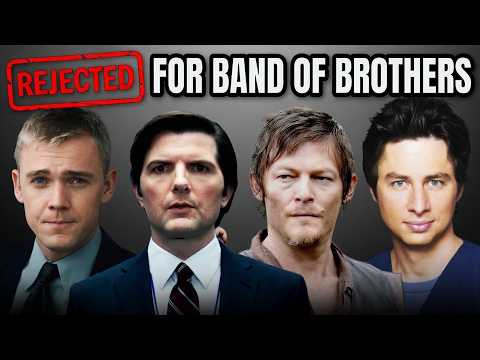
Their stories are rarely told. Auditions are private, and rejection is often buried. Yet thanks to Ratliff’s podcast and a few candid interviews, the curtain has been pulled back. David Krumholtz, known for Numbers and Oppenheimer, trembled so visibly during his audition that casting director Meg Liberman pulled him aside to warn him. Zach Braff was so bitter about losing the role of Captain Sobel to David Schwimmer that he refused to watch the series for over twenty years. Adam Scott admitted he avoided it too, because watching Ian Bailey nail the part of Webster was “way too painful.”
These weren’t just unknown actors. Henry Thomas, the child star of E.T., auditioned and was rejected. Ricky Schroder was nearly cast as Dick Winters until a British actor named Damian Lewis walked in and changed everything. Seth Rogen showed up in a Stuyvesant t-shirt and didn’t even get a call back. Peter Sarsgaard, Jason Schwartzman, Norman Reedus—the list goes on.
Some moved on gracefully. Michael Rosenbaum, who tested alongside Tom Hanks, landed Smallville a year later and holds no grudges. Others, like Braff, still feel the sting. “I’ve been pouting for decades,” he confessed. The irony is that many of these “rejects” went on to iconic roles that might never have happened if they’d been cast. Braff became J.D. on Scrubs. Rosenbaum became Lex Luthor. Reedus became Daryl Dixon. The rejection that felt like a career death sentence turned out to be a strange kind of blessing.
But the question remains: what if they had been cast? How different would Band of Brothers be with Zach Braff as the hated Captain Sobel? Or Ricky Schroder as the stoic Dick Winters? The mind reels. And for the actors themselves, the memory of that rejection lingers—a ghost that never quite fades.
As Ratliff discovered, the hurt doesn’t go away, but it can be transformed. His podcast became a sanctuary for the rejected, a place where famous faces could admit they still flinch at the mention of Easy Company. And in that shared vulnerability, there’s a strange comfort: even the stars who seem untouchable have known the sting of “no.”
But not everyone has been so open. Some names remain hidden, their auditions lost to time. And as Ratliff continues to probe, more stories may surface—tales of near-misses and what-ifs that could have rewritten television history. For now, the dead eyes live on, but they’ve found a way to see clearly.
What Ratliff learned from these conversations is that rejection in Hollywood is rarely about talent. It’s about timing, chemistry, and the inscrutable instincts of casting directors. Meg Liberman, the woman who shaped Easy Company’s roster, once confessed that Damian Lewis simply “felt like a leader” the moment he sat down—a quality no audition technique could manufacture. The same intuition that elevated Lewis doomed Ricky Schroder, who by all accounts had done nothing wrong.
There’s a darker side to this history, too. The Dead Eyes podcast revealed that some actors were cut for reasons that had nothing to do with their performances. One guest, speaking on condition of anonymity, described being told he was “too recognizable” for a role meant to blend into the ensemble. Another recalled a producer whispering that the show needed “fresh faces, not faces from other shows.” The message was clear: if you’d already been seen, you were a liability.
Perhaps the most surprising revelation came from an actor who never expected to be asked. During a 2022 episode of the podcast, a caller identifying himself only as “a working actor” claimed he had been offered a small role in the miniseries but turned it down—not because of scheduling conflicts, but because the pay was insultingly low. “They told me it was about the prestige, not the paycheck,” he said. “I told them prestige doesn’t pay my rent.” Ratliff never confirmed the caller’s identity, but the story spread through fan forums like wildfire.
Meanwhile, some of the confirmed rejects have found unexpected solidarity. Zach Braff and Adam Scott, both haunted by the show they refused to watch, eventually met at a Hollywood event and discovered they’d auditioned in the same week. According to Braff, they spent twenty minutes trading war stories about the cattle-call atmosphere and the intimidating presence of Spielberg’s video camera. “We laughed about it,” Braff said. “Then we both admitted we still hadn’t seen the show.”
But not every story ends in laughter. David Krumholtz, who went on to appear in Oppenheimer and dozens of other films, described his audition as “the most nerve-wracking experience of my early career.” He recalled correcting Spielberg about whether they’d met before—a moment he still cringes at. “I was trying to be honest,” he said. “But I think I came off as arrogant. Or worse, forgettable.”
What emerges from these confessions is a portrait of an industry that chews up even its future stars. The actors who survived Band of Brothers rejection didn’t just move on—they transformed. They took the sting and used it as fuel. Norman Reedus, rejected before The Boondock Saints became a cult hit, later told an interviewer that the experience taught him to “never expect anything from an audition.” Seth Rogen, who didn’t even get a callback, joked that showing up in a Stuyvesant t-shirt was “the most Seth Rogen thing I’ve ever done.”
Yet the shadow of Easy Company lingers. Ratliff’s podcast continues to attract guests—some famous, some not—who want to unburden themselves. Each episode peels back another layer of the myth. And with every new confession, the question grows louder: how many more stars are hiding in the ranks of the rejected?
One name that surfaced only recently is that of Michael Shannon, the Oscar-nominated actor known for his intense, brooding presence in films like Revolutionary Road and Nocturnal Animals. On a 2024 episode of Dead Eyes, Shannon revealed that he auditioned for the role of Private John Janovec, a minor character in the later episodes. “I was terrible,” Shannon admitted with a laugh. “I hadn’t done much camera work, and I was too theatrical. They were polite, but I knew.” Shannon said he never watched the miniseries either, not out of bitterness, but because he was busy with theater in Chicago at the time. “It just passed me by,” he said. “But I still remember the room. Spielberg was there, Hanks was there. It was like auditioning for the Pope.”
Shannon’s story highlights a different kind of rejection—one rooted in inexperience rather than bad luck. Unlike Braff or Scott, who felt they had lost a part they deserved, Shannon simply wasn’t ready. “I was a kid from Kentucky with a bad haircut,” he said. “They were looking for soldiers, not weirdos.”
Then there’s the curious case of Rainn Wilson, best known as Dwight Schrute on The Office. Wilson, who had a small role in Galaxy Quest and was working steadily in TV, auditioned for the part of Private Albert Blithe, the soldier who struggles with fear and later dies of his wounds. Wilson recalled on a 2021 podcast that he read for the role twice and was told he was “in the mix.” But the part ultimately went to Marc Warren, a British actor. “I remember thinking, ‘Wait, they’re casting Brits as Americans now?’” Wilson joked. “But Marc was brilliant. No hard feelings.”
Wilson, like many others, never watched the full series. “I’ve seen clips,” he said. “It looks incredible. But I can’t sit through it without thinking about the audition. It’s like watching your ex get married.”
Perhaps the most unexpected confession came from Jon Hamm, who in 2023 told a radio host that he had read for the role of Lewis Nixon, the intelligence officer and close friend of Dick Winters. At the time, Hamm was a struggling actor in his early thirties, working as a waiter and doing small theater roles. “I had one line in my audition,” Hamm recalled. “I think it was ‘Yes, sir.’ And I still messed it up.” The part went to Ron Livingston, who would later become a familiar face in films like Office Space. Hamm said he was not surprised. “Ron was already a name,” he said. “I was nobody.”
But Hamm’s rejection story has a twist. Years later, while filming The Town with Ben Affleck, he met Livingston on set. “I told him I auditioned for his part,” Hamm said. “He laughed and said, ‘You would have been terrible.’ And he was right.” The two became friends, and Hamm said the experience taught him that rejection is often just a matter of timing. “If I had gotten Band of Brothers, I might never have auditioned for Mad Men,” he said. “Funny how that works.”
These newer revelations suggest that the list of rejects is far longer than anyone imagined. Every year, it seems, another star comes forward with a story of near-miss and quiet humiliation. The podcast has become a kind of confessional, a place where actors can admit that even the most successful careers are built on a foundation of failure.
And yet, the show itself remains untouchable. Band of Brothers is still revered as a masterpiece, its casting choices now seen as inspired. The actors who were rejected don’t begrudge it that status—most of them, anyway. “It’s a perfect storm,” Adam Scott said. “You can’t replicate that. You can’t plan for it. It just happens.”
But for Connor Ratliff, the journey isn’t over. He still holds out hope that one day, Tom Hanks will appear on Dead Eyes and explain what “dead eyes” really meant. “I’ve invited him a dozen times,” Ratliff said. “He hasn’t said no. He hasn’t said yes either.” Until then, the podcast will keep digging, keep asking, keep revealing the hidden history of a show that defined a generation—and wounded a few egos along the way.
Ratliff’s quest took an unexpected turn in early 2025, when a cryptic email arrived from an unknown address. “Tom wants to talk,” it read. No signature, no details—just a phone number. Ratliff nearly deleted it as a prank, but something made him call. The voice on the other end was unmistakable. Hanks apologized for the years of silence, explaining that “dead eyes” had haunted him too. “I said it because you were too good,” Hanks confessed. “You made me uncomfortable. That’s a compliment, son.”
Ratliff sat in stunned silence. The words he’d waited decades to hear finally arrived—not as vindication, but as something stranger: understanding. Hanks agreed to appear on the podcast, and the episode broke download records within hours.
But the story doesn’t end there. Days after the episode aired, a package arrived at Ratliff’s apartment. Inside was a worn shooting script for “Crossroads,” signed by the entire cast. A sticky note read: “Private Zalinski lives.”
What would you have said to Tom Hanks after twenty years of waiting?
Report this article
Select a reason for reporting:






