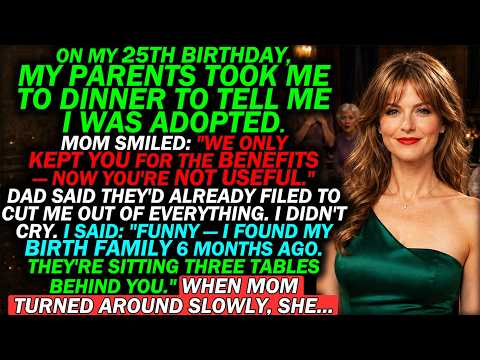
The restaurant was called Vantair, and I had never been taken there in my life. My mother chose it. That should have been my first clue because Diane Mercer did not spend money on me without a reason printed somewhere on the receipt. She wore the gray cashmere she saved for funerals and board meetings. My father, Wesley, had booked the table under her name, not mine, which I noticed when the hostess asked, and he answered before I could.
There was no banner, no balloon tied to my chair, no cake waiting in some back kitchen with my name piped in blue. For a birthday dinner, the table was strangely bare, and the air between my parents had the careful politeness of people about to read a verdict. I had spent four years sitting in rooms like this. I booked tables like this for clients, for signings, for the quiet conversations families have when somebody dies and the money has to move. I knew the difference between a dinner and a deposition. And this had the temperature of a deposition.
So, I did what I always do when a room goes cold. I studied my breathing and I counted the exits. That was when I clocked the small brass number standing on the table behind us and to the left, table 9. I held it in my mind without quite knowing why. The way you note a landmark before you’ve decided you’ll need to find your way back. I set my own thing down beside my water glass. A thin manila folder, plain and unremarkable. My mother glanced at it and assumed I think that it was a resume or maybe a card. She had no idea what I’d put inside it.
You have to understand what birthdays were in our house to understand why I wasn’t surprised. When I was small, my birthday was one candle. Not one candle as a tradition, the way some families do a single tall number. One candle pressed into a grocery store cupcake my mother bought on the way home and never bothered to refrigerate. I’d watch it sweat on the counter while she took a call. Meanwhile, three weeks later, my cousin Brett got a rented bounce house and a caterer with little quiches on silver trays because Brett was my aunt Renee’s son, and Brett was blood. I remember asking the year I turned 8 if I could have a party, too. My aunt was over drinking my mother’s wine, and she answered for her. We can only do one nice thing a month, honey, she said it kindly. That was the part that taught me the most. How kind people can sound while they’re explaining your size to you.
So, I learned the math. One cupcake costs less than a party. A child who asks for less is cheaper than a child who asks for the same. By the time I was nine, I had stopped asking for cake because I could see it made the arithmetic easier for everyone at the table and being easy felt like the only currency I had. I didn’t tell myself it was sad. I told myself it was efficient. That’s the thing about growing up useful. You don’t notice you’ve been priced until somebody reads the number out loud. And across that white tablecloth at Vantair, 25 years old, I could feel my mother getting ready to read it.
I left that house the week I turned 18 with two duffel bags and a community college acceptance I’d filled out myself. Nobody drove me. I worked nights at a pharmacy counter and took classes in the morning, then transferred to the state school and finished a paralegal program while waiting tables on weekends. I paid for all of it. I want to be clear about that, not because it makes me special, but because it matters for what came later. Nobody handed me a thing. By 25, I was a paralegal at a trusts and estates firm downtown. And I was good at it. I spent my days inside other people’s wealth, organizing what happens to a person’s life after they can’t hold on to it anymore. I drafted the boring pages that decide everything, beneficiary designations, distribution schedules, the quiet language that controls who eats and who doesn’t long after the funeral wilt. I could read a trust the way some people read a face. And the joke of my life, the one I didn’t laugh at for years, was this. I could set a perfect boundary for a total stranger. I could tell a grieving widow exactly what she was owed and exactly what she wasn’t. But I could not, for the life of me, ask my own family to want me.
The only person I ever called was my grandmother. Every Sunday, 4:00, like clockwork, all through college and after, Nana Ruth. She was the one Mercer who answered the phone like she’d been waiting for it to ring. And it was something Nana once said to me that turned out to be the hinge the whole night swung on. Nana Ruth Mercer was my father’s mother and she was the only adult in that family who ever made me feel like a person instead of a line item. She had opinions about everything and apologies for nothing. When I was 12 and crying in her kitchen because Brett had told me I wasn’t a real Mercer, she put down her dish towel, took my chin in her hand, and said the sentence I carried for the next 13 years. You were chosen, sweetheart, not collected. Then she made me a grilled cheese and let me stay up too late.
Nana died when I was 23. Two years before that dinner, I gave the only eulogy that mentioned her by who she was instead of what she left behind. And within a month of the funeral, my parents quietly moved out of their cramped split level and into the larger house on Lynden Road, the one that had been in the family for a long time, the one connected to Nana’s name in ways I understood better than they realized. I didn’t think much of it then. I was grieving. But there was a thing Nana said to me on one of our last Sundays, her voice thin over the phone, that I filed away without understanding. I made sure she told me that you’ll never have to ask anyone for your own life. I thought she meant it as encouragement. A grandmother telling a granddaughter to be strong. It would be 6 months before that dinner, going through county records for an entirely different reason that I’d learned she had meant it literally in writing and notarized.
The year before I turned 25, my family started getting quiet around me and not the comfortable kind. Texts that used to come back in an hour took three days. My mother stopped looping me into the holiday planning chain, then acted surprised when I showed up to Thanksgiving without a side dish nobody had asked me to bring. My aunt Renee, meanwhile, got louder. She’d started using a word in the family group chat that she’d never bothered with before. Blood. As in, this is a blood only weekend at the lake. As in the cabin sleeps 8 and we want to keep it to blood this year. You understand? I did understand. I understood perfectly. I just didn’t have the documents yet to know why the temperature had dropped so suddenly all at once in the same season. People don’t usually turn cold on a schedule. Families drift, sure, but this wasn’t drift. This was coordinated. And the analyst part of my brain kept flagging it. The way you notice three unrelated invoices arrive on the same Tuesday and realize they aren’t unrelated at all.
So when my phone lit up one evening in March with my mother’s name and a voice 3° warmer than it had been in a year, I didn’t feel flattered. I felt the small cold click of a lock turning somewhere I couldn’t see. Honey, she said, and she only called me honey when she wanted something. We’d like to take you out to celebrate 25 properly. The way we never quite managed. And every instinct I’d built in four years of reading other people’s bad news told me the same thing. This is too neat. Here is what most people get wrong about my mother. They think the cruelty is loud. It isn’t. The cruelty is the planning. The cruelty is a woman who never once managed a birthday cake suddenly reserving a corner table at Vantair and calling it celebrating you properly. When Diane gets generous, it’s because a spreadsheet somewhere has told her the generosity will pay for itself. I’d watched it my whole life. I’d just never been the line item before.
So, I said yes sweetly the way she’d taught me. And then I hung up the phone and I sat at my kitchen table for a long time doing what I do. I thought about timelines. I thought about the house on Lynden Road. I thought about the word blood showing up in the group chat exactly now, exactly this season, and about a sentence my grandmother had said to me before she died. And I thought about the manila folder already sitting in my work bag, the one I’d assembled 6 months earlier for reasons that had nothing to do with my mother and everything to do with finally knowing where I came from. I didn’t call my parents back to ask questions. I didn’t warn them I’d been to the county clerk. Instead, I made a few calls of my own. Quiet ones, the kind you make when you’ve decided you’re not going to be ambushed. You’re going to be ready. I won’t tell you yet who I called. But I’ll tell you the rule I live by. The one Nana never said out loud but taught me anyway. When my mother is sweet, someone at the table is about to lose something. I just made sure this time it wouldn’t be me.
People assume a story like this is about money. And I understand why. There’s a will somewhere, a house, a folder slid across a table. But sitting in my car in the Vantair parking lot that night, engine off, hands steady on the wheel, the thing I was afraid of losing had no dollar amount. I was afraid of losing the last idea that I had ever belonged anywhere.
Because as cold as that house had been, it was still the only origin story I had. If they cut that thread tonight the way I suspected they’d come to cut it, then I would be exactly what Brett had called me at 12. Not a real Mercer. Just a girl somebody picked up and put down. That’s the wound they were aiming for, and they knew it because it’s the wound they’d been pressing on my whole life.
What they didn’t account for was that the wound had already closed. Six months can do that if the right people find you. I checked my reflection in the visor mirror, tucked the folder under my arm, and walked across that lot with the particular calm of a woman who has read the last page of a book everyone else thinks is still being written.
I wasn’t going to a disownment. I was going to a goodbye I’d already chosen. They just didn’t know it yet.
So here’s my question for you. If you knew tonight’s dinner would end with you walking toward a table that had been saving your seat all along, what would you leave behind on the white cloth?
Report this article
Select a reason for reporting:






