Adolf Hitler—the name evokes images of monstrous tyranny, of speeches that whipped crowds into frenzy, of a regime that plunged the world into darkness. But behind the carefully constructed façade of the infallible leader, a far more unsettling truth was buried. For decades, the image of Hitler was meticulously manipulated, his personal quirks and contradictions hidden from public view. Official reports, psychological studies, and secret documents have slowly peeled back the layers, revealing a man whose private life was as bizarre as his public persona was terrifying. What were they so desperate to conceal? How much of the real Hitler remains shrouded in the shadows of history?
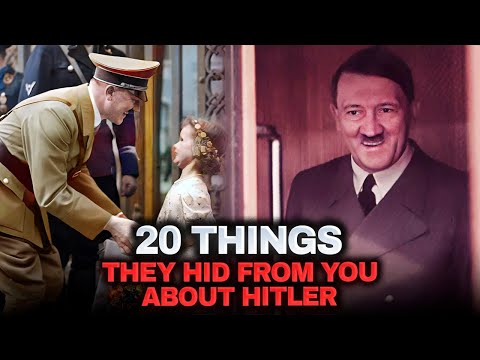
From his failed dreams as an artist to his obsessive fears and strange habits, the fragments of Hitler’s life that have emerged paint a picture of a deeply disturbed individual. He was a man who ordered the deaths of millions yet wept for his mother, who preached discipline yet relied on a cocktail of drugs, who projected strength yet cowered from physical contact. These contradictions were not mere eccentricities—they were carefully guarded secrets that, if exposed, could have shattered the myth of the Führer.
In the years following World War II, intelligence agencies and historians began to piece together the hidden aspects of Hitler’s life. What they found was a man whose paranoia and compulsions shaped not only his personal routines but also the course of history. He feared poisoning so much that he had young women taste his food before every meal. He avoided handshakes, despised loud noises, and insisted on absolute silence in his residences. These were not the traits of a confident leader, but of a man consumed by his own anxieties.
Perhaps most striking is the contrast between his public image and his private reality. Hitler presented himself as a ascetic, a vegetarian who abstained from alcohol and tobacco, a man of discipline and willpower. Yet behind closed doors, he was a hypochondriac who relied on injections of animal hormones and stimulants to function. His personal physician, Theodor Morell, administered daily doses of everything from cocaine to opiates, a regimen that left Hitler increasingly erratic and dependent. This addiction was a secret the regime fought to keep hidden, for it undermined the very foundation of his authority.
As the war turned against Germany, Hitler retreated further into his delusions, ordering the construction of elaborate underground bunkers and secret tunnels. He feared bombing raids even in the remote Alps, demanding that his shelters be equipped with independent ventilation systems and camouflaged exits. He never visited a concentration camp, never witnessed the horrors he had set in motion, yet he micromanaged the logistics of mass murder from the safety of his offices. This detachment allowed him to maintain a semblance of moral distance, even as his orders led to the deaths of millions.
The secrets of Hitler’s life are not merely historical curiosities—they are a window into the mind of a tyrant. They reveal how image and reality can diverge, how power can be built on a foundation of lies, and how the most monstrous acts can be committed by a man who was, in many ways, profoundly human in his flaws. As we delve deeper into these hidden aspects, we begin to understand not only Hitler but also the mechanisms of control and deception that defined his regime.
These hidden fragments also expose the machinery of image-making that surrounded him. Joseph Goebbels, the Reich Minister of Propaganda, understood that the Führer could never be seen as ordinary. Every photograph was retouched, every newsreel edited, every public appearance choreographed down to the smallest gesture. Hitler was not merely a politician; he was a product, manufactured and packaged for mass consumption. The regime understood that the man behind the curtain had to remain invisible.
One of the most revealing documents to surface after the war was a series of psychological profiles commissioned by the U.S. Office of Strategic Services. Analysts who never met Hitler in person dissected his speeches, his writings, and the testimonies of defectors. Their conclusion was chilling: the man they described was a narcissistic personality with paranoid tendencies, incapable of genuine empathy, and driven by a need for absolute control. Yet even these reports acknowledged that the full picture remained incomplete.
What the analysts could not fully grasp was the extent to which Hitler’s private habits were intertwined with his political strategy. His vegetarianism, for instance, was not merely a personal choice—it became a tool of propaganda. Magazines published glowing articles about the Führer’s compassion for animals, his abstention from alcohol, his simple diet. These stories were designed to humanize him, to present him as a man of moral purity in contrast to the decadence of his enemies.
But the truth was far more complicated. Witnesses who worked closely with Hitler described a man who could be charming one moment and explosive the next. He would lecture his guests for hours about the virtues of raw vegetables, then fly into a rage if a door was slammed too loudly. His temper was legendary, but it was carefully controlled in public—only those in his inner circle ever saw the full force of his fury.
His relationship with Eva Braun was another carefully guarded secret. For years, she was kept out of the public eye, living in the shadow of the man she adored. She was not permitted to appear at official functions, and Hitler rarely showed her any affection in front of others. Even within the walls of the Berghof, their relationship was distant, formal, almost businesslike. Braun attempted suicide twice, a fact that was suppressed by the regime. The woman who shared Hitler’s private life was, in many ways, as isolated as he was.
As the war progressed, the gap between the public image and the private reality grew wider. Hitler’s health deteriorated, his temper became more unpredictable, and his grip on reality seemed to loosen. By 1944, he was a shadow of the figure who had once mesmerized crowds, his body ravaged by disease and his mind clouded by drugs. Yet the propaganda machine continued to present him as the indomitable leader, the man who would lead Germany to victory against all odds.
The final months in the bunker revealed the full extent of his delusion. He ordered divisions that no longer existed to launch counterattacks. He spoke of secret weapons that would turn the tide of the war. He blamed everyone but himself for the collapse, accusing the German people of failing him. The man who had once promised to restore Germany’s glory now spoke of its destruction with cold indifference.
When the end finally came, Hitler chose to disappear from history rather than face the consequences of his actions. His body was burned, his remains scattered, and the world was left to piece together the fragments of a life that had been deliberately obscured. The secrets he took with him—the fears, the obsessions, the contradictions—would continue to fascinate and horrify for generations to come.
Yet even in death, the manipulation continued. Soviet authorities, who claimed to have recovered his remains, withheld the details for decades. Conspiracy theories flourished, fueled by the absence of a definitive account. Was he truly dead? Had he escaped? The regime’s obsession with secrecy had, in the end, created the perfect conditions for myth to flourish.
What remains, then, is not a complete picture but a mosaic of fragments—each piece revealing a different aspect of the man who terrorized the world. The frustrated artist, the animal lover, the drug addict, the paranoid recluse, the grieving son, the architect of genocide. These identities coexisted within the same individual, each one carefully hidden from view when it threatened the image of the Führer.
But the most unsettling discoveries were yet to come. In the decades following the war, researchers gained access to previously sealed archives in Moscow, Washington, and Berlin. Among the thousands of pages of captured German documents were personal notes, private correspondence, and medical records that had been hidden away for nearly half a century. What they revealed was not just a tyrant but a man whose psychological disintegration was far more advanced than anyone had suspected.
One dossier, compiled by Soviet intelligence in the immediate aftermath of the war, contained testimony from Hitler’s personal valet, Heinz Linge. Linge described a man who would spend hours staring at his own reflection, not out of vanity but out of a strange, almost ritualistic compulsion. He would practice his expressions, his gestures, even his silences, as if he were an actor preparing for a role that never ended. The mirror was not a tool for grooming—it was a stage.
These testimonies also shed light on Hitler’s obsession with control over the smallest details of his environment. He personally approved the fabric of his uniforms, the arrangement of furniture in his offices, and the exact temperature of the rooms he occupied. Any deviation from his specifications sent him into a fury. Yet this same man, who demanded perfection in his surroundings, lived in a state of perpetual physical decline—his hands trembling, his digestion ruined, his body betraying him at every turn.
Perhaps the most revealing documents were the transcripts of private conversations recorded by his aides at the Berghof and in the bunker. In these unguarded moments, Hitler revealed not the calculated political strategist but a man consumed by resentment and paranoia. He spoke of the German people as ungrateful children, of his generals as cowards, of the world as a conspiracy against him. The grandiose vision of a thousand-year Reich had shrunk to a bunker in Berlin, and the man who had once commanded millions now raged against shadows.
Yet even in these private moments, the performance never fully stopped. Hitler continued to speak in the same cadences, to use the same phrases, to construct the same narrative of betrayal and redemption. The line between the public persona and the private self had blurred to the point of disappearance. He had become the Führer so completely that there was nothing left underneath.
This was perhaps the most disturbing secret of all: not that Hitler was a monster, but that he had constructed himself so thoroughly that the man and the myth became indistinguishable. The frustrated artist, the animal lover, the grieving son—all of these had been absorbed into the machine of his own making. What remained was a figure who could no longer distinguish between his own lies and reality, a man who had become the very fiction he had created.
As researchers continued to sift through the evidence, they began to understand that the true horror of Hitler lay not in his eccentricities but in his ordinariness. He was not a demon or a madman in the conventional sense. He was a man who had chosen, again and again, to become something inhuman. And in that choice, there was a lesson that the world could not afford to forget.
The archives revealed one final contradiction. Hitler, who had rehearsed every gesture before a mirror, who had scripted his own myth with the precision of a stage director, left behind no final performance. In the end, the curtain fell in silence, and the world was left to wonder what was real and what was theater.
His secrets—the trembling hands, the tainted food, the forged passport, the unread books—were not merely the quirks of a tyrant. They were the cracks in a monument built on deception. And through those cracks, history glimpsed the frightening truth: the most dangerous monsters are not born, but made—and hidden, piece by piece, behind closed doors.
What remains is a question that still haunts us: if so much of Hitler’s life was a carefully constructed lie, how many other leaders have learned to hide their own truths behind the same curtain of power?
Report this article
Select a reason for reporting:






