Dr. Rebecca Torres had examined thousands of old photographs in her fifteen years as a digital genealogist, but something about this one made her pause. It was a Tuesday afternoon in February 2024, and she was working from her small office in Boston, scanning through images submitted by the Hendrickx family—descendants of a once-prominent Richmond, Virginia household. The photograph before her was a formal family portrait dated 1898.
The Hendrickx family sat rigidly in a photographer’s studio, dressed in their Sunday best. Thomas Hendrickx stood behind his seated wife, Elizabeth, his hand resting protectively on her shoulder. Three children surrounded them: two girls in white lace dresses and a boy in a dark suit with a stiff collar. The sepia tones had faded over the decades, giving the image a dreamlike quality.
Rebecca leaned closer to her monitor, adjusting her glasses. She had been hired to trace the Hendrickx lineage for a client planning a family reunion, and this photograph was supposed to be straightforward documentation. But as she began applying digital enhancement techniques—adjusting contrast, sharpening details, removing scratches—a chill ran down her spine.
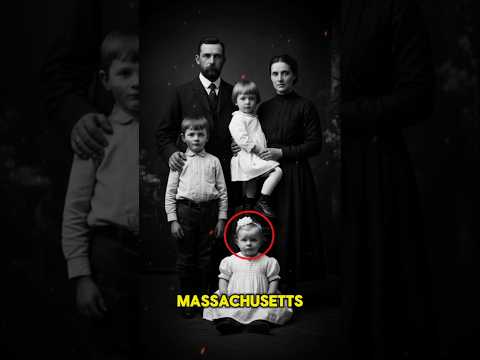
There, in the background, partially obscured by the shadow of a heavy curtain, was a figure she hadn’t noticed before. A baby girl, no more than two years old, stood alone in the corner of the room. Her dress was identical to the other girls’, but her face was blurred, as if she had moved during the long exposure. Rebecca’s heart raced. “That’s impossible,” she whispered. “The family records only list three children.”
She quickly pulled up the Hendrickx family tree on her second monitor. Thomas and Elizabeth had three children: Margaret, born 1890; William, born 1893; and Eleanor, born 1896. No baby girl. No fourth child. Yet the photograph clearly showed a fourth figure, standing apart from the group, her tiny hands clasped in front of her.
Rebecca spent the next hour enhancing the image further, isolating the baby’s face. The blur was stubborn, but she managed to sharpen the edges slightly. The girl’s eyes were dark, her expression solemn. “Who are you?” Rebecca murmured. She checked the back of the photograph—nothing but a faint inscription: “Hendrickx Family, 1898.” No names, no dates, no mention of a fourth child.
She dug deeper, searching census records from 1900. The Hendrickx household listed Thomas, Elizabeth, Margaret, William, and Eleanor—but no baby. She checked birth records for Richmond, Virginia, between 1896 and 1898. Nothing. It was as if the child had never existed.
Frustrated, Rebecca turned to the family’s correspondence, which the client had digitized. Among the letters, she found one dated March 1898, from Elizabeth Hendrickx to her sister. The handwriting was elegant but hurried: “We have decided to keep little Lillian out of the portrait. It is too painful. The photographer will remove her from the negative.”
Rebecca’s breath caught. Lillian. A name she hadn’t found anywhere else. She read on: “The doctor says she will not last the winter. We cannot bear to have her memory frozen in time, only to lose her.”
But the photograph showed Lillian. She was there, in the corner, a ghostly presence that the photographer had failed to erase completely.
Rebecca’s mind raced. Why was Lillian omitted from all records? What happened to her? And why did the photographer leave her in the image, even after being instructed to remove her?
She glanced at the clock. It was nearly midnight. She had been so absorbed that she hadn’t noticed the hours slipping by. She saved her work and leaned back in her chair, staring at the screen. The baby girl—Lillian—seemed to stare back, her blurred features hinting at a story long buried.
Rebecca knew she had to find out more. “I’ll find you, Lillian,” she said softly. “I promise.”
The next morning, Rebecca arrived at her office before sunrise, a cup of coffee in one hand and a notepad in the other. She had barely slept, her mind churning with questions about the forgotten child. Her first call was to the client, a great-grandson of William Hendrickx named David, who lived in Seattle.
“A fourth child?” David repeated, his voice thick with disbelief. “My grandmother never mentioned anyone named Lillian. Are you sure the letter wasn’t a mistake?”
“The photograph doesn’t lie,” Rebecca replied. “She’s standing right there in the corner. I think your family erased her from the record—perhaps because they couldn’t bear the loss.”
David was quiet for a long moment. Then he mentioned something that made Rebecca sit up straight: an old trunk in his attic, filled with papers his grandmother Eleanor had kept until her death in 1972. He had never gone through it. “I’ll overnight it to you,” he said. “If Lillian is real, she deserves to be remembered.”
The trunk arrived two days later. Rebecca opened it carefully, the smell of aged paper and cedar filling her office. Inside were dozens of letters, a few faded photographs, and a small leather-bound diary. The diary belonged to Elizabeth Hendrickx, and its pages were filled with cramped, grief-stricken handwriting.
Rebecca turned to the entry dated February 1898. “Lillian is fading,” Elizabeth had written. “The fever has taken her strength. Thomas cannot look at her without weeping. We told the photographer to erase her, but I do not know if I can bear it. She is still here. She is still ours.”
Another entry, dated April 1898, was barely legible, the ink smeared as if tears had fallen on the page. “Our little Lillian is gone. The photographer kept his word—she is not in the portrait. But I see her everywhere. I hear her laughter in the halls. God forgive us for hiding her.”
Rebecca set the diary down, her hands trembling. The photographer had been instructed to remove Lillian from the negative, and the family believed he had. But somehow, her image had survived—a faint, stubborn trace that no amount of chemical erasure could fully erase.
She pulled up the enhanced photograph again and stared at the baby girl in the corner. The blur was still there, but now it felt less like a flaw and more like a message. Lillian had been loved. She had been real. And for over a century, she had been waiting to be seen.
Rebecca picked up her phone and dialed David’s number. “I found her,” she said, her voice steady. “I found Lillian. And I think I know why she never left the photograph.”
“What do you mean, she never left?” David asked, his voice tight. Rebecca could hear the rustle of him sitting down, the creak of an old chair. She chose her words carefully.
“The photographer was told to erase her from the negative. But erasing a figure from a glass plate in 1898 wasn’t a perfect science. He scraped at the emulsion, maybe painted over the spot with opaque ink. But Lillian was standing in front of a dark curtain, and the light caught her dress. When I reverse the enhancement, I can see the scrape marks—clumsy, hurried. He tried to blot her out, but he was grieving too, David. He left just enough of her behind.”
Silence stretched across the line. Then David asked the question Rebecca had been dreading. “Why would a photographer care about our family’s grief?”
Rebecca pulled up the studio’s stamp from the bottom corner of the photograph. Ellison & Rowe, Fine Portraits, Richmond, Virginia. She had already spent the morning tracing the name. “Because I don’t think he was just a photographer,” she said. “I think he was family.”
She explained what she’d found in the Richmond city directory of 1898. The Ellison in Ellison & Rowe was a man named Samuel Ellison—Elizabeth Hendrickx’s younger brother. The same brother whose wife had received that hurried letter in March. “Elizabeth wrote to her sister, but it was Samuel who took the portrait,” Rebecca said. “He was told to erase his own niece. He couldn’t do it completely. He left her in the corner, small enough that no one would notice—unless they looked.”
David let out a shaky breath. “So the family didn’t erase her. They tried, but her own uncle couldn’t bring himself to finish the job.”
“That’s what I believe,” Rebecca said. “But there’s more. The diary mentions a fever, but it never names the illness. I want to check the Richmond death records from 1898. If Lillian died that spring, there should be a certificate—even if the family tried to keep it quiet.”
She spent the afternoon in the county archive, scrolling through microfilm until her eyes ached. The records were incomplete, many pages water-damaged or faded beyond legibility. But just before closing time, she found it: a single line in the register of deaths for April 1898. Lillian Hendrickx, age 1 year, 11 months. Cause: scarlet fever. Buried at Hollywood Cemetery, plot 14-B.
Rebecca stared at the entry, her throat tight. A plot number. A grave. The family had buried her after all—they had simply refused to speak her name.
She called David that evening with the news. He was quiet for a long time. “Plot 14-B,” he finally said. “My grandmother Eleanor is buried in plot 14-C. She’s right next to her.”
Rebecca felt the pieces click into place. Eleanor, the youngest surviving child, had spent her whole life beside the sister no one talked about. “David,” she said slowly, “I think Eleanor knew. I think she kept that trunk because she wanted someone to find Lillian eventually.”
The line crackled. “Then we finish what she started,” David said. “I want a headstone for Lillian. A real one. And I want her name on the family tree.”
Rebecca smiled, though her eyes stung. “I’ll start the paperwork tomorrow.”
But as she hung up, she found herself turning back to the photograph one last time. The baby girl in the corner seemed to have shifted somehow—her blurred face tilted toward the camera, as if she had finally been acknowledged. Rebecca knew it was an illusion, a trick of the fading emulsion. Still, she whispered to the screen before shutting it off.
“You’re not forgotten anymore, Lillian. You never were.”
The headstone arrived on a cold morning in October. Rebecca flew to Richmond to meet David at Hollywood Cemetery, where plot 14-B had waited for more than a century beneath a tangle of ivy and weeds. The marker was simple—a small granite stone engraved with a single word: Lillian.
David knelt beside it, brushing away the dirt. “She was here the whole time,” he said, his voice breaking. “Right next to Eleanor. We just never knew.”
Rebecca placed a white rose on the fresh earth. She had brought a printed copy of the photograph with her, the enhanced version where Lillian’s tiny figure stood clear in the corner. She tucked it into the ground beside the stone.
Later that evening, David sent her a message. He had updated the family tree, adding Lillian’s name beneath her siblings. “I’m telling everyone at the reunion,” he wrote. “She deserves to be celebrated, not hidden.”
Rebecca closed her laptop and looked out the window at the Boston skyline. In fifteen years of tracing other people’s ancestors, she had never felt so certain of her work. A photograph was more than an image. It was a promise that someone had once lived, and loved, and been loved in return.
She thought of Samuel Ellison, scraping at the negative with trembling hands, unable to erase his niece completely. He had left her there on purpose—a quiet act of defiance against a family’s grief. And now, at last, the world would see what he had saved.
What would you do if you discovered a forgotten face hidden in your own family’s history?
Report this article
Select a reason for reporting:






