June 1945. The gray troop ship groaned against the Atlantic waves. Below deck, 147 German women sat in darkness—nurses, prisoners, enemies of the most powerful nation on Earth. For eleven days, they had barely slept, whispering the same terrified questions: Will they beat us? Will they starve us? Will they make us disappear? One nurse, 23-year-old Hannah Cleaner from Berlin, clutched a small notebook. Inside were 312 names—every soldier she had watched die on the Eastern Front. She wondered if her own name would soon be added to someone else’s list.
The ship slowed. Engines quieted. A voice crackled over the loudspeaker: We have arrived. The women climbed to the deck. Through the morning haze, they saw it—the skyline of New York City, the richest city in the world, the heart of the enemy. Armed guards lined the gangplank. This is it, Hannah thought. The punishment begins now.
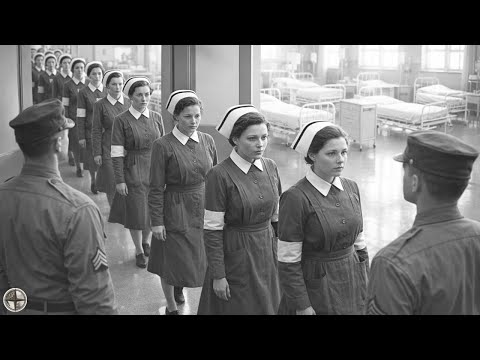
But then something happened. Something that made no sense. A woman in an American military uniform stepped forward. She spoke to them in German. And what she said next would shatter everything they had been told about Americans.
“You are prisoners of war,” Colonel Margaret Harper announced, her voice firm but not cruel. “But you are also nurses. You will be sent to military hospitals across the United States. There you will assist in the care of wounded American soldiers. You will be treated with the respect due to medical personnel under the Geneva Convention.”
The women stared, disbelief etched on their faces. Respect? From the enemy? This had to be a trick. But there was no punishment. Instead, they were guided toward Red Cross ambulances and civilian buses with cushioned seats. No one shouted. No one shoved. No one pointed a weapon.
As the buses rolled north into New Jersey, the German nurses pressed their faces to the windows. Green trees. Paved roads. Neat houses with gardens and parked automobiles. Everything looked untouched by war. No bombed buildings, no rubble, no refugees walking with bundles on their backs. Hannah thought of Berlin, reduced to dust. She thought of Dresden, where Anna Vieber had watched 25,000 people burn. And here was America—whole and clean and impossibly peaceful.
At a military processing center, American nurses conducted thorough medical checks—temperatures, blood pressure, eyes, ears, teeth, skin. The process was professional, clinical. No roughness, no humiliation. Then came the supply room. Neatly folded on tables were new uniforms: white dresses with matching caps, stockings, leather shoes in multiple sizes. Lizel Hartman held up her dress. The fabric was soft. The stitching perfect. She had not worn anything this clean in over a year.
Next came the showers—hot water, real soap, thick white towels. Anna stood under the stream and let the heat soak into her muscles. She could not remember the last time she had bathed with warm water. In the final months of the war, German hospitals had no fuel for heating. Nurses washed with cold water from buckets. Sometimes they did not wash at all.
After the showers, the women were led to a dining hall. Long tables were set with plates, forks, and napkins. American kitchen staff brought out trays of food: roast chicken, mashed potatoes with butter, fresh green vegetables, bread rolls still warm from the oven, and for dessert, apple pie with coffee and real cream.
Hannah sat down. Her hands trembled as she picked up her fork. In Germany, civilians were surviving on 1,000 calories per day. She had once gone three days eating nothing but stale bread and turnip soup. She took a bite of the pie. The sweetness spread across her tongue. The crust was flaky. The apples were soft and warm. And then the tears came. She did not sob. She did not make a sound. The tears simply rolled down her cheeks and dripped onto the table. She was not crying from sadness. She was crying because someone had fed her like a human being.
Around the room, other women were crying too—quietly over their plates of chicken and potatoes, over their cups of real coffee. They cried because this was not punishment. This was kindness. And kindness, after years of war, felt almost unbearable.
That night, the nurses slept in clean barracks with real beds, sheets, pillows, blankets that did not smell of blood or smoke. Hannah whispered to her bunkmate in the darkness. “They gave us uniforms like we are still nurses,” her friend replied softly. “They gave us dignity.”
The next morning, the women learned their assignments. They would be split into groups and sent by train to hospitals across the country—Kansas, California, Illinois, New York. Their job: to care for wounded American soldiers. The same men who had fought against Germany. This was not a gift. It was a test. And what happened in those hospitals would prove whether enemies could become something more.
The trains left New Jersey on June 15th, 1945—seven different trains heading in seven different directions. Each carried a group of German nurses toward American military hospitals that desperately needed help. The war had ended in Europe, but the wounded kept arriving. Every day, transport ships docked at American ports, carrying broken soldiers from the battlefields of France, Belgium, and Germany. Young men with missing arms, shattered legs, faces burned beyond recognition, minds destroyed by what they had seen.
Hospitals were overwhelmed. The wards were full. American nurses worked double shifts and still could not keep up. By June 1945, over 670,000 American soldiers had been wounded in the European theater alone. Another 250,000 had been wounded fighting in the Pacific. The hospitals needed 12,000 additional nurses just to meet basic care standards. They had fewer than 8,000. So the German prisoners became workers.
Hannah Cleaner’s train headed west toward Kansas. She sat by the window and watched America pass by—endless farmland, golden wheat fields stretching to the horizon, small towns with white churches and main streets lined with shops. Children played in yards. Women hung laundry on clotheslines. Everything was untouched, whole, alive. Hannah thought about the train rides she had taken across Germany in 1944—bombed-out stations, destroyed bridges, refugees crowded into cattle cars with everything they owned tied in bedsheets. She had seen a child freeze to death on a platform in Munich because the train was delayed twelve hours in the snow. Here the American train had cushioned seats, a dining car serving sandwiches and coffee, clean bathrooms. The contrast was almost too painful to understand.
Lizel Hartman’s train traveled to California—three days across the entire country. She watched deserts turn into mountains, then mountains into green coastal valleys. She had never imagined a nation so vast, so untouched by war. In Austria, her hometown of Vienna had been bombed seventeen times. Over 12,000 civilians had died. Here, the cities glowed with electric lights at night.
Anna Vieber went to Illinois. Her train passed through Pennsylvania, Ohio, Indiana. Everywhere she looked, she saw factories running at full speed, smokestacks pouring out clouds of steam, rail yards filled with freight cars. America had not just survived the war. It had grown stronger because of it. She later wrote, “I realized then that we never had a chance. Germany was fighting a nation that could build faster than we could destroy.”
On June 18th, the trains began arriving at their destinations. The German nurses stepped off onto platforms where military personnel waited with trucks and instructions. The women were tired, nervous. They still wore their American nurse uniforms. They still did not fully believe they would be treated as medical staff.
At a military hospital outside Topeka, Kansas, Hannah Cleaner and fourteen other German nurses were led through the front entrance. The building was massive—three stories tall, over 400 beds. The hallways smelled of disinfectant and bandages. Somewhere deeper inside, someone was screaming.
The head nurse, Captain Dorothy Wells, met them in the lobby. She was a stern woman in her forties with sharp eyes and no patience for nonsense. She looked the German women up and down. “You will work six-day weeks,” she said. “Eight-hour shifts. You will follow orders from American medical staff. You will treat every patient with professionalism. You are prisoners, but you are also nurses. Act like it.”
Then she handed each woman a name badge and a ward assignment. Hannah was assigned to Ward C—amputees. Her hands shook as she pinned the badge to her uniform. She followed an American nurse down a long corridor. The floor was polished tile. The walls were painted pale green. Through open doors, she could see rows of hospital beds—men lying motionless, men with stumps where legs used to be, men with bandages covering half their faces.
The American nurse stopped at a doorway. “This is your ward. Forty-two patients. Most lost limbs at the Battle of the Bulge or during the Rhine Crossing. Some have infections. Some have phantom pain. All of them have been through hell.” She paused and looked directly at Hannah. “They know you’re German. Some will refuse your care. Some will say ugly things. Do your job anyway.” Then she walked away.
Hannah stood alone in the doorway. Inside the ward, dozens of eyes turned toward her—American eyes, soldiers who had fought against her country. Men who had watched their friends die at the hands of German bullets and bombs. One man, a sergeant with both legs amputated below the knee, stared at her uniform, then at her face. Then he spat on the floor. “They’re making us get cared for by Nazis now,” he said loudly. “What’s next? Hitler himself comes to fluff my pillow.” A few men laughed. Most stayed silent. The tension in the room was thick enough to choke on.
Hannah took a breath. She walked into the first bed—a young private, maybe nineteen years old, with his right arm missing at the shoulder. His chart hung on a hook at the foot of the bed. She picked it up and read it. Infection. Dressing change needed twice daily. Morphine every four hours for pain. She looked at him. He looked away. She set the chart down. “I am here to change your bandages,” she said in halting English.
The private said nothing. Hannah gathered her supplies—clean gauze, antiseptic, scissors, tape. Her hands moved automatically. She had done this a thousand times before—on German soldiers, on Russian prisoners, on dying boys who called for their mothers in languages she did not speak. She began to unwrap the bandages on the private’s shoulder. He flinched but did not pull away. The wound beneath was red and raw. She cleaned it gently, applied fresh antiseptic, wrapped it in new gauze with precise, careful folds. When she finished, the private finally looked at her. His eyes were hard, suspicious, but he nodded once. It was not trust, but it was not hatred either. It was a beginning.
The first week was the hardest. In Kansas, Hannah worked her eight-hour shifts in silence. She changed bandages. She adjusted morphine drips. She cleaned wounds that smelled of infection and rotting tissue. She did not speak unless spoken to. She moved quietly between beds like a shadow. Most patients ignored her. A few muttered insults under their breath. One man refused to let her touch him at all. He demanded an American nurse every time she approached. Captain Wells allowed it. She simply reassigned Hannah to other patients who did not object.
But on the fifth day, something changed. The young private with the missing arm—the one whose bandages Hannah had changed that first day—was running a fever. His wound had become infected. The skin around the stitches was hot and swollen. He needed constant monitoring. Hannah checked his temperature every two hours. She applied cold compresses to his forehead. She cleaned his wound three times that day, each time more carefully than the last. She did not speak. She simply worked.
By evening, the fever broke. The private’s temperature dropped back to normal. He opened his eyes and saw Hannah standing beside his bed, checking his chart. “You stayed,” he said. His voice was rough and tired. Hannah nodded. “You needed care.” He was quiet for a long moment. Then he said, “Thank you.” It was the first time an American soldier had thanked her.
Across the country in California, Anna Vieber faced a different kind of challenge. She had been assigned to the burn ward at a naval hospital in San Diego. The patients there were Marines who had fought in the Pacific. Many had been burned by flamethrowers on Iwo Jima and Okinawa. Their injuries were severe. Some had lost fingers. Others had faces so scarred they could barely open their mouths to eat. The smell in the burn ward was unforgettable—charred skin, antiseptic ointment, the sickly sweet odor of healing flesh. It turned Anna’s stomach the first time she entered, but she had smelled worse. In Dresden, she had treated burn victims pulled from buildings that were still smoking. She had held the hands of women whose skin came off in sheets.
On her third day, Anna assisted in surgery. A twenty-one-year-old Marine needed skin grafts on his chest and arms. The American surgeon, Major Richard Callaway, was exhausted. He had performed eleven surgeries in three days. His hands shook slightly as he prepared his instruments. Anna stepped forward. “I can assist,” she said. Major Callaway looked at her. He hesitated, then nodded. “Have you done this before?” “Many times,” Anna replied.
During the operation, Anna handed him instruments before he asked for them—scalpel, forceps, sutures. Her movements were smooth and practiced. She had worked in field hospitals where there was no time to think, only to act. Her hands remembered. When the surgery ended, Major Callaway pulled off his gloves and looked at her. “You’ve got good hands,” he said. “Steady hands.” Anna allowed herself a small smile. “I was trained well.” He paused. “Where did you work before?” “The Eastern Front,” she said. “And Dresden.” His expression shifted. He knew what had happened in Dresden—the firebombing, the 25,000 dead. He nodded slowly. “Then you’ve seen hell.” “Yes,” Anna said. “Just like these boys.”
Lizel Hartman was assigned to a rehabilitation ward in Illinois. Her patients were men learning to walk again with prosthetic legs, learning to use artificial arms, learning to live in bodies that no longer worked the way they once did. Among them was a sergeant from Texas named William Crawford. He had lost both legs at the Battle of the Bulge when a German shell hit his foxhole. He was twenty-eight years old. Before the war, he had been a ranch hand. Now he could not stand without help.
Lizel worked with him every day. She helped him practice with his new prosthetic legs. She held his arms when he tried to stand. She caught him when he fell. And he fell often. Sometimes he cursed. Sometimes he threw things. Once he shouted at her, “I wouldn’t be like this if it wasn’t for you people.” Lizel did not respond with anger. She simply helped him back into his wheelchair.
But one afternoon, after Crawford had successfully walked fifteen steps across the room, he stopped and looked at her. His face was red from effort. Sweat ran down his temples. “I hated Germans,” he said quietly. “Thought you were all monsters.” Lizel met his eye. She did not look away. Crawford continued. “But you’ve got gentle hands. Patient hands.” Lizel’s voice was soft. “We were told the same thing about Americans—that you were monsters, that you showed no mercy.” Crawford nodded slowly. “And now?” Lizel said, “Now I think that war makes liars of everyone.”
By December 1945, the lines between captive and captor had begun to blur. In Kansas, Hannah found a cup of hot coffee waiting at the nurse’s station, a folded note beside it: “For the nurse who doesn’t sleep. Thank you. Bed 14.” In Illinois, Sergeant Crawford and five other amputees pooled their cigarette rations for weeks to buy Lizel a single Hershey’s bar for Christmas. She broke it into pieces and handed one to every man in the circle. “Then we share it,” she said, like a family.
In California, the blinded Marine Thomas Garrett pressed his Purple Heart into Anna’s hands. “I can’t see it. I’ll never see it. But you can. Carry it for me—so someone who understands what it cost can keep it safe.” Anna wore it around her neck for fifty-six years.
When 1947 came, the nurses were given a choice: return to ruined Germany or stay. Seventy-three went home. Seventy-four remained. Hannah married an American veteran and never returned. Lizel went back to Vienna, writing to Crawford until his death in 1989.
They had crossed the Atlantic as enemies and discovered that pain has no nationality. Compassion, not conquest, wins the longest wars.
If a single act of kindness could dissolve a lifetime of hatred, what enemy might you be one small gesture away from calling a friend?
Report this article
Select a reason for reporting:






